<?xml version="1.0" encoding="utf-8" ?>
<rdf:RDF xmlns:rdf="http://www.w3.org/1999/02/22-rdf-syntax-ns#" xmlns:dc="http://purl.org/dc/elements/1.1/" xmlns:syn="http://purl.org/rss/1.0/modules/syndication/" xmlns="http://purl.org/rss/1.0/">


<channel rdf:about="http://www.advancedaquarist.com/2013/1/index.html/RSS">
  <title>January 2013</title>
  <link>http://www.advancedaquarist.com</link>

  <description>
    
      Volume XII, Issue I
    
  </description>


            <syn:updatePeriod>daily</syn:updatePeriod>
            <syn:updateFrequency>1</syn:updateFrequency>
            <syn:updateBase>2009-05-01T05:00:21Z</syn:updateBase>
        

  <image rdf:resource="http://www.advancedaquarist.com/logo.png"/>

  <items>
    <rdf:Seq>
      
        <rdf:li rdf:resource="http://www.advancedaquarist.com/2013/1/aafeature"/>
      
      
        <rdf:li rdf:resource="http://www.advancedaquarist.com/2013/1/aquarium"/>
      
      
        <rdf:li rdf:resource="http://www.advancedaquarist.com/2013/1/fish"/>
      
      
        <rdf:li rdf:resource="http://www.advancedaquarist.com/2013/1/review"/>
      
    </rdf:Seq>
  </items>

</channel>


  <item rdf:about="http://www.advancedaquarist.com/2013/1/aafeature">
    <title>Feature Article: LED Lighting Tests: Maxspect Mazarra P and Aqua Illuminiation Vega</title>
    <link>http://www.advancedaquarist.com/2013/1/aafeature</link>
    <description>As LED lighting moves further into the mainstream, there is new effort being made to provide a fuller spectrum light that can be tuned by the aquarist to satisfy both the demands of the corals as well as the visual pleasure of the aquarist.  </description>
    <content:encoded xmlns:content="http://purl.org/rss/1.0/modules/content/"><![CDATA[<p><em><strong>Click through to see the images.</strong></em></p> <br /><div id="body">
<p><img src="vegamaxspect2.jpg" alt="vegamaxspect2.jpg" class="image-inline" /></p>
<p><span class="dropcap">N</span>ew LED fixtures continue to be introduced into the hobby. Specifically, there is an increase in the number of LED fixtures providing a more fuller color spectrum with multiple channels of control, allowing the user more freedom in custom tuning the light output. Continuing in the same vein as my previous LED lighting tests, this article presents data on light intensity and spread along with spectral plots for several new LED fixtures. Table 1 presents a list of the LED lighting fixtures reviewed in this article. Each of these was tested using the same set up as my previous reflector tests, using a 3'X3' grid with a spacing of 3" in the X,Y direction. The fixtures were centered on this grid, and PAR was measured as PPFD (Photosynthetic Photon Flux Density) in micromoles/m<sup>2</sup>/sec using a LICOR 1000 data logger and a LI-192SA underwater cosine corrected sensor calibrated for both air and water. The data logger was set to average 5 readings for each data collection point. The data was imported into Microsoft Excel for analysis and the data was plotted to display the light spread and intensity at various distances. 4 plots of the data with 2 plots at each distance were generated showing:</p>
<ul>
<li>A 3-D surface plot showing the actual PAR values recorded</li>
<li>A contour plot viewing the surface from the top showing the distribution</li>
</ul>
<p>The spectral distributions were measured using the Licor LI-1800 spectroradiometer. The spectral data was collected from the various LEDs and normalized such that integrated light output (spectral irradiance) between the wavelengths of 400-700 nm was 100 Watts/m<sup>2</sup>. Data was collected at full power output for the individual channels of light control (eg. Blue, white) along with data with ALL LEDs on at full power. The data was normalized so that the full output was at 100 Watts/m<sup>2</sup> over the wavelength range 400-700 nm. The various LED color outputs were then scaled by the same scale factor to allow of determination of the contribution of the various LEDs to the full output. The results are plotted as a Spectral power distribution plot.</p>
<table class="listing nosort" id="table1">
<caption>Table 1: LED Lighting Fixtures Tested</caption> <thead> 
<tr>
<th>
<p><strong>LED Fixture</strong></p>
</th> <th>
<p><strong>Picture</strong></p>
</th>
</tr>
</thead> 
<tbody>
<tr>
<td>AquaIllumination: AI-Vega</td>
<td>
<div class="photo-wrapper"><a class="popup" href="aafeature_album/table_1_ai_vega_picture.jpg" rel="gallery"><img src="aafeature_album/table_1_ai_vega_picture.jpg/image_half" alt="table_1_ai_vega_picture.jpg" class="image-inline" /></a></div>
</td>
</tr>
<tr>
<td>Maxspect
<p>Mazarra-P</p>
</td>
<td>
<div class="photo-wrapper"><a class="popup" href="aafeature_album/table_1_mazzara_p_picture.jpg" rel="gallery"><img src="aafeature_album/table_1_mazzara_p_picture.jpg/image_half" alt="table_1_mazzara_p_picture.jpg" class="image-inline" /></a></div>
</td>
</tr>
</tbody>
</table>
<p>The fixtures were tested for light spread and intensity at 24"and 30", unless otherwise noted. Power draw was measured with a Kill-A-Watt meter.</p>
<h2>Maxspect Mazarra P-series</h2>
<p>The Mazarra P series is a modular lighting system that is sold as a complete unit with LED modules, frame mounts, power supply, and controller. The modular design allows for the addition of additional LED modules, on a support frame that is adjustable to fit a wide range of aquarium sizes. The mounting of the LED modules allows for sliding the location of the LED modules as well as allowing the LED modules to be mounted at an angle. The ability to adjust angular orientation allows for better control in directing the light output. It addition to the flexibility in mounting, this lighting fixture also allows for a plug and play replacement of the LED bulbs and the optics. 100, 70 and 40 degree optics come standard with the modules. The controller provides 4 dimmable channels, and each controller can control 16 LED modules. The LEDs used in each module are Cree XLamp XM-L, Philips Luxeon Rebel, Epileds Dual-Core, and Cree XLamp RP-G LED chips. As per the specification, each LED module is rated as 60W (4-Cree XLamp XM-L 7000-8000K @ 1500mA, 4-Philips Luxeon Rebel 460-490nm @ 1000mA, 4-Philips Luxeon Rebel 440-460nm @ 1000mA, 1-Epileds Dual-Core 400-410nm @ 1000mA, 1-Epileds Dual-Core 410-420nm @ 1000mA, and 2-Cree XLamp XP-G 3000K @ 1000mA).</p>
<div class="photo-wrapper"><a class="popup" href="aafeature_album/image005.jpg" rel="gallery"><img src="aafeature_album/image005.jpg/image_full" alt="image005.jpg" class="image-inline" /></a></div>
<div class="photo-wrapper"><a class="popup" href="aafeature_album/figure_1_mazzara_p_channels.jpg" rel="gallery" title="Figure 1. Mazzara-P showing the arrangement of the different color LED in each cluster and the different channels of control"><img src="aafeature_album/figure_1_mazzara_p_channels.jpg/image_full" alt="figure_1_mazzara_p_channels.jpg" class="image-inline" /></a>
<p class="caption">Figure 1. Mazarra-P showing the arrangement of the different color LED in each cluster and the different channels of control</p>
</div>
<div class="photo-wrapper"><a class="popup" href="aafeature_album/figure_2_mazzara_p_distribution.jpg" rel="gallery" title="Figure 2 Mazzara-P single LED module Light Intensity and Distribution at 24" and="and"><img src="aafeature_album/figure_2_mazzara_p_distribution.jpg/image_full" alt="figure_2_mazzara_p_distribution.jpg" class="image-inline" /></a>
<p class="caption">Figure 2 Mazarra-P single LED module Light Intensity and Distribution at 24" and 30"</p>
</div>
<div class="photo-wrapper"><a class="popup" href="aafeature_album/figure_3_mazzara_p_spectral.jpg" rel="gallery" title="Figure 3: Spectral Distribution of Mazzara-P"><img src="aafeature_album/figure_3_mazzara_p_spectral.jpg/image_full" alt="figure_3_mazzara_p_spectral.jpg" class="image-inline" /></a>
<p class="caption">Figure 3: Spectral Distribution of Mazzara-P</p>
</div>
<h2>AquaIllumination AI - VEGA Color</h2>
<p>The AI-Vega is the next generation LED light fixtures from Aqua Illumination. Compared to their previous products, popular AI-Sol and Sol-Blue, the AI Vega offers additional LED colors and 6 channels of control. Each LED fixture comprises the following LEDs:</p>
<ul>
<li>4-Cree XM-L Cool White</li>
<li>4 - Cree XP-E Royal Blue</li>
<li>4 - Cree XP-E Blue</li>
<li>4 - OSRAM OSLON Deep Blue</li>
<li>2 - Cree XP-E Green</li>
<li>2 - OSRAM OSLON Deep Red</li>
</ul>
<p>A wireless controller allows for infinite control of the 6 lighting channels to create a wide range of color combinations, along with programing in special effects such as clouds and lightning.</p>
<div class="photo-wrapper"><a class="popup" href="aafeature_album/figure_4_ai_vega_led_arrangement.jpg" rel="gallery" title="Figure 4 AI- Vega Showing the arrangement of the different color LEDs"><img src="aafeature_album/figure_4_ai_vega_led_arrangement.jpg/image_full" alt="figure_4_ai_vega_led_arrangement.jpg" class="image-inline" /></a>
<p class="caption">Figure 4 AI- Vega Showing the arrangement of the different color LEDs</p>
</div>
<div class="photo-wrapper"><a class="popup" href="aafeature_album/figure_5_ai_vega_distribution.jpg" rel="gallery" title="Figure 5 AI Vega Light Intensity and Distribution at 24" and="and"><img src="aafeature_album/figure_5_ai_vega_distribution.jpg/image_full" alt="figure_5_ai_vega_distribution.jpg" class="image-inline" /></a>
<p class="caption">Figure 5 AI Vega Light Intensity and Distribution at 24" and 30"</p>
</div>
<div class="photo-wrapper"><a class="popup" href="aafeature_album/figure_6_ai_vega_spectrum.jpg" rel="gallery" title="Figure 6. AI Vega Spectral Distribution"><img src="aafeature_album/figure_6_ai_vega_spectrum.jpg/image_full" alt="figure_6_ai_vega_spectrum.jpg" class="image-inline" /></a>
<p class="caption">Figure 6. AI Vega Spectral Distribution</p>
</div>
<p><strong>Conclusions</strong></p>
<p>As LED lighting moves further into the mainstream, there is new effort being made to provide a fuller spectrum light that can be tuned by the aquarist to satisfy both the demands of the corals as well as the visual pleasure of the aquarist. Hopefully this data will help the aquarist make an informed choice on what to expect from the individual LED fixtures and how best to utilize them to achieve the desired coverage and light intensity.</p>
</div> <br /><br /> <script type="text/javascript"><!-- google_ad_client = "ca-pub-5170032844807535"; /* Square250x250 */ google_ad_slot = "6862474606"; google_ad_width = 250; google_ad_height = 250; //--></script><script type="text/javascript" src="http://pagead2.googlesyndication.com/pagead/show_ads.js"></script>]]></content:encoded>
    <dc:publisher>No publisher</dc:publisher>
    
    <dc:creator>Sanjay Joshi, Ph.D.</dc:creator>
    <dc:rights>Pomacanthus Publications, Inc.</dc:rights>
    
      <dc:subject>LED</dc:subject>
    
    
      <dc:subject>Ph.D.</dc:subject>
    
    
      <dc:subject>Sanjay Joshi</dc:subject>
    
    
      <dc:subject>Aqua Illumination</dc:subject>
    
    
      <dc:subject>Feature Article</dc:subject>
    
    <dc:date>2013-01-16T16:00:00Z</dc:date>
    <dc:type>Page</dc:type>
  </item>


  <item rdf:about="http://www.advancedaquarist.com/2013/1/aquarium">
    <title>Feature Aquarium: Paul Bruns 427 Gallon Sunroom Reef</title>
    <link>http://www.advancedaquarist.com/2013/1/aquarium</link>
    <description>There are reef aquariums, then there are REEF AQUARIUMS.  Paul Bruns' 427 gallon captive reef is a true masterwork of aquascaping, husbandry, technology, and technique.</description>
    <content:encoded xmlns:content="http://purl.org/rss/1.0/modules/content/"><![CDATA[<p><em><strong>Click through to see the images.</strong></em></p> <br /><div id="body">
<p><img src="aquarium_album/paulbruns2.jpg" alt="paulbruns2.jpg" class="image-inline" /></p>
<p><span class="dropcap">M</span>y name is Paul Bruns and I live in Bridgewater Massachussetts. It is quite an honor to have my aquarium featured here in Advanced Aquarist. I have been keeping aquaria in one form or another for over 40 years so it's a thrill for me to be asked to display my reef here. Since its setup almost eight years ago there have been many changes to my system and reef . In this write up I will try to explain what I have done and why. I also hope to convey the wonder and great pleasure I experience with this hobby.</p>
<div class="photo-wrapper"><a class="popup" href="aquarium_album/2012-10-01/full%20tank%20shot.jpg" rel="gallery"><img src="aquarium_album/2012-10-01/full%20tank%20shot.jpg/image_full" alt="full%20tank%20shot.jpg" class="image-inline" /></a></div>
<div class="photo-wrapper"><a class="popup" href="aquarium_album/2012-12/PaulBruns2012-1.jpg" rel="gallery"><img src="aquarium_album/2012-12/PaulBruns2012-1.jpg/image_full" alt="PaulBruns2012-1.jpg" class="image-inline" /></a></div>
<h2>Some Background</h2>
<p>My reefkeeping philosophy can be summed up as having two priorities. First and foremost is the welfare and health of the animals under my care. I would do almost anything for them. Secondly, I like to pay a lot of attention to the aesthetics, beauty and presentation of the aquarium to make the viewing experience the best I can make it. I know that the main focus should ultimately be about what is <i>inside</i> the tank. However, I think the appearance of the entire setup and the room it is located in can have a big impact on the viewer. As the aquarium is in the middle of my home I think this is very important. My present system is the product of what I learned from the many that came before it. I used that experience to create what I think is a unique viewing experience of a beautiful reef in an unconventional room.</p>
<div>
<p style="text-align: center; "><a href="https://www.youtube.com/watch?v=7M52dm9m4W0">https://www.youtube.com/watch?v=7M52dm9m4W0</a></p>
</div>
<h2>The Tank</h2>
<p>The tank itself is 427 gallons. It is eurobraced acrylic with a center overflow made by Invisions Inc. The tank measures 84" x 36" x 29". The center overflow allows for unobstructed viewing from all angles of the room.</p>
<p>Building the stand was a challenge because I generally dislike the look of all conventional aquarium stands. I wanted something that I could see through and would not appear boxy. The stand is made of 4 columns of cinderblock topped with 3 steel I beams and 3/4" plywood. The columns and sides were tiled over with the same tile used for the floor of the room. This helps the stand fade from view instead of standing out. I have had guests jump with shock when one of my dogs comes walking out from under the stand to say hello. All the plumbing and electrical are routed through the legs of the stand to the sump in the basement below.</p>
<p><a class="popup" href="aquarium_album/2012-12/PaulBruns2012-3.jpg" rel="gallery"><img src="aquarium_album/2012-12/PaulBruns2012-3.jpg/image_full" alt="PaulBruns2012-3.jpg" class="image-inline" /></a></p>
<h2>Filtration</h2>
<p>I don't think there is any kind of aquarium filtration method I haven't tried or used. All are useful and have their applications. I have found that no single method alone of nutrient control is sufficient to handle the bioload of my reef. I have gone through a progression of methodologies over the past eight years. I used ozone for a while but found keeping the air dry for it problematic. I had a remote deep sand bed when I originally set up the system. At around the second year nitrates began to rise and I realized this method of nitrate control just wasn't working anymore. I switched to vodka dosing and bought a sulfur denitrator. That worked, but what a pain! Daily additions of vodka were tedious. The reactor worked well but I didn't like the adjustments I had to make to it as nitrate levels of the water fluctuated.</p>
<p>I also had a persistent problem with phosphates. I used GFO and dripped lanthanum chloride into filter socks and a diatom filter. GFO was expensive and often caused STN on my acros when I changed them. Lanthanum dosing was a <i>real</i> chore. Through a lot of experimentation and lots of trial and error I eventually found success. A combination of a good skimmer, carbon dosing (biopellets) and an Algae Turf Scrubber keeps the nutrient levels of my water very low. I can feed large amounts of food without worry. The skimmer is a Bubble King 250 Internal. The biopellets tumble in a NextReef reactor. The algae Turf Scrubber I made myself.</p>
<h2>Lighting</h2>
<p>Originally I had two Maristar fixtures with four 250 watt halides and four 39 watt T5s. I also used some 12" Finnex T5 fixtures to try and light up some of the darker areas of the tank. This lighting configuration was used for 6 years. It was not entirely successful as there were dimly lit areas of the tank and all those fixtures hanging above looked pretty poor. In 2011 I upgraded the lighting to 12 Aqua Illuminations Sol Blues. Since that time I have added 2 more. The difference has been dramatic for my corals and the overall look of the tank and room were remarkably enhanced. I have some advise for anyone that is thinking of changing to LED lighting. Measure the intensity of your present system with a par meter or lux meter. I used a lux meter. When you put up your LEDs, match that intensity as best you can and slowly change from there.</p>
<p><a class="popup" href="aquarium_album/2012-12/PaulBruns2012-6.jpg" rel="gallery"><img src="aquarium_album/2012-12/PaulBruns2012-6.jpg/image_full" alt="PaulBruns2012-6.jpg" class="image-inline" /></a></p>
<h2>Circulation</h2>
<p>There are five Tunze Stream Pumps. Three are attached to Vertex Moceans that sweep back and forth across areas that are mostly populated with SPS. Three others are in fixed positions. All are mounted on the center overflow. The return pump is a Reeflow Goby Gold and is located with the sump in the basement.</p>
<h2>Temperature control</h2>
<p>Believe it or not, cooling has never been a big issue, even in a sunroom. When the temperature of the water reaches 80.0F, a fan on the wall adjacent to the tank blows air across the surface of the water. Even with the air temp of the room at 86F, the tank temp has not exceeded 80.2F. With the new AI lighting, the room stays a lot cooler and the AC runs a lot less. There are two 500watt titanium heaters in the sump for heating. In the winter the sump and everything I can reach are insulated.</p>
<h2>Controllers</h2>
<p>I have an Apex Lite controller but this is relatively new and is not completely configured. It presently controls the heaters, the cooling fan, the lights on the ATS and some air pumps. I will get an e-mail and text message if the power fails or if the pH or temperature go out of range. The specific gravity and top- off are controlled by the SeaVisions Dialyseas, which is described next.</p>
<h2>Maintenance</h2>
<p>I thought a lot about maintenance when I was planning this tank. I ended up buying a Dialyseas made by Seavisons. I was very tired of doing water changes and I knew a tank of this size would need sizable and frequent ones. The Dialyseas does all the water changes for me. I just add the salt of my choice to the brine bucket. I can set how much water I want changed on a daily basis. Right now I have it set low, only 1.5 gallons a day. The Dialyseas also makes all the RO/DI water I need and monitors the specific gravity with a conductivity meter. It makes adjustments when needed and is amazingly stable and accurate. Here is a link to a vid that shows the basement sump and equipment.</p>
<div>
<p style="text-align: center; "><a href="http://www.youtube.com/watch?v=jq-XumCtH4Y">http://www.youtube.com/watch?v=jq-XumCtH4Y</a></p>
</div>
<p>The algae turf scrubber is scraped once weekly, usually on the weekend. I get a large dinner-plate full of algae every week. I replace 2 cups of carbon in the carbon reactor (an old converted calcium reactor) every third week.</p>
<p>I add one large spoonful of calcium hydroxide to the kalk stirrer every night. I clean the acrylic almost every day, but that is because I have OCD when it comes to my tank. The Tunze powerheads get bleached and vinegar dipped when needed.</p>
<p><a class="popup" href="aquarium_album/2012-12/PaulBruns2012-7.jpg" rel="gallery"><img src="aquarium_album/2012-12/PaulBruns2012-7.jpg/image_full" alt="PaulBruns2012-7.jpg" class="image-inline" /></a></p>
<h2>Calcium and Alkalinity</h2>
<p>I utilize both a calcium reactor and a kalk stirrer to keep up with  the demand. The calcium reactor is made by Schuran and the kalk reactor  by Aqua Medic. A Spectrapure LitreMeter pulls RO/DI water through the  kalk reactor for all top-off.</p>
<h2>Additives</h2>
<p>Lugols Iodine, 8 drops daily.</p>
<h2>Feeding</h2>
<p>A sheet of nori and a cube of cyclops are fed in the moring while I have my coffee. At 10 AM, 5PM and 8PM an automated feeder dispenses various pelletized dry foods. Around 2 PM I feed 10 cubes of frozen mysis and one cube of cyclops.</p>
<h2>Livestock</h2>
<div class="photo-wrapper"><a class="popup" href="aquarium_album/2012-12/PaulBruns2012-74.jpg" rel="gallery"><img src="aquarium_album/2012-12/PaulBruns2012-74.jpg/image_full" alt="PaulBruns2012-74.jpg" class="image-inline" /></a></div>
<h3>Fish</h3>
<p><b><span><span>Anthias</span></span></b></p>
<ul>
<li>2 Bartlets</li>
<li>2 Squarespot</li>
<li>3 Dispar</li>
<li>6 Evansi</li>
</ul>
<p><b><span><span>Pseudochromis</span></span></b></p>
<ul>
<li>1 Royal Dottyback</li>
</ul>
<p><b><span><span>Cardinalfish</span></span></b></p>
<ul>
<li>1 Bluestreak Cardinalfish</li>
<li>1 Pajama Cardinalfish</li>
<li>2 Banggai Cardinalfish (pair)</li>
</ul>
<p><b><span><span>Butterflyfish</span></span></b></p>
<ul>
<li>1 Copperbanded Butterfly</li>
</ul>
<p><a class="popup" href="aquarium_album/2012-12/PaulBruns2012-42.jpg" rel="gallery"><img src="aquarium_album/2012-12/PaulBruns2012-42.jpg/image_full" alt="PaulBruns2012-42.jpg" class="image-inline" /></a></p>
<ul>
</ul>
<p><b><span><span>Angelfish</span></span></b></p>
<ul>
<li>3 Coral Beauty (Centropyge bispinosa)</li>
<li>1 Lemarcks Angelfish (Genicanthus lamarck)</li>
</ul>
<p><b><span><span>Damselfish/Clownfish</span></span></b></p>
<ul>
<li>1 Ocellaris Anemonefish (Amphiprion ocellaris)</li>
<li>5 Pink Skunk Anemonefish (Amphiprion perideraion)</li>
<li>6 Blue Green Chromis (Chromis viridis)</li>
<li>2 Lemon Damselfish (Pomecentrus moluccensis)</li>
<li>1 Allen's Damselfish (Pomacentrus alleni)</li>
</ul>
<p><b><span><span>Wrasses</span></span></b></p>
<ul>
<li>1 Redfinn Fairy Wrasse (Cirrhilabrus rubripinnis)</li>
<li>1 Golden Wrasse (Halichoeres chrysus)</li>
<li>1 Neon Wrasse ( Halichoeres melanurus)</li>
<li>1 Leopard Wrasse (Macropharyngodon meleagris)</li>
<li>1 Carpenters Flasher Wrasse (Paracheilinus carpenteri)</li>
<li>1 Dusky Wrasse (Halichoeres marginatus)</li>
</ul>
<p><a class="popup" href="aquarium_album/2012-12/PaulBruns2012-40.jpg" rel="gallery"><img src="aquarium_album/2012-12/PaulBruns2012-40.jpg/image_full" alt="PaulBruns2012-40.jpg" class="image-inline" /></a></p>
<ul>
</ul>
<p><a class="popup" href="aquarium_album/2012-12/PaulBruns2012-55.jpg" rel="gallery"><img src="aquarium_album/2012-12/PaulBruns2012-55.jpg/image_full" alt="PaulBruns2012-55.jpg" class="image-inline" /></a></p>
<p><b><span><span>Blennies</span></span></b></p>
<ul>
<li>1 Midas Blenny (Ecsenius midas)</li>
</ul>
<p><b><span><span>Dragonets</span></span></b></p>
<ul>
<li>2 Green Mandarinfish (Synchiropus splendidus)</li>
</ul>
<p><b><span><span>Gobies</span></span></b></p>
<ul>
<li>Pair Longfinned or Diamondback Sleeper Goby</li>
</ul>
<p><b><span><span>Rabbitfish</span></span></b></p>
<ul>
<li>1 Foxface Rabbitfish (Siganus unimaculatus)</li>
</ul>
<p><b><span><span>Triggerfish</span></span></b></p>
<ul>
<li>1 pair of Bluethroat Triggerfish ( Xanthichthys auromarginatus)</li>
</ul>
<p> </p>
<p>Both my Rabbitfish and my Hippo Tang lost parts of their fins on their introduction to the tank. I do not know what the cause was, and neither fish regained what was lost. The Hippo Tang is the Edward Scissorhands of the reef and looks like he went through a blender. He is very healthy though and continues to grow. My Bluethroat Triggerfish are my favorite and exhibit the most personality. The male follows me around the room and I swear he's smiling at me.</p>
<div class="photo-wrapper"><a class="popup" href="aquarium_album/2012-12/PaulBruns2012-77.jpg" rel="gallery"><img src="aquarium_album/2012-12/PaulBruns2012-77.jpg/image_full" alt="PaulBruns2012-77.jpg" class="image-inline" /></a></div>
<div id="body"></div>
<h2></h2>
<h3></h3>
<h3></h3>
<h3>Corals</h3>
<p>I'm not going to attempt to list all the corals present in my tank. Suffice it to say that it is a mixed reef with softies, gorgonians, and many SPS. Reefers who keep careful track of all the corals they place in their systems have my due admiration. Someday I will get around to cataloging them all. Right now I can say that I try to achieve the most diversity that I can. That is the goal and my challenge.</p>
<h3>Inverts</h3>
<ul>
<li>1 large S. gigantea anemone</li>
<li>1 green curly cue anemone</li>
<li>1 golden tear-drop T.maxima clam</li>
<li>2 T.crocea clams</li>
<li>1 very large black sea cucumber</li>
<li>Various shrimps, crabs and snails</li>
</ul>
<p> </p>
<ul>
</ul>
<p><a class="popup" href="aquarium_album/2012-12/PaulBruns2012-19.jpg" rel="gallery"><img src="aquarium_album/2012-12/PaulBruns2012-19.jpg/image_full" alt="PaulBruns2012-19.jpg" class="image-inline" /></a></p>
<p> </p>
<ul>
</ul>
<h2></h2>
<h2>Issues</h2>
<p>No reef tank endeavor would be complete without experiencing some of the common problems we all suffer through. I think I have had my fair share of all the plagues that are common to this hobby. Everything from cyano to red bugs, I have met them all. I have had AEFW present in the main display since at least 2008 and probably well before that. I control them now with wrasses and a turkey baster. I cannot detect any damage to my corals, but I'm sure there would be if I let their populations increase. The worst effect of their presence is that I do not give out or sell any acro frags.</p>
<p>Another problem is that I find that the reef gets crowded very fast. I love to buy corals and I want to have as much diversity as I can manage. Also of course everything grows. The challenge is to arrange everything in such a way so that the reef doesn't look like a big block. I am continuously moving things around and adjusting the aquascape. Reefkeeping is very much like gardening. There is lots of pruning and transplanting. As a result there is usually an area somewhere in the reef where things look new with young frags and recently acquired corals. I have documented the many transformations with videos on YouTube. You can see these videos here:</p>
<p class="no-embed noembed"><a class="no-embed noembed" href="http://www.youtube.com/user/reefkeeper2/videos?flow=grid&view=0">http://www.youtube.com/user/reefkeeper2/videos?flow=grid&amp;view=0</a></p>
<h2></h2>
<h2>Water Parameters</h2>
<p>I have listed the water parameters but the only testing I do on a regular basis is for alkalinity and iodine.</p>
<ul>
<li>Temperature: 78.4-80.0F</li>
<li>pH: 7.9-8.3</li>
<li>Specific Gravity: 1.025</li>
<li>Ammonia: non-detectable</li>
<li>Nitrite: non-detectable</li>
<li>Nitrate: non-detectable</li>
<li>Phosphate: 0.01- 0.03ppm</li>
<li>Calcium: 450ppm</li>
<li>KH: 8.2</li>
<li>Magnesium: 1500ppm</li>
</ul>
<p> </p>
<ul>
</ul>
<h2></h2>
<h2>Equipment list</h2>
<ul>
<li>Skimmer: Bubble King 250 Internal</li>
<li>Pumps: Return pump is a Reeflow Goby Gold. Circulation pumps are Tunze Streams</li>
<li>Heaters: 2 Finnex 500 watt heaters</li>
<li>Calcium Reactor: Schuran Calcium Reactor</li>
<li>Kalk Stirrer: Aqua Medic Kalk Stirrer</li>
<li>Auto Feeder: Eheim Auto Fish Feeder for pelletized foods</li>
<li>Control System: Seavisions Dialyseas for water changes and control of specific gravity. Apex controller is used for heating, cooling, lighting of the ATS and alarms.</li>
<li>Lights: 14 Aqua Illuminations Sol Blues</li>
<li>Top off: Liter Meter III</li>
<li>RO Unit: Dialyseas</li>
<li>Other: Next Reef Reactors for biopellets</li>
</ul>
<p> </p>
<ul>
</ul>
<h2></h2>
<h2>Conclusion</h2>
<p>I really love this hobby. There are so many different facets to it that keep you engaged and interested. If you are a tech geek, a biologist, chemist, a photographer or just someone that appreciates great natural beauty, there is something here for you. I never seem to tire of it. I would like to thank Leonard Ho for asking me to display my aquarium here. I would also like to thank Greg Thevenin for his tremendous help with the photography, and all of my friends and fellow reefers of the Boston Reefers Society who have made this hobby even more enjoyable for me.</p>
<p> </p>
<hr />
Here is a small sampling of the 100+ photos of Paul Bruns' Feature Aquarium photo album.  Click on the "view FEATURE AQUARIUM photo album" link below to see all the photos.<br />
<p style="text-align: center; "><a class="external-link" href="aquarium_album"><img src="../../magazine/photoicon.jpg" alt="photoicon.jpg" class="image-inline" /></a></p>
<p style="text-align: center; "><a class="popup" href="aquarium_album/2012-12/PaulBruns2012-63.jpg" rel="gallery"><img src="aquarium_album/2012-12/PaulBruns2012-63.jpg/image_full" alt="PaulBruns2012-63.jpg" class="image-inline" /></a></p>
<div class="photo-wrapper"><a class="popup" href="aquarium_album/2012-12/PaulBruns2012-70.jpg" rel="gallery"><img src="aquarium_album/2012-12/PaulBruns2012-70.jpg/image_full" alt="PaulBruns2012-70.jpg" class="image-inline" /></a></div>
<div class="photo-wrapper"><a class="popup" href="aquarium_album/2012-12/PaulBruns2012-73.jpg" rel="gallery"><img src="aquarium_album/2012-12/PaulBruns2012-73.jpg/image_full" alt="PaulBruns2012-73.jpg" class="image-inline" /></a></div>
<p style="text-align: center; "><a class="popup" href="aquarium_album/2012-09-17/IMG_3413.JPG" rel="gallery"><img src="aquarium_album/2012-09-17/IMG_3413.JPG/image_full" alt="IMG_3413.JPG" class="image-inline" /></a></p>
</div> <br /><br /> <script type="text/javascript"><!-- google_ad_client = "ca-pub-5170032844807535"; /* Square250x250 */ google_ad_slot = "6862474606"; google_ad_width = 250; google_ad_height = 250; //--></script><script type="text/javascript" src="http://pagead2.googlesyndication.com/pagead/show_ads.js"></script>]]></content:encoded>
    <dc:publisher>No publisher</dc:publisher>
    
    <dc:creator>Paul Bruns</dc:creator>
    <dc:rights>Pomacanthus Publications, Inc.</dc:rights>
    
      <dc:subject>Paul Bruns</dc:subject>
    
    
      <dc:subject>Feature Aquarium</dc:subject>
    
    <dc:date>2013-01-30T16:00:00Z</dc:date>
    <dc:type>Page</dc:type>
  </item>


  <item rdf:about="http://www.advancedaquarist.com/2013/1/fish">
    <title>Aquarium Fish: Sharing a small house without conflicts: the pistol shrimp and the shrimpgoby's life</title>
    <link>http://www.advancedaquarist.com/2013/1/fish</link>
    <description>Coral Reefs, thousand of species, thousand of associations: but the relationship between little gobies and their shrimp partners is one of the most famous and better balanced, where everybody wins and nobody loses. A wonderful example of mutualistic symbiosis.</description>
    <content:encoded xmlns:content="http://purl.org/rss/1.0/modules/content/"><![CDATA[<p><em><strong>Click through to see the images.</strong></em></p> <br /><div id="body">
<p><img src="fish_album/gobyshrimps2.jpg" alt="gobyshrimps2.jpg" class="image-inline" /></p>
<p><span class="dropcap">F</span>ew examples of symbiosis in the whole natural world show such a wonderful balance between giving and receiving like the mutual relationship existing between Shrimp-Gobies and their fellows Alpheid Shrimps.</p>
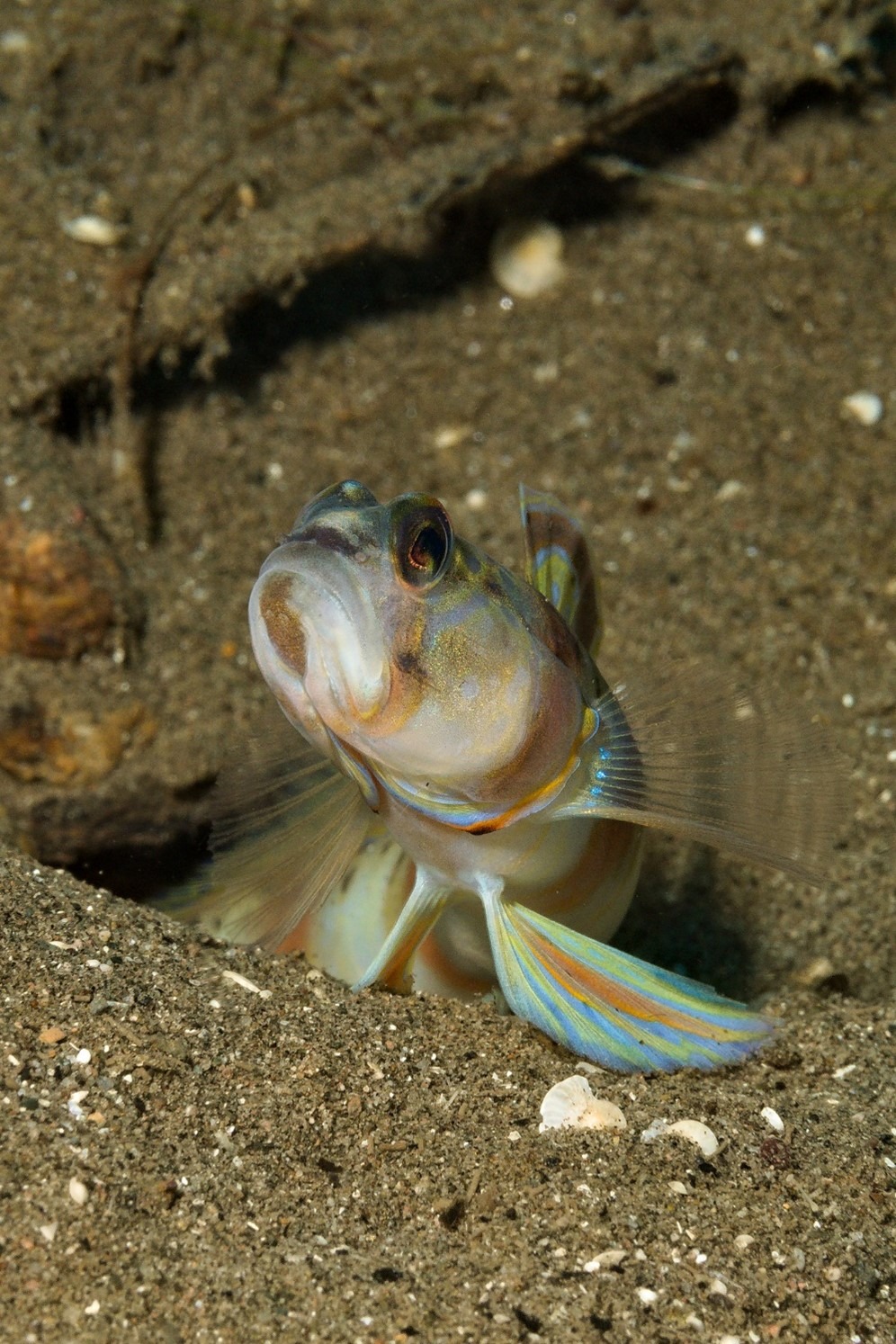
<p>Shrimp-Gobies are little fish widespread along tropical and sub-tropical seas worldwide, especially in sandy or rubble areas, where they share their 'house' (a burrow) with small prawns, commonly called snapping-shrimps.</p>
<div class="photo-wrapper"><a class="popup" href="fish_album/fig_1.jpg" rel="gallery"><img src="fish_album/fig_1.jpg/image_full" alt="fig_1.jpg" class="image-inline" /></a></div>
<div class="photo-wrapper"><a class="popup" href="fish_album/fig_1b.jpg" rel="gallery" title="Fig. 1-1b: The Broad-Banded Shrimp-Goby Amblyeleotris periophthalma is quite common in some areas of Tropical Indo-Pacific. He likes muddy or sandy lagoons or shallow reefs, and he's easily distinguishable by the large brown bands along the body and the red spot below the head. He can live with different species of Shrimps, in this case he share his burrow with Alpheus ochrostriatus."><img src="fish_album/fig_1b.jpg/image_full" alt="fig_1b.jpg" class="image-inline" /></a>
<p class="caption">Fig. 1-1b: The Broad-Banded Shrimp-Goby <i>Amblyeleotris periophthalma</i> is quite common in some areas of Tropical Indo-Pacific. He likes muddy or sandy lagoons or shallow reefs, and he's easily distinguishable by the large brown bands along the body and the red spot below the head. He can live with different species of Shrimps, in this case he share his burrow with <i>Alpheus ochrostriatus</i>.</p>
</div>
<p>It is quite common to observe these gobies watching the burrow entrance, in strict physical contact with the shrimp's antenna, while he approaches the surface to eliminate the material excavated from the burrow. Shrimp's eyes, used to the burrow's darkness, are almost blind out of the hole and the he could be a too-easy prey without the protection and the continuous surveillance of the goby. On the other hand, the goby is not able to dig a hole by itself, and if a burrow not well maintained would collapse in a very short time. When a danger approaches, the goby first signals it to the shrimp by flippering the caudal fin. If the danger gets worst, the goby turns rapidly escaping inside the burrow.</p>
<div class="photo-wrapper"><a class="popup" href="fish_album/fig_2.jpg" rel="gallery" title="Fig. 2: A Gold-barred Shrimp Goby Amblyeleotris randalli displays his wonderful dorsal fin and eyespot. This feature can make a predator thinking that the fish is bigger of how he really is."><img src="fish_album/fig_2.jpg/image_full" alt="fig_2.jpg" class="image-inline" /></a>
<p class="caption">Fig. 2: A Gold-barred Shrimp Goby <i>Amblyeleotris randalli</i> displays his wonderful dorsal fin and eyespot. This feature can make a predator thinking that the fish is bigger of how he really is.</p>
</div>
<div class="photo-wrapper"><a class="popup" href="fish_album/fig_3.jpg" rel="gallery"><img src="fish_album/fig_3.jpg/image_full" alt="fig_3.jpg" class="image-inline" /></a></div>
<div class="photo-wrapper"><a class="popup" href="fish_album/fig_3b.jpg" rel="gallery" title="Fig. 3-3b: A Flag-Tail Shrimp-Goby Amblyeleotris yanoi sharing his burrow with the colorful shrimp Alpheus randalli. This is an example of obligate relationship: this goby share his burrow only with this species of shrimp."><img src="fish_album/fig_3b.jpg/image_full" alt="fig_3b.jpg" class="image-inline" /></a>
<p class="caption">Fig. 3-3b: A Flag-Tail Shrimp-Goby <i>Amblyeleotris yanoi</i> sharing his burrow with the colorful shrimp <i>Alpheus randalli</i>. This is an example of obligate relationship: this goby share his burrow only with this species of shrimp.</p>
</div>
<p>It has been quite a debate if we should consider the goby just like a "watchman" for the shrimp, or on the contrary the shrimp is barely a housekeeper for the goby. The truth is that both of them have built a very complex and stable relationship, where right and duties of the pair are well established and balanced: even if sometimes it's possible to observe a shrimp without his goby (or vice versa, that's it is called "facultative association", at least in some species), it's normally a temporary situation. The couple pairing is necessary for the survival of both, as life is hard alone. Natural enemies like Lizardfish, Jackfish, Sandperches and some other predators like snake eels have been observed sometimes successfully hunting Shrimp-Gobies.</p>
<p>It's a chicken-and-egg debate if is the goby first to find the shrimp, or the shrimp that finds the goby: the only sure thing is that they use different methods. Apparently gobies find their partners mainly using their visual ability, while chemical signals seem to have a prevalent role from the shrimp's point of view: it seems reasonable considering the poor visual ability of the little crustacean. This relationship can begin shortly after the goby settles from planktonic life, when the little fish is almost 1 cm long. When the sexual maturity is reached, normally a pair male-female of gobies shares the same burrow together with a pair of shrimps.</p>
<div class="photo-wrapper"><a class="popup" href="fish_album/fig_4.jpg" rel="gallery" title="Fig. 4: A Black-Rayed Shrimp-goby Stonogobiops nematodes hovering out of his burrow where a shrimp Alpheus randalli keeps removing sand. Species belonging to the genus Stonogobiops have a swim bladder, feature not very common in the Gobiidae family."><img src="fish_album/fig_4.jpg/image_full" alt="fig_4.jpg" class="image-inline" /></a>
<p class="caption">Fig. 4: A Black-Rayed Shrimp-goby <i>Stonogobiops nematodes</i> hovering out of his burrow where a shrimp <i>Alpheus randalli</i> keeps removing sand. Species belonging to the genus <i>Stonogobiops</i> have a swim bladder, feature not very common in the Gobiidae family.</p>
</div>
<div class="photo-wrapper"><a class="popup" href="fish_album/fig_5.jpg" rel="gallery"><img src="fish_album/fig_5.jpg/image_full" alt="fig_5.jpg" class="image-inline" /></a></div>
<div class="photo-wrapper"><a class="popup" href="fish_album/fig_5b.jpg" rel="gallery" title="Fig. 5-5b: Not every Shrimp-Goby shows nice colors: this Black-Nape Shrimp-goby Cryptocentrus inexplicatus's color pattern makes a perfect camouflage with the sandy bottom. On the contrary, his fellow shrimp Alpheus sp. displays a wonderful color especially on his legs."><img src="fish_album/fig_5b.jpg/image_full" alt="fig_5b.jpg" class="image-inline" /></a>
<p class="caption">Fig. 5-5b: Not every Shrimp-Goby shows nice colors: this Black-Nape Shrimp-goby <i>Cryptocentrus inexplicatus</i>'s color pattern makes a perfect camouflage with the sandy bottom. On the contrary, his fellow shrimp <i>Alpheus sp</i>. displays a wonderful color especially on his legs.</p>
</div>
<div class="photo-wrapper"><a class="popup" href="fish_album/fig_6.jpg" rel="gallery" title="Fig. 6: Quite often the same burrow is inhabited by pairs of Gobies and/or Shimps. In this case a pair of Alpheus ochrostriatus share the burrow with Broad-Banded Shrimp-Goby Amblyeleotris periophthalma. It's almost impossible to distinguish the sex of the shrimps without bringing them out of the water, anyway sometimes even male-male or female-female pairs have been observed."><img src="fish_album/fig_6.jpg/image_full" alt="fig_6.jpg" class="image-inline" /></a>
<p class="caption">Fig. 6: Quite often the same burrow is inhabited by pairs of Gobies and/or Shimps. In this case a pair of <i>Alpheus ochrostriatus</i> share the burrow with Broad-Banded Shrimp-Goby <i>Amblyeleotris periophthalma.</i> It's almost impossible to distinguish the sex of the shrimps without bringing them out of the water, anyway sometimes even male-male or female-female pairs have been observed<i>.</i></p>
</div>
<div class="photo-wrapper"><a class="popup" href="fish_album/fig_6b.jpg" rel="gallery" title="Fig. 6b: Quite often the same burrow is inhabited by pairs of Gobies and/or Shimps. In this case a pair of Alpheus randalli share the burrow with a Flag-Tail Shrimp-Goby Amblyeleotris yanoi. It's almost impossible to distinguish the sex of the shrimps without bringing them out of the water, anyway sometimes even male-male or female-female pairs have been observed."><img src="fish_album/fig_6b.jpg/image_full" alt="fig_6b.jpg" class="image-inline" /></a>
<p class="caption">Fig. 6b: Quite often the same burrow is inhabited by pairs of Gobies and/or Shimps. In this case a pair of <i>Alpheus randalli</i> share the burrow with a Flag-Tail Shrimp-Goby <i>Amblyeleotris yanoi.</i> It's almost impossible to distinguish the sex of the shrimps without bringing them out of the water, anyway sometimes even male-male or female-female pairs have been observed<i>.</i></p>
</div>
<p>When the pair it's formed, the process of building the burrow starts and, depending on the substrate and on the species of shrimp, could be short and branching, or long and deep, as it has been observed sometimes in some aquariums where the shrimp decided to build his house nearby to the glass.</p>
<p>The activity of the pair during the day is quite intense: the shrimp keep removing material from the burrow, enlarging the house and looking for food. The goby, aside from his watchman duties, is busy in catching his food (mainly zooplankton). Most gobies just lay down on the sand waiting, while some others hover on the top of the hole. The pair activity normally is reduced in the late afternoon, and in some cases during the night the shrimp closes the burrow entrance as a further protection against night predators.</p>
<h2>Watchman Goby</h2>
<p>More than 130 different goby species belonging to almost 20 genera are officially already described, but probably many other are still waiting to be discovered, especially in the Coral Triangle area (Indonesia, Malaysia, Philippines an Papua New Guinea). The symbiosis has been observed with up to 30 different species of pistol-shrimps, mainly of the genus <i>Alpheus</i>.</p>
<div class="photo-wrapper"><a class="popup" href="fish_album/fig_7.jpg" rel="gallery" title="Fig. 7: smart engineers, this Steinitzi Shrimp-Goby Amblyeleotris steinitzi and his little shrimp Alpheus sp. have a reinforced entry, equipped with stones and pieces of coral that avoid the burrow entry's collapse."><img src="fish_album/fig_7.jpg/image_full" alt="fig_7.jpg" class="image-inline" /></a>
<p class="caption">Fig. 7: smart engineers, this Steinitzi Shrimp-Goby <i>Amblyeleotris steinitzi</i> and his little shrimp <i>Alpheus sp</i>. have a reinforced entry, equipped with stones and pieces of coral that avoid the burrow entry's collapse.</p>
</div>
<div class="photo-wrapper"><a class="popup" href="fish_album/fig_8.jpg" rel="gallery" title="Fig. 8: many species of Shrimp-Gobies have not been yet described officially, like this Vanderhorstia sp. photographed in Tulamben (Bali, Indonesia)"><img src="fish_album/fig_8.jpg/image_full" alt="fig_8.jpg" class="image-inline" /></a>
<p class="caption">Fig. 8: many species of Shrimp-Gobies have not been yet described officially, like this <i>Vanderhorstia sp.</i> photographed in Tulamben (Bali, Indonesia)</p>
</div>
<div class="photo-wrapper"><a class="popup" href="fish_album/fig_8b.jpg" rel="gallery" title="Fig. 8b: many species of Shrimp-Gobies have not been yet described officially, like this Cryptocentrus sp. photographed in Bunaken (North Sulawesi, Indonesia)"><img src="fish_album/fig_8b.jpg/image_full" alt="fig_8b.jpg" class="image-inline" /></a>
<p class="caption">Fig. 8b: many species of Shrimp-Gobies have not been yet described officially, like this <i>Cryptocentrus sp.</i> photographed in Bunaken (North Sulawesi, Indonesia)</p>
</div>
<div class="photo-wrapper"><a class="popup" href="fish_album/fig_8c.jpg" rel="gallery" title="Fig. 8c: many species of Shrimp-Gobies have not been yet described officially, like this Flag-Fin Shrimp-Goby Tomiyamichthyis sp. photographed in Tulamben (Bali, Indonesia)"><img src="fish_album/fig_8c.jpg/image_full" alt="fig_8c.jpg" class="image-inline" /></a>
<p class="caption">Fig. 8c: many species of Shrimp-Gobies have not been yet described officially, like this Flag-Fin Shrimp-Goby <i>Tomiyamichthyis sp.</i> photographed in Tulamben (Bali, Indonesia)</p>
</div>
<p>The genus <i>Amblyeleotris</i> includes almost 40 different species, usually are the largest Shrimp-Gobies in the wild, growing up to 20 cm length in the bigger species, and with more fin rays than other genera. Even <i>Cryptocentrus</i> is a successful genus and it's distinguishable for the bigger head and some other anatomical features. <i>Ctenogobiops</i> and <i>Vanderhorstia</i> are quite diffused all around tropical Indo-Pacific waters, but few species have been official described until now. One genus particularly loved by aquarists, <i>Stonogobiops</i>, includes few species all with swim bladder that allows them to hover motionless few centimeters on the top of the burrow entrance.</p>
<p>Shrimpgobies in the wild feed on zooplankton mainly. Quite often a couple of gobies inhabits the same burrow, where the female lays the eggs. They are territorial fish even if the territory is not very large and in the same area it's possible to find several couples. They are not very good swimmer of course, but can be very fast.</p>
<h2>House-maid Shrimp</h2>
<p>All the shrimps living in association with a goby belong to the Alpheidae family (genera <i>Alpheus</i> or <i>Synalpheus</i>). They are even called "Snapping Shrimps" or "Pistol Shrimps" for their ability to produce a loud snapping sound using their larger claw. Even if they are so small, they are one of the major sources of underwater noise.</p>
<div class="photo-wrapper"><a class="popup" href="fish_album/fig_9.jpg" rel="gallery" title="Fig. 9: the genus Vanderhorstia is relatively new and many species has been discovered in recent years. This Twin-Spotted Shrimp-Goby Vanderhorstia ambanoro inhabits sandy areas of Tropical Indo-Pacific."><img src="fish_album/fig_9.jpg/image_full" alt="fig_9.jpg" class="image-inline" /></a>
<p class="caption">Fig. 9: the genus <i>Vanderhorstia</i> is relatively new and many species has been discovered in recent years. This Twin-Spotted Shrimp-Goby <i>Vanderhorstia ambanoro</i> inhabits sandy areas of Tropical Indo-Pacific.</p>
</div>
<div class="photo-wrapper"><a class="popup" href="fish_album/fig_10.jpg" rel="gallery" title="Fig. 10: the rare Mottled Shrimp-Goby Tomiyamichtys oni with the common generalist shrimp Alpheus randalli."><img src="fish_album/fig_10.jpg/image_full" alt="fig_10.jpg" class="image-inline" /></a>
<p class="caption">Fig. 10: the rare Mottled Shrimp-Goby <i>Tomiyamichtys oni</i> with the common generalist shrimp <i>Alpheus randalli.</i></p>
</div>
<p>The production of this noise is one of the most amazing performances of the animal world: by snapping their claw they produce a small cavitation bubble that moves approximately 100 km/h generating a huge acoustic pressure. This bubble, producing almost 220 decibels, can also kill small fish or other animals and preys. A human eardrum ruptures a 150, just to give an idea of the power. And, unique case in the animal world, the bubble produces a small luminescence (not visible to the naked eye), called "sonoluminescence", provoked by the bubble's superficial temperature. Due the importance of the bigger claw in a snapping shrimp's life, in the case they lost it, the second claw grows to replace the lose one, and the missing limb will regenerate in a smaller claw. This amazing phenomenon is called "claw symmetry" and it has been documented only once in nature.</p>
<p>Snapping shrimps are socially monogamous and territorial, with females performing all parental care. Anyway, male and female partners share other duties like territorial defense, burrow construction, and foraging duties by returning food to the burrow, where both partners consume it.</p>
<p> </p>
<p>
<hr />
</p>
<h2>Biography</h2>
<p>Francesco Ricciardi is a PhD in Marine Biology, with specialization on the impact of pollution on marine life, aquatic biodiversity and marine tropical ecology, including some studies on symbiosis ecology. Underwater Photographer and Scuba Instructor since more than 10 years, he's actually located in the island of Bali (Indonesia).</p>
</div> <br /><br /> <script type="text/javascript"><!-- google_ad_client = "ca-pub-5170032844807535"; /* Square250x250 */ google_ad_slot = "6862474606"; google_ad_width = 250; google_ad_height = 250; //--></script><script type="text/javascript" src="http://pagead2.googlesyndication.com/pagead/show_ads.js"></script>]]></content:encoded>
    <dc:publisher>No publisher</dc:publisher>
    
    <dc:creator>Francesco Ricciardi</dc:creator>
    <dc:rights>Pomacanthus Publications, Inc.</dc:rights>
    
      <dc:subject>Fish</dc:subject>
    
    
      <dc:subject>Francesco Ricciardi</dc:subject>
    
    
      <dc:subject>Sharing a small house without conflicts</dc:subject>
    
    
      <dc:subject>Gobies</dc:subject>
    
    <dc:date>2013-01-09T16:00:00Z</dc:date>
    <dc:type>Page</dc:type>
  </item>


  <item rdf:about="http://www.advancedaquarist.com/2013/1/review">
    <title>Product Review: Ecotech Marine Radion XR30w Pro</title>
    <link>http://www.advancedaquarist.com/2013/1/review</link>
    <description>It's been a little over a year since Ecotech Marine introduced the Radion LED light. The Radion made big waves with aquarists and quickly ascended to mass popularity. In January 2013, Ecotech Marine began shipments of their latest and most powerful incarnation of the Radion platform: the XR30w Pro. Advanced Aquarist takes a closer look at the Pro.</description>
    <content:encoded xmlns:content="http://purl.org/rss/1.0/modules/content/"><![CDATA[<p><em><strong>Click through to see the images.</strong></em></p> <br /><p><img src="review_album/radionpro.jpg" alt="radionpro.jpg" class="image-inline" /></p>
<p>On September 1, 2011, Ecotech Marine introduced the Radion XR30w.  The highly anticipated LED light was marketed as a "purpose-built" modular, upgradeable lighting system.  Ecotech Marine's President Tim Marks remarked at the time: "Our goal was to deliver a product with the ability to evolve and get   better over time, not become obsolete."</p>
<p>Flash forward a year: On September 15, 2012, Ecotech Marine made good on the Radion's upgrade potential when they announced the <b><a class="external-link" href="http://ecotechmarine.com/products/radion/radion-xr30w-pro/?utm_source=Advanced%2BAquarist&utm_medium=Banner&utm_campaign=Radion%2BPro">Radion XR30w Pro</a></b>.  The Pro is an evolution of the original XR30w and builds on its  strengths with additional features and increased output.  As such, my review will focus on the improvements the Pro brings to the table when compared to the original, well-known, and highly-regarded Radion.</p>
<p><img src="review_album/Rpro1.jpg/image_full" alt="Rpro1.jpg" class="image-inline" /></p>
<h2 class="ms500">Specifications                                                            
<hr />
</h2>
<h3>Model –<span class="notranslate"> Radion </span>XR30w Pro</h3>
<p> </p>
<p><b>Features:</b></p>
<div class="blurb">
<ul>
<li>42 energy-efficient LEDs</li>
<li>New water-resistant cooling fan </li>
<li>Full spectrum output from ultraviolet (405nm) to hyper-red (660nm)</li>
<li>Output optimized for PAR and appearance</li>
<li>Create custom light modes or use pre-programmed modes</li>
<li>Wide light spread with minimal color banding</li>
<li>Six channels of control allow users to adjust each color group individually</li>
<li>Fully upgradeable modular LED cluster, lens and driver assemblies</li>
<li>Capacitive touch exterior controls</li>
<li>Wireless synchronization with EcoTech lights through EcoSmart Live</li>
<li>Compatible with EcoTech hanging and rail kits to suspend multiple<span class="notranslate"> Radion</span>s</li>
<li>Compatible with the EcoTech Battery Backup</li>
<li>Highly efficient heat sink design</li>
</ul>
<p> </p>
<ul>
</ul>
</div>
<p><b>LEDs:<br /></b></p>
<p><i><b>• </b><b>White:</b></i> 8 Cree XT-E Cool White (5w each)<br /> <i><b>• </b><b>Red:</b> </i>4 Osram Oslon SSL Hyper Red, 660nm (3w each)<br /> <i><b>• </b><b>Yellow:</b> </i>2 Osram Oslon SSL Yellow, 590nm (3w each)<br /> <i><b>• </b><b>Green:</b></i> 4 Cree XP-E Green, 520nm (3w each)<br /> <i><b>• </b><b>Blue:</b> </i>8 Cree XP-E Blue, 468nm (3w each)<br /> <i><b>• </b><b>Royal Blue:</b> </i>8 Cree XT-E Royal Blue, 442nm (5w each)<br /> <i><b>• </b><b>Indigo:</b> </i>4 SemiLEDs UV, 415nm (2.5w each)<br /> <i><b>• "</b><b>Ultraviolet":</b> </i>4 SemiLEDs UV, 405nm (2.5w each)</p>
<p style="padding-left: 30px; "><i>*All wavelengths are the peak emitted wavelength of the LED.</i></p>
<p><b>Dimensions:</b></p>
<p><i><b>Length:</b></i> 11.8 inches (30 cm)<br /> <i><b>Width:</b></i> 7 inches (18 cm)<br /> <i><b>Thickness:</b></i> 1.5 inches (3.9 cm)</p>
<p> </p>
<p><i><b>Max Wattage of<span class="notranslate"> Radion </span>Fixture:</b></i> 170 Watts<br /> <i><b>Max Wattage of LED Channels:</b></i> 155 Watts</p>
<p> </p>
<p><b>MSRP: </b>$899 USD</p>
<p>For more information, visit: <a class="external-link" href="http://ecotechmarine.com/products/radion/radion-xr30w-pro/?utm_source=Advanced%2BAquarist&utm_medium=Banner&utm_campaign=Radion%2BPro">www.ecotechmarine.com</a></p>
<hr />
<p> </p>
<h2>Design</h2>
<p>The Radion XR30w Pro is an evolutionary product that shares much of the design and components of the original XR30w but with some key changes to enhance its functionality and performance.</p>
<p><img src="review_album/Rpro3.jpg/image_full" alt="Rpro3.jpg" class="image-inline" /></p>
<p style="text-align: center; "><span class="discreet">A look inside the XR30w Pro.  Notice the new black LED circuit boards.</span></p>
<p>The most obvious and significant improvement over the standard XR30w is  the new LED array cluster.  The Pro features eight more LEDs over the  first generation XR30w and ten more LEDs over the second generation  "G2" XR30w. (42, 34, and 32 respectively).  Like the recently announced <a class="external-link" href="ecotech-marine-announces-the-radion-xr30w-g2">XR30w </a><a class="external-link" href="ecotech-marine-announces-the-radion-xr30w-g2">G2</a>, the Pro now uses the new 5W Cree XT-E white and royal blue LEDs.  The XT-Es are more efficient than the XP-E and XP-G bulbs they replace (and is consequently why the XR30w G2 requires two less bulbs than the first generation).</p>
<p>The additional LEDs are comprised of two 3W Osram Oslon SSL Yellow diodes (590nm), four 2.5W SemiLEDs "Indigo" diodes (415nm), and four 2.5W SemiLEDs "UV" diodes (405nm).  The 590nm diode - a spectrum bordering between yellow and orange - is centered on each of the LED cluster arrays and was chosen by the Ecotech design team "to provide a more rounded spectrum" according to Tim Marks.</p>
<p>The indigo and "UV" diodes warrant a paragraph of their own because few aquarium LED fixtures include sub-440nm "royal blue" spectra, and those that do often output only token amounts.  The Pro, on the other hand, includes a class-leading 20 watts of sub-440nm light. Ecotech Marine recognized that lower wavelength bulbs are less efficient so the Radion would require a substantial number of sub-440nm LEDs to produce meaningful light in this spectral range.  Thus, Ecotech Marine engineers added eight 2.5W LEDs to provide the bottom end of the spectrum.</p>
<p>The four 415nm "indigo" LEDs are a close approximation to the tried-and-true 420nm actinic fluorescent lights reefkeepers have used for decades. The 405nm LEDs are technically not UV (UV is defined as spectra between 10-400nm) but extremely close.  The four 405nm LEDs extend the Pro's combined spectrum to encompass nearly the entire 400-700nm photosynthetically active radiation (PAR) range</p>
<p><img src="review_album/procluster.jpg/image_full" alt="procluster.jpg" class="image-inline" /></p>
<p>Below are two photos comparing the first generation XR30w (left; upgraded with the TIR lens) and the new Pro model (right; TIR lens are now standard on all Radion models).  (<a class="external-link" href="ecotechs-tir-lenses-hands-on">Read our review on the TIR lens</a>)</p>
<p><img src="review_album/Rpro4.jpg/image_full" alt="Rpro4.jpg" class="image-inline" /></p>
<p><img src="review_album/Rcomparison.jpg/image_full" alt="Rcomparison.jpg" class="image-inline" /></p>
<p>Beyond the new yellow, indigo, and "UV" LEDs, you will also note the  new white XT-Es produce a warmer colored white light compared to the  previous white XP-Gs.  Both LEDs are marketed by Cree as ""cool white," yet they look visibly different. You can also easily spot the design  difference between the older royal blue XP-Es and the new XT-Es.</p>
<p>The Pro also employs a redesigned "water-resistant" fan, which operates at approximately the same volume as the original Radion.   The top acrylic panel (including the touch controls and mounting points) remain exactly the same as the standard XR30w.</p>
<p><img src="review_album/Rpro2.jpg/image_full" alt="Rpro2.jpg" class="image-inline" /></p>
<p> </p>
<h2></h2>
<h2></h2>
<h2></h2>
<h2>User Interface</h2>
<p>I will not review the Pro's user interface simply because it is the same interface as the original Radion.  Anyone who has used a Radion will know how to use the Pro, and there is an abundance of reviews/documentation about the Radion user interface posted over the past 15 months. The one notable change to mention is the Pro includes one additional control channel (six channels vs five channels on the standard XR30w G1 and G2) to control the sub-440nm LEDs.</p>
<p>At the time of this writing, Ecotech Marine is still beta testing their new EcoSmart Live web-based interface, which will of course be able to control the Radion Pro. Note: The beta platform is now open to the public so all Radion Pro owners can use the beta EcoSmart Live if they so choose to.</p>
<p> </p>
<h2>Light Output</h2>
<p>Dr. Sanjay Joshi plans to test the Ecotech Marine Radion XR30w Pro for an upcoming Advanced Aquarist magazine article.  His tests will provide definitive empirical data on spectrum and light distribution.  I will do my best to describe the Pro's light within the scope of this review.</p>
<p>So the big question is: Just how much more light do the new LEDs add to the Pro?  The answer is: Quite a lot.</p>
<p>Using our Apogee Quantum Meter, I measured the the PPFD 36 inches directly under the center (in between the pair of LED clusters) of each Radion fixture.</p>
<ul>
<li>Original Radion with original reflector measured <b>98 </b>μmol m<sup>-2</sup>s<sup>-1</sup></li>
<li>Original Radion with TIR lens upgrade measured <b>118 </b>μmol m<sup>-2</sup>s<sup>-1</sup></li>
<li>Radion Pro measured <b>144 </b>μmol m<sup>-2</sup>s<sup>-1</sup>.</li>
</ul>
<p>These results tell us the Pro is significantly brighter than the original Radion (even with the TIR lens upgrade):</p>
<ul>
<li><b>+46.9%</b> more PPFD vs original Radion with original reflector</li>
<li><b>+22.0%</b> more PPFD vs original Radion with TIR lens upgrade</li>
</ul>
<p style="text-align: right; ">(<i>Note: These measurements are for comparative purposes only</i>)</p>
<p>Advanced Aquarist does not currently have access to the Radion XR30w G2.   However, turning off the sub-440nm channel on the Pro should adequately replicate the G2.  With the "UV" and "indigo" LEDs switched to 0%, the PPFD was reduced to 127 μmol m<sup>-2</sup>s<sup>-1</sup>, which means the Pro produces approximately 11% more PAR (requiring 15% more power) versus the G2.</p>
<p><dl class="image-right captioned">
                                        <dt>
                                            <img alt="Graphs by Ecotech Marine" src="review_album/Radion_Pro_graphs.png/image_half" />
                                        </dt>
                                        <dd class="image-caption">Graphs by Ecotech Marine</dd>
                                        </dl>But quantity is only half the story of the Pro.  What about its light quality?</p>
<p>The Pro produces a richer light than the original XR30w.  Ecotech does not assign correlated color temperatures (AKA Kelvin rating) to their LED lights because it's an inexact math at best.   To the naked eye, the Pro produces a warmer and more natural color rendition than the first generation Radions.  While I would describe the original Radions as a cool blue-grey light at full output, the Pro hedges towards a warmer purple-white.  We can safely assume the difference is accounted for by the new yellow and indigo LEDs as well as the warmer XT-E white LEDs.  And sure enough, when you dial the "UV" channel to 0%, the Pro produces a more cool, grey tone.  The sub-440nm do not contribute much in the way of perceived brightness, but they definitely add a richness to the light that is hard to describe.</p>
<p>It is also worth noting that certain corals fluorescence more under the Pro than the first generation Radion (or metal halides for that matter).  This is one unmistakeable benefit where the 400-440nm spectra LEDs can really enhance the appearance of the livestock.  Reefkeepers already know that "true actinic" lighting can bring out biofluorescence that higher spectrum lighting can not, so it's not surprising that the addition of the Indigo and "UV" LEDs help flesh out corals' colors.  And the Pro accomplishes this feat without making the entire aquarium look unnaturally monochromatic blue.</p>
<p>All in all, the Radion XR30w Pro is a true "full-bodied" high intensity light source for the tropical marine environment.  Furthermore, at full output, the Pro produces a pleasing and balanced color unlike some other &gt;150W multi-color LEDs on the market.</p>
<p> </p>
<h2></h2>
<h2>Power Consumption</h2>
<p>The XR30w Pro consumed 171 watts at full  power (virtually spot on to the advertised 170W rating) and 8.9 watts when all the LEDs were manually turned off but with the fan running.  When the  LED light was disconnected from its power supply, the power supply still  drew 5.2 watts.</p>
<p>Note: The Pro shares the same power supply model as the original and G2 Radion.</p>
<p> </p>
<h2>Conclusion</h2>
<p>The Ecotech Marine XR30w Pro does everything I expect of an advanced LED lighting system.  It is a highly flexible and controllable lighting fixture which provides ample amounts of PAR with "natural" color rendition.  The Pro builds on the strengths of the original Radion; It does not reinvent the wheel but rather improves upon a lighting fixture that has been vetted by thousands of satisfied Radion users.  And this "modular evolution" concept is exactly how the Radion platform was conceived.</p>
<p>I will conclude my review on a personal note: I found previous LED lights (including the first generation Radions) lacked the power or color rendition to replace my trusty 250W metal halide and lumenarc III reflector system used over my 176 gallon reef.  The Ecotech Marine XR30w Pro is the first LED unit to impress me enough with both its light quantity and quality that this reviewer has finally decided to make the switch from MH to LED.</p>
<p> </p>
<hr />
<p><i>FCC Disclosure: This product was provided by the manufacturer for the purpose of review.</i></p> <br /><br /> <script type="text/javascript"><!-- google_ad_client = "ca-pub-5170032844807535"; /* Square250x250 */ google_ad_slot = "6862474606"; google_ad_width = 250; google_ad_height = 250; //--></script><script type="text/javascript" src="http://pagead2.googlesyndication.com/pagead/show_ads.js"></script>]]></content:encoded>
    <dc:publisher>No publisher</dc:publisher>
    
    <dc:creator>Leonard Ho</dc:creator>
    <dc:rights></dc:rights>
    
      <dc:subject>Ecotech</dc:subject>
    
    
      <dc:subject>Radion</dc:subject>
    
    
      <dc:subject>LED</dc:subject>
    
    
      <dc:subject>Product Review</dc:subject>
    
    <dc:date>2013-01-23T16:00:00Z</dc:date>
    <dc:type>Page</dc:type>
  </item>


</rdf:RDF>