A
selection of useful tidbits of information for the aquarist.
Readers are encouraged to send their tips to
terry@advancedaquarist.com or to post them to our Hot
Tips sticky in the Reefs.org General Reefkeeping Discussion forum for possible
publication. Next month's Hot Tip theme will be "Critter
Selection Tips".
Quarantine
Tips:
I
always cover the sides of my quarentine tanks with dark,
non-reflective fabric. A lot of wholesalers use this practice
on transhipped fish. I also open the bag (or box if it's
shipped livestock) in dim lighting. Both measures are employed
to reduce stress of newly introduced fish.
-- Len
Make
sure that the q-tank is sufficiently large that the occupant
in not stressed by the size of the tank. In cramped conditions,
the quarantine process could do more harm than good.
--
Jeff CC
You
should quarantine both inverts and fish, if only to reduce
the number of simultaneous stresses on any new critter.
Inverts carry parasites as well and you should use the time
in quarantine to carefully examine the new arrivals and
if possible give them time to recover with as little stress
as possible. Also, if you happened to purchase a soft coral
or other invert that appeared healthy but was actually quite
sick, you don't put your whole tank at risk of a crash if
it dies. Even new live rock should be quarantined for unwelcome
hitchhikers, though simple base rock obviously doesn't need
as much care as an uncured rock with a lot of varied life,
for instance.
You
should have a separate tank for invert quarantine from your
regular fish quarantine tank (so that any copper/treatment
residues on the aquarium and filter components don't leach
back into the water and kill your inverts for you). I painted
the front and sides of the fish quarantine tank with a red
"Hospital Tank", "Fish Only", "Medicines-OK"
messages and a big Red Cross (+) medical symbol to make
sure that there's no confusion from family members and friends
when quarantine coincides with a business trip or vacation
and I have to trust someone else with treating my fish.
In
the fish quarantine tank, try to limit your decorations
to PVC (so that they won't absorb much of the various treatments
you may need to use), but still try to create shapes that
the new fish will find comforting (8" long 8"
diameter PVC with one endcap for a Gramma or other cave
dweller, 20" long 1" PVC tube with both ends open
for a Watchman Goby, at least one good pile of mixed pieces
for Chromis, etc.). I like to have a collection of PVC lying
around so I can usually scrape something together appropriate
for any new arrival.
For
my fish quarantine tank, I selected a standard 29 gallon
tank to get some length without too much space being taken
up and without spending a lot of money. I also bought a
wooden stand that can hold two tanks. When running, the
tank is on top of the stand with support materials underneath.
When not running, the tank and pile of equipment are inside
the stand taking up a lot less space while packed away in
storage.
My
invert quarantine tank is actually a 20 gallon invert only
nano-reef that I leave set up all the time. By leaving the
invert quarantine tank as a running nano tank, it just looks
like a second aquarium in the house and isn't nearly as
much of an eyesore as the sparsely populated quarantine
tank which is only set up when needed (and in an out of
the way place).
If
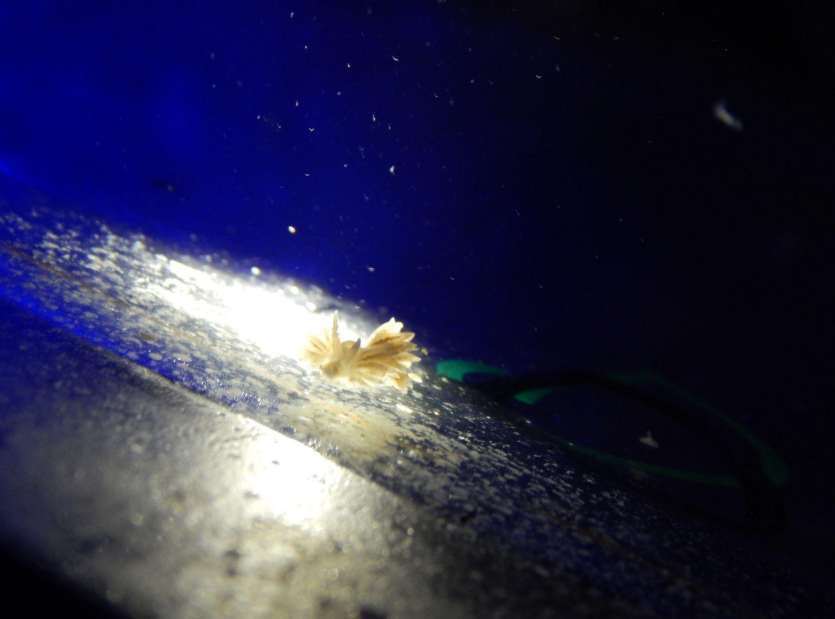
I detect a nasty parasite (like a tiny little Millepora-eating
nudibranch that I caught in there) then the quarantine tank
really begins to earn it's keep. At that point, I'll attempt
to do what I can to "cure" the infected invert.
If I fail, I'll do my best to be sure that the quarantine
tank is free of the parasite (if the bug can only survive
on Millepora, then when the Millepora has been gone for
three months, I'll feel fairly safe putting another coral
frag in there). If I can't be sure that the tank is free
of the parasite, I'll scorch the invert quarantine tank
and start it over.
Use
the water you take from main tank during a water change
for the quarantine tanks, or if that's not practical, mix
the water for the quarantine tanks exactly the same way
you mix for a water change in your regular tank.
If
you don't have a fish quarantine tank that you keep running
all the time (some people keep a tank with a few tough fish
for just this purpose), you'll need to jump start the bacterial
populations, especially with more sensitive new arrivals.
I like to take a filter sponge and leave it in my sump for
three or four days before the new arrival shows up. The
night before the purchase, I'll fill the quarantine tank
with tank water and the next day I'll move the sponge to
the quarantine tank's filter while dripping tank water into
the transfer bag.
Some
people recommend adding copper to the quarantine tank in
reduced dosages to discourage any parasites that may not
be visible. I don't know for a fact but I suspect that this
practice may eventually produce copper-resistant parasite
strains that we will all have nightmares with down the road.
If you're going to use copper, I suggest making sure the
fish has an infection that will be helped by copper, that
the fish can deal with the copper, then using the full recommended
dose for the full amount of time.
If
the fish in your tank have a parasite infection, don't screw
around with garlic and other ineffective herbal remedies:
clear all of the fish to the quarantine tank, treat the
quarantine tank with the medications that work, and keep
the fish in the hospital tank until the disease is absolutely
gone. Taking the fish from the main tank sounds like a lot
of trouble (it can be), but the only treatments of marine
velvet and ich that are known to actually work can only
be done in a true fish only tank.
If
you religiously quarantine all fish coming into your tank,
you will never have to deal with moving all of your fish
from your main tank to the quarantine tank and treating
them for some disease. The disease will never have a chance
of entering your tank. To me, this is the best possible
reason to go through the trouble of a quarantine tank in
the first place.
--
Ross, aka "rabagley"
In
some cases, we are limited by space and budget and can only
have one QT tank. If this sounds like you, make sure the
filter system you use has some type of skimmer that will
allow you to keep fish or more delicate inverts and corals
for the observation period. Just make sure it operates on
it's own so you can disconnect or turn it off when necessary.
A QT tank doesn't do much good if your new arrivals get
further stressed or don't make it out due to improper water
quality.
--
J. Howard
Ross
has chanted my mantra, including q/t of inverts, so there's
not a whole lot I can add to that. I have a feeling he's
handled very large numbers of fish and inverts, or has learned
from someone who has - it always pays to quarantine. Would
a public aquarium, upon acquisition of new specimens, just
drop them into their displays? Absolutely not, there is
a very specific protocol for all new arrivals, and it includes
a minimum of 30 days disease/trouble free. And there is
a very good reason for this: if it gets loose among the
population the results can be catastrophic in a manner that
far exceeds anything the home hobbyist need consider. "Down"
displays are displays that can't make that aquarium/zoo
money, not to mention it's quite expensive to treat and/or
restock.
However,
folks don't realize that a fish (or invert) can be kept
in anything that holds water and is chemically inert. This
is why, for those who, for whatever reasons can't set up
another actual aquarium, I recommend Rubbermaid tubs - stackable,
30 gallons, sturdy, chemically inert, inexpensive. Also,
speaking to PVC use, Steven Pro had linked me an article
once that seemed to demonstrate a marked difference in recurrence
of ich (the bane of all fishkeeping, honestly) with fish
kept in systems with porous materials (i.e. live rock) and
systems with non-porous materials (i.e. PVC). Guess which
system experienced more trouble with recurrences and needed
repeated treatments.
Also,
at this point I think it's a good idea to mention that there
can be a difference between a hospital tank and a quarantine
tank. Quarantine only means to keep separate from, whereas
hospital speaks directly to the need for treatment. That
being said, I have learned (through my years working the
trade - both retail and wholesale), and subsequently prefer,
to use only those items that can be easily sterilized in
quarantine. This need precludes things such as macro algae,
live rock, et al.
I'd
like to mention the use of hyposalinity and freshwater dips.
Many folks feel it's too stressful, but I disagree. I feel
it's a technique whose efficacy has been well-proven when
treating things such as velvet and black spot disease (which
can be eliminated through dipping and hypo alone). I feel
this is a good tool well-used, have always done this with
good results, and advocate it. The only (very few, less
than a dozen, in relation to handling thousands of fish)
times I've lost fish to dipping was when they were extremely
ill in the first place. I made it part of my standard regimen
pre-quarantine introduction routine and pre-display introduction
- along with making sure the water's matched for temperature
and pH, I like to add enough methylene blue to turn the
water a rich blue.
--
Seamaiden
I
keep a simple sponge filter (large breeder size) at all
times in the sump of my main tank for emergency use for
either a Q tank or Hospital tank. Makes it easy to set one
up in a hurry.
--
Lawdawg