TFH Publications, Inc
Neptune City, NJ 07753
TEL. (800) 631-2188
WEB SITE: www.tfhpublications.com
448 pages, Illustrated with 450 full
page color photographs. Includes a glossary, a
list of online resources, a bibliography, and an
index as well as photograph credits.
It was back in December of 1999 that I reviewed Scott Michael's Marine
Fishes: 500+ Essential-To-Know Aquarium Species for Aquarium
Frontiers. At that time I praised the care and intelligence
that in general go into the publications of James Lawrence's
Microcosm Ltd., and especially the convenient small pocketsize
of the current volume, which is a pleasure to carry, thumb-through
and read. I said, "Do yourself and your organisms a favor.
Take this book with you before you make a decision
to acquire a new specimen." I actually follow my own advice
and keep the book in my car's side-pocket for use whenever
I'm tempted to bring in a new tank resident. At the time
I also was happy to report that the book was intended to
be the first in a series and looked forward to the next
in the set. It's been more than five years but a second
volume has finally arrived.
Ron Shimek is a zoologist well known to marine aquarists.
He has participated as an authority on invertebrates both
in his writings and as a speaker at virtually all important
recent marine aquarium conferences. He has authored a very
valuable companion piece to Scott's earlier work on marine
aquarium fishes. This volume also follows the pattern of
the previous work by offering practical husbandry requirements
for each species discussed and a consistent set of criteria,
both of which make it very useful for those considering acquiring
a specimen.
Proud
sponsor of this column
Each page contains a clear color photograph of the organism
discussed. Many of these photos were provided by Scott Michael,
Alf Jacob Nilsen, Paul Humann and others recognized for the
quality of their knowledge and their photographic work. For
each species Shimek provides data on their maximum size,
their natural range, the minimum aquarium size to maintain
the organism, the lighting they require, advice on foods
and feeding, their suitability as an aquarium subject, their
compatibility with tank mates and tips on captive care.
The book is very ambitious in its breadth of coverage, including
organism from the foraminifera through the sponges, hydrocorals,
jellyfishes, gorgonians, the soft corals, the sea anemones,
the zooanthids, the stony corals, the worms, shrimps, crabs,
the tridacnid clams, the sea stars and other echinoderms,
finally ending with the tunicates.
The volume opens with a short introductory chapter on the
complexities of current taxonomy of marine invertebrates,
followed by a description of the "conditions of maintenance" he
uses, listed above, with elaborations of his views on reef
aquarium suitability and compatibility, followed by maps
of the world's coral reefs. While the Table of Contents itself
does not include any subdivisions, there is a handy "Quick
Finder" on the inside back cover that serves as an alphabetized
grouping for efficient searches.
The main 499 page section on Species Accounts starts with
short sections on the Red tree foram and the various calcareous
sponges found in reef tanks. He then goes on the demisponges,
a group including species such as Orange ball sponges (Cinachyra)
and Blue finger sponges (Halicona). In general he
considers them toxic and therefore poor subjects for reef
tanks. I maintained a ball sponge for a year or so and found
its ability to move by extending tiny "pseudopodia" fascinating
and saw no toxic effects.
There are a few pages on hydroids followed by a section
on the more interesting hydrocorals, those often beautiful
but azooxanthellate species and therefore almost impossible
to maintain as well as the hardy fire corals, Millepora.
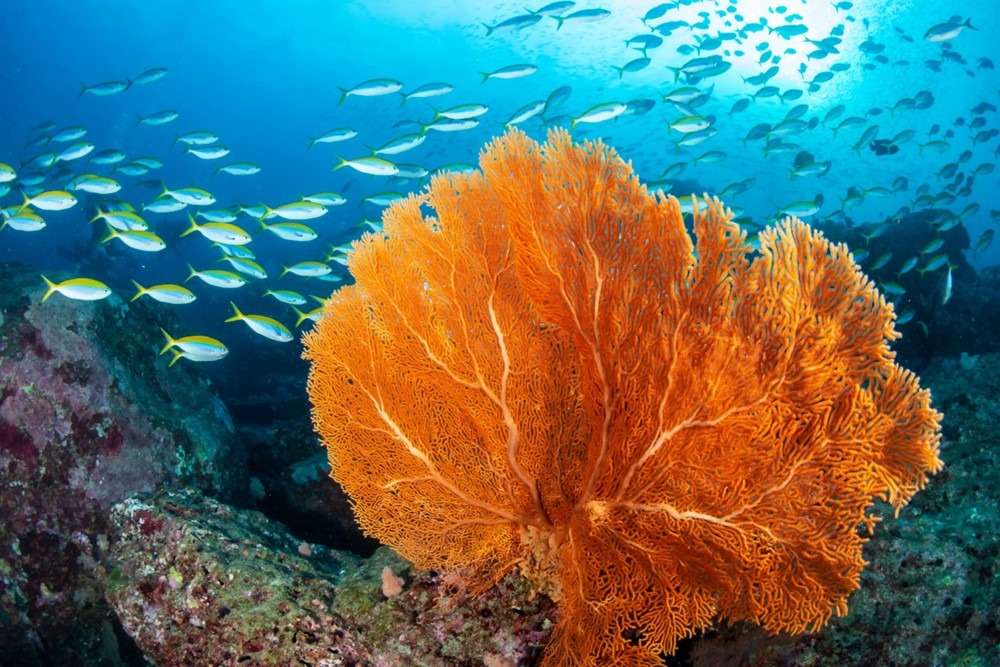
The gorgonians are the next group of particular interests
to aquarists. It is in sections such as this that excellent
guides are most helpful. Many gorgonian species are available,
not all of them zooxanthellate. Having this guide with you
when you are considering additions can make the critical
difference between choosing a specimen that can flourish
in your system and one doomed to starvation.
A rather short section on soft corals and a longer one on
sea anemones follows, I think a reversal of usual reef keeper
interest. The major pest, Aiptasia spp., are included
and although Ron believes that in well-fed tanks the Peppermint
shrimp Lysmata wurdemanni "will live on excess food
and refuse to eat the anemones," I found them completely
effective, and in short order, in two different tank set-ups.
My observed problem was the opposite. I'm pretty sure they
starved soon after the Aiptasia were gone.
Next is a nice 30-page section on the zooanthids and corallimorphs,
followed by 60 pages on the small- and large-polyped stony
corals, covering the great bulk of coral species offered
in the trade.
Shimek's next section is on the worms, including the polychaetes
such as fire worms and the feather duster worms, with many
species of the latter covered in informative depth. I found
his description of insufficient food as the cause for crown
shedding in the Sabellid worms very interesting and helpful
for the husbandry of these beautiful animals. One of Ron's
contributions to our hobby has been to change aquarist's
perceptions about the small fire worms found in our substrates
from dangerous to beneficial.
The next section of high interest for aquarists is a comprehensive
one on the so-called ornamental shrimps, followed by shorter
sections on lobsters and crabs. The author seems generally
distrustful of hermit crabs and recommends stocking fewer
than 1 per 10 gallons, significantly lower than that usually
recommended. I stock many more than that and find them an
effective first guard against any algae growing on introduced
rock or specimens. 10 pages on the tridacnid clams and more
than 40 pages on snails follow this. The author's choice
of priorities here may represent his own interests or what
he considers to be a paucity of information on snails but
it seems a bit unbalanced given the relative interest of
most aquarists. Nudibranchs, cuttlefishes, octopuses - even
Chambered nautiluses -are next, with the echinoderms and
tunicates as the concluding groups.
As I said in introduction to this guide, it is certainly
comprehensive. As usual the interests of the author are evident
in the species chosen and the emphasis placed on groups.
All in all, Ron Shimek's guide to marine invertebrates is
undoubtedly a "must-have" for serious aquarists. Keep it
with you next to Scott Michael's guide to fishes when you
are tempted to acquire another tank resident and save yourself
some grief while you help to discourage the trade in inappropriate
organisms.
Video Review: Marine Bioluminescence: Secret Lights in
the Sea
Harbor Branch Oceanographic Marine Science Educational
Series
26 Minutes of video recordings of marine bioluminescent
organisms.
For those of us interested in the fascinating subject of
bioluminescence - I think an increasing group and one that
includes me - this video provides beautiful and exciting
examples. The principal scientist behind the work is Edith
Widder, Ph.D. of the Harbor Branch Oceanographic Institute.
The videographers have captured images from organisms at
all oceanic strata, from warm surface waters to the cold
depths of the marine world. They make the astonishing statement
- to me at least - that more than half of marine creatures
have the capacity to use bioluminescence as part of their
repertoire for survival. They go on to state that since 99%
of our biosphere is oceanic, "bioluminescence may be the
most common form of communication on the planet."
I acquired my copy through the Sea Grant office here in
Hawaii and had some trouble finding the purchase price on
the net, but it would certainly be worthwhile to go to the
web sites above to search for information on getting this
fascinating video. The sites are full of other important
information on marine issues and deserve a visit in their
own right.
If
you found this article worthwhile, help support future
AAOLM publications with your generous contribution.