This last thumbnail opens an
extremely large (over 4000 pixels wide) panoramic view of
the entire tank.
I
set up my first reef tank in 1989. It was a 90 gallon tank
aquascaped and stocked in the "classic" design of reef
tanks of the time. I stepped up to a 300 gallon tank several years
later, again aquascaping along the lines of most reef tanks with
Fiji live rock lining the back wall almost to the water's surface.
Like most reef keepers, I had never really seen a natural coral
reef except in photographs. I simply emulated what other hobbyists
were doing at the time. As I gained more experience in maintaining
a reef tank I became curious about natural reefs. Reading
scientific journals and academic books on coral reefs, I began to
wonder if we werereally recreating natural reefs as well as we
could. Ibecame scuba certified and began traveling to the Pacific
todive the coral reefs hobbyists were ostensibly emulating. I was
quite surprised to find that real coral reefs don't look anything
like traditionally aquascaped reef tanks. The more I dived and
observed the natural reef, the more I realized that while the
hobby's traditional approach to aquascaping was perhaps an
aesthetic success (beauty is in the eye of the beholder, after
all), the traditional aquascape approach created practical
challenges and the potential for serious problems as the tank
matured. I resolved to set aside traditional aquascaping
conventions and instead model a new tank after actual Indo-Pacific
reefs. My 2000 gallon tank is the result.
I
wanted a large tank, but I also wanted one that I could work on
without too much difficulty. My 300 gallon tank was traditional in
construction. The glass tank was two feet tall sitting on a three
foot stand. The overall height with light hood made it difficult
to reach all parts of the tank. In addition, the tank was best
viewed standing up. In a seated position, one had to look up at
the tank - not the best angle for viewing. I decided to build my
new tank on the floor with the sump area beside the tank rather
than below it. This offered several advantages. At four feet in
height, the tank can be viewed from above. The tank is roughly
four feet from front to back, so using long handled grabbers I can
reach any part of the tank. This makes the tank easier than my 300
gallon tank to work on. Despite it's size, I rarely have to get in
the tank to work on it.
Configuration
The
tank is concrete with two viewing windows. Each viewing window is
roughly eight feet across. While it would have been possible to
create a single larger viewing window, I chose two windows because
a person's normal field of vision is about 50 degrees arc, so at
the distance one views my tank he or she can't see much more than
six feet of the tank anyway. Two viewing windows enabled me to
create the impression of two differently aquascaped tanks.
Structurally, it also had its advantages. The center support
pillar allows a thinner rebar enforced front wall tied to the rest
of the tank only at the sides.
Circulation
Considering
its size, the components of the tank are rather ordinary only
larger. Circulation is generated by two 1HP Dolphin pumps in
closed loops. I'm currently experimenting with eductors to
increase flow. Modest protein skimming is generated by two MTC
Power-Pros. A small quantity of ESV carbon is used from time to
time.
Calcium/Alkalinity
Supplementation
Calcium
replacement has proved to be a challenge due to the rapid growth
of corals. Kalkwasser dosed through a Deltek reactor combined with
a Knop calcium reactor and constant dosing with ESV B-Ionic is
required to prevent a decline in calcium levels. Future plans
include a large Deltek calcium reactor.
Maintenance
Over
the years I've found that large water changes with properly aged
artificial seawater have provided long term stability in the
chemistry of my reef tanks. I normally do a 10% water change each
month, mixing up a bucket of Instant Ocean in five 44 gallon
Rubbermaid trash cans.
A
small closet to one side of the tank houses the equipment, a sump,
and a 60 gallon refugium that sits atop the sump. The refugium
serves as a combination holding and experimental tank if I'm
working on a special project. Eight separate electrical circuits
allow the equipment to be distributed across multiple circuit
breakers. This way, if a circuit breaker shuts off, it doesn't
affect the entire system. Plumbing is mostly schedule 80 pvc.
Extensive use of true-unions and multiple pumps offer flexibility
and the ability to switch systems if a component fails.
Lighting
Lighting
is a combination of natural sunlight and four industrial size
pendants with Iwasaki 400 watt metal halide bulbs. During the
summer months when the sun sweeps directly above the skylights,
light in the tank approach natural reef levels throughout much of
the tank. In the winter, the tank relies primarily on the metal
halide lighting.
Aquascaping
Perhaps
the most unusual aspect of the tank is the appearance and
aquascaping of the tank. Early photos of the tank accompanied an
article in the 2002 Marine Reef and Aquarium Annual. Some
hobbyists were surprised by the appearance of the tank suggesting
that it was too stark in it's aquascaping.
The
average reef tank begins as a glass box packed with live rock and
sand. It is not unusual to see the rock-work within an inch or two
of the water's surface. With enough rock cleverly aquascaped, one
can create a dramatic looking reef tank with nothing else in it.
The problem with this approach only becomes apparent over time.
With a large portion of the tank's volume consumed by rock and
sand, there is comparatively little room for corals to grow and
fish to swim. In a short time the tank can become packed with
corals crowding each other and fish with little room to swim. If
the tank becomes too crowded, tank conditions can deteriorate. If
one wants a healthy tank that looks attractive years later, the
tank needs to be aquascaped with plenty of open space.
Open
space also makes the tank appear more realistic. Most of the stony
corals maintained by hobbyists grow on low relief patch reefs with
plenty of sunlight and turbulent water motion. I modeled my tank
after a patch reef with large areas of sand and isolated patches
of live rock, called bommies. This spartan look isn't attractive
at first, but over time the empty space is filled by growing
corals. The tank's inhabitants will grow and mature as they would
on a natural reef.
Stocking
There
is a temptation in the hobby to take a "stamp collecting"
approach to adding corals to the tank. The hobbyist accumulates one
coral after another until every available space is occupied. There are
several problems with this approach. First, over-crowding creates
competition for space. Corals grow together and as they do, subtle but
deadly warfare breaks out. It has been shown that competition for space
creates stress and stress can impair the health of corals. A separate
aesthetic problem of a tank over-stuffed with corals is that corals
develop their characteristic shape over time. The small corals and
cuttings we begin with rarely capture the full variety and diversity of
coral shapes and colors. Corals become more spectacular as they grow, so
it is better to have a small number of coral colonies with room to grow
rather than a larger number of corals with no room to grow.
One
of my goals in creating a large reef tank was to give corals room to
grow to realistic sizes. For that reason, most of the corals found in
the 2000 gallon tank are simply corals from my 300 gallon tank that have
been given the additional space to continue growing. Tank capacity is a
little less than 400 cubic feet, but my goal is to have fewer than one
hundred coral colonies. My largest corals are approaching five cubic
feet. At the rate at which they are growing, my largest colonies will
reach the surface of the water in less than one year, and these corals
rest on the bottom of the tank.
Another
reason for growing large corals is to facilitate sexual reproduction.
Hobbyists have had limited success in observing captive sexual
reproduction. This has generated a great deal of speculation about
possible causes including heavy metal accumulation. While there are a
number of possible environmental explanations, the most likely
explanation is that most hobbyists have "young" corals. Corals
are rarely given the opportunity to reach maturity in captivity. During
my observation of mass spawning events around the world, the one
consistency has been that large colonies spawn and small ones don't.
There's no reason to think that colonies in captive systems would behave
any differently.
So
far my success has been limited to "brooding" corals. Pocilloporadamicornis broods planulae and releases them into the water
column. I currently have approximately twenty colonies of P.
damicornis growing on the back wall of the tank, with the largest
nearly six inches across. These colonies all grew from planulae,
probably released by a colony more than a foot across.
Other
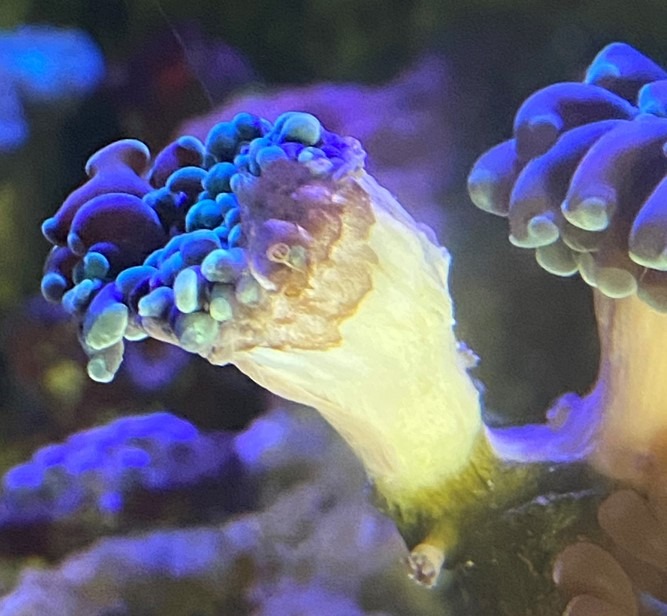
corals in the tank include several Montipora and Porites species,
Stylophora, Pavona, Fungia including a Halomitra pileus
larger than a dinner plate, Polyphyllia slipper coral, Pectinia,
Turbinaria, Caulastrea, Echinopora, Platygyra, and several
Euphyllia species.
Fish
Studies
of natural reefs have shown that algae overgrowth is primarily a
function of the absence of herbivores. My tanks have always had a high
proportion of herbivore fish, and I've been fortunate to have never had
a serious algae problem. The "clean-up crew" includes five Zebrasoma
tangs including a pair of Yellow tangs (Z. Flavenscens), as well
as Purple (Z. Xanthurum), Black, and Scopas tangs. I also have a
Yelloweye surgeonfish (Ctenochaetus strigosus) and a pair of
Convict surgionfish (Acanthurus triostegus). The odd couple of
the tank are a pair of Siganus rabbitfish, one S. unimaculatus
the other S. doliatus that are inseparable. The Rabbitfish,
Yelloweye, and Scopus were added shortly after the new tank was started,
but the other fish were moved from the 300 gallon tank. Those fish I've
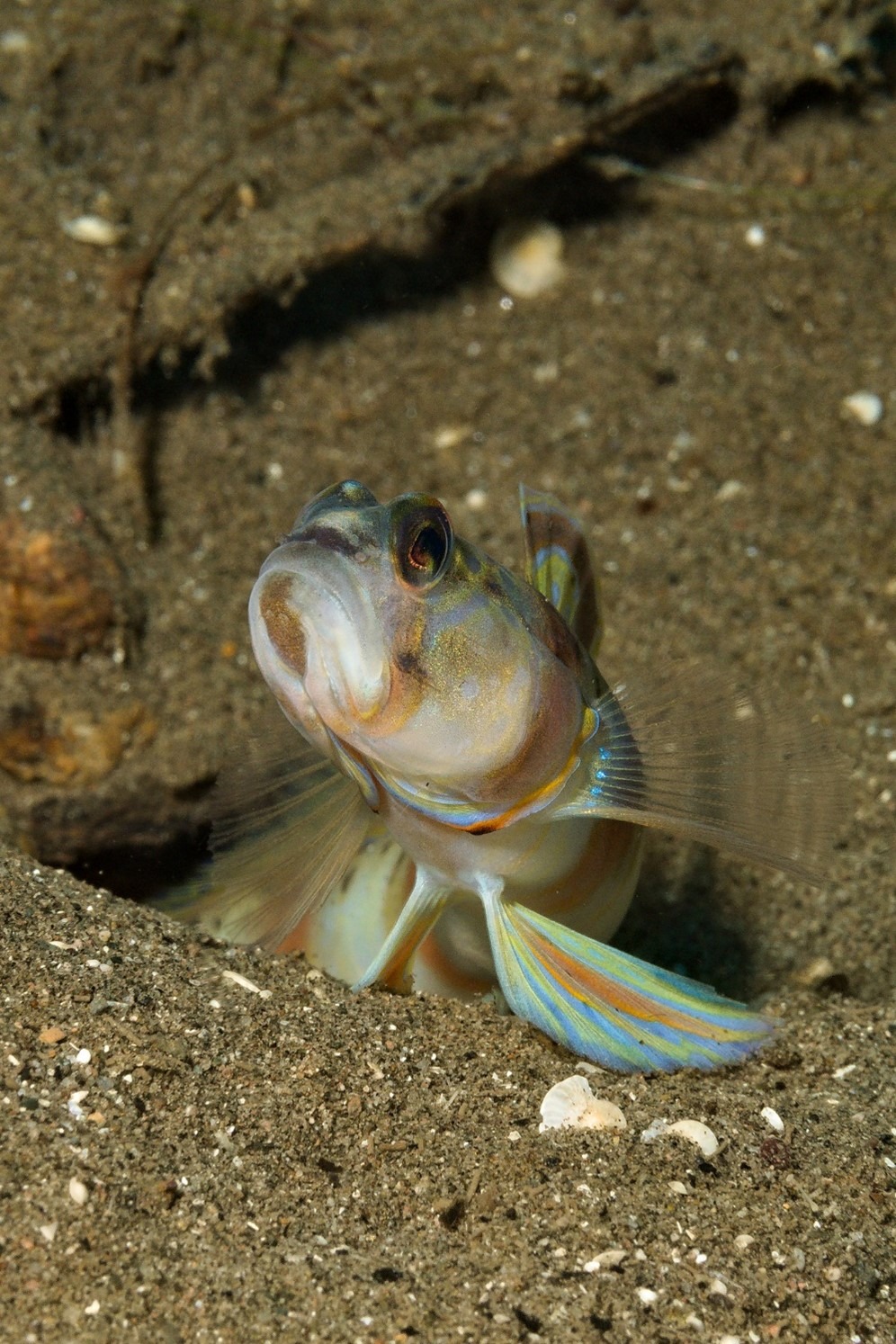
had for five to eight years. Other fish include a Copperband
butterflyfish (Chelmon rostratus), Neon gobies, psedochromis,
Banggai cardinalfish, a Bluespotted jawfish (Opistognathus
rosenblatti), a pair of Flame pygmy angelfish (Centropyge
loriculus), Chrysiptera Damselfish, and a half dozen Bartlett's
Anthias.
Invertebrates
also serve a useful purpose in controlling algae in my tank. A conch can
consume large quantities of algae in short order - the problem is their
size. While the animals sold in the hobby are small and manageable in
the average reef tank, they grow quickly. I inherited two large Queen
Conchs (Strombus gigas) from hobbyists when they became too large
for their tanks. Other useful organisms in the tank include Lysmata
cleaner shrimp, a few blue legged hermits, and thousands of polychaetes.
Like most beginning hobbyists I assiduously removed every bristle worm I
found in my earlier tanks, but I've developed a respect for their value
in a reef tank. I now raise polychaetes in a separate tank to help
maintain a high density in the main tank. Recently the polychaetes
created my first observed mass spawning event when hundreds released egg
bundles into the water column one evening. I had photographed mass
spawnings of polychaetes in the wild, but this was my fist observed
event in a reef tank.
While
the tank is approaching nearly three years of development, I consider
the tank still quite young. Cryptic sponges are only now reaching
reasonable sizes. Most corals have now encrusted the adjacent live rock,
so I expect growth to accelerate. In a reef tank, only bad things happen
quickly; Good things take time as inhabitants adjust and adapt to their
surroundings.