Last
time, I explained what sea slugs are, and why the common
name "nudibranch" should not be applied blindly to the over
3000 species of opisthobranch molluscs (for more detail,
consult a good invertebrate textbook such as Brusca and
Brucsa 1990; Ruppert and Barnes 1994). I also discussed
a couple of the non-nudibranch opisthobranch sea slugs that
can be reasonably kept in an aquarium. For the most part,
I have always advised against the purchase of any sea slugs
because it is not common for many hobbyists or retailers
to differentiate among the groups that may be suitable for
some reef aquaria (some anaspideans, cephalaspideans or
sacoglossans) and those that are almost certainly not (virtually
all nudibranchs). In the first part of this article, I discussed
some basic biology about the anaspidean and sacoglossan
sea slugs. In this article I will focus specifically on
the nudibranch sea slugs.
Hydatina
physis is a common tropical cephalaspidean sea slug
that is commonly called a "paper bubble"
because of their lightly calcified shells. This slug
is a highly specialized predator, feeding only on
cirratulid polychaete worms.
Hypselodoris
bullocki is often mislabelled as a "reef safe
herbivore" ideal for aquarium clean-up crews.
Quite to the contrary, this
nudibranch is, like every true nudibranch ever discovered,
a highly specific predator. There are several color
morphs that each appear to feed on only one or two
species of sponges.
Micromelo
undata is another spectacular cephalaspidean sea slug.
The lightly calcified shell is obvious in this photo,
but little is known about their feeding habits. These
animals typically live in sandy habitats in which
they burrow periodically for protection which keeps
their shell clean from fouling.
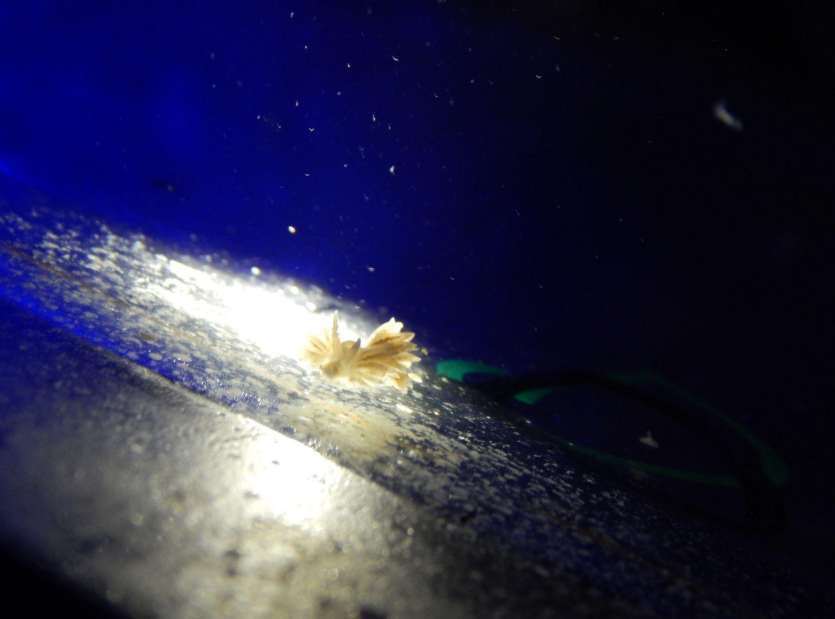
Phyllodesmium
is a common nudibranch predator on a variety of soft
corals, and often mimic their preferred prey. The
cerrata on the back of this nudibranch have an amazing
likeness for the polyps of the coral Xenia, on which
this slug feeds exclusively.
Nudibranch
Sea Slugs
With only a
couple of exceptions (see below), nudibranchs are completely
inappropriate animals for home aquaria. Most large public
aquariums have difficulty in keeping these animals alive
for any length of time, and their success rate in home aquaria
is abysmal. There are a variety of reasons for this low
success rate, but their delicacy and highly specific feeding
needs are two of the primary hurdles to keeping them in
aquaria. Combine those with a lack of information about
the basic needs of the vast majority of species (both in
the scientific and hobby community), and you have a recipe
for disaster.
OK, so which
opisthobranch sea slugs are actually nudibranchs? Well,
there are four suborders of Nudibranchs, although only 3
would ever be likely to appear in a pet shop: the Dendronotacea,
Aeolidacea and Doridacea. The dendronotids are the smallest
of these groups and are characterized by a cup-like sheath
surrounding their rhinophores (the "antennae"). With
few exceptions, dendronotids feed exclusively on cnidarians,
and are most commonly found by aquarists as unwanted hitchhikers
on Xenia or Sarcophyton. These animals are
one of the exceptions to the rule that most nudibranchs
starve to death in captivity. Although these animals often
do reasonably well in the aquarium when accidentally introduced
with the corals on which they feed, they can rapidly consume
their coral prey in the aquarium (e.g., see Figure 8 in
Ron Shimek's article here).
Thus, these slugs are not generally something that you want
to discover in your tank, let alone intentionally add! Aeolids
are the second largest group of slugs, and are most easily
identified by not belonging to one of the other two groups
I am describing… Aeolids typically have well developed
cerrata (finger or feather-like extensions along
the back of the slug which contain a branch of the digestive
system) in which many species store the unfired nematocysts
(stinging cells of cnidarians) from their prey to use in
their own defense when attacked. Obviously if they collect
and store the stinging cells of their cnidarian prey, the
nudibranchs must actively feed upon these animals. I will
come back to this below. The aeolids are all predatory,
and the vast majority of them feed on hydroids (although
some also prey on other opisthobranchs or their eggs, corals,
gorgonians, sea anemones, bryozoans or tunicates). The final
group, the dorids, are the largest, with more species than
all the other nudibranch groups combined. They are most
easily distinguished by the presence of a ring of gills
around the anus at the back of the slug. These are some
of the most spectacularly colored and commonly photographed
of all opisthobranch molluscs. There are three major groups
of dorid nudibranchs (based on their morphology) and once
again, all are specialist predators on other invertebrates.
Two of the dorid groups are primarily sponge predators,
while the third feeds primarily on bryozoans and tunicates.
General Advice
To Avoid Buying Sea Slugs
I need to reiterate
a point I made in the
last article just to make sure that the message gets
through - even if you didn't read Part 1. Unless you are
able to determine the species of a sea slug and its exact
requirements in captivity from a reliable source, I would
always recommend against buying any of these
animals. In their book Reef Invertebrates, Anthony
Calfo & Bob Fenner (2003) have an entire section devoted
to opisthobranch molluscs and discuss the selection, care
and feeding of many of the species offered for sale in the
hobby. They discuss the members of these groups in more
detail than is possible in a short article here. Julian
Sprung (2001) also has some very nice photographs and descriptions
of some of the more common sea slugs to be sold in the hobby
in his book, Invertebrates. If you don't have one
of these books, and are unsure of the identification of
the animals offered for sale in your local shop, ask your
dealer to show you their copy of the books to compare. Although
there are some spectacular pictures in these books, there
are only a few of the more than 3000 known species mentioned,
and your best resource for up-to-date information about
the taxonomy and biology of an unidentified sea slug will
probably be Bill Rudman's Sea Slug
Forum or Michael Miller's Slug
Site. Despite the fact that there are many beautiful
sea slugs out there, unless you know exactly what
you are buying and their feeding requirements, the
rule of thumb is to always avoid ever purchasing
any sea slug. Sadly, the vast majority of sea slugs
are beautiful, but virtually impossible to care for
in the aquarium.
However, as
I mentioned
last time, there are some sea slugs that are reasonably
well-suited to life in the aquarium. In fact, there are
now some species of captively-raised sea slugs now available
from vendors such as Inland Aquatics,
IndoPacific
Sea Farms, or Stockly's
Aquarium. You should also keep in mind that all opisthobranchs
are relatively short-lived, and you may be paying a lot
of money for an animal that will only live several months
under the best of conditions! If you're determined to add
a sea slug to your aquarium, however, I'd recommend that
you look into one of the captively-raised species - not
only will you get an animal well-adapted to life in an aquarium,
the supplier will be able to tell you exactly what conditions
are required to keep the animals alive! And, because their
requirements are known and can be met, you may find that
one of these species actually thrives in your aquarium and
are able to reproduce.
Proud
sponsor of this column
Reef-Safe Herbivores??
If you do a
search for "reef safe nudibranch" on the web, there are
literally hundreds of hits, but the vast majority of these
are either gravely misinformed or trying to sell you a line.
For example, I found several sites that listed "algae eating
purple and yellow nudibranchs" for sale that claimed these
slugs were "incredible algae eaters that will not harm any
invertebrates or corals!!!" Well, that information quite
simply wrong. First of all, no dorid nudibranch is
herbivorous, and there is a page of the Sea Slug Forum devoted
to dispelling some of the common
aquarium trade misinformation such as this. Quite simply,
although dorids are the most diverse group of opisthobranchs,
they are also among the most specific feeders of
all molluscs. The animals studied thus far are almost without
exception specialist predators that require one or at most
a few species of specific prey to survive, and in most cases
the animals will not even recognize perfectly suitable
alternatives as food! In any case, there are no true
nudibranchs yet discovered that are herbivores, so this
is either a big misunderstanding on the part of these suppliers,
or (and I hope this is not the case!) a deliberate ploy
to get consumers to buy a beautiful but completely inappropriate
animal before it starves to death.
These lovely
purple and yellow nudibranchs are Hypselodoris bullocki.
This species used to belong to the genus Chromodoris,
but has recently been reclassified as Hypselodoris.
Contrary to the reports from many suppliers, these beautiful
little slugs are sponge specialists, and many accept only
a single sponge species as suitable prey. In fact,
it turns out that these nudibranchs don't even recognize
other sponges as food, let alone algae, and the claim that
buying these nudibranchs will add "beautiful color and take
care of algae at the same time" is absolutely false and
misleading. Aside from wasting your money as a consumer,
it is terrible to sentence these animals to a slow death
via starvation because even well-intentioned aquarist have
been mislead into providing inappropriate food for their
animals. Unfortunately, in this case, scientists are not
even sure about the exact species of sponge on which the
various color forms of this nudibranch feed. There are reports
of H. bullocki feeding on some sponges of the genus
Halichondria, while others report that they feed
exclusively on Dysidea or Aplysilla. Sadly,
no one knows whether the reports of these slugs being found
on a given sponge represent actual feeding, or whether the
slug will accept any other sponge species even if the feeding
reports are all accurate. Given that most reef sponges are
considered more difficult to keep than even these delicate
sea slugs, the chances that you have an abundant supply
of suitable food on hand to feed these guys is pretty slim.
However, biology is full of exceptions to the rule: Bill
Rudman reports
that the endemic species of Rostanga in New Zealand,
by some freak of biochemistry, was found to prefer an introduced
sponge from Europe over all the native New Zealand sponges
that it normally fed on.
Regardless of
whether the ultimate cause of the misinformation at the
retail level is a lack of education or a deliberate ruse,
the ultimate message is that you as a hobbyist should never
consider purchasing one of these animals. Unless you know
specifically which slug you are buying and what their preferred
prey are (e.g., the Aiptaisa predator slug, Berghia
verrucicornis), you should avoid any true nudibranch
sea slugs (no matter how badly you want one), because their
feeding requirements are so specific that very few
people can keep them alive in aquaria (even large public
aquaria with huge feeding budgets generally avoid them!).
Even well-intentioned suppliers and advanced hobbyists can
be easily misinformed about the animals they are trying
to keep, and our knowledge of sea slug taxonomy and biology
is still sadly incomplete. Add to that fact that there are
more species of nudibranchs than there are of all of the
remaining sea slug orders combined and that many are undescribed
or their feeding biology is unknown, and it becomes very
likely that a random sea slug in your local shop is going
to starve to death in your tank if you were to buy it.
Some Sea Slugs
That Can Thrive In Captivity (Whether You Want Them Or Not!)
OK, I have to
come clean and admit that there are some true nudibranchs
that can do well in aquaria. Most of these exceptions are
actually considered pests in the aquarium. Almost all dendronotid
sea slugs feed exclusively on cnidarians, and these animals
are most commonly found by aquarists as unwanted hitchhikers
on Xenia or Sarcophyton in the reef aquarium.
The most common nudibranchs to prosper in the aquarium tend
to be members of groups such as Phyllodesmium and
Doto which prey exclusively on aquarium corals such
as Briareum, Xenia, Carijoa and Sarcophyton,
to name a few. It is becoming more-and-more common that
small aeolid nudibranchs have been found consuming prized
colonies of SPS corals in reef tanks. Many of these slugs
are tiny (less than 1 centimeter in length) and are very
easy to overlook. Unfortunately for hobbyists, these animals
appear to some of the few sea slugs that reproduce well
in the aquarium, because they lay tiny egg masses that house
the babies through the entire larval stage until they hatch
as crawl-away juveniles. This is a particular worry because
once they are introduced to dealer's tanks, they can be
easy spread into the home aquarium by hitchhiking either
as eggs or well-camouflaged adults. In general these slugs
are not something that you want to discover, let alone intentionally
add to your tank!
There are some
cases where we try to take advantage of the specific prey
habits of these slugs for biocontrol in the aquarium. There
are a variety of species that feed specifically on aquarium
pests and are therefore sold as a remedy to remove these
pests. One of the most popular such species, Berghia
verrucicornis, is being actively cultured for addition
to aquaria plagued by the proliferation of those pesky glass
anemones, Aiptasia (e.g., Carroll and Kempf 1990).
Unfortunately for both the animals and the aquarist who
has spent a considerable amount of money on them, most slugs
are quite sensitive and frequently die shortly after being
introduced to a new aquarium. Another concern is that they
often fall short of the lofty goal of eradication because
of their extreme diet specificity. These animals often reduce
the population of the pest species in the tank to the point
that they starve. Sadly, they usually can't find those last
few pests in the tank before they succumb to starvation
and therefore pack it in just short of complete eradication.
After the nudibranchs starve to death, the pests are again
able to grow unchecked and the plague continues.
But there is
at least one cool exception to that rule. There is a filter-feeding
dendronotid nudibranch, Melibe leonine, that can
be maintained on feedings of enriched brine shrimp in aquaria
(Monterey Bay Aquarium has a magnificent display of
these animals)! Unfortunately for the average aquarist
at home, this species is temperate, and can only be maintained
in a cool water aquarium representative of their natural
range from Alaska through the Gulf of California.
Proud
sponsor of this column
Dorid Nudibranchs
- The Spanish Dancer
The dorids
are the largest group of nudibranch sea slugs, with more
species than all the other nudibranch groups combined. They
are most easily distinguished by the presence of a ring
of gills around the anus at the back of the slug. There
are three major groups of dorid nudibranchs (based on their
morphology) and two of these groups are primarily sponge
predators, while the third group feeds primarily on bryozoans
and tunicates (Brusca and Brucsa 1990; Ruppert and Barnes
1994). Although dorids are the most diverse group of opisthobranchs,
they are also among the most specific feeders of
all molluscs. The animals studied thus far are almost without
exception specialist predators that require one or at most
a few species of specific prey to survive, and in most cases
the animals will not even recognize perfectly suitable
alternatives as food! Many species are specifically adapted
to deal with the defensive chemistry of their prey and often
take advantage of those chemical defenses for their own
defense as well.
For example,
the Spanish Dancer (Hexabranchus sanguinensis) is
a nudibranch that is often offered for sale in petshops.
Like most of its brightly colored relatives, the Spanish
Dancer defends itself with distasteful chemical compounds
(antifeedon chemical defenses) that it derives from its
prey. Like the vast majority of dorids, which prey specifically
on one or a few species of invertebrate prey, H. sanguinensis
is a specialist predator that consumes only sponges. Like
many other nudibranchs, these animals concentrate and/or
modify distasteful chemicals from their prey and incorporate
them into their skin to repel attacks by their own predators.
Many (if not most) interactions between feeding by nudibranch
species and their prey are not particularly well studied,
but H. sanguinensis happens to be one of those that
is well-known (which is why I picked it as an example).
The defensive compounds (trisoxazole macrolides, if you
are into such things), are derived from the black sponge
(Halichondria sp.) on which they primarily prey.
However, it turns out that H. sanguinensis is one
of the lesser specialized species of dorid in this respect,
and although they will only eat sponges, the list of sponges
that they will consume includes Ancorina, Callyspongia,
Cliona, Haliclona, Adocia, Mycale, Zygomycale, Pachastrella,
Paraesperella, Petrosia, Stelletta, Xestospongia, Halichondria,
and Leucetta (Francis 1980; Pawlik et al. 1988).
Halichondria
sponges have a variety of nasty defensive chemicals (e.g.,
(Yamagata et al. 1990), that are highly effective in protecting
the sponge from being eaten on the reef (Dunlap and Pawlik
1996). However, the specific defensive chemicals isolated
from the flesh of the nudibranch are not actually found
in the sponge. Instead, the defensive compounds used by
this slug are modified directly from sponge products during
the digestion process after the sponge is eaten (Pawlik
et al. 1988). The Spanish Dancer then incorporates the toxic
compounds derived from the sponges on which it feeds into
its egg masses as well as its own brightly-colored flesh.
In this case, the defensive chemicals also happen to have
an antimicrobial function, and are thought to protect the
eggs from both predation and infection simultaneously (Pawlik
et al. 1988). Like the other nudibranchs, these animals
are simultaneous hermaphrodites, and the eggs which they
produce hatch into feeding veliger larvae which feed on
phytoplankton for 4-6 weeks before metamorphosing into tiny
adult slugs. The biggest problem is that the chemical cue
to which these larvae respond and on which they metamorphose
is unknown. People have hypothesized that the cue is associated
with the sponge species on which they prey, but no one has
yet managed to isolate the metamorphic inducers for this
(or most other) opisthobranch species (Pawlik 1992). So
even if it were possible to breed them and raise the larvae,
there would be no way to induce them to settle, so they
would never turn into adults.
Having said
that, obviously any animal you see in the pet shop is wild-caught,
and despite the impressive list of diverse sponges on which
this species will feed, you are unlikely to be able to find
a reliable supply of any of them in your local shop. Thus,
adding one of these beautiful animals to your aquarium guarantees
that it will be doomed to slow starvation, no matter how
well established or diverse. Sadly, by buying one of these
animals, you also encourage the pet shop to bring in more
to sell. That is bad because even the most experienced aquarist
will be unable to feed it properly (even professional aquariums
such as Monterey Bay and Waikiki have a difficult time keeping
nudibranchs well-fed and healthy), and they will inevitably
die in home aquaria.
Aeolid Nudibranchs
Aeolids are
the second largest group of nudibranch sea slugs after the
dorids, and are most easily identified by not belonging
to one of the other 2 groups I have described above (for
a more detailed explanation, see Brusca and Brucsa 1990
or Ruppert and Barnes 1994). Aeolids typically have well
developed cerrata (finger or feather-like extensions
along the back of the slug which contain a tubular branch
of the digestive system). These cerrata function jointly
as gills, and for the digestion and assimilation of their
prey. The wonderfully unique feature of these gills that
that most species use their cerrata to store the unfired
nematocysts (stinging cells of cnidarians) from their
prey to use in their own defense when attacked. These nudibranchs
rip off mouthfuls of their cnidarian prey, but have figured
out how to prevent the nematocysts from their food from
discharging and stinging them. Instead, the nematocysts
are collected and stored in the tip (often very obvious
and bright white) of the cerrata of the nudibranch for their
own defense. The slugs are so good at providing suitable
storage for these stolen nematocysts (called kleptocnidae)
that even immature isolated nematocysts are capable of maturing
and being ready to fire in defense of the slug when attacked.
Nematocysts don't last forever, though, and as the cells
age and become incapable of firing their defensive threads,
they are expelled from the tips of the cerrata and digested.
Proud
sponsor of this column
Once again,
the aeolids are all predatory, and there are no herbivorous
members that could be considered tank cleaners. The vast
majority of aeolid species feed on hydroids, corals, gorgonians,
and sea anemones (although some also prey on other opisthobranchs
or their eggs, bryozoans or tunicates).
Summing Up
All true nudibranchs
should be considered "very difficult to keep" and even experienced
and advanced aquarists should avoid purchasing them. Unless
you know the identity of the slug to determine the specific
requirements of the animal and its prey species,
and are able and willing to provide for both, no one should
ever consider buying a nudibranch for their reef tank. In
my last column I discussed the general biology of some of
the sea slugs that are more likely to be suited to life
in the aquarium than the nudibranch sea slugs discussed
here. Granted, there are some exceptions, such as Berghia
verrucicornis which I mentioned above. However, there
are only a handful of such species from the more than 3000
described opisthobranch sea slugs out there. The simple
fact is that the vast majority of nudibranchs should
be avoided in the aquarium trade.
Even in the
case of well-known nudibranch species where we know the
specific food requirements of the animal (such as the Spanish
Dancer discussed above), the problem remains that most preferred
prey species are rarely available in the hobby. Obviously,
we need both the animal and its food to care for it in captivity,
and the sale of one without the other is deceitful and irresponsible.
Sadly, even this example in which the sale of the Spanish
Dancer is frequently done without proper consideration of
the prey availability is actually better than most nudibranchs.
At least someone who is really determined to keep a Spanish
Dancer knows in advance what is needed to attempt this feat.
That is not true for the vast majority of these amazing
molluscs; not only is the prey unavailable, but in the vast
majority of cases, it is completely unknown.
Finally, before
I sign off for this article I have to get on my soap-box
and say that not all shops have staff that is qualified
to provide buyers with accurate information about the animals
they sell. Keep in mind that the shops are not just hurting
your chances of keeping an animal if they provide blatantly
false information about their care (such as the "reef safe
herbivores" section above or the examples I mentioned last
time that got me started on this series). If that kind of
misinformation is indicative of the general quality of information
a given supplier provides you, then you probably ought to
look around for a shop that provides you with more reliable
information on your future purchases. Personally, I'd much
rather hear "I don't know" from the shop employees than
something that is totally inaccurate! At least "I don't
know" can be followed up with research that gives the animal
a chance of survival, but blatantly misleading information
is essentially a guarantee that you will fail with your
new animal. Only by letting the dealers take the hit with
animals dying in their tanks and never being sold can we
'cast our vote' to stop the spread of misinformation and
the importation of inappropriate animals to the pet trade...
Brusca, R.
C., and G. J. Brucsa. 1990. Invertebrates. Sinauer
Associates, Inc, Sunderland, Mass.
Calfo, A.
& R. Fenner, 2003. Reef Invertebrates: An Essential
Guide to Selection, Care and Compatability. Reading
Trees, Monroeville, PA.
Carroll,
D. J., and S. C. Kempf. 1990. Laboratory culture of the
Aeolid nudibranch Berghia verrucicornis (Mollusca,
Opisthobranchia): Some aspects of its development and
life history. Biological Bulletin 179:243-253.
Dunlap, M.,
and J. R. Pawlik. 1996. Video-monitored predation by Caribbean
reef fishes on an array of mangrove and reef sponges.
Marine Biology 126:117-123.
Francis,
M. P. 1980. Habitat, food and reproductive activity of
the nudibranch Hexabranchus sanguineus on Tongatapu
Island. The Veliger 22:252-258.
Gosliner,
T. M. 1995. The genus Thuridilla (Opisthobranchia:
Elysiidae) from the tropical Indo-Pacific, with a revision
of the phylogeny and systematics of the Elysiidae. Proceedings
of the California Academy of Science 49:1-54.
Hay, M. E.,
J. R. Pawlik, J. E. Duffy, and W. Fenical. 1989. Seaweed-herbivore-predator
interactions: Host-plant specialization reduces predation
on small herbivores. Oecologia 81:418-427.
Paul, V.
J. 1992. Explorations in Chemical Ecology: Ecological
Roles of Marine Natural Products. Cornell University
Press, Ithaca, N.Y.
Pawlik, J.
R. 1992. Chemical ecology of the settlement of benthic
marine invertebrates. Oceanographic and Marine Biology
Annual Reviews 30:273-335.
Pawlik, J.
R., M. R. Kernan, T. F. Molinski, M. K. Harper, and D.
J. Faulkner. 1988. Defensive chemicals and the Spanish
dancer nudibranch Hexabranchus sanguineus and its
egg ribbons: Macrolides derived from a sponge diet. Journal
of Experimental Marine Biology and Ecology 119:99-110.
Rudman, W.
B. 1999 (May 6). Hypselodoris bullocki (Collingwood,
1881) - Page 1. Sea Slug Forum:http://www.seaslugforum.net/hypsbull.htm.
Ruppert,
E. E., and R. D. Barnes. 1994. Invertebrate Zoology.
Saunders College Publishing, Harcourt Brace Jovanovich
Publishers, Orlando, FL.
Sprung, J.
2001. Invertebrates: A Quick Reference Guide. Sea
Challengers, Danville, CA.
Yamagata,
K., Y. Yamagiwa, and T. Kamikawa. 1990. Synthesis of chiral
long-chain α-hydroxy acids from L-ascorbic acid:
Useful components for the synthesis of cerebrosides. Journal
of the Chemical Society Perkin Transactions I:3355-3357.
If
you found this article worthwhile, help support future
AAOLM publications with your generous contribution.