Although
some marine fish will breed and grow quite readily in
captivity, others are more problematic. One of the major
difficulties in breeding these fish is the supply of suitable
food for the larvae. In nature, many marine fish depend on
copepods as their initial first food, but very few species of
marine copepods have been successfully cultivated on a scale
that is suitable for use in home aquaculture. Hopefully, this
column will provide a basic background into copepod biology
and life cycle, as well as provide a simple procedure for
growing your own copepods. The procedures described below are
taken from a basic understanding of the life requirements of
the animal and a practical understanding of what a home
hobbyist has access to. In my opinion, copepod cultivation may
make an important contribution in home aquaculture, when fish
fry are too diminutive to eat rotifers as a first food.
It
is well known that for many species of fish fry live food is
essential at the first critical stages of first feedings. In
the oceans, potential food items most likely to be encountered
by fish larvae are the nauplius stages of copepods. Copepods
have probably been important in the diet of many fish during
their evolution and effective predation strategies have
evolved for capturing copepods as primary foods. Marine
copepods are particularly suitable as food for fish fry. The
size range (~100uM nauplii to ~1000uM adult) fit into the
mouth of many larval fish. Copepod nauplii elicit a strong
feeding response from many fish larvae, and Copepods have
naturally higher levels of essentially fatty acids.
Currently
the easiest way to supply copepods for home aquaculture is to
capture them via netting in the wild; however, since our
column focuses on home culture we will explain a simple how-to
home culture copepods.
Copepods:
Copepods
are a class of animals within the larger group Crustacea. The group is
diverse, with more than 10,000 different species in many different
ecological niches. Copepods occur in most bodies of marine and
freshwater. Many copepod species are parasitic, others swim freely as
part of the plankton, while still others are benthic (bottom dwelling)
or live on or around other organisms. Few free-living copepods exceed
2 mm in length as adults. Three major groups of free-living copepods
have been identified: the Calanoida, primarily free swimming
planktonic animals, The Cyclopoida, which may be planktonic or
demersal, and the Harpacticoida, which are entirely benthic.
Copepods
pass through very distinct life stages. They emerge from an egg as a
nauplius, usually 100-150uM in length. After six nauplius stages
(referred to as stages N1 to N6), with growth between each stage, the
body shape changes and a series of usually six copepodid stages follow
(referred to as stages C1 to C6). The last of these stages is the
adult in which different sexes can be identified. Reproduction is
sexual in nature, and in parts of the sea the nauplius larvae of
calanoid copepods are the most abundant metazoan animals.
Life
history and development:
Fertilized
eggs are held in a sac against the urosome of the female. When first
released the eggs appear dark brown. As embryos develop the color and
shade lightens until the mature embryos appear light brown with a dark
eye spot just visible in each. Nauplius larvae emerge from the egg sac
and swim freely. Newly released nauplii have up to four or five small
lipid droplets regularly arranged in their body cavity. The first
nauplius stage (N1) is very brief (a few hours) before the animals
metamorphose to N2, then a rapid growth to N6. Following N6, the first
copepodid stage (C1) occurs. By this stage the overall body form has
changed from the ‘pear shape’ of the nauplius to the general form
of the adult with conspicuous first antennae and a distinct division
between the prosome and the urosome. As the animal develops through
stages C1 to C6, the number of pairs of swimming legs increases from
one to five and the total size increases. Between each developmental
stage the animals shed the previous exoskeleton. By the stage C5 the
geniculate antennae of males can just be detected, but by C6 (adult)
this feature is conspicuous. The prosome length of females is slightly
larger than that of males. When the final (C6 or adult) stage is
reached, no further molting occurs. Development time is temperature
dependent. At 25°C, embryo and nauplius stages are completed in 4 - 5
days and full maturity (embryo - adult) in a total of 10 - 12 days.
Nauplii swim continually and are attracted to directional light.
Copepodid stages are progressively less attracted to light and by
stage C4 start to attach to substrates. Mature animals attach to
substrates for lengths of time varying between seconds and minutes.
Habitat:
Copepod
populations are located in habitats where salinity ranges from
almost fresh water to >35ppt. They can withstand
temperature ranges from 10 - 28°C and water quality that is
quite suspect.
As
an example G. imparipes,
as individual animals, can withstand salinity changes over a
widerange.
They can survive in temperatures from ~6°C to 28°C, and can
tolerate periods withoutfood.
Adult copepods can store energy in large lipid reserves and
persist without additional food. Embryos are protected by
being carried until free-swimming nauplii are hatched and the
survival rate of juveniles is increased by parental investment
of food reserves in the embryo. This indicates that many
copepod species are hardy enough to withstand the rigors of
home cultivation.
Proud
sponsor of this column
Temperature:
Although
many copepods can survive through a wide temperature range (6 - 28°C),
the bestbalance
of animal health and culture production occurs between 20 - 25°C. At
lowertemperatures
growth and egg production rates decrease, and at higher temperature
waterquality
in the culture is difficult to maintain. Animals can be maintained
within therecommended
temperature range and then used at a higher temperature.
Movement:
Many
calanoid copepods possess two different modes of locomotion. A
smooth, gliding, swimming motion is achieved by the force
produced as the second antennae sweep at high frequency. This
movement achieves both a feeding and swimming movement. The
typical body orientation when swimming is with the body held
at 45° to the horizontal.
More
rapid movement through the water occurs as the animals
‘row’ with the five pairs of legs, resulting in brief
moments of jerky movement through many body lengths.
Proud
sponsor of this column
Body
size:
Copepods
at the first nauplius stage are ~125µm long and ~65µm wide. These
grow to~310µm
long by N6. For copepodids and adults the length of the prosome is the
most convenient descriptor of size. Adult G.
imparipes have prosome lengths of 750µm - 950µm depending on the
temperature at which they developed. As for other invertebrate
animals, the growth rate is depressed at the low end of the tolerable
temperature range, while the final body size of adults is larger for
those grown in cooler than those grown in warmer water.
Nutritional
content:
All
copepods are not of equal value to the diet of larval fish. Larval
fish require a particularly long chain highly of unsaturated fatty
acids (HUFAs) in their diet to ensure the normal development of their
nervous system. These HUFAs are not synthesized by animals but are
produced by phytoplanktons. Well-fed copepods are likely to have
stores of these HUFAs and therefore to be beneficial in the diet of
fish. Those copepods, which feed by scavenging on detritus or by
predation on ciliates or rotifers, have a larger proportion of fatty
acids in their stores have been synthesized from bacteria rather from
phytoplanktons. These copepods are of lesser value in their diet to
larval fish.
If
copepods, which store high levels of lipids and carry embryos in a
clutch have suitable phytoplanktons in their diet, their value as a
food item for fish increases. A healthy population of these
phytoplankton-enriched copepods will include adult females with fresh
algal food in their gut, lipids in storage and eggs developing in
their reproductive tracts. Studies have shown these enriched animals
to be preferentially selected by feeding fish.
Feeding:
Feeding
appendages on the top part of the prosome are used for food
collection. When the copepod feeds, the second antennae sweep
backwards and forwards very rapidly to generate a current of water
which flows through combs of fine setae on the first and second
maxilla. These setaes remove potential food particles from the water.
Food is then transferred to the mouth. In animals that have been
actively feeding, the gut appears colored by the ingested food. When
copepods have access to abundant food they produce feces at intervals
of ~20 minutes. Fecal pellets can usually be seen in the lower gut of
well-fed animals. Each pellet is contained within a membrane of
chitin, which is released by the animal.
Copepod
Culturing:
There
are many reasons to culture copepods and each of these reasons has its
own set of requirements to gauge success. For purposes of this
discussion, we will use the basis of culturing copepods to provide
more diverse live food for a reef aquarium. It should also be
understood that this is only one way to achieve the desired results
and like most things in this hobby, there are many ways to achieve
success.
Parts:
The
first step, as in any project, is to assemble the parts we will need
for the project.
1
– 10 gal tank
1
– Small air pump
1
– 2 gang air valve
1 – 36" ¼" rigid tube (cut in two equal pieces)
1
– 12" section of ¼" airline
1
– 24" section of ¼" airline
1
– 36" section of ¼" airline
1
– Acrylic lid with holes for rigid tube
Assembly:
The
next step is to assemble the parts.
1)Connect the air pump to the gang valve with the 12"
section of ¼" airline.
2)Connect each gang valve to the two remaining sections of
airline.
3)Connect a piece of rigid tubing to the ends of the two airline
sections.
4)Insert the rigid tubing in two of the holes in the acrylic lid.
Place them at opposite ends of the tank. This will allow for better
flow through the tank.
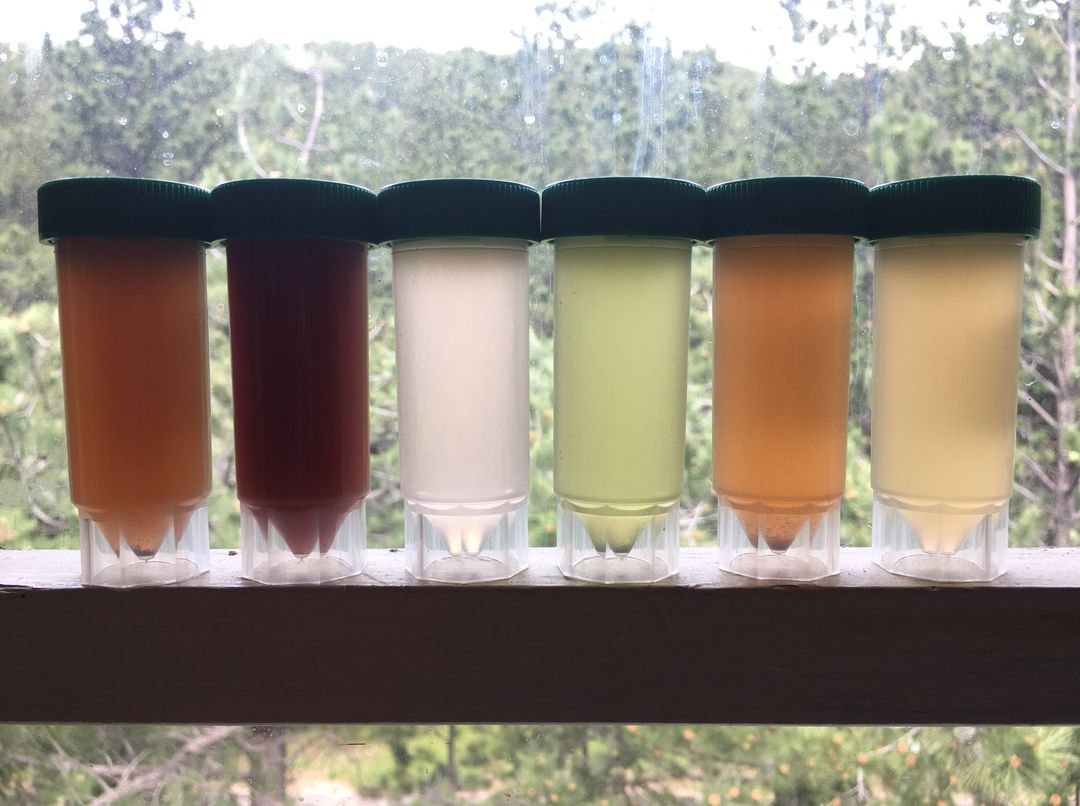
Select
a source for phytoplankton to feed the Copepods
Phytoplankton
can be found from many sources, including home culturing. Commercially
available phytoplankton will tend to be more concentrated than home
grown cultures. Pictured here are examples of DT's Live Marine
Phytoplankton,Reed
Mariculture's Plankton Live FeedDiet, and the typical 2-liter bottle
of home grown phytoplankton. Which ever source you decide to use, make
sure you use according to instructions to prevent contamination and
spoilage.
Nannochlroposis
is my preferred phytoplankton to feed copepods. Others may work as
well or better, but Nannochlropsis is widely available from both commercial and home
grown sources.
Once
we have the phytoplankton, we need to fill the culture tank with an
appropriate amount of phytoplankton. To prevent spillage and some of
the mess, I typically fill the tank less than half full.
Now
we have the culture tank filled and ready for copepods, not just yet.
We need to make sure the culture tank parameters are within ranges.
Temperature
– For culturing copepods, I do not use a tank heater. I have had great
success with room temperature. So what is room temperature? It means a
room that is typically considered comfortable. This does not include
the room with no insulation on the Northwest side of a house on the
plains of North Dakota in January.
Salinity
– It is best to match the culture tank to the tank to be fed. This
helps eliminate the possibility of salinity shock for the copepods.
Airflow
– With the culture tank filled with phytoplankton, we can set up the
airflow. This does not need to be forceful, but does have to provide
some circulation. I found that adjusting the airflow to a rate slow
enough to count the bubbles to be adequate.
Lighting
– Ambient room lighting or low wattage fluorescent lighting.
Adding
the Copepods:
If
we've successfully completed all the above, we can now add the
copepods. When adding the copepods try to insure they are near the
same water parameters as that of the culture tank. If not, try to
"acclimate" them slowly, although they are quite hardy.
Standard acclimation procedures will work fine.
Culturing:
With
the phytoplankton and copepods added to the tank and the airflow set
up properly, we are now culturing copepods. Well, we got started. The
idea is to keep a green tint to the water, the greener the better to
cultivate copepods to feed the target tank. As the water clears in
color, add more phytoplankton. Once we reach the desired density we
can start feeding the target tank.
What
density are we looking to achieve before we start feeding? This
depends on the target tank. Once you start seeing copepods gathering
on the tank glass, you probably have a good
density.
These
pictures show a copepod tank that has consumed the phytoplankton and
the culture water has gone clear.
Having
the culture water turn clear in color is not a 'bad thing,’ but it
is something we should try to avoid. If this does happen, we are left
with two options:
1)Add more phytoplankton to the culture tank to return the water
to a green color.
2)Drain the tank through a strainer (53 micron works well), and
then backwash the copepods into the culture tank with fresh phytoplankton. When draining the tank, I use a small diameter rigid tube to siphon out the water and copepods. When draining/siphoning the tank, try to minimize the amount of 'gunk' that is siphoned out.
The
'gunk' that builds up on the bottom of the tank is normal. Eventually,
we will need to change the culture water and restart the culture. This
can be done by following Option 2 above.
Feeding:
Feeding
methods vary from person to person. I will quickly describe the two
methods I use to feed my tanks.
1)Scoop out the desired feeding amount from the culture tank and
pour it into the target tank. Replace the feeding amount taken from
the culture tank with fresh phytoplankton. Because this is simple, it
is my preferred method.
2)The second method is to do the same as above except strain the
copepods from the culture water and then backwash into the target
tank. This reduces the amount of culture tank water added to the target tank.
Cross-Culture-Contamination:
I
haven't seen any ill effects from cross-contamination of cultures,
with the exception of brine shrimp. It seems brine shrimp will eat
almost anything and that includes copepods. It is possible to have a
dual culture of copepods and rotifers.
Miscellaneous
Notes:
1)Don't worry if
the water goes clear. I have had some copepods in a 2 liter bottle
with no phytoplankton added for almost 3 months. They might have
lasted longer, but I added some phytoplankton.
2)Divide the 10
gal tank into two equal sections with a piece of plexiglass. This allows you to have two cultures of copepods
and gives you some redundancy in case of a culture crash.
3)Don't be afraid
to feed the target tank. I have deliberately fed large amounts of
copepods to my main tank, and I have yet to see a negative impact.
4)Try to change
the culture tank water every 4 weeks on average or as water parameters warrant. This will help keep
the quality of the culture water higher.
5)When feeding
from the culture tank, try not to scoop the bottom of the culture
tank. If you scoop the bottom of the tank, you stir up a lot of waste
that then potentially gets put into your target tank.
6)Share your
cultures with others and educate them on the ease of culturing live
foods.