Brown,
B.E., Downs, C.A., Dunne, R.P. and S.W. Gibb. 2002. Exploring the basis
of thermotolerance in the reef coral Goniastrea aspera. Marine
Ecology Progressive Series 242:119-130.
Over the last
eight years various studies have appeared that deal with the ability of
zooxanthellae to adapt to higher temperatures and light levels through
various mechanisms such as antioxidant enzymes, down-regulation of
photosynthesis and xanthophyll cycling. In contrast, very little work
has been done on the reaction of the host coral tissue to the same
stressors with most studies focusing on UV blocking compounds and
fluorescent pigments that reduce light penetration and heat shock
protein production that limits damage to cellular functions.
Colonies of the
stony coral Goniastrea aspera were examined in Phuket, Thailand.
What makes this particular coral interesting is that during periods of
high water temperatures in 1991, 1995 and 1998 many of these colonies
exhibited differential bleaching; the east facing sides bleached but the
west facing did not. What makes this remarkable, is that during earlier
parts of the year the corals bleached on the west side due to higher
irradiance levels on that side of the coral during afternoon aerial
exposure on low spring tides rather than the more shaded eastern side of
the colony. Subsequent work showed that this was due to a significantly
higher thermal tolerance on the west side, which the authors feel was
due to the previous exposures to the higher light levels at low tide.
Somehow, this prior experience resulted in greater heat tolerance as
well. The goal of this study was to investigate the physiological
mechanisms involved in acclimatization and how the co-tolerance to both
heat and light could occur.
Cores were taken
from both east and west sides of 66 colonies for a total of 162 cores.
In addition two cores were from each east and west facing side from five
colonies to be proved a baseline analysis. Over the course of two days
the 162 cores were subjected to elevated temperatures (5o C
above ambient). Various molecular biomarkers of oxidative stress in both
zooxanthellae and host were measured in cores taken from east and west
sides, both before and after exposure to higher temperatures as well as
zooxanthellae density and zooxanthellae photosynthetic efficiency. The
biomarkers measured in the coral symbiosis (host and zooxanthellae)
included: 4-hydroxynonenal (HNE) and malondialdehyde (MDA), which are
indicators of oxidative damage and ubiquitin which is a marker of
cellular damage. The animal host tissue and isolated zooxanthellae were
both tested for the heat shock proteins Hsp70 and Hsp 60. These markers
are involved in reconstituting denatured proteins and increased levels
of these two indicate a response to stress. Two important enzymes
involved in the anti-oxidative response were also measured in both
animal host tissue and isolated zooxanthellae. Copper-zinc superoxidase
dismutase (CuZnSOD) and manganese superoxide dismutase (MnSOD), any
increase in these would be an indication of a defense response by the
animal host or zooxanthellae to oxidative stress. Finally the
zooxanthellae were also assayed for the presence of chloroplast small
heat shock protein (Chls-Hsp). This protein protects photosynthetic
processes during heat stress, oxidative stress and during high
irradiance.
At ambient
temperatures (29.4 +/- 0.5 oC, range 28.7-31.1 oC)
there was little difference between cores from the east and west sides
of the coral, but HNE and ubiquitin were higher in east cores while
CuZnSOD was higher in west cores. When temperatures were elevated to
33.6 oC (+/- 0.25 oC, range 33.1-35.2 oC)
significant increases in all biomarkers were observed in both east and
west cores for both host and algal tissues. All measures of oxidative
stress (HNE, MDA) and protein damage (ubiquitin) were higher in the east
side cores, while host defenses (CuZnSOD, Hsp70 and Hsp60, but not MnSOD)
were higher in west cores than east cores. There were no changes in
algal biomarkers between west and east cores at elevated temperatures.
There were very little changes in algal pigments between sides or
temperatures. Algal densities were higher in west cores at ambient
temperatures. At elevated temperatures algal densities dropped in the
east cores only with a 26% decline in algal numbers. Finally,
observations of fluorescent pigment showed a greater abundance on the
west side than on the east side cores.
The
question that has puzzled researchers for some time is whether
thermotolerance is a function of the host, the zooxanthellae or a
combination of the two. This study has provided evidence that on the
west facing side of the Goniastrea studied, the host tissue
confers a great deal of the thermotolerance. Increased CuZnSOD, Hsp60
and Hsp70 production by the coral tissue helped to deal with thermal
stress. Furthermore, the greater amount of fluorescent pigment on the
west side helped to reduce the amount of solar radiation penetrating the
tissue, which in turn reduces the possibility of light damage at higher
temperatures.
Of course the
zooxanthellae also play a role in thermotolerance as evidenced
by the increase in algal biomarkers (including Chls-Hsp) on both
sides of the coral when temperatures increased. Although the
production of heat stress proteins has been known to occur in
stony corals for some time, this study showed that both the host
tissue and the zooxanthellae produced these proteins. Both
corals and zooxanthellae produced significant amounts of Hsp60
and Hsp70 such that by the end of the two days over 5% of total
soluble protein production could be attributed to these two
stress proteins. When it comes to photosynthetic capability it
has been shown that xanthophyll cycling and xanthophyll pigments
help to reduce the effects of light at increased temperatures in
higher plants by dissipating excess light and is likely in
corals since previous studies have shown increased oxidative
stress when the xanthophyll cycle is inhibited. This study found
no difference in xanthophyll pigments between east and west
cores at elevated or ambient temperatures but did find a higher
pool of available xanthophylls in west side corals in their
baseline samples. They concluded that this was due to earlier
exposure to higher light levels on the west side of the coral on
the reef. What was noteworthy was how quickly the zooxanthellae
on the east side increased their xanthophyll cycling capability.
This underlined the fact that while the zooxanthellae on the
east side could quickly adjust (within hours) to the
experimental conditions in this study; the coral host defenses
took much longer.
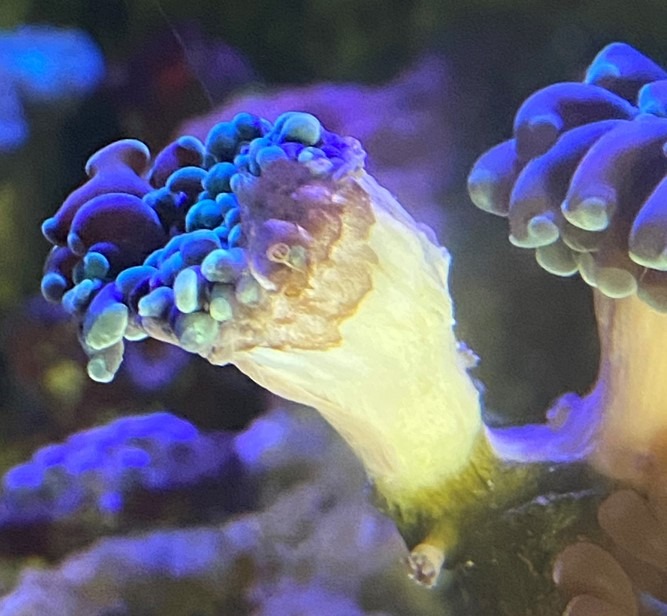
Goniastrea aspera.
Photo: Julian Sprung
The question still
remains, how does protection against high light levels help to confer
greater resistance to damage caused by high temperatures? Several
studies have shown that one of a coral’s greatest problems in dealing
with high temperature is its increased susceptibility to high light
levels. Therefore anything that can reduce light penetration (e.g.
fluorescence) or can dissipate light energy (e.g. xanthophyll cycling)
will help reduce damage. Furthermore, the productions of anti-oxidants
(e.g. CuZnSOD) inactivate oxygen radicals and reduce tissue damage
caused by high light.This
study also found an increase in heat shock proteins in all cores when
light levels were increased, with the greatest increases being found in
the west side cores. Heat shock proteins not only respond to thermal
stress but also other stressors such as high light, so it should not be
surprising that the higher irradiated west sides of Goniastrea
would show higher levels of these proteins and hence, confer a greater
resistance to heat induced bleaching than the east side.
This study is
significant not only in that it shows that corals that are acclimatized
to high irradiance, even for short periods, can develop increased
thermotolerance, which may prevent bleaching at high sea temperatures,
but also that the host tissue plays an important role on in dealing with
higher temperatures in the higher irradiated west sides of Goniastrea
aspera.
For aquarists
this study points out a couple of useful things. First
of all it may be possible to confer a greater
resistance to higher temperatures and therefore reduce
a coral’s risk of bleaching, by increasing the light
intensity on an aquarium that may be somewhat under
lit. Of course any changes that would be made in
lighting would need to be gradual so as to lower the
risk of light induced bleaching if done too rapidly.
As this study has shown, the zooxanthellae can respond
rather quickly; however, the host tissues do take
longer to adjust.
Secondly the
roll that anti-oxidants play in dealing with excess
light is again underscored. In this study CuZnSOD
concentrations were shown to differ significantly
between west and east cores over the two day trial
while MnSOD did not. However, both enzymes did
increase on both sides over the course of the study.
Julian Sprung, in the December 2002 issue of this
publication, hypothesized about the importance of
manganese (Mn) additions to aquaria in order to
facilitate the production of anti-oxidants in Goniopora.
Perhaps in Goniopora MnSOD levels drop over
time due to lack of Mn in the water or in the diet of
the corals. Sprung’s preliminary results in dosing
an Mn-Fe solution have been encouraging. However, a
more convincing argument for the role of MnSOD in Goniopora
could be made by measuring the levels of this enzyme
over a time course to see if Mn additions do indeed
increase the levels of MnSOD in the coral host tissue.
Without such testing it is unknown whether MnSOD or
CuZnSOD or levels of both decline in Gonipora
and whether or not manganese additions play any direct
role.
Also
underscored is the potential for variation in enzyme
activity between genera and perhaps between species of
corals. In the case of corals like Goniastrea,
copper and zinc additions might also be helpful in
maintaining enzyme levels along with manganese, and
may also play a role in Goniopora.
In fact, the concentration of both copper (0.0005
mg/L) and zinc (0.0049 mg/L) are higher in natural
seawater than manganese (0.0002 mg/L) in natural
seawater (Spotte, 1979). However, the levels of copper
and zinc in Instant Ocean were shown to be several
times of that in seawater, whereas manganese was
undetectable (Shimek, 2002). However, possible
inaccuracies in Shimek’s table #1 make any
conclusions based on his testing suspect. http://www.reefkeeping.com/issues/2002-02/rs/feature/index.htm
Proud
sponsor of this column
References
Shimek,R. L. 2002. “It's (In) The Water.” Reefkeeping.Com.
Volume 1. Number 1.February, 2002.
Spotte, S. 1979. Seawater
Aquariums: The Captive Environment. Wiley-Interscience, John Wiley
and Sons, New York, 413pp.
Interesting
Citations from the Periodical Literature
The following are
citations for some of the articles that might be of interest to
aquarists, which were published in the fall and winter of 2002.
Corals
Annis, E.R. and
C.B. Cook. 2002. Alkaline phosphatase activity in symbiotic
dinoflagellates (zooxanthellae) as a biological indicator of
environmental phosphate exposure. Marine Ecology Progressive Series
245:11-20.
Carlon, D.B. and
A.F. Budd. 2002. Incipient speciation across a depth gradient? Evolution
56(11):2227-2242.
Cumming, R.L.
2002. Tissue injury predicts colony decline in reef-building corals. Marine
Ecology Progressive Series 242:131-142.
Duh, C.Y., ElGamal,
A.A.H., Chu, C.J., Wong, S.K. and C.F. Dai. 2002. New cytotoxic
constituents from the Formosan soft corals Clavularia viridis and
C. violacea. Journal of Natural Products 65(11):1535-1539.
Ferrier-Pagès,
C., Boisson, F., Allemand, D. and E. Tambutté.
2002. Kinetics of strontium uptake in the scleractinian coral Stylophora
pistillata. . Marine Ecology Progressive Series 245:93-100.
Rowher, F.,
Sequriten, V., Azam, F. and N. Knowlton. 2002. Diversity and
distribution of coral-associated bacteria. Marine Ecology Progressive
Series 243:1-10.
Rudi, A., Levi,
S., Benayahu, Y. and Y. Kasman. 2002. Lemnaflavoside, a new diterpene
glycoside from the soft coral Lemnalia flava. Journal of
Natural Products 65(11):1672-1674.
Rohwer, F.,
Seguritan, V., Azam, F. and N. Knowlton. 2002. Diversity and
distribution of coral-associated bacteria. Marine Ecology Progressive
Series 243:1-10.
Savage, A.M.,
Trapido-Rosenthal, H. and A.E. Douglas. 2002. On the functional
significance of molecular variation in Symbiodinium, the symbiotic algae
of Cnidaria: photosynthetic response to irradiance. Marine Ecology
Progressive Series 245:27-37.
Shao, Z.Y., Zhu,
D.Y. and Y.W. Guo. 2002. Nanjids A-C, new steroids from the Chinese soft
coral Nephthea bayeri. Journal of Natural Products
65(11):1675-1677.
Torres, J.L. and
J. Morelock. 2002. Effect of terrigenous sediment influx on coral cover
and linear extension rates of three Caribbean massive coral species. Caribbean
Journal of Science 38(3-4):222-229.
Fish
Auster, P.J. and
J. Lindholm. 2002. Pattern in the local diversity of coral reef fishes
versus rates of social foraging. Caribbean Journal of Science
38(3-4):263-266.
Booth, D.J. and
G.A. Beretta. 2002. Changes in a fish assemblage after a coral bleaching
event.
Marine Ecology
Progress Series 245:205-212.
Copeman, L.A. and
C.C. Parrish. 2002. Lipid composition of malpigmented and normally
pigmented newly settled yellowtail flounder, Limanda ferruginea (Storer).
Aquaculture Research 33(15):1209-1220.
FerryGraham, L.A.,
Wainwright, P.C., Westneat, M.W. and D.R. Bellwood. 2002. Mechanisms of
prey capture in wrasses (Labridae). Marine Biology 141(5):841-854.
Konigon, S.,
Fjalling, A. and S.G. Lunneryd. 2002. Reactions in individual fish to
strobe light. Field and aquarium experiments performed on whitefish (Coregonus
lavaretus). Hydrobiologia 483(1-3):39-44.
Kume, G.,
Yamaguchi, A. and I. Aoki. 2002. Dummy egg production by a female
cardinalfish to deceive cannibalistic males: oogenesis without
vitellogenesis. Environmental Biology of Fishes 64(4):469-472.
McCormick, M.I.,
Makey, L. and V. DuFour. 2002. Comparative study of metamorphosis in
tropical reef fishes. Marine Biology 141(5):841-854.
Planes, S.,
Lecaillon, G., Lenfont, P. and M. Meekan. 2002. Genetic and demographic
variation in new recruits of Naso unicornis. Journal of Fish
Biology 61(4):1033-1049.
Privatera, L.
2002. Reproductive biology of the coral reef goby Asterropteryx
semipuntata, in Kaneohe Bay, Hawaii. Environmental Biology of
Fishes 65:289-310.
Rossel, S.,
Corlija, S. and S. Schuster. 2002. Predicting three dimensional target
motion: how archer fish determine where to catch their dislodged prey. Journal
of Experimental Biology 205(21):3321-3326.
Thompson, E.D.,
Mayer, G.D., Walsh, P.J. and C. Hogstrand. 2002. Sexual maturation and
reproductive zinc physiology in the female squirrelfish. Journal of
Experimental Biology 205(21):3367-3376.
Ecology
Peris, S., Lean,
D.D.S., Pick, F.R. and A. Mazumder. 2002. Photosynthetic carbon
allocation: effects of planktivorous fish and nutrient enrichment. Aquatic
Sciences 64(3):217-238.
Sponges
ElSayed, K.A.,
Yousaf, M., Hamann, M.T., Avery, M.A., Kelly, M. and P. Wipf. 2002.
Microbial and chemical transformation studies of the bioactive marine
sesquiterpenes (S)-(+)-curcuphenol and –curcidiol isolated from a deep
reef collection of Jamaican sponge. Journal of Natural Products
65(11):1547-1553.
Water Treatment
DiPalma, L.,
Verdone, W., Chianese, A., DiFelice, M., Merli, C., Pertucci, E. and G.
Veriani. 2002. Treatment of waste water with high inorganic salts
content. Environmental Engineering Science 19(5):329-340.
Volesky, B.,
Weber, J. and J.M Park. 2003. Continuous flow metal biosorption in a
regenerable Sargassum column. Water Research 37(2):297-306.
Bokn,
T. L. Moy, F.E., Christie, H., Engelbert, S., Karez, R., Kersting, K.,
Kraufvelin, P., Lindblad, C., Marba, N., Pedersen, M.F. and K. Sørensen.
2002. Are rocky shore ecosystems affected by
nutrient-enriched seawater? Some preliminary results from a mesocosm
experiment. Hydrobiologia 484
(1-3): 167-175.