In the last 15 years, the ability to recreate a piece of
a living reef in ones home has reached unprecedented heights. With the development of high
intensity lighting, the maintenance of corals that require light has become possible and
is now within the reach of almost any aquarist. Corals such as Acropora, Montipora,
and Seriatopora are now commonly grown and reproduced through fragmentation in home
aquariums. However, there are still a group of corals that, despite all the advances of
the past fifteen years are still proving almost impossible to keep. Although there are
isolated cases where some success has been reported, the maintenance of these corals for
long periods of time, where growth and propagation have approached natural rates, still
remains elusive. Commonly know as azooxanthellate or non-photosynthetic corals, they
include several families and genera. These include soft corals such as Chironephthya,
Dendronephthya, Scleronephthya, Siphonogorgia and Stereonephthya,
gorgonians such as Acabaria, Acalcygorgia, Melithaea and Subergorgia,
black corals and wire corals such as Antipathes and Cirripathes, hydrocorals
such as Stylaster and Distichopora, and of course stony corals in the genus Tubastraea.
Although the term "soft" coral is used to describe a grouping of corals, it
should be noted that this is a generic term used primarily for corals in the suborder
Alcyoniia.
Picture of stream tank. Photo: S
Brown.
Above: Schematic diagram of a simple flow
tank using a motor driven propeller.
Below: Stream tank using
motor driven propeller.
The reasons for the poor success rates with the majority
of these corals can be traced to fact that they need to feed on plankton. Enough food, of
the right type and size must be provided. Until recently, very little was known about the
feeding requirements of these corals. The vast majority of soft corals and gorgonians
available in the hobby rely greatly on zooxanthellae for their nutrition. However, recent
studies have shown zooxanthellae may not be able to meet the total nutritional needs of
all soft corals. Fabricius and Klumpp (1995) found that twelve of the most common
photosynthetic soft coral species investigated on the Great Barrier Reef could not meet
their carbon requirements by photosynthesis alone. This brings up the question of just
where do they get their carbon? Many octocorals are known as polytrophic feeders, meaning
that they are capable of obtaining nutrition from more than one source (Williams, 1993).
Possible sources may be one or all of the following: the direct absorption of nutrients,
the ingestion of zooplankton and/or phytoplankton, the ingestion of "marine
snow" along with its attached bacteria and organic material. Several studies have
shown that soft corals, gorgonians and sea pens can feed on a variety of zooplankton such
as copepod nauplii and eggs, invertebrate eggs and other small items of poor mobility.
Many of these studies, however, were conducted in the laboratory, using artificial foods (Artemia)
or concentrated natural zooplankton of unknown density (Fabricius et al.,
1995a). These studies showed that octocorals tend to be highly selective for non-evasive
forms such as mollusc larvae; indicating poor capture ability of more elusive prey such as
large adult copepods. This poor capture ability is most likely due to the lack of
effective nematocysts, resulting in the selection of less motile prey (Fabricius et al.,
1995a). In fact, Fabricius (unpublished data) found that an inability to feed on
zooplankton was widespread amongst zooxanthellate soft coral genera on the Great Barrier
Reef (i.e. three species of Sarcophyton, two species of Sinularia, Cladiella
sp., Nephthea sp. and Paralemnalia sp.). The role that zooplankton play in
the nutrition of photosynthetic octocorals is, as yet, unclear but new information is
showing that they contribute only a small portion to the nutritional budget of many
octocorals (Fabricius et al., 1995a and b). However, many of the studies that
looked at a corals ability to feed on zooplankton often used Artemia nauplii as
prey items under controlled situations. Artemia are rather large, and it may not be
surprising given the small size and weak nematocysts of many soft corals, that they are
not easily captured. Perhaps smaller zooplankton such as copepod nauplii, rotifers, or
marine infusoria is fed upon? However, the question remains, if not zooplankton, then what
are their main prey items?
Phytoplankton is an order of magnitude more common on
coral reefs than zooplankton. Studies have shown that phytoplankton is somehow depleted
over corals reefs, though where it goes no one knows (in Fabricius et al., 1995a).
In 1961, Roushdy and Hansen showed that the asymbiotic soft coral Alcyonium digitatum
feed on 14C labeled phytoplankton (in Fabricius et al.,
1995b). In 1969, it was demonstrated that the temperate watersea pen Ptilosarcus
gurneyi fed primarily on phytoplankton; its bright orange colour, the result of
carotenoids derived from a diet of dinoflagellates (in Best, 1988). Elyakova et al.
(1981), in a general survey of carbohydrases in marine invertebrates, found the presence
of laminarinase and amylase in three species of the zooxanthellate soft coral genus
Alcyonium, enzymes involved in the digestion of plant material. It was not until 1995
that Fabricius et al. published papers that demonstrated quite clearly that the Red
Sea azooxanthellate soft coral Dendronephthya hemprichi, fed extensively on
phytoplankton, gaining more than enough carbon to cover respiration and growth
requirements. Although this species also fed on zooplankton, only 2.4-3.5% of the daily
carbon requirement of this coral was met by ingesting zooplankton. Three other asymbiotic
Red Sea octocorals, D. sinaiensis, Scleronephthya corymbosa and the
gorgonian Acabaria, were also found to contain large quantities of phytoplankton in
their gastrovascular cavities (Fabricius et al., 1995b). Adaptations for
phytoplankton capture include the small spaces between the pinnules of D. hemprichi,
which appear to be ideal for straining phytoplankton from flowing waters. The large
spicules found in the body column and around the polyps of Dendronephthya spp.,
appear to function more in holding the column and polyps erect in strong current flows,
than to protect against predation, allowing the polyps to strain phytoplankton effectively
from the passing waters (Fabricius et al., 1995a). Some of the most
impressive growths of Dendronephthya spp. are often found on shipwrecks in the
South Pacific, where structures high above the bottom and projecting into the current are
often heavily encrusted. It is tempting to equate this with oyster hatcheries, where
oysters are hung in cages well above the bottom and within strong currents. Both organisms
feed on phytoplankton, and hence benefit from these positions by being exposed to maximal
phytoplankton concentrations. In light of this new evidence, scientists need to
re-evaluate the role of phytoplankton in the nutrition of other octocorals. Several
studies are now underway to determine to what extent both zooxanthellate and
azooxanthellate species actually feed on phytoplankton.
Proud
sponsor of this Feature Article
Another mode of
feeding may be the trapping of mucus flocs often called marine "snow". These are
composed of detritus, bacteria, protozoans and possibly phytoplankton trapped in mucus.
The source of this mucus is most likely soft and stony corals, which rid themselves of
epizoic growths and excess carbon and fats, by releasing mucus. This mucus is not easily
degraded by bacteria and is often infested with large quantities of bacteria and
eukaryotes (flagellates, ciliates and diatoms) (Vacelet and Thomassin, 1991). These mucus
flocs could be trapped by the spiky polyps of Dendronephthya spp. and used as a
food source. It is fully possible that octocorals employ a combination of some or all of
the above feeding mechanisms, with varying degrees of importance for each.
Armed with the above information, first
presented to hobbyists in The Reef Aquarium volume two, (Sprung and Delbeek, 1997)
several North American aquarium supply companies now make available various mixtures of
phytoplankton, some live, some cryo-preserved, and some consisting of dead algal cells.
Most of these products were originally developed for the aquaculture industry. Although
phytoplankton may be of importance to soft corals, its direct role for other
non-photosynthetic corals is not as well demonstrated, and may indeed be questionable.
Certainly corals such as Tubstraea spp. and antipatharians are known to prey
heavily on zooplankton. The needs of some gorgonians can also be well-met using
zooplankton substitutes such as enriched Artemia, rotifers and copepods.
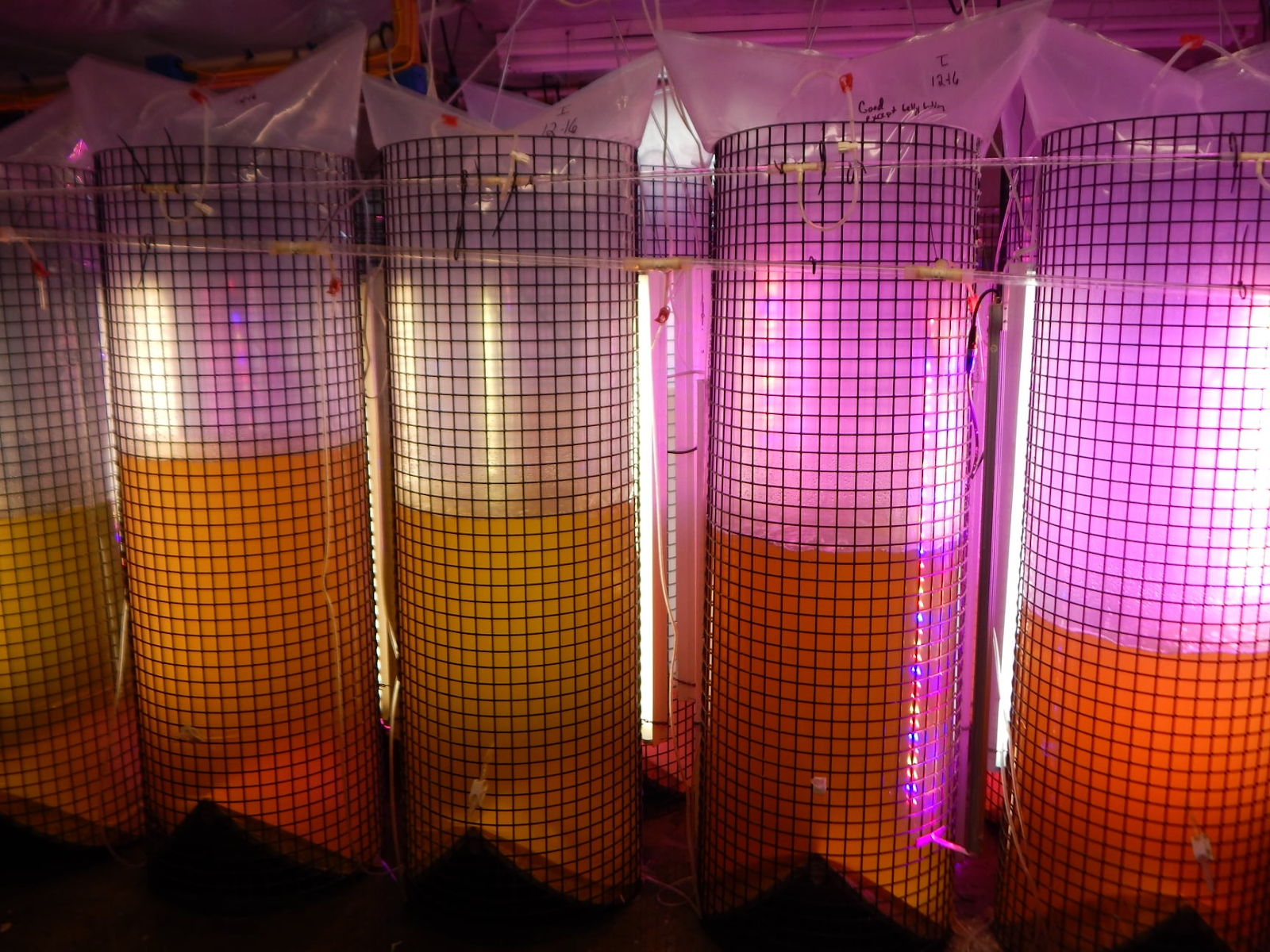
Cylinder tank used for Dendronephthya
research. Note central stand pipe and twin return pipes at the back of the tank each
connected to a separate pump and timer. Photo: Norton Chan.
Proud sponsor of this Feature Article
As it turns out,
the foods required for success are only one piece of the puzzle. Another factor, equally
important is water motion; not only the type but also the velocity of water motion can be
critical for some genera, but less critical for others. Given that octocoral polyps have
few, small stinging cells (or none at all) and that their pinnules offer a large surface
area, they are generally classified as suspension feeders, straining fine particles from
the passing water. As such their feeding efficiency is affected by the rate of current
flow, polyp and colony flexibility, and orientation. Several studies have shown that
feeding efficiency generally increases up to a maximum velocity and then drops off at
velocities beyond that (Best, 1988; Sponaugle and LaBarbera, 1991; Dai and Lin, 1993;
Fabricius, et al., 1995a). However, the flexion of the polyps and colony can act
together to increase the range of current velocities over which suspension feeding is
successful (Sponaugle, 1991).
The polyps themselves can actually modulate the
flow around them, to enhance prey capture. In a study of the effects of flow on particle
capture in the asymbiotic temperate octocoral Alcyonium siderium, Patterson (1991)
found that at low flows (2.7 cm/s) tentacles on the upstream side of the polyps capture
the most prey. At intermediate flows (12.2 cm/s) downstream tentacles within a polyp
capture the most prey. In high flow (19.8 cm/s) polyps are bent downstream, eddies form
over the polyp surfaces and all tentacles capture prey effectively. Prey is trapped most
effectively at the tips of the tentacles relative to locations near the mouth (Patterson,
1991). No one current flow is the best for all species. For example, Dai and Lin (1993)
found three Taiwanese asymbiotic gorgonians Subergorgia suberosa, Acanthogorgia
vegae and Melithaea ochracea to feed over a wide range of flow rates. The
ability to keep polyps open was also related to flow rates and the size of their polyps. Subergorgia
suberosa had the largest polyps, which were deformed by the lowest currents speeds
(>10 cm/s), severely hindering prey capture. In contrast, Melithaea ochracea,
which had the shortest and the least easily deformed polyps at high flow rates, could feed
at the highest flow rates (40 cm/s). Acanthogorgia vegae had an intermediate polyp
size and fed in flows of 0-24 cm/s. Although all three fed most effectively at flows of 8
cm/s, S. suberosa had the narrowest feeding range (5-10 cm/s) while M. ochracea
had the widest range (4-40 cm/s) (Dai and Lin, 1993). This varying ability to feed in
various current flows is a major factor in determining distribution on reefs. Melithaea
ochracea is the most widely spread gorgonian on southern Taiwanese reefs, occurring on
the upper part of reef fronts where currents are strong. Subergorgia suberosa,
which feeds in a narrow range of flow velocities, has a restricted distribution pattern,
being found on lower reef slopes or on sheltered boulders where currents are weaker. Acanthogorgia
vegae, which can feed in relatively strong currents, is most commonly found on the
semi-exposed reef fronts or the lateral side of boulders (Dai and Lin, 1993).
Tank soon after filling and the addition of corals.
Both photos: Norton Chan
Proud sponsor of this Feature Article
Therefore, water
flow and its interactions with polyps and colonies, appears to greatly influence
distribution patterns of colonies, colony growth, size and morphology, and rates of gas
exchange (in Fabricus et al., 1995a). To summarize, in increasing flows, feeding
rates initially increase, peak, then decrease as flow rate increases. Having too great a
flow can also cause polyps to stay open for shorter and shorter periods of time and having
flow rates too low do not stimulate polyps to open and feed.
In aquaria, water motion is predominantly of
two types, laminar and chaotic. Laminar flows occur close to the outlets of powerheads and
water returns. Chaotic flows begin to appear further from these sources as the flowing
water encounters resistance from water, tank walls, rocks and corals. Areas where two
water flows intersect also provide areas of chaotic water motion. However, the areas where
the majority of non-photosynthetic corals appear on reefs, (along drop-offs and channels
in reefs) have laminar flows that usually operate on tidal cycles. Water flow will
gradually increase in one direction then decrease, then change direction and increase
again. There are periods of "slack" tides between these two extremes. The corals
in these regions therefore receive strong laminar flow in one direction for several hours
followed by a slack period, then another period of strong water flow in the opposite
direction for several hours. To stimulate this in aquaria is difficult and may require the
design of new tank designs and water motion devices.
Tank with various corals, one month after collection.
Photo: Norton Chan.
Dendronephthya colonies located along outer
edge where greatest flow rate was attained. Photo: Norton Chan.
At the Waikiki Aquarium we have been working
with a cylindrical tank to simulate these conditions with two water pumps operated by
timers. The tank contains live sand, some live rock and has a continuous flow of natural
seawater, and so no other filtration is required. Lighting is supplied by ambient natural
sunlight coming from overhead acrylic panels with some direct sunlight for a few hours
each day. Other tank designs such as flumes and flow tanks could also be used. For
example, at the Vancouver Aquarium, in Canada, an exhibit of coldwater gorgonians has been
constructed that uses a flow tank with high horsepower pumps to simulate the very strong
tidal currents that occur in some of the passes between the islands offshore of British
Columbia.
At the Waikiki Aquarium we have had some
moderate success with keeping certain species of black coral, and good success with wire
corals by feeding them a diet of enriched Artemia and copepods. The Long Beach
Aquarium of the Pacific in California has had some success with Dendronephthya,Distichopora
and some other soft corals using a diet of phytoplankton including Chlorella sp., Spirulina
sp., Isochrysis sp., and Nanochloropsis sp. To that algae "soup",
they add rotifers and supplemented Artemia. They also found that Distichopora,
unlike non-photosynthetic soft corals, unquestionably require low light levels. If left in
even moderate light, fouling organisms quickly adhere to their delicate tissues and result
in mortality. The Shedd Aquarium in Chicago, has had one colony of Dendronephthya
for over a year, which has shown noticeable growth. They are feeding phytoplankton as well
as live rotifers and copepods. Our success with Dendronephthya has been less
inspiring.
Dendronephthya along outer edge. Photo:
Norton Chan.
In early December
2000, we collected fifteen small colonies of Dendronephthya in Fiji and transported
them back to Hawaii under permit. At present (March 17, 2001) we have seven of the fifteen
colonies still surviving. Although we have tried several food types such as live marine
phytoplankton (Chaetoceros,Isochrysis, Nannochloropsis etc.), copepods,
rotifers, fatty acid supplements and "marine snow" products, we have had mixed
results. In some cases, damaged colonies quickly regrow polyps and attain new tissue,
however, established colonies slowly decreased in size. Interestingly enough, the greatest
reaction to substances added to the aquarium occurs in two ways. When the interior of the
glass is wiped of algae the colonies show an increase in size only an hour or so later.
Secondly, when the juice from thawed frozen squid is added to the aquarium, colonies show
the greatest increase in expansion. It is likely that these corals feed to a greater
extent on zooplankton then current research has indicated and aquarists should not rely
solely on phytoplankton as a food source. Peter Wilkens has been able to keep small
colonies for some time in his aquaria by occasionally stirring the bottom substratum,
releasing detritus and quite possibly bacteria and other infauna, on which the corals may
feed.
In April of 2001, our director Dr. Bruce
Carlson returned from Fiji with a specimen of the gorgonian Menella. With its
magenta tissue and snow-white polyps it is a beautiful sight when fully opened! As with
the Dendronephthya we had collected previously, this coral opens its polyps most
frequently when squid juice is added or the tank window is cleaned. While closely
observing the polyps, live Artemia naupilli, live rotifers and copepods were added
in separate feeding trials. Even polyps that had Artemia directly applied to them
could not hold onto the struggling live food, and were eventually released. Next, live
microalgae cultures were tried as well as Algamac, a commercially available artificial
phytoplankton substance (see www.argent-labs.com). During these trials individual arms of
the polyps could be seen periodically bending towards the mouth, wiping along the aboral
surface of the polyp. I believe that mucus on these arms and their associated pinnules may
be trapping passing phytoplankton cells then passing them to the mouth to be ingested.
Proud sponsor of this Feature Article
Orientation of
colonies is another factor that can play a significant role. Colonies that were placed
upright on the sand bottom in our system initially appeared to do well, but over time,
began to shrink in size. When placed upside-down from a supporting structure, these
colonies slowly recovered and looked much better, some even showing new growth and
reattachment to the substratum. The key seems to be to not allow the colonies to touch the
bottom with their branches; this seems to irritate them over time and results in the loss
of spicules. This is of greatest concern when the colony is deflated. Another interesting
observation is that colony inflation and deflation does not seem to follow any discernable
pattern. In the early morning the colonies are deflated and then inflate later in the
morning and would remain so for most of the day, although deflation could occur again at
any time during the day.
As I mentioned briefly above, the Waikiki
Aquarium has had some success in maintaining live wire corals and black corals. The wire
coral Cirrhipathes anguina was easily maintained on live Artemia naupilli enriched
with Super Selco and Algamac, and growth was readily visible. The black coral, Antipathes
dichotoma, fed on live copepods but growth was not as noticeable and the colonies
would slowly deteriorate with time. Recently, I tried feeding this coral frozen copepods
from Argent called Cyclopeez, which I was feeding to my Pseudanthias tank at the
time. These were rather large compared to Artemia, about twice as wide. They are
also enriched with various pigments and appear bright orange/red.
Dendronephthya sp. at 120 ft.,
Solomon Islands. Photo: JC Delbeek
Dendronephthya sp. Sulawesi, Indonesia. Note
large red spicules embedded in the tissue for added support. Photo: JC Delbeek
I placed a small branch in a dish of seawater
and placed this under a dissecting microscope. I used an eyedropper to add a small amount
of Cyclop-eez to the expanded polyps. To my surprise the polyps easily grasped these large
copepods and would engulf the entire animal by expanding the mouth until the entire animal
could be passed in. Apparently the fact that these were not moving targets helped the
polyps capture and ingest them as opposed to a struggling live prey item. I assume that
the lack of any water movement also made prey capture easier. Unfortunately, I have not
had time to pursue this due to other projects, but I would like to attempt a long term
study by feeding this food item to a colony over a period of months and see whether or not
its growth and survival improves over that of copepod and Artemia fed
colonies.
There are several questions that remain to be
answered in keeping non-photosynthetic corals. The role of temperature, colony
orientation, nutritional composition of foods (including pigments), food density, the best
techniques for coral collection, and handling and shipping are just some that need to be
investigated over the next few years. We are beginning to see limited success with many of
the non-photosynthetic corals that used to be very difficult to keep, and it is only a
matter of time until tanks filled with colorful, healthy non-photosynthetic organisms will
be as common as tanks filled with Sarcophyton are today.
Scleronephthya with it's distinctive dark
polyp mouth and light tentacles, has proven easier to keep than Dendronephthya spp. Photo:
JC Delbeek
Bibliography
Best, B.A. 1988. Passive suspension
feeding in a sea pen: effects of ambient flow on volume flow rate and filtering
efficiency. Biol. Bull. 175:332-342.
Dai, C.D. and M.C. Lin. 1993. The
effects of flow on feeding of three gorgonians from southern Taiwan. J. Exp. Mar. Biol.
Ecol. 173:57-69.
Elyakova, L.A., Shevchenko, N.M. and
S.M. Avaeva. 1981. A comparative study of carbohydrase activities in marine invertebrates.
Comp. Biochem. Physiol. 69b:905-908.
Fabricius, K.E. and D.W. Klumpp. 1995.
Wide-spread mixotrophy in reef-inhabiting soft corals: The influence of depth and colony
expansion and contraction on photosynthesis. Mar. Ecol. Progr. Ser. 126:145-152.
Fabricus, K.E., Genin, A. and Y.
Benayahu. 1995a. Flow-dependant herbivory and growth in zooxanthellae-free soft corals. Limnol.
Oceanogr. 40:1290-1301.
Fabricus. K.E., Benayahu, Y. and A.
Genin. 1995b. Herbivory in asymbiotic soft corals. Science 268:90-92.
Patterson, M.R. 1991. The effects of low
on polyp-level prey capture in an octocoral, Alcyonium siderium. Biol. Bull.
180:93-102.
Sponaugle, S. 1991. Flow patterns and
velocities around a suspension-feeding gorgonian polyp: Evidence for physical models.
J. Exp. Mar. Biol. Ecol. 148:135-145.
Sponaugle, S. and M. LaBarbera. 1991.
Drag-induced deformation: a functional feeding strategy in two species of gorgonians. J.
Exp. Mar. Biol. Ecol. 148:121-134.
Sprung, J. and J.C. Delbeek. 1997. The
Reef Aquarium: A Comprehensive Guide to the Identification and Care of Tropical Marine
Invertebrates. Ricordea Publ., Coconut Grove, FL, USA, 546 pp.
Vacelet, E. and B.A. Thomassin. 1991.
Microbial utilization of coral mucus in long-term in situ incubation over a coral reef. Hydrobiologia
211:19-32.
Williams, G.C. 1993. Coral Reef
Octocorals: An Illustrated Guide to the Soft Corals, Sea Fans and Sea Pens Inhabiting the
Coral Reefs of Northern Natal. Durban Natural Science Museum, Durban, South Africa. 64
pp.