Breeding of the
American Seven-spined Gobies (Neon Gobies) By Dr. James L. Van
Tassell1 & Naomi Delventhal2
Forward by-Frank
Marini
For
the past 6months we have been examining the home culturing of
primary foods for our upcoming fish breeding endeavors. With
this background knowledge we are ready to make our first jump
into fish breeding. Therefore, for our initial exposure into
home fish breeding, I though that we should examine a species
that everyone is familiar with and one that many people have
had success with, even though many were unaware they were
breeding fish at home.
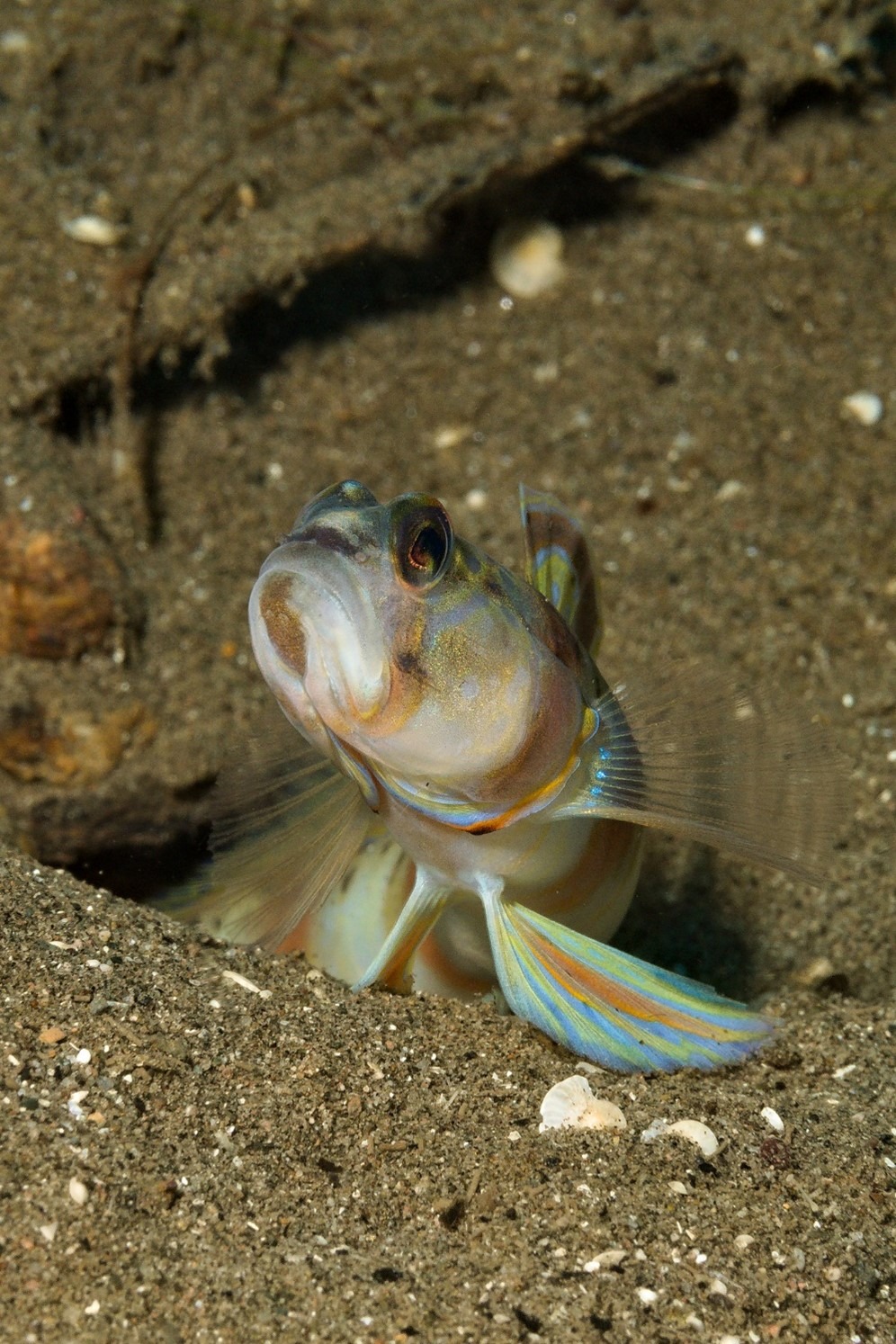
The neon gobies
These
diminutive fish make wonderful additions to mini-reef tanks;
they are brightly colored, highly active, eat almost any food
type, live in small groups, and often unbeknownst to their
owners spawn quite regularly in rock caves. The offspring of
neon gobies are perfectly sized for us to provide them with
the initial foods we are familiar with. Raising these fry can
give the aquarist valuable experience, which may lead to tackling
more difficult ornamental fish.In this month’s column, I have asked Dr. James Van
Tassell and Naomi Delventhal, two recognized experts in the
field of goby research to provide an in-depth background on
these wonderful fish and explains the ins-and-outs of home
goby breeding.
Introduction
(P1)Gobies
belong to the suborder Gobioidei, one of the most diverse groups of
the Percomorphs, with approximately 2121 species in 268 genera.They represent 5-10% of all teleosts (bony fishes), with
species occurring in (P2) marine, fresh, and brackish water environments.Both the smallest extant vertebrate, Trimmatomnanus (Winterbottom and
Emery, 1981), with a length of 8.0 mm SL for gravid females, and the
lightest weight vertebrate, Schindleriapraematura (Schindler,
1930), with a maximum weight of 8 mg (Bruun, 1940), belong to the
suborder.Some gobioids
are amphidromous, returning to their freshwater streams by traversing
the face of 130 m waterfalls (Fitzsimons and Nishimoto, 1990).Gobioids occupy a diverse variety of marine habitats including
open water, sandy or rocky biotopes, (P3)
tidepools, caves, sponges, and mudflats.They are found at depths ranging from 0 to 500 meters and in
temperatures ranging from 70C for Leucopsarionpetersi Hilgendorf (Matsui,1986)
to 400C for Chlamydogobiuseremius (Zietz, 1896),
(Glover, 1973).
The New World goby fauna is dominated by the
American Seven-spined gobies (tribe Gobiosomatini).The tribe contains 24 of the 26 New World genera and
thus represents about 40% of the New World gobioid genera with
about 120 species. They are found in the Atlantic from
Massachusetts to Argentina and in the Pacific from southern
California to Chile. They inhabit both estuarine and marine
environments and every type of substrate type possible. Most
of the species are found in the Caribbean region where they
have evolved to occupy the many niches available in the
diverse coral reef habitat. Perhaps the best know members of
the group are the (P4)
Neon gobies (now placed in the genus Elacatinus).They occur either in association with sponges or corals
with about 14 species currently described, and more on the
way! (P5)Elacatinuslori was just described from Honduras and Belize. The description
can be found in an online journal Zootaxa at http://www.mapress.com/zootaxa/2002f/zt00106.pdf.
All possess a bright neon stripe running horizontally on the
body and those that live on coral exhibit cleaning behavior;
maintaining cleaning stations and removing ectoparasites from
other fishes.
Proud
sponsor of this column
The classification of this group is complex and
undergoing changes. It is beyond the scope of this article to explain
in detail but for purposes of this article I’ll separate the old
genus Gobiosoma into two
genera (P6)
Elacatinus and (P7) Gobiosoma and we’ll divide Elacatinus
into two subgenera Elacatinus
and (P8)
Tigrigobius. If you want to keep up with the changes or find out
more details go to my web site http://gobiidae.com
and check out the history section.
P1
Oxyurichthys sigmalophius
P2
Lythrypnus sp
P4
Elacatinus oceanops
P3
tidepool Colary Islands
P5
Elacatinus lori
P6
Elacatinus xanthiprora
P7
Gobiosoma bosc
P8
Tigrigobius saucrus
P9
Elacatinus prochilus
The Neon
Gobies (Elacatinus and Gobiosoma)
Elacatinus
(the Neon gobies) are brightly colored, generally somewhat active
swimmers, and great for reef aquaria. They are also easy to breed and
have been bred for many years for the aquarium trade.Most species also hybridize readily producing an even greater
array of color patterns.You
will generally find (P6) Elacatinus oceanops, (P9)E. prochilos, (P10)
E. puncticulatum, and (P11)
E. horsti in the aquarium trade.
The subgenus Tigrigobius
is a very diverse group of generally coral and/or rock reef fishes.
They may have vertical bars such as the Wide-banded cleaner goby
(P12) (T. limbaughi)
and the (P13) Narrow banded
cleaner goby (T. digueti)
from the east Pacific that inhabit rocky habitats or the (P14) Green goby (T.
multifasciatum) which lives under long spined sea urchins in the
Atlantic.A variety of
other color patterns also exist such as is found in (P15)
(T. saucrus), (P16) (T. gemmatus ) and (P17) (T.
macrodon).
The genus
Gobiosoma contains about 17 species. Most of these fishes are
estuarine living on sand or mud bottoms in association with rocks,
shells, or wood pilings. They tend to be light brown with diffuse
bands and bars. The Atlantic species include(G. bosc), (P18) (G.
grosvenori), (P20) (G.
spilotum), and in the Pacific (P19)
(G. paradoxum) to mention a
few.
All
of the species of Elacatinus and Gobiosoma
are great in the aquarium. They’re not shy or reclusive and are all
easy to breed.
Breeding
husbandry for Neon Gobies
Elacatinus
oceanops
were among the first marine fish to be successfully bred by aquarists,
and they (as well as other Elacatinus and Gobiosoma
species) remain among those most frequently propagated by amateur and
commercial breeders. Due to their small adult size, willingness to
spawn captivity, and relatively large, demersal eggs, these small
gobies are ideal candidates for the beginning breeder of marine
fishes.
A ten gallon tank is suitable for breeding Elacatinus.One technique is to use a (P21)
Lustar breeder box with a transparent front panel for easy
viewing; the heavy plastic screening does not clog and is easy
to clean.Use a
salinity of about 30ppt (specific gravity 1.021).The brood stock can be obtained through collections,
local dealers, and mail order.Many local dealers can “special order” species they
don’t usually stock.It’s
usually a good idea to start with about six adults, since it
is not always easy to determine their sex by inspection.Place two together in a tank and see if they get along
– if they fight too much they are either not a pair or not
compatible.It’s
often helpful to combine individuals of slightly different
size.
The adults should be fed at least three times a
day – more often is even better.Flake foods can be used to keep these gobies alive and
healthy, but they generally don’t work very well for
conditioning.Many
breeders like to use a gel formula made with various
ingredients (e.g. fresh seafood, vegetables, marine algae,
Ziegler’s salmon starter and a multivitamin blended together
and mixed with unflavored gelatin.Another good food is a mixture of finely chopped clams,
shrimp, squid and capelin roe.Frozen enriched Artemia
can be fed on occasion.In
addition, I like to use live blackworms occasionally –
gobies love them and they are good for conditioning.The key is to feed a wide variety of food and as often
as possible.
Proud
sponsor of this column
P10
Elacatinus ncticulatum
P11
Elacatinus horsti
P12
Tigrigobius limbaughi
P13
Tigrigobius digueti
P14
Tigrigobius tifasciatus
P15
Tigrigobius saucrus
P16
Tigrigobius gemmatum
P17
Tigrigobius macrodon
P18
Gobiosoma grosvenori
P19
Gobiosoma paradoxum
Spawning
caves
The gobies spawn
in small caves; a short length of ˝-inch diameter PVC pipe makes a
great substitute.You may
be lucky enough to witness the actual spawning event; if not, the
first indication that spawning has occurred will be the male’s
constant entering and exiting of the (P22)
PVC cave for the purpose of guarding and fanning the eggs.The eggs hatch in about 3-7 days (depending on the species and
temperature) (P22.A, B, C).When the eggs are ready to hatch, the eyes will be fully
pigmented and the yolk sack will no longer be visible.Place the PVC tube in a small cup in the water (being careful
not to let air touch the eggs) and transfer it to the rearing tank.
Larval
rearing tank
The sides of the
10-gallon larval rearing tank should be painted black (the front can
have a sheet of black paper taped to it to be removed for viewing).Light should come only from the top, as this is necessary to
orient the larvae for feeding.The
tank should be lightly aerated with a ceramic airstone.Too much aeration will cause the larvae to be whipped about in
the tank, but too little will promote stagnation, and allow the
rotifers to concentrate only in certain spots.The rearing tank should have the same water chemistry as the
breeding tank – a water exchange between the two tanks prior to
moving the eggs will help ensure this.A light flow of water produced by a pipette about the time the
lights normally go out in the evening will simulate the male’s
fanning and induce the eggs to hatch.
Feeding the
larval fish
Larvae should be
fed the morning after they hatch. (P22D)Add one liter of Isochrysisgalbana (cultured under
fluorescent lighting according to protocol outlined by Hoff and Snell
(1987) and about 40,000 rotifers (10 rotifers per milliliter).(Rotifers are not difficult to culture at a density of about
100-250 per ml in a ten gallon aquarium or large Rubbermaid container
with a salinity of about 25ppt (specific gravity 1.017). They can be
fed cultured Isochrysis or a
combination of Culture HUFA from Salt Creek, Inc. and concentrated
Isochrysis paste from Reed Aquaculture, Inc.)Rotifer density is estimated by taking several 1 ml quantities
of the rearing water with a pipette and counting the rotifers under
magnification; an experienced breeder can estimate densities without
counting.Keep the
rotifer density in the rearing tank the same, and add about 1 liter of
Isochrysis daily (just
enough to keep the water tinted slightly brown).Every 3-4 days change 50% of the water.Use a length of airline tubing to siphon water out of the
tank; to refill the tank slowly siphon new water into the tank from a
suspended bucket.
Introduce
a small amount newly hatched Artemia
about 15 days after the larvae hatch.If the larvae are able to eat them, their bellies will turn
pink-orange and bulge.After 5-10 days (when all the larvae have pink-orange bellies)
switch to Artemia exclusively.At this time add a sponge filter to the tank to help maintain
water quality.Depending on the temperature the larvae will settle in 20-30
days and start acting like miniature gobies.Some species (e.g. E. puncticulatus) take longer, perhaps 50-60 days.After this point dry food may be introduced. For information on
commercial culture of gobiid fishes see “A system for laboratory of
commercial culture of gobiid fishes: by Todd Gardner and James L. Van
Tassell in SeaScope Vol 18
2001.
P20 Gobiosoma
spilotum
P23
Evermannich spongicola
P21 Lustar bree10 gal
tank
P22
Tigrigobiustum in tank
P22
A E oceanops egg 01
P22
B Epuncticulum egg
P22
C Tigrigobius macrodon egg
P22
D A puntic larvae
P24
Risor ruber
P25
Nes longus
To summarize by Frank Marini:
The
seven spine gobies are great inhabitants for a reef-style aquarium.
Their diminutive size, coupled with their willingness to breed in
captivity make them an excellent choice for a home fish breeder. While
determining sexes of these fish is somewhat difficult, you can
overcome this issue by providing multiple fish. Established male
gobies will find an appropriate nesting site, and breed with a willing
female. Males will guard the egg masses and provide a minimal amount
of parental care, keeping the male in the presence of the eggs will
increase the likelihood of hatching success. Once hatched, goby fry
can be established on phytoplankton-enriched rotifers followed by a
weaning onto Artemia. While the goby fry are small, they are robust feeders and
grow quickly. These above reasons make neon gobies an excellent
candidate for a first endeavor into home fish breeding.
P26 Microgobius
revispinnis
In upcoming months for
the Breeder’s Net column, we will continue to exam the home
culture of microfoods (such as bivalve veligers and copepods),
which will provide us with progressive smaller and
nutritionally diverse foods for tiny fish fry. We will also delve
into some commonly bred marine ornamental fish. With the
success of our home breeding of gobies, I will also be asking
Dr. Van Tessell for future columns on additional goby species,
such as (P23)
Evermannichthys and (P24)Rizor that live inside sponges, (P25) Nes that live in burrows with shrimp, and (P26)Microgobius tube dwelling species that live in soft mud and have
brilliant iridescent colors.
Affiliations
1Dept.
of Biology, 114 Hofstra University, Hempstead NY 11549