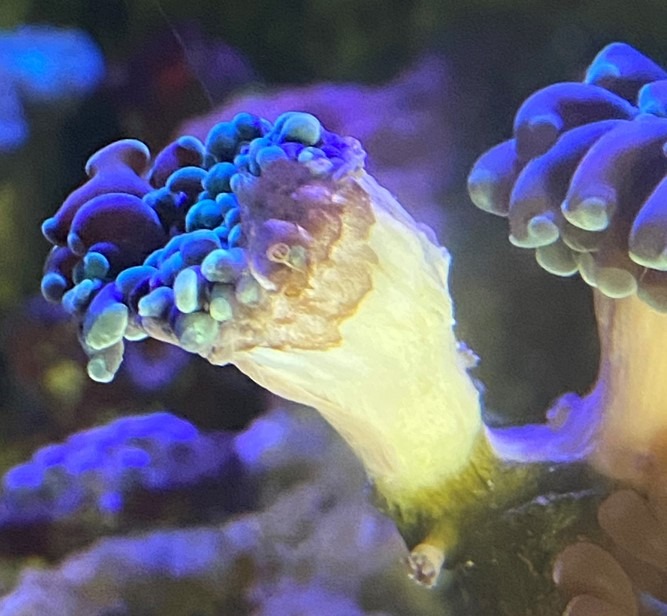
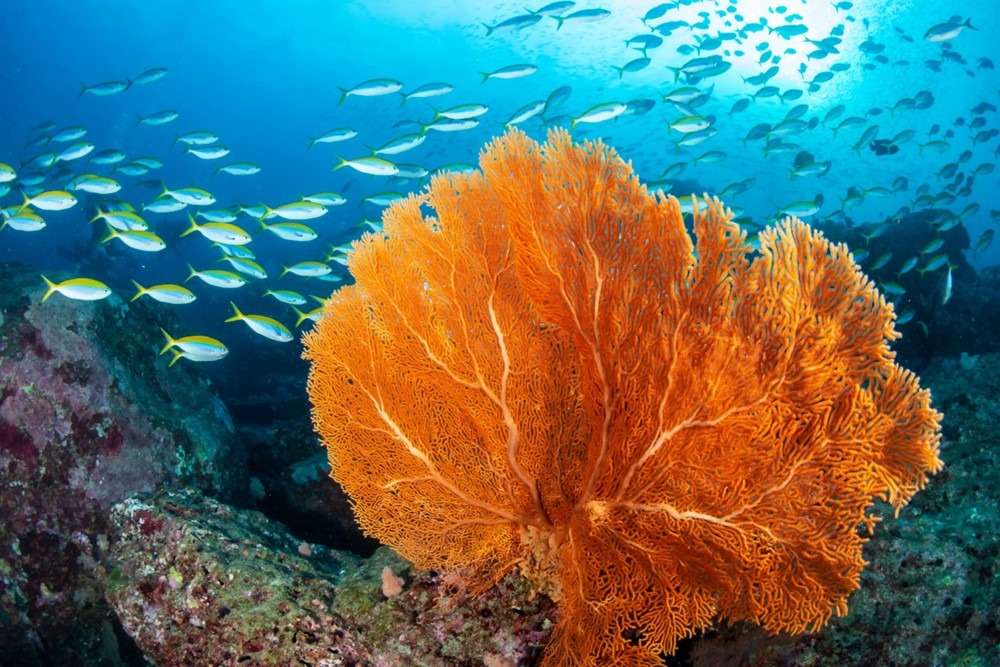
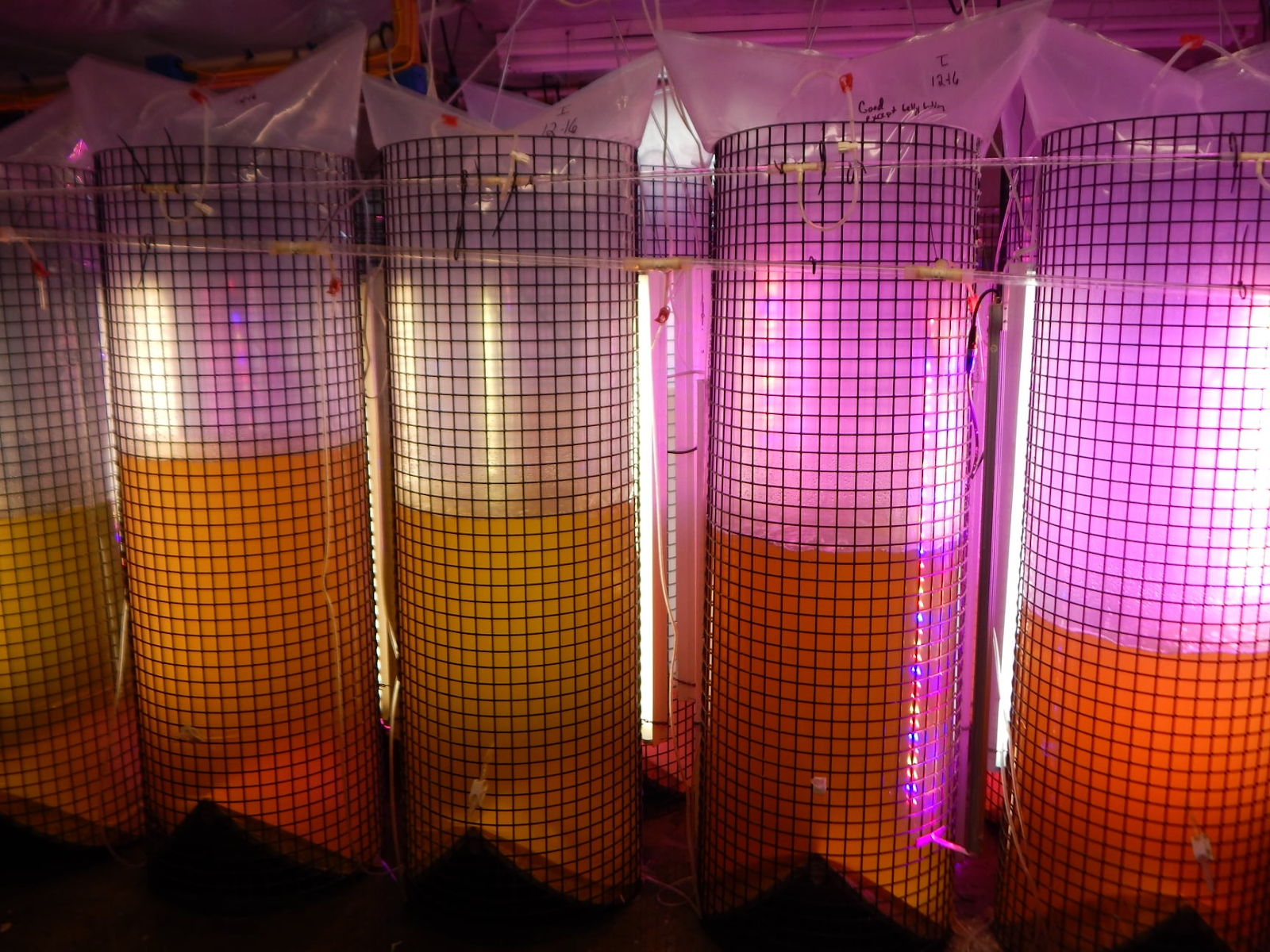
Rapidly
growing corals can interfere with both water circulation
and light reaching their inner branches and other nearby
corals. In other words, the conditions that allowed
the fragments to grow rapidly are altered by their growth
patterns. Click on either picture for full-size image.
One hears too
often, my reef was thriving, with everything growing, and
then it crashed. Both in Nature and in our small reefs corals
can often be their own worse enemies. In Nature they are on
a suicide mission, growing toward the light - the Sun - but
also toward the atmosphere where they will be destroyed by
wave action, desiccation, UV, heat, etc. However, the situation
in our reef tanks is different. Corals, when healthy, grow
very rapidly, increasingly making it difficult for water circulation
and light to reach them. This can generate stress, often leading
to a crash. Of course, there can be many other reasons. But,
reading Charles Delbeek's Media column this month got me to
thinking about growing corals and water motion.
In his column
Charles wrote, "The following two articles support the observation
that good water flow is an essential component in a successful
reef aquarium that houses a lot SPS corals such as Acropora
and may help to prevent coral bleaching brought on by increased
water temperatures and light levels." I suggest you read Charles'
column carefully; it might save you from a crash.
We all know that
it is much easier to start a fragment than a whole colony,
letting the fragment adapt to the environment we provide,
but what we may forget is that growing corals change the environment
that they adapted to by their growth patterns. They may grow
to the point where they cannot get the water circulation and
or light that they need to survive. To avoid a crash we may
need to increase light and water circulation and periodically
thin out our corals. This may be one of the reasons that we
too often hear, just before the crash everything seemed to
be doing so well.
Ron Shimek raised
most reef keeper's anxiety level a few years ago by claiming
that our reef tanks were sinks for the accumulation of toxic
heavy metals. In part 2 of his series "Is It In The Water?"
Richard Harker confronts Dr. Shimek's controversial position
with data of his own. The beauty of science is that, when
confronted with new data, it is self-correcting.