Living
here in Hawaii, an important collection area for a
number of popular aquarium species, has sensitized me to
a major downside of our desire to maintain and observe
the beautiful and fascinating creatures of the tropical
reefs in glass boxes in our homes.While none of the fishes collected for the international
trade in ornamental species are endangered, it is clear
that there have been important reductions in population
of targeted aquarium fishes here, especially the Yellow
tang, Zebrasoma flavescens, with all parties in
agreement about these reductions.This has led, as I've reported before, to active
hostility in Hawaii to aquarists in general and aquarium
fish collectors in specific and to the establishment of
"no-take" zones for aquarium collectors.Approximately one third of the western, or Kona, coast of the
Big Island of Hawaii has been set aside as "Fish
Replenishment Areas" (FRA's) closed to aquarium
collection, with the expectation that recruitment and
migration will infuse the "open" areas with
more stock, an intervention that has proved successful
in food fish management.I have also reported that, after two anxious
years of no change, this year's transect studies
indicate that there has been a significant increase in
population for the collected species within the
protected areas, justifying the FRA strategy and
hopefully pointing to a sustainable aquarium fishery.The absolute population numbers for aquarium
species, however, still remain well below pre-collection
figures.The
likelihood of full population recovery seems low,
certainly in the short term.
It
seems clear that one of the potential mitigators of the
unfortunate negative impact that our activities as
aquarists has on the population of "targeted"
species-
paradoxically those we most appreciate and value - is
the development of aquacultural techniques for the
breeding of important ornamentals, and researchers in
Hawaii have made important contributions to this effort.I have reported before on the
Waikiki Aquarium's announcement of its success in
breeding and rearing the endemic Hawaiian Masked
Angelfish, Genicanthus personatus, on Oceanic
Institute's success in spawning the Flame Angelfish, Centropyge
loriculus as well as Dr. Malia Chow's rearing of
Fisher's Angelfish, Centropyge fisheri at the
Hawai'i Institute of Marine Biology.None of these efforts, however, are currently
ongoing nor have they led to the successful rearing of
commercial numbers of these fishes or to their
availability to aquarists.
This
situation for at least one important species is in the
process of being changed.Dale Sarver, Ph.D. and Neil of Black Pearls,
Inc., a division of Kona Blue Water Farms, have not only
successfully bred and raised the highly popular Flame
Angelfish, they are capable of producing them in
commercial quantities for the aquarium trade.
Both
Dale and Neil are highly trained and experienced marine
science researchers and commercial aquaculturists, with
an excellent staff.Their primary interests are in cultivating pearl
oysters and food fish.They are located in the Hawaiian Ocean Science
and Technology (HOST) area of the Natural Energy
Laboratories of Hawaii Authority (NELHA), the only
facility in the world that supplies pristine ocean
water, both warm surface water and cold deep water, to
land-based aquaculture projects.The Authority provides not only the water for
open-system aquaculture but also the necessary state and
federal permitting and monitoring of environmental
impacts.
As
I discovered to my surprise when I spoke with them for
this article, their success in breeding and rearing the
Flame Angels is, for them, a secondary outcome rather
than a primary interest. These researcher/
aquaculturists have their eye on a larger goal - the
development of new methodologies for rearing
economically important fish larvae, especially food
sources for the critical early stages of fish
development from the larval to the juvenile forms.Lack of appropriate food items for these early
stages is the major roadblock in the commercial breeding
of many important fish species, both food fish and
ornamentals.Even
Martin Moe, an experienced expert in breeding tropical
ornamentals, reported in Raising the Orchid Dottyback,
that he had to collect "wild" plankton at one
point in order to bring his fish through full
metamorphosis.(Of course similar problems exist with respect to
aquarium invertebrate species, not only for their larval
stages but for their adult forms as well.)
So how do the
Flames fit into the picture?They
are the equivalent of laboratory mice in this project!The first criterion for a research subject was to pick an
experimental species that that would provide sufficient larvae for
research purposes, and the second was to select one that was relatively
difficult to rear in order to raise problems that challenge commercial
projects.In addition, the
experimental species had to have an egg size close to those of desirable
food fish species and a similarly small larval mouth. Of great
importance as well is a larval form with an inborn, fixed action
pattern, food-striking repertoire triggered by the movements of small
targets, similar to the patterns of difficult to rear commercial
species.The Flames fill
all these criteria.They
are a relatively difficult group to rear and, under the care of these
researchers the brood stock spawn readily and frequently year-round,
providing a constant source of larvae for experimental purposes.Their larval mouth size and feeding triggers are within the
appropriate experimental range as well.Currently available commercial foods will not maintain the larvae
and the research is designed to explore new food items and sources.
The Black Pearls
project is funded through a three year grant from The Advanced
Technology Program, under the National Institute of Standards in
Technology, a federal program supporting basic research in important
technology.The first step
for the researchers is the collection of a variety of potential food
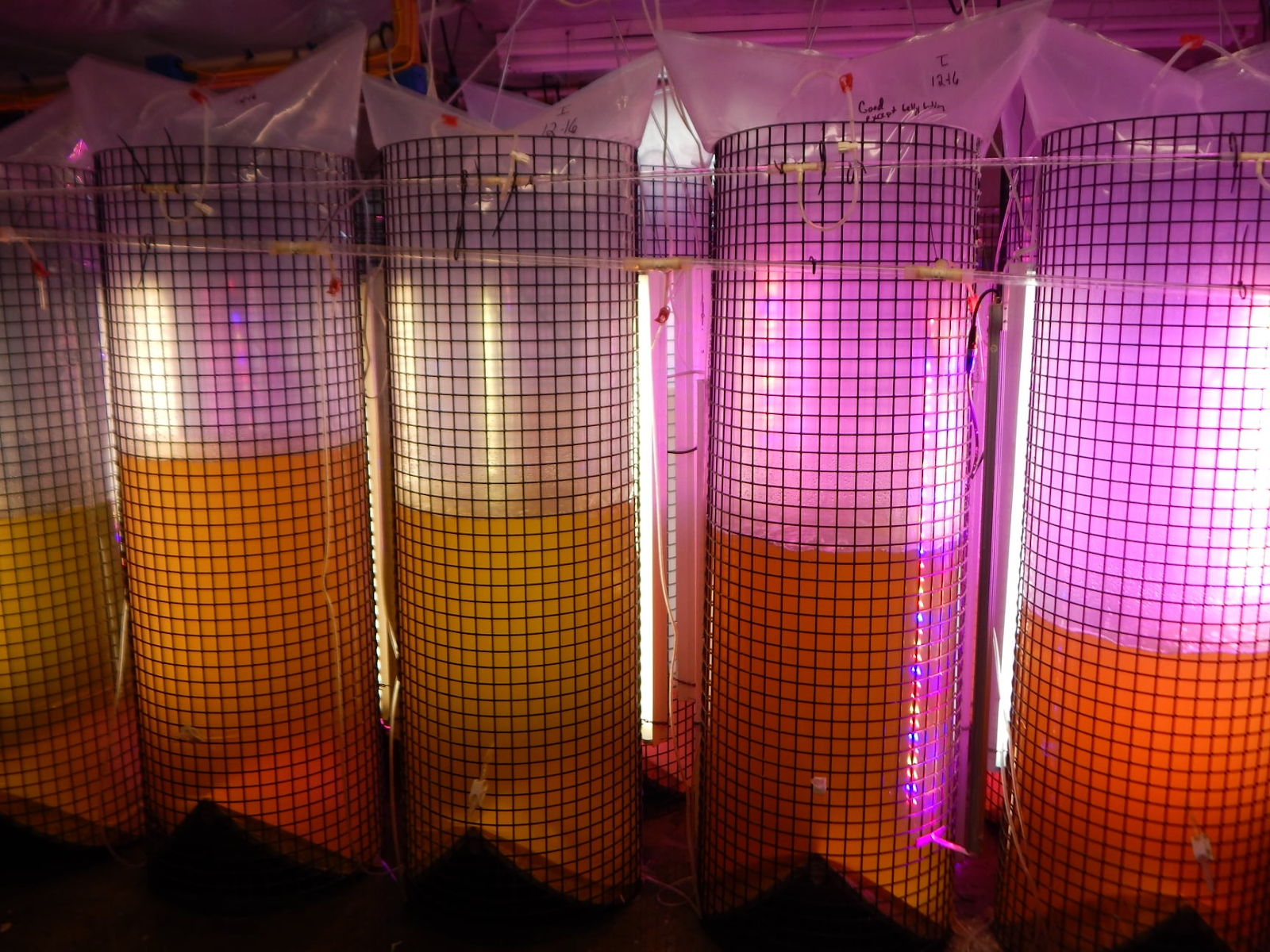
organisms from the plankton-rich first two meters of surface water.The research vessel used is outfitted with a collection drum that
accepts variable screen sizes so that potential food items including
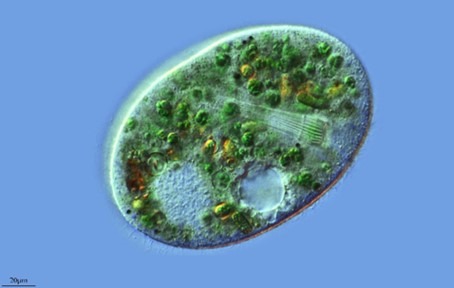
ciliates, crustaceans and the larval stages of another organisms, can be
selected by size and then presented to the larvae.The accepted food organisms must then be identified.The final step is the cultivation and enhancement of the accepted
food organisms so that their supply is reliable and their nutritional
quality can be maximized.
There are a number
of critical stages for most fish larvae during the first two weeks.The most critical stage for the larvae is the first feeding,
which takes place about three days after hatching.The research program is primarily directed at finding food items
for this stage.There is
another critical stage at about a week to a week and a half for reasons
that are not well understood, probably due to maturational changes in
the structure of the larval gut.There
is an additional early critical period during the development of the
swim bladder when the larvae have to take in a gulp of air.Commercial aquaculture projects often consider three to five
percent larval survival rates successful, although much higher success
rates are possible in some species.Success rates with Flames depend upon the experimental variables
employed.
The Flame angel
breeders are kept in harems, with one to four females per male.Currently about five harems are being maintained.They spawn almost daily in the late afternoon or early evening,
laying hundreds of eggs.The
eggs float to the surface where they are collected by surface skimming.The eggs are inspected to verify fertilization, which can range
from 100 percent to poor for unknown reasons. Hatch rates also vary,
primarily due to experimental variations in hatching conditions such as
concentration of eggs and whether or not they are moved.The experimental protocols are always subject to
"real-world" constraints of egg numbers and tank space.
The Flame Angel
larvae are slow in developing compared with those of most food fish,
requiring about two months to reach the juvenile stage.At first the larvae are transparent but after feeding for about a
week they develop chromataphores and start to look pink.At about two weeks they turn red but retain the larval rather
than the juvenile shape.There
is no hard and fast boundary between the stages but a gradual change to
the form of a miniature adult fish.At this stage the juveniles are "weaned," and gradually
shifted over to small commercial weaning pellets.This period is somewhat protracted for the Flames and they
require a relatively long period of simultaneous feeding with live foods
and pellets to keep mortality down, compared with the weaning period for
most food fish.At about
eight months they start to show sexual dimorphism and even start harem
formation.It is at about
then that they are of marketable size.
At
this point the researchers are not clear about actively moving to
exploit the commercial possibilities of breeding and marketing the young
Angels for the trade in ornamental species, although they did
intentionally select them as a potentially saleable subject for their
experimental organism and they have sold a number of them through local
retailers here in Hawaii.They
also plan to try to breed another dwarf angel, Potter's Angelfish, Centropyge
potteri, with an eye toward a possible commercial venture in the
future.
The long
developmental period of the fish and the associated expenses of rearing
and then shipping them make it uncertain that they can compete with
retail prices for wild caught fish.This is not an issue for this species alone.Aquarists should demand aquacultured fish when possible, and be
willing to pay reasonable premiums for them. Tank reared fish offer a
number of advantages to aquarists over their wild caught cousins.First and most important, there is the ethical concern over the
unintended but real negative consequences that collection of our
specimens entails, as I discussed at the beginning of this piece.You can have aquacultured fish and a clear conscience.
Maintaining
tank-reared specimens has other, practical, advantages
in addition to a having a clear aquarist conscience.These fish are already acclimated to aquarium
life, foods and feeding regimes. Perhaps more
important, at least for these Flame Angels, they have
been conditioned to living together, rather than
aggressively maintaining territories as wild fish do.This may allow aquarists to keep more than one per tank, and
even keep them in groups in larger tanks.I have been maintaining two of them in a 36
inch, 44 gallon tank with no signs of aggressivity -
on the contrary, they usually remain close together.
Unfortunately,
these researchers have no experience with marketing
and shipping for the ornamental trade.Their primary interest remains in research to discover and
develop aquaculture supplies for larval stages of food
fish, for which they have received substantial grants.Should they be successful, as their rearing
experiments with the Flames indicate, the early larval
food is a product with economic potentials far above
that for sales in the aquarium trade.In addition, their plans for commercial
ventures are focused on food fishes, especially
Amberjack, Seriola dumerili (for the lucrative
sushi trade), and Mahi mahi, Coryphaena hippurus.For the time being, the Flame Angels remain a marine
"laboratory mouse" with an aquarium future.
The
researchers are currently keeping their findings about
food sources for early larval stages secret.This is not unusual among aquaculturists who
have made breakthroughs in rearing regimens.When the Hawaiian
masked angelfish, Genicanthus personatus, was
bred in captivity and the larval masked angels were
successfully brought through the 75 or more days to
develop from hatching to metamorphosis at the Waikiki
Aquarium, the announcement
only stated, "A
breakthrough came when aquarium biologist Karen
Brittain discovered a new, living food source to
sustain the small larval angelfish" without
specifying the organism.Similarly, when the Oceanic Institute of Oahu announced that
they had succeeded in nurturing Flame and Fisher's
Angelfish larvae through metamorphosis at the hatchery
they stated, "The key to this recent success was
in culturing suitable microscopic zooplankton organism
as prey for the angelfish larvae.Conventional diets are too large for such tiny
larvae, therefore our researchers isolated plankton
directly from the local reef environment" without
specifying the prey organism.