AN
AQUARIST'S EXPERIENCES WITH A SPECIES OF ACROPORA PARASITES by GREG
HILLER
Sponsored in part by:
About
two years ago a thread1
started up on the SPS (small-polyp scleractinian) Coral Keepers
sub-forum on Reef Central.I read through the thread and suddenly felt rather ill.The thread described a species of small ‘bug’, almost like a
‘mite’ that infected genus Acropora corals and basically
sucked the life out of them.I dashed down to one of my fragment grow out tanks and sure
enough, there they were, just as described on the forum.I’d been wondering why some of the frags in my grow out tank
were growing slowly, or not at all, and had poor color.I dashed upstairs to examine corals in my main SPS display
system, no sign of them, ‘phew!!’Dodged that bullet!
Where
do they come from?
I
undoubtedly got the parasites from someone I traded Acropora
coral fragments with.I’d
always loved the idea of acquiring the next new ‘hot’ colored Acropora
that grew at light speed under normal output fluorescent bulbs.I’d been shipping and receiving Acropora from all
over the US over the past few years.Clearly, I paid dearly for not practicing 'safe trading.’Of course the parasites must originally have come from the
wild, but in the wild something must suppress their growth, or prey
on them.When browsing
pet shops I’ve noticed that it is very rare to find a wild
collected Acropora with the parasites.Over the course of numerous scuba dives trips in the Pacific
and Caribbean I also have yet to find an Acropora in the wild
infested with these parasites.
Proud sponsor of this column
What
do they infect?
In my experience
the parasites ONLY infect corals of the Acropora genus.I have had
numerous other SPS
corals in the same tank, frequently right next to infected Acropora
colonies that never became infected themselves.Some of these included Pocillipora damicornis, Stylophora,
multiple Montipora spp., Heliopora, and even the closely
related Anacropora.My experience also has been that the parasites only affect
certain Acropora species.Exact
species identifications within the Acropora genus are of course
very difficult to assign, but I’ve found that the commonly know 'Green
slimer' Acropora (sometimes called A. youngei) seems to be
immune to the parasites.Could
it be that the extra thick slime coat this Acropora secretes
somehow protects it?Some Acropora species are only moderately affected and
are likely carriers of the disease.Such colonies continue to grow well, and healthy, the owner
thinks nothing of trading the fragments of that colony with other
reefkeepers.Once in a new
tank, the parasites travel to Acropora species/variants more to
their appetite and can eventually kill such colonies.My experience has been that if left untreated, only about 20% of Acropora
species/variants are killed by the parasites, perhaps another 25% are
stunted, or loose color, maybe another 25% are carriers, and the final
30% are immune and do not become colonized.Of course in times of other tank stresses like high temperatures,
poor circulation, low calcium or alkalinity values, the additional
‘pressure’ that these parasites put on a colony might be enough to
push other colonies ‘over the cliff.’
What
does an infection look like?
The first
indication that a hobbyist has that a colony is infected with the
parasites is usually a loss of color.The colony will loose its colored tips (if it has them), and in
general turn a very pale color.Upon close inspection, even with the naked eye, the tiny
yellowish ‘bugs’ with a red spot on one end of their bodies become
apparent.The parasites can
actually move about on the colony quite quickly and easily, and this
motion can often be detected with the naked eye.One of the best places to look for the parasites is on the shaded
side of the colony, where the polyps may be more sparse, and the tissue
smoother.I estimate the
size of the parasites to be about 500 microns, or ½ of a millimeter.
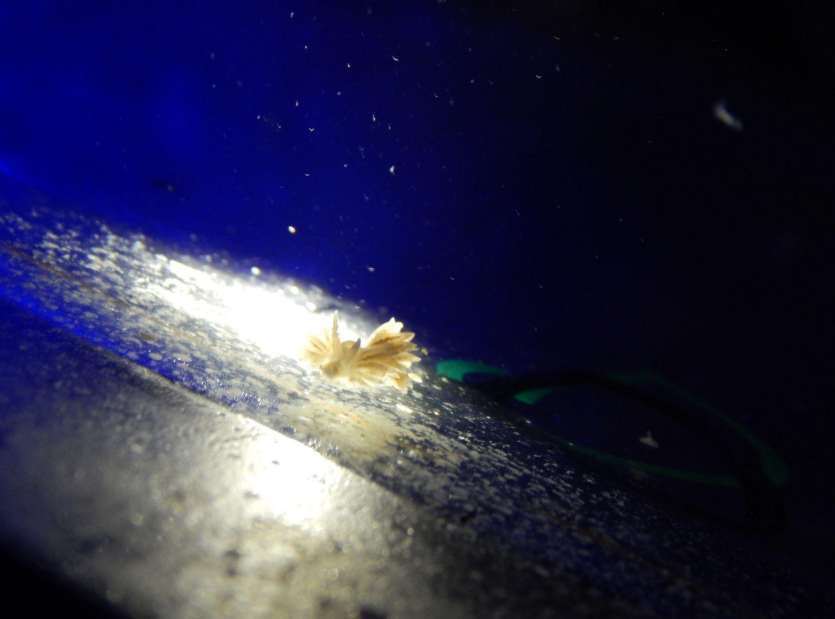
Figure 1 –
Close up photos from several angles and lighting conditions –
photos by Tracy Gray
Figure 2 – Close up
photo of the parasite on an Acropora – note size in relation to
coral polyp – photo by author
Figure 3 –
Additional close up photos – photos by author
Figures 4 and 5 – two
videos of the organisms – taken by Ramon Primicias
Good
question, and one that is not easily answered.Dr. Ronald L. Shimek described the parasites as harpacticoid
copepods probably of the genus Tegastes2,
but the parasite is not easily distinguished even under the microscope
from stenothoid amphipods which are also found on Acropora and
are not parasites.He
further commented that to his knowledge, no scientific research is being
done on these organisms to determine their effect on corals.
I
sent formalin-preserved specimens to coral researchers at the Waikiki
Aquarium in Honolulu and they were baffled.They forwarded the specimens to The Bishop Museum in Waikiki.The invertebrate zoologist at the museum, Dr. Luscius G. Eldredge
identified the organisms as micro-amphipods due to their “large
colored eyes, short antennae, and laterally-compressed, bent abdomen.”Other experts in amphipods or copepods that I attempted to
contact, either couldn’t be bothered, or were of little help.
Why
should I care?
Well,
in a nutshell, these parasites can kill some species/variants of Acropora.It may be a slow process, taking perhaps weeks or months, but
watching that Acropora colony die that grew in five years from a
one-inch fragment to a colony that eventually breaks the water’s
surface is not what I call fun.Also,
once you have acquired the parasites and word gets around, you may be
the ‘Typhoid Mary’ of your local reefkeeping community, and
certainly no one will want to be trading corals with you!
Okay,
I’ve got them and I care, how do I get rid of them (the first step in
recovery is admitting you have a problem)
The
method of eradication, if it can be accomplished will depend upon the
characteristics of the Acropora infected, the level of
infestation, and the nature of the system that the affected colony(s)
are in.
1.Mechanical
Means
If
the infestation is not too bad you can blast them off a colony with a
powerhead.This works
particularly well if you 'sneak' up on them; i.e., blast them suddenly
with a powerhead before they have a chance to ‘hunker down.’Then you must check very carefully with a magnifying glass
(or preferably a dissecting microscope) to make sure you got them all.If you blast the colony repeatedly over several days, you might
just rid the colony of all of the parasites.You might also have to pluck a few off with a tweezers.I cleared one branch of a particularly colorful Acropora
with this method, but in hindsight, if I’d had a clean piece of the Acropora
in an uninfected system I certainly wouldn't have bothered.Of course this powerhead blasting technique should only be used
in a tank or container where the now free-swimming parasites won’t
infect other colonies.It
should also be mentioned that the parasites will sometimes crawl into a
polyp and subsequently crawl out, apparently none the worse for the
wear, so a single observation of a colony after a powerhead blasting
should not be used as a 100% certainty of the successful removal of all
of the parasites.If you
have time, and enough tanks, the best test of removal would likely be
placing a colony that you know is particularly susceptible to the
parasites next to a colony you believe you have just ‘cleaned’, and
wait for several weeks or maybe even months.If the susceptible colony is clean after two months you can be
nearly certain that you have ‘cleaned’ the originally infected
colony.
2.Biological
Means
The
fish I’ve tried for control include a six-line wrasse (Pseudocheilinus
hexataenia), a blue Mandarin (Synchiropus splendidus), and an
orange-spotted filefish (Oxymonacanthus longirostris).None of these fish had any impact on the populations that I could
see. The orange-spotted
filefish is known to feed on certain SPS corals, and I had hoped it
would also consume the parasites as a side dish, but despite much time
observing the fish in a tank with the parasites I never saw the fish
consume them.Please no
flames on the keeping of an orange-spotted filefish; while it is a very
difficult fish to maintain long term, I have succeeded in the past with
this fish.Pipefish of the
genus Corythoichthys have also been recommended, but not tested,
as a possible control of the Acropora parasites 3.This genus of pipefish ‘crawls’ along the surface of corals
and rocks, pecking at various minute crustaceans and other organisms.While not the easiest fish to maintain, these pipefish4
can be successfully kept in a healthy and diverse reef system.Other aquarists have tried citron gobies (Gobiodon citrinis)
and neon gobies (Gobiosoma oceanops) without success.1
The
only species of fish that some have reported success with is the yellow
clown gobies (Gobiodon okinawae).1I’ve kept this species of goby before and while they are
beautiful and entertaining little fish, they have a somewhat annoying
habit of clearing the tissue away from sections of branching hard coral
to make a spot to lay their eggs.Fortunately,
usually once they clear a spot they don’t do much more damage. Some
hobbyists have reported that the gobies will clear the parasites from Acropora
colonies that they nest in, but will not clear the parasites from other
colonies in the tank.Unfortunately,
the gobies are not a panacea, as other hobbyists have reported zero
success with these gobies.
Some
reefkeepers have proposed that the common symbiotic Xanthiid crabs that
nearly always inhabit wild Acropora colonies and sometimes defend
these colonies from certain threats might be of some value in the
control of the Acropora parasite.1 However, others
have also had infected Acropora colonies, complete, with a
Xanthiid crab completely ignoring the parasites.I conjecture that the colonies that had the crabs and no
parasites were coincidentally a species of Acropora that happened
to not be susceptible to the parasites.
Obviously
there must, in nature, be some organism or environmental factor that
limits the numbers and destructiveness of these Acropora
parasites.Ideally in the
future on the reefkeeping forums such an organism would be well known
and a simple, quick, and easily obtained critter could be recommended.One such example of an easily obtained pest control organism
that comes to mind is the now well known peppermint shrimp’s (Lysmata
wurdermanni) control ability for Aiptasia genus anemones that
so commonly become problematic in the captive reef environment.If anyone is aware of such an organism for the Acropora
parasite control I hope they make the information widely available.
3.Chemical
Means
The one chemical means of
control that has worked for me was the coral dip called Reef Dipâmanufactured by Seachem.I used it at the maximum recommended dosage for a 15 minute
dip and it seemed to be a 100% kill with minimal effect on
the Acropora colonies that I experimented with.I performed the dip twice on two consecutive days.However, I have had variable results with this dip.The dip, even when administered several times over days or
weeks was not 100% effective for highly infected Acropora
colonies.The parasites
would often return, even when the treated colony was placed into a
new tank that was free of Acropora.Some have reported more success using this dip at many times
it’s recommended dosage level and duration of treatment.5Lugol’s strong iodine solution can be used in a similar
manner to the SeaChem dip.The
SeaChem dip appears to be iodine based, but might have other
components making it more effective than Lugol's solution alone.Lugol’s solution can be used at 10 drops per liter for a 15
minute treatment in an isolated container.Such a dip is commonly used on newly acquired hard corals to
prevent RTN (rapid tissue necrosis) outbreaks in SPS dominated
tanks.
Proud sponsor of this column
I have also experimented with Tetra Medica's Oomedâ
to remove the Acropora parasites.Oomed is a quinine based chemical preparation for treating fish
diseases that is no longer available in the US.Some have found this chemical useful for controlling the red
photosynthetic flatworm (Convolutriloba retrogemma) in reef
systems.Observing an Acropora
branch under a microscope I found that this chemical irritated the mites
at low concentrations, and killed them at high concentrations, but these
high concentrations might be too much for most Acropora.The mites clearly started to be much more active and moved about
or swam off the coral more quickly when the Oomed was used.This high activity level might help facilitate mechanical
removal.I've not tried to
treat a whole tank with the Oomed, only individual colonies have been
treated in external dips.I’ve
also tried freshwater dips, but not found this to be a good solution as
the parasites seem to be able to ‘hide’ in the slime coat of the Acropora,
and a dip of sufficient length to kill the parasites also kills the
coral.Of course this
‘killing of the patient’ is the overriding problem with all of the
mentioned treatments/eradication methods.
Proud
sponsor of this column
One
additional chemical whole tank removal technique was related to
me by a local reefkeeper.5He found that while treating his tank with Red Slime Removerâ
from Ultralife for control of a plague of green cyanobacteria a
side benefit was that the Acropora parasites also seemed
to disappear.In a
later experience he came to believe that the mere chemical
treatment with the Red Slime Removerâ
was not sufficient, but significant quantities of red or green
cyanobacteria also had to be in the tank for the chemical
treatment to also kill the Acropora parasites.
4.
The waiting game
This,
in my experience, is a 100% effective method of eradicating the
parasite from a reef system.If ALLAcropora genus corals are
removed from a tank and the tank is left 'Acropora free'
for a week, preferably two weeks, any 'clean' Acropora
colonies later added to the tank will not become infected.Unfortunately, for well-established tanks that have Acropora
encrusted all over the rock structure it may be nearly
impossible to do this.I performed this technique on two of my fragment grow out
tanks and was successful in the eradication of the parasite both
times.It was
heart-wrenching throwing out mildly infected beautiful Acropora
colonies from the tanks, but I saw no alternative after months
of external experiments.I still count my stars that while I was unaware of the
existence of the parasite in my fragment grow out tanks it did
not infect my main hard coral display tank.I was always careful only to move new Acropora
colonies or fragments into my main display tank, when I was
fairly certain there was nothing ‘strange’ going on in my
fragment tanks, and when I had not added any newly acquired
corals to the fragment grow out tanks in quite some time.
In
closing I would recommend that anyone with a reef tank with
significant number of Acropora colonies should be
particularly careful when introducing a newly acquired Acropora
specimen.At a
minimum, careful visual examination of the colony with a small
magnifying glass, and a prophylactic chemical dip are in order.Aquarists with well-established Acropora display
tanks should consider the above plus a lengthy quarantine and
careful observation in a separate system.