The
January 2003 issue of Limnology and Oceanography (48:1) has a special
section, part 2, which contains papers that deal with light in shallow
waters including ultraviolet, and how this can affect remote sensing. In
addition there are several papers that deal with coral fluorescence that
might be of interest to aquarists.
Fluorescence
in corals is a very popular topic of debate in not only hobbyist circles
but also in the scientific community. While hobbyists are more concerned
with the colors of their corals and how best to make them more colorful
(either via one or all of high light intensity, blue spectrum bulbs or
ultraviolet light) the scientific community is more concerned with the
role that these pigments play in coral physiology, and how this
fluorescence could be used for remote sensing applications of coral
reefs. Recent studies are now beginning to show that the commonly
believed functions of these pigments are not holding up under scrutiny.
The following two papers are indicative of the research being conducted.
Mazel,
C.H., Lesser, M.P.,Gorbunov,
M.Y., Barry, T.M., Farrell, J.H., Wyman, K.D. and P.G. Falkowski. 2003.
Green-fluorescent proteins in Caribbean corals. Limnology and
Oceanography 48(1):402-411.
One
of the first fluorescent proteins identified was the green fluorescent
protein (GFP) in the hydromedusa Aequorea victoria. Subsequent
studies have shown that a large number of Caribbean and Indo-Pacific
corals have fluorescent pigments that are closely related to GFP. GFP in
corals emits a spectrum that peaks at 500-518 nanometers resulting in a
strong green color. It is generally felt that fluorescence can have one
or both of the following two roles: 1) provides photoprotection under
high-light levels and 2) enhances photosynthesis in low- light
conditions by providing additional photons. This fluorescence can be
seen under normal light conditions or in some cases only becomes visible
when light with the appropriate wavelength is used. Using molecular and
biophysical approaches this study attempted to ascertain the ecological
role of this pigment in the photobiology of Caribbean corals.
Nineteen
species of stony coral were examined using a variety of techniques. In
all cases, GFP was found in varying amounts. It should be noted here
that GFP is also found in Ricordea, Palythoa, Zoanthus
and the anemones Condylactis gigantea and Phymanthus crucifer.
However, GFP levels were found not to vary much with depth. In fact,
there was no correlation at all between depth and GFP levels. Measurements
of reflectance and of the excitation spectrum for chlorophyll
fluorescence in GFP-containing corals over
a wide range of depths and GFP fluorescence indicated
no
evidence of GFP photon absorption either to enhance or reduce
photosynthetic activity. If GFP plays a role in photosynthesis by either
adding or taking away protons, then one would expect to see a
correlation with depth as one does with other protective compounds such
mycrosporine-like amino acids (MAAs) that protect against ultraviolet
light, but there does not appear to be one in the corals they examined (Montastrea
faveolata and M. caernosa). Compared to other
non-photochemical methods that corals have to reduce the effects of
excess excitation energy, the authors concluded that the photoprotection
afforded by GFP is negligible in Caribbean corals. Another pet theory of
aquarists is that ultraviolet light is involved in the production of
fluorescent pigments. In the case of GFP at least this is most likely
not the role it plays. The authors could find no evidence of an
excitation peak in the range of UV (200-400 nanometers), suggesting GFP
plays no role in UV protection. The authors, however, are quick to point
out that it is still possible that GFP may play a role in helping a
coral deal with environmental stresses such as high light, UV or
temperature levels by as yet, undiscovered mechanisms. There is
preliminary evidence that GFP levels are inversely correlated with
superoxide dismutase (SOD) protein levels in corals exposed to light and
temperature levels that produced superoxide radicals (SOD is involved in
their reduction). It is tempting to speculate on the possible reasons
for this inverse correlation.
Mazel, C. H. and
E. Fuchs. 2003. Contribution of fluorescence to the spectral signature
and perceived color of corals. Limnology and Oceanography
48(1):390-401.
I
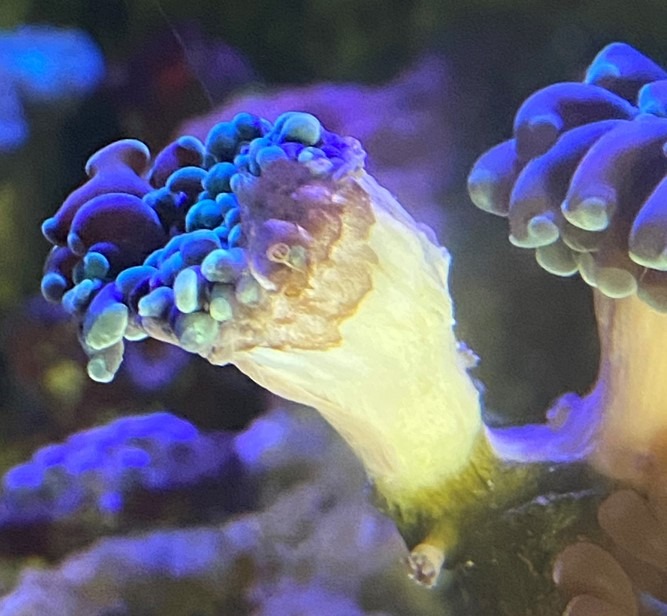
can remember diving in murky waters in Indonesia when at 90 feet I came
upon a day-glow orange Fungia. I quickly snapped a picture but
was disappointed to find that when I got my pictures back it looked
green and not the bright orange I had seen. This paper helps to describe
why this occurs. Most early studies on coral color focused on
qualitative observations of the color and quantitative measurements of
its spectral characteristics. It was noticed decades ago that in many
cases the bright, natural colors were often augmented by or due mainly
to fluorescent pigments found in the animal tissue, this was especially
noticeable with corals that appear orange or red at depth when those
colors are already absent in the downwelling light due to the filtering
characteristics of the water.
Corals
can be colorful even without fluorescent pigments. As
has been stated before (Delbeek and Sprung, The Reef
Aquarium vol. 1), corals are predominantly brown because
the zooxanthellae they contain are brown due to the fact
they absorb most other colors. Other colors can also be
found in the host tissues and are the result of
non-fluorescent pigments. What many people may not
realize is that just because a coral contains
fluorescent pigments, they may not be apparent to our
eyes. For example a coral that appears brown to our eyes
under natural ambient light may glow blue under
ultraviolet or blue light. This can be explained by
several factors such as the spectral distribution of the
ambient light and the strength of the fluorescence. The
authors used the same measurement techniques as the
previous paper to measure coral reflectance and
fluorescence and the modeling of downwelling spectral
irradiance to explore the contribution of fluorescence
to the spectral signatures of corals as a function of
variations in depth, solar zenith angle and fluorescence
efficiency.
Spectra
from several pigments were used from both Caribbean
(p486, p515 and p 575) and Indo-Pacific corals (p538 and
p583), the number refers to the wavelength emission peak
of the fluorescence produced. Four of the emission
spectra produced strongly saturated colors while the
fifth p486, was relatively unsaturated. Both p515 and
p538 produced a bright green fluorescence while p575 and
p583 produced orange to red. It is important to note
here that the emission spectrums of all these pigments
were independent of the excitation spectrum, the
emission wavelengths are averages and there can be quite
a bit of variation, and that the excitation spectrum can
vary from specimen to specimen for any given pigment. In
order from least to most efficient in fluorescence: 486
(3-5%), p575 (8-10%) and p515 (10-12%)
The
degree of fluorescence observed varies due to the
spectrum of the downwelling light, which varies with
increasing depth, and the amount of reflectance of the
coral tissue in general. Some of the fluorescent
pigments turned out to be more noticeable than others
and it became obvious that the mere presence of a
fluorescent pigment was not a guarantee that the coral
would exhibit fluorescence under ambient light
conditions. It therefore became appropriate to divide
the fluorescent response between those pigments that
exhibited “overt fluorescence” for cases where the
corals would fluoresce under ambient light, and for
those that exhibited “covert fluorescence” only when
illuminated with an appropriate light source in
darkness. It should be pointed out here that this last
form is still emitted under natural light but is simply
overwhelmed by the reflected light of the coral and as
such is not visible to the naked eye.
In general it
could be concluded that fluorescent pigments that absorbed wavelengths
that are transmitted well by water, have high fluorescent efficiency,
emit fluorescent wavelengths that are only moderately attenuated by
water, and emit at wavelengths to which the human eye is most sensitive
are able to produce the most striking fluorescent effects for human
eyes. This is especially true for p575 and p583 that emit in the orange
range of the spectrum, one that is attenuated enough by water to reduce
any competing influence from downwelling light and coral reflectance,
but not strong enough to reduce the emitted light. These corals absorb
heavily in the green range of the spectrum, which is still easily
transmitted through water. The greenish pigment p515 is the most
widespread in corals but it emits in a region of the spectrum that is
not heavily attenuated by seawater so would argue that it would be
overwhelmed by ambient light, however, the high efficiency of this
pigment and the sensitivity of the human eye to green combine to give a
high level of visible fluorescence. In contrast to these pigments, the
blue-green p486 is not readily observed in nature. This is due to
several factors. First this portion of the spectrum is readily
transmitted by water so the degree of coral reflectance is high.
Combined with the low efficiency and % color saturation of p486, the
reflectance is great enough to overwhelm the fluorescence emitted by
p486 under natural ambient lighting conditions. As a result green and
orange emissions are the ones most commonly seen by divers.
Finally
the mere presence of fluorescent pigments or any color
for that matter should not be used as a sign that
these pigments have a function. There is certainly a
reason for the color, but there may be some other
function of the pigment, and the color is merely a
neutral by-product. No one knows yet what the
functions of these pigments are, they may merely be due to
genetic differences. The authors identify several
areas where further research may lead to some idea of
the functions of coral pigments, in particular the
fluorescent ones: ecological studies that examine the
relationship between habitat and color morph
distribution, controlled studies to determine what
factors control the expression of color in corals
(probably the area of most interest to aquarists!),
analysis of coral emission spectra and its
relationship to vision in fishes, and molecular
studies of the fluorescent pigments to determine a
relationship between structure and function (this will also help to ascertain the elemental composition of these pigments which may provide clues as to what elements might be necessary to replenish in closed systems to help maintain or intensify these colors e.g. manganese for anti-oxidants as has been speculated by Julian Sprung)
. The
authors feel that once the function of pigments and
how their expression is controlled, is understood,
coral color may prove to a good indicator of
environmental conditions on a reef.
For
aquarists this paper helps to explain why corals may
appear certain colors under certain lamps. Obviously
those lamps in the blue end of the spectrum such as
actinic 03s provide light of such a narrow spectrum
that there is no light in their spectrum for
fluorescence in the green, orange and red ranges of
the spectrum to compete against and helps to explain
why corals under these conditions exhibit the greatest
fluorescence intensity. Also high Kelvin metal halide lamps have a larger portion of blue in their spectrum that further enhances the fluorescent effect of some pigments."
It might also be interesting
to add a little green to some lamp combinations in
order to stimulate those corals that might contain
orange fluorescent pigments such as Scolymia
and Cynarina.
What
is still not clear is why corals develop more color
under some lamps as opposed to other lamps? Several of
us have observed that corals will change color when
lights are changed from one spectrum type to another,
or from one wattage to another. If coral pigments
offer no protection against ultraviolet light or high
intensity as these two papers seem to suggest, then is
it that the pigments are merely a by-product of some
other reaction that is being driven by light intensity
or the presence of ultraviolet light? I think this is
an area that aquarists should be working with
scientists on … I think the results would be very
useful to both fields!
And
for me … I finally have my answer… when I saw that day-glow orange coral it
was emitting fluorescence in a wavelength that had
been greatly reduced by the intervening water above,
but when I took the picture with my flash the added
colors in the flash overwhelmed the orange
fluorescence of the coral … so next time … no
flash.
Proud
sponsor of this column
Simones,
F., Riberio, F. and D.A. Jones. 2002. Feeding early stages of the fire
shrimp, Lysmata debelius (Caridea, Hippolytidae). Aquaculture
International 10(5):349-360.
One
of the problems encountered when attempting to rear ornamental shrimp is
high mortality during the early stages of development. In this paper the
authors assert that the reason for this high mortality is the belief
that larvae do not need feeding until their egg yolk is completely consumed
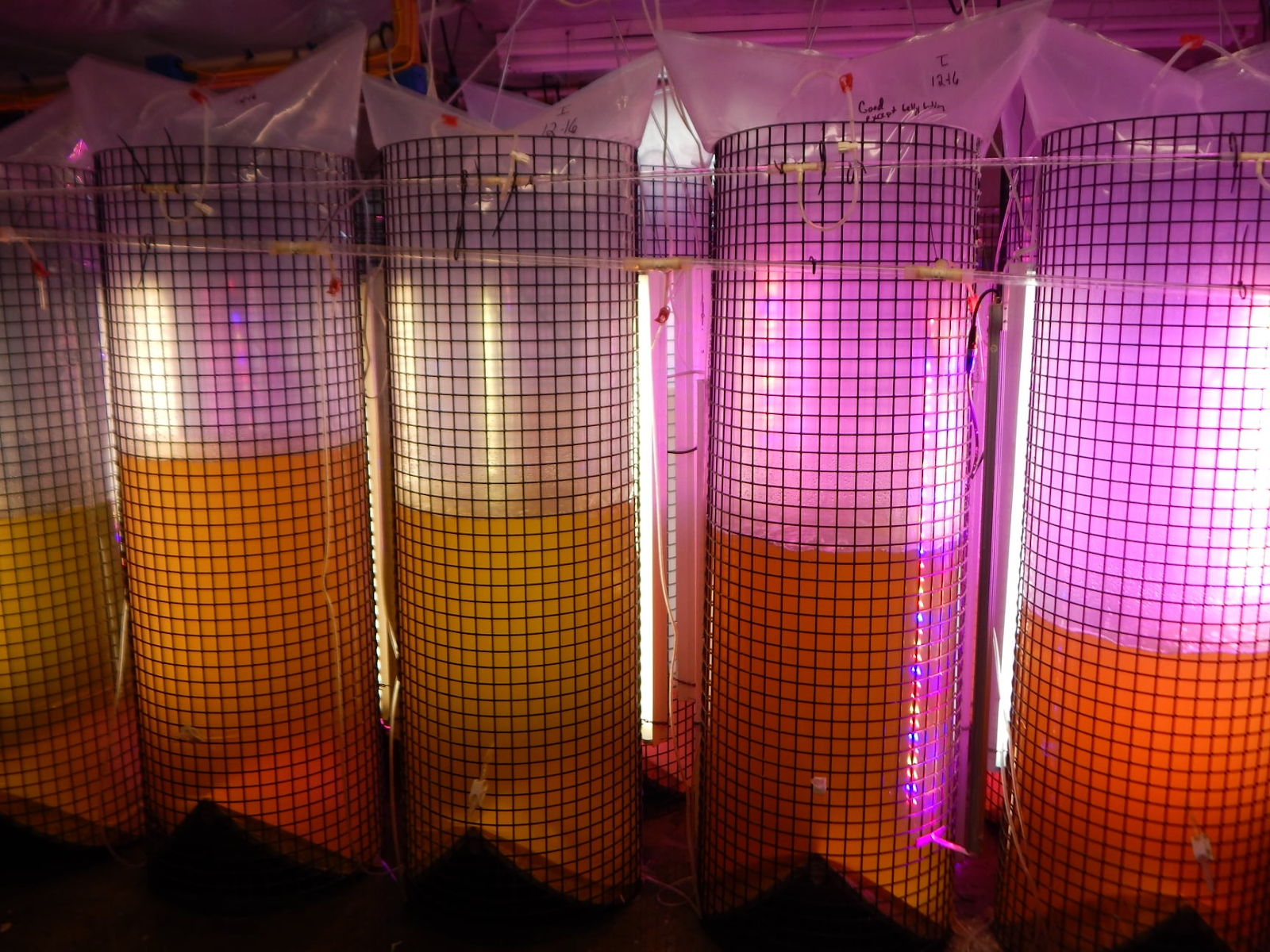
after 24 hours. In experiments with the commercial rearing of the marine
ornamental shrimp Lysmata debelius they should that high larval
mortality during early stages of larval collection could be reduced if
they were fed immediately after hatching and not waiting 24 hours. Their
work demonstrated that captive newly hatched L. debelius larvae
ingest microalgae within minutes after hatching. When fed solely with Artemia
nauplii, they had acceptable survival rates with stocking densities at
or below 50 larval per liter; but when nauplii are combined with
microalgae, survival was further improved to zoea stage 2 as initial
mortality was reduced, and higher stocking densities were supported (up
to 75 larvae per liter). The microalgae used were Rhinomonas
reticulata, Skeletonema costata and Tetraselmis chuii.
Higher survival through metamorphosis to zoea 2 was always observed for
groups fed combinations of microalgae including Tetraselmis chuii.
Their recommendation is that larvae should be fed microalgae within 2
to3 hours of hatching.
Recent
Publications
Anemones
Mitchell,
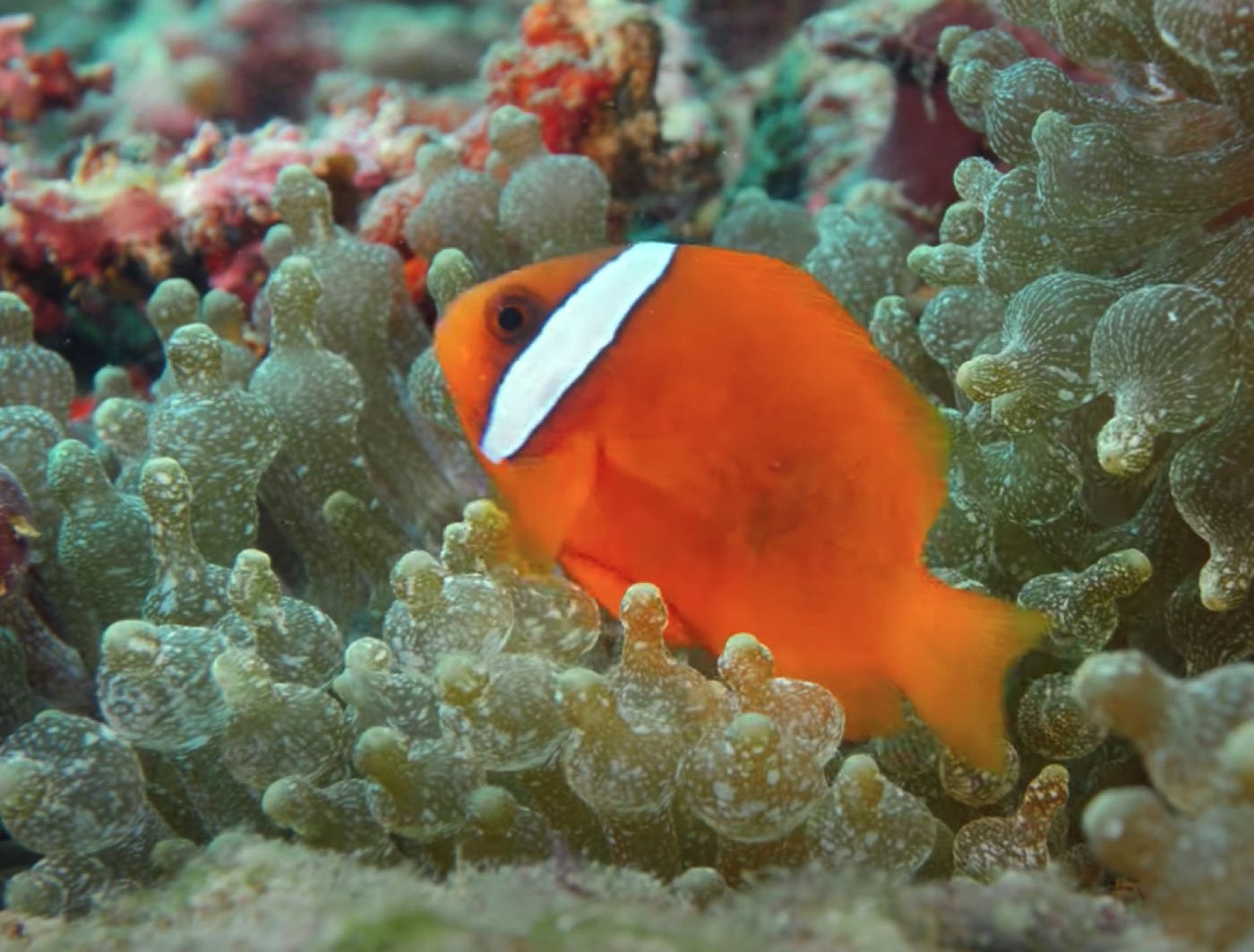
J.S. 2003. Mobility of Stichodactyla gigantea sea anemones and
implications for resident false anemonefish, Amphiprion ocellaris.
Environmental Biology of Fishes 66(1):85-90.
Kirk,
J.T.O. 2003. The vertical attenuation of irradiance as a function of the
optical properties of water. Limnology and Oceanography 48(1):9-17.
Corals
Al
Horani, F.A., Al Moghrabi, S.M. and D. deBeer. 2003. The mechanism of
calcification and its relationship to photosynthesis and respiration in
the scleractinian coral Galaxea fasciularis. Marine Biology
142(3):419-426.
Al
Horani, F.A., Al Moghrabi, S.M. and D. deBeer. 2003. Microsensor study
of photosynthesis and calcification in the scleractinian coral, Galaxea
fasciularis: active internal carbon cycle. Journal of
Experimental Marine Biology and Ecology 288(1):1-16.
Echeverria,
C.A. 2003. Black corals (Cnidaria: Anthozoa: Antipatharia): first
records and a new species form the Brazilian coast. Revista de
Biologia Tropical 59(3-4):1067-1079.
Goffredo,
S. and N.E. Chadwick-Furman. 2003. Comparative demography of mushroom
corals (Scleractinia: Fungiidae) and Eilat, Red Sea. Marine Biology
142(3):411-418.
Goulet
T.L. and M.A. Coffroth. 2003.Stability of an octocoral-algal symbiosis
over time and space. Marine Ecology Progress Series Vol. 250
Lirman, D.,
Orlando, B., Macia, S., Manzello, D., Kaufman, L., Biber, P. and T.
Jones. 2003. Coral communities of Biscayne Bay, Florida and adjacent
offshore areas: diversity abundance, distribution and environmental
correlates. Aquatic Conservation of Marine and Freshwater Ecosystems
13(2):121-136.
Mate, J.L.. 2003.
Ecological, genetic and morphological differences among the three Pavona
(Cnidaria:Anthozoa) species from the Pacific coast of Panama. Marine
Biology 142(3):426-440.
Philipp,
E and K. Fabricius. 2003. Photophysiological stress in scleractinian
corals in response to short-term sedimentation. Journal of
Experimental Marine Biology and Ecology 287:57-78.
Stake,
J.L. and P.W. Sammarco. 2003. Effects of pressure on swimming behavior
in planulae of the coral Porites asteroides (Cnidaria,
Scleractinia). Journal of Experimental Marine
Biology and Ecology 288(1):181-203.
Coral Diseases
Croquer,
A., Villamizar, E. and N. Noriga. 2002. Environmental factors affecting
tissue regeneration of the reef-building coral Montastrea annularis
(Faviidae) at Los Roques National Park, Venezuela. Revista de
Biologia Tropical 59(3-4):1055-1066.
Frias-Lopez,
J., Bonheyo, G.T., Jin, Q.S. and B.W. Forke. 2003. Cyanobacteria
associated with black band disease in Caribbean and Indo-Pacific reefs. Applied
and Environmental Microbiology 69(4):2409-?.
Filtration
Barak,
Y., Cytryn, E., Gelfand, I., Krom, M. and J. van Rijn. 2003. Phosphorus
removal in a marine prototype recirculating aquaculture system. Aquaculture
220(1-5):313-326.
Fish Behavior
Cheney,
K.L. and I.M. Cote. 2003. Habitat choice in adult longfin damselfish:
territory characteristics and relocation times. Journal of
Experimental Marine Biology and Ecology 287:1-12.
Light
Kirk, J.T.O. 2003. The vertical attenuation of irradiance as a function of the optical properties of water.
Limnology and Oceanography 48(1):9-17.
Mariculture
Asoh,
K. 2003. Reproductive parameters of female Hawaiian damselfish Dascyllus
albisella with comparison to other tropical and subtropical
damselfishes. Marine Biology, DOI 10.1007/s00227-003-1108-6 Online
publication: May 28, 2003
Calado,
R., Narciso, L, Marcis, J., Rhyne, A.L. and J. Lin. 2003. A rearing
system for the culture of ornamental decapod crustacean larvae. Aquaculture
218:329-339.
Clarke,
P.J., Kamatsu, T., Bell, J.D., Lasi, F., Oengpepa, C.P. and J. Legata.
2003. Combined culture of Trochus niloticus and giant clams (Tridacnidae):
benefits for restocking and farming. Aquaculture 215:123-144.
Job,
S.D., Do, H.H., Meewig, J.J. and H.J. Hall. 2002. Culturing the oceanic
seahorse, Hippocampus kuda. Aquaculture 214:333-341.
Woods,
C.M.C. 2003. Growth and survival of juvenile seahorse, Hippocampus
abdominalis reared on live, frozen and artificial foods. Aquaculture
220(1-5):287-298.
Woods,
C.M.C. 2003. Effects of varying Artemia enrichment on growth and
survival of juvenile seahorses, Hippocampus abdominalis. Aquaculture
220(1-5):537-548.
Woods,
C.M.C. 2003. Effects of stocking density and gender segregation in the
seahorse Hippocampus abdominalis. Aquaculture 218:167-176.