I recently saw
someone on one of the message boards ask if clownfish will
accept a tube anemone as a host. The answer was correctly
no, but the person went on to explain that "instead of providing
shelter and protection for the clownfish, the tube anemones
would immediately kill and eat them!" I see this sort of
information repeated in many places, and I wanted to write
an article that outlined what is known about the biology
of these animals to dispel some of the erroneous information
that has been propagated about them in the hobby.
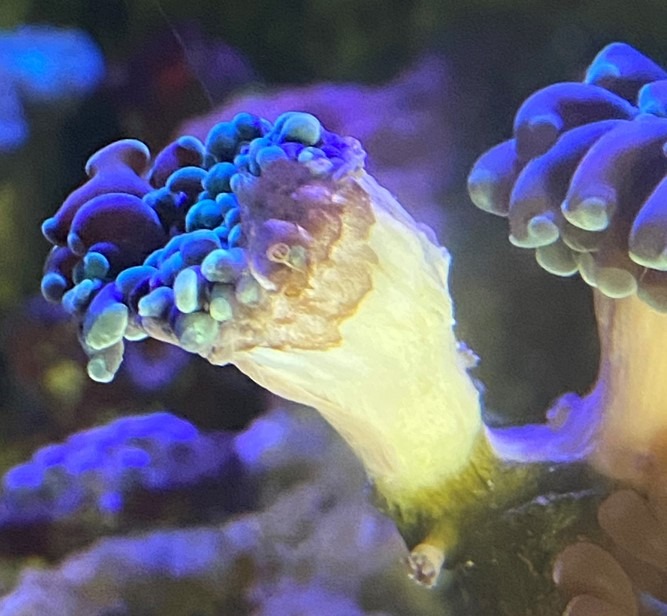
The
two whorls of tentacles are particularly obvious in
this stunning animal with green labial tentacles and
reddish feeding tentacles. Tube anemones such as this
one are generally nocturnal, and often show off their
stunning florescent colors under actinic lighting
in the aquarium.
Caption
by Robert Toonen and
Photos
by Julian Sprung and Larry Jackson
I have only
seen a couple of books that cover these animals in any detail,
and in general they warn of the long and extremely poisonous
tentacles of these animals that are capable of killing their
tankmates. The fact of the matter is that many popular anemones
in the hobby are much more dangerous to the animals in our
tanks than are tube anemones. For whatever reason people
tend to be better informed and prepared for the potential
dangers of clownfish-hosting anemones, and don't consider
them a threat to our tanks. However, a large carpet anemone
is far more likely to consume fish (other than the clownfish
living within them) and invertebrate tank mates than is
a tube anemone. In fact, Jim Fatherree had an article entitled
"Killer Carpet" at one point in which he chronicled roughly
$300 worth of tankmates that his Stichodactyla haddoni
consumed over the previous year.
Proud
sponsor of this column
In contrast,
tube anemones are generally filter feeders that require
regular feedings of live or frozen small foods, and an emphasis
should be placed on small feedings made as frequently as
time will allow. Minimally, feeding several times per week
with some krill or shrimp pellets seems to suffice. Surprisingly,
even articles or book sections that correctly describe these
animals as filter feeders often follow that with a strong
warning about these animals being notorious fish killers.
I am not sure where the fish-killer reputation for tube
anemones originated, but I don't see much justification
for it - either in the biology of the animals, or the ones
that I have kept in my aquaria.
The response
I read on the message board is not really any different
than that I see other places, however, and I'm sure that
the person was simply trying to be helpful and repeating
the information provided by their favorite reef aquarium
text book. Unfortunately, the answers provided by most of
these texts are simply not accurate - the chances of a tube
anemone eating a healthy fish are actually much lower
than any of the clownfish hosting anemones accomplishing
the same feat. Despite that however, every article about
tube anemones usually includes a warning to the effect of
"in view of the risk they pose to other animals, think carefully
before introducing them to a well populated aquarium" (Haywood
& Wells 1989). In contrast, we rarely see a warning
about Stichodactyla or Cryptodendrum, which
are two of the most voracious and powerful anemones available
in the hobby, being placed into a populated reef aquarium.
In fact, to use the same text as an example, Haywood &
Wells (1989) say that carpet anemones are "one of the few
in the hobby that can sting man…In view of this stinging
potential, be very careful when servicing the aquarium"
- meanwhile no mention of potential risk to tank mates.
So where exactly
did the idea arise that tube anemones were such dangerous
animals to house in an aquarium? What is the basis for this
warning? I simply can't answer that question. As far as
I can tell someone at sometime in our distant reefkeeping
past saw one consume a fish and decided that these anemones
were deadly fish killers, and every text and column written
since that time has repeated that misinformation as fact.
I want to discuss these animals in some detail and pose
the question: why is it that the tube anemone is always
met with such caution while most species of anemone that
are true specialist fish predators are not?
As I said, I
simply don't know. But in this article I would like to share
a variety of factoids about tube anemones to try to dispel
some of the myth-information in the hobby about these fascinating
animals. First off, you may have noticed that I keep referring
to them as "animals" rather than "anemones" unless I specifically
say "tube anemone" somewhere above. The reason for this
is that despite their appearance, these animals are not
anemones at all, and are in fact most closely related to
the black corals (of jewelry fame). It is true that they
superficially resemble anemones, but the internal differences
are so great that they are placed in a different subclass
(the Ceriantipatharia) from the true anemones (Brusca &
Brucsa 2002). Just to give you an idea of how different
being in separate subclasses makes them, true sea anemones,
scleractinian (hard) corals, zoanthids and corallimorphs
(mushrooms) are all grouped into the same subclass while
these animals are not!
Biology
of tube anemones (the Ceriantharia)
So why are the
cerianthids (the scientific name for tube anemones)
not anemones? Aside from some internal structural differences
that no one here probably cares about, there are a couple
major differences between tube anemones and true anemones
that are easy to see. First, they are the only "anemone-like"
animal with two distinct whorls of tentacles on the oral
disc - they have a batch of short "labial" tentacles which
surround the mouth and then a ring of very long tentacles
which encompass the outer edge of the oral disk. These long
tentacles are used primarily in prey capture and defense,
while the shorter labial tentacles are used primarily for
prey manipulation and ingestion. In many species the tentacles
can be bioluminescent, which is thought to be a visual "startle"
defense against fishes that may attack the long feeding
tentacles of the animal during their nocturnal expansion.
Although some species are seen exposed during the day (and
more so at depth), in general the species from shallow tropical
waters are very stubborn in avoiding light, and rarely come
out during daylight hours - even at night, the animals will
retract as soon as the edge of a dive light beam passes
across them. Their primary predators are not fish, however,
but dendronotid nudibranchs which have a sterotypic feeding
behavior to latch onto and ingest the feeding tentacles
of these animals (e.g., Shaw 1991). These slugs can even
be "sucked" into the tube of the "anemone" when it withdraws,
but it doesn't seem fatal to either animal - the slugs can
crawl back out of the tube when they have finished their
meal, and individual tube anemones have been followed for
up to 10 years in areas where they are regularly preyed
upon by these nudibranchs.
Tube
anemones are distinguished from true anemones by
their two distinct whorls of tentacles on the oral
disk. Here, the short labial tentacles which surround
the mouth are in turn surrounded by a ring of partially
curled, long feeding tentacles which cover the outer
edge of the oral disk.
Caption
by Robert Toonen and
Photos
by Julian Sprung and Larry Jackson
The
fully expanded feeding tentacles of a tube anemone
such as this can form a foot diameter sphere around
the end of the tube. Because the animals are active
primarily at night, many aquarists place the tube
without consideration for the length of the tentacles
when extended. Failing to consider how far they
can reach with their tentacles when expanded can
lead to placing them within easy reach of delicate
tank-mates.
Caption
by Robert Toonen and
Photos
by Julian Sprung and Larry Jackson
A second key
difference between the cerianthids and true anemones is
that cerianthids lack the pedal disk and all associated
musculature as well as lacking any sphincter muscles - this
may sound minor to you, but it means that unlike true anemones,
they cannot attach their base to the substrate on which
they live. Anyone who has kept a true anemone knows that
a happy and healthy animal will be strongly attached to
something in the aquarium at all times. Rather than a pedal
disk (which true anemones use to hold onto the substrate),
cerianthids end in a blunt point (sometimes called the foot)
in which a small hole (which allows water to escape the
inflated animal during retraction into the tube).
More importantly,
however, although cerianthids can withdraw into their tube,
unlike true anemones they cannot contract the oral disk
or withdraw their tentacles (Brusca & Brucsa 2002).
That is a pretty major difference. If you've ever seen a
true anemone feed, you've seen it contract the oral disk
to bring it's tentacles closer to the mouth, and when disturbed
the tentacles of true anemones are retracted, the oral disk
is contracted and a sphincter muscle closes the top of the
animal into a ball to protect itself. Cerianthids are unable
to do this, and can only retract into their tube to try
to protect themselves.
The tube in
which these animals live consists of a material almost akin
to fiberglass, which is formed by the discharge of special
cnidae (the stinging cells of all cnidarians, with nematocysts
being the most common kind) called ptychocysts which true
anemones do not possess and are also found in only the tube
anemones. Depending on the species (there are about 25 world-wide),
these tubes can be quite elaborate and some measure >2m
in length below the sediment surface! Although there are
not many species in this group, it is virtually impossible
to identify the species of a tube anemone without killing
them and examining some internal structures.
Lastly I want
to briefly discuss reproduction within this group, but any
such discussion is hampered by the fact that there has been
precious little research done on this subject. The species
that have been studied are protandric hermaphrodites,
meaning that small or young individuals are males, and the
animal switches to being a female at some point in their
lives (possibly triggered by some size or age threshold).
Sexual reproduction apparently occurs by the release of
gametes into the water column. There are several reports
of a tiny tube anemone being found within the body cavity
of an adult, but it is unclear whether this is evidence
for internal brooding or an aberrant developmental pathway.
Likewise, there is some evidence that these animals are
capable of reproducing asexually, but to date there is no
evidence that this has occurred in an aquarium. Regardless
of the exact method of reproduction, the chances that your
tube anemone will reproduce in captivity are very slim,
indeed.
Proud
sponsor of this column
Dangerous
Fish Killers?
OK, that's all
interesting, but it does nothing to address the question
of whether or not these animals are likely to eat fish in
an aquarium. The fact is that there are simply no
detailed studies of the natural diet of the animals sold
in the aquarium trade. So the simple answer is that we don't
really know exactly what they eat. However, there are some
studies that examine the distribution and abundance of these
animals in the wild (e.g., Shepard et al. 1986, Langton
& Robinson 1990, Chang et al. 1992, Holohan et al. 1998).
These studies link cerianthids occurrence to high densities
of plankton in the water, not to any fish prey. At least
one deep-water species appears not to feed at all, but rather
to live entirely off symbiotic bacteria in their gut or
tube (Jensen 1992). A survey by the National Marine Fisheries
Service found that densities of these animals was actually
highest in association with polluted waters in which there
was significant enrichment and/or resuspension of benthic
infauna (Chang et al. 1992). Another study showed that nutrient
enrichment in aquaria (resulting in dense phytoplankton)
blooms led to significant population increases of Cerianthiopsis
americanus (Widbom & Frithsen 1995). The authors
attributed the growth of these tube anemones to feeding
on detritus and dead phytoplankton 'raining down' onto them
rather than directly on the phytoplankton themselves. These
types of studies suggest that cerianthid anemones are plankton
or even detritus feeders in nature, which is quite a stretch
from what we should expect of an animal that is supposed
to be such an efficient fish killer in an aquarium.
Unfortunately,
there are simply no detailed studies of the natural diet
for any of the tube anemones sold in the hobby. Without
such studies, it is difficult to answer exactly what they
eat in the wild. The few detailed studies of natural feeding
preferences that have been done have concentrated on temperate
rather than tropical species. However, none of the tube
anemones studied so far appear to feed large mobile prey;
some are non-feeding and live entirely off the symbiotic
bacteria in their gut or tube, some feed on small zooplankton,
and some appear to feed primarily on detritus. In the species
studied in most detail, the guts were filled almost entirely
with harpacticoid and calanoid copepods (Eleftheriou &
Basford 1983, Holohan et al. 1998). Regardless of the specific
dietary preferences of the animals, there are simply no
studies done (whether on the associations with plankton
abundances or the feeding preferences) to date that support
the idea that these animals are highly toxic fish killers.
In fact, young Acadian redfish (Sebastes fasciatus)
appear to use dense patches of tube anemones as juvenile
habitat and are found primarily among the tube anemones
rather than the surrounding areas (Auster et al. 2003)!
The fact remains
that all of the clownfish hosting anemones and even some
species of corallimorpharians (particularly the Elephant
Ear Mushroom, Amplexidiscus enestrafer) are much
more effective predators on fish than are tube anemones.
Regardless of this fact, however, the mere mention of "tube
anemone" continually elicits a strong warning among hobbyists
to avoid them. If we consider the relative risk of adding
a tube anemone or an Elephant Ear Mushroom into our tanks,
there seems to be little reason for such dire warnings (and
I don't think I've ever seen anyone warned against adding
a corallimorph of any sort to their tank on the message
boards).
The sting
and toxins of tube anemones
The "extremely
poisonous tentacles" description seems especially unwarranted,
in fact, because there are now a couple of studies on the
stinging cells of tube anemones in comparison to other species.
One study examined the toxins present within the stinging
cells of Aiptasia and compared those to the tube
anemone Pachycerianthus torreyi; the authors found
that the toxin of Aiptasia was much more potent and
complex than that of the tube anemone (Phelan & Blanquet
1985). Another study examined the toxic effects of 11 species
of anemone-like animals - true anemones, mushroom polyps
and tube anemones - to compare the toxicity and effectiveness
of the stinging cells of these animals (Cline & Wolowyk
1997). The researchers found that the toxins of all species
tested except for those from the tube anemonePachycerianthus
fimbratus had potent effect on a variety of test vertebrates.
Cline & Wolowyk (1997) were able to show that the nematocyst
toxin of these animals varied in strength relative to the
approximate size and activity level of their preferred prey.
Thus, the specialist fish predator anemones Urticina
lofotensis and U. piscivora had the strongest
toxin of any species tested, and the toxicity declined through
the list of true anemones and corallimorpharian (mushroom)
corals, with the tube anemone being the least toxic of the
entire group. In fact, the toxins of the specialist fish
predators did not seem to be specific to just fish - tests
using guinea pig, rat and dog cell cultures all resulted
in massive cell death from the addition of tiny amounts
of their toxin. In stark contrast to those results, the
sting of the tube anemone P. fimbratus were not found
to be lethal to any species in any test these researchers
conducted (Cline & Wolowyk 1997). In fact, fish in this
experiment showed no significant effect from the sting of
the tube anemone! Hmm, that doesn't sound like a species
that warrants a strong warning to me...
Does that mean
that tube anemones are completely harmless cannot possibly
sting or consume a fish or other tank inhabitant? Of course
not! What this research does show, however, is that it is
much less likely for a tube anemone to harm tank-mates than
any of the true anemones to do the same. In other words,
contrary to the aquarium lore, the sting and toxins of tube
anemones are among the weakest of any anemone-like
animal, not the strongest. In fact, even Aiptasia
pack much more punch in their sting than do cerianthids.
We take some precautions when we add a large anemone to
the tank to prevent the sting from causing problems, and
you should take similar precautions with a tube anemone.
However, the chances of the tube anemone causing a problem
for tank-mates should be much lower than the risk of adding
a carpet or sebae anemone to the same tank….
I have kept
a number of cerianthids in my tanks over the years, and
although they have been with a variety of fish all along,
I have seen no evidence that they have ever caught anything
large in my tank. I wish I could say the same thing about
my carpet anemone, which has caught several expensive fish
and invertebrate tank-mates over the years! As I said above
(and want to re-emphasize to make sure this article is not
taken as these animals are completely harmless) it is always
possible that a tube anemone may capture a small fish in
an aquarium, and I'm sure that the story of the 'dangerous
fish killing tube anemone' had to start from something untoward
happening at some point. However, the point that I am trying
to make here is that by all accounts these animals are far
less dangerous to fish and invertebrate tank-mates than
either true anemones or even some species of corallimorpharian
'mushrooms'. Given that, the fact that these animals strike
fear into the hearts of reefkeepers appears to be more a
result of aquarium urban legend than fact. Especially given
that no such response is seen when discussing other species
that are potentially much more dangerous.
Aquarium
care
So, now that
we've looked at the facts and can say that tube anemones
are less likely to be a threat to your fish than many other
animals that you may already have in your tank, let's talk
about what a tube anemone needs to thrive in captivity.
Tube anemones can be an interesting and very attractive
addition to a reef tank if the proper conditions exist.
However, that last part 'if proper conditions exist' is
critical, and more often than not, the conditions preferred
by tube anemones are not those maintained in our home aquaria.
This colorful animal would be a gorgeous
addition to any tank with sufficient space and the
proper conditions to house a tube anemone.
Caption
by Robert Toonen and
Photos
by Julian Sprung and Larry Jackson
First, they
are called tube anemones for a reason - they should have
a well-developed tube when you purchase them (essentially
it looks like fiberglass because it is woven of the threads
of special stinging cells as explained above). They can
rebuild their tube, but it is stressful and energetically
costly, and you can be assured that they will be stressed
enough when being moved to a new tank and forced to develop
a new burrow, so it is always advisable to aim for one with
a good tube to start with. Animals that lack a tube when
you buy them have lost it for a reason. As I explained above,
these animals cannot retract into a protective ball like
true anemones can, and therefore the tube is the only source
of protection that they have. Given that, they do not leave
their tubes willingly, and an animal without a tube is a
good indication that is has been seriously mistreated somewhere
during collection and/or transport.
Second, these
animals live with their tubes buried deeply in fine sands
and muds. If you have a bare-bottom tank, or one with either
a thin bed or coarse (rice-grain size or greater) gravel,
these animals will not be able to find a spot that suits
them and will most likely perish in short order in your
aquarium. In the wild, the burrows of large animals can
extend a couple of meters, so a sandbed that is only a couple
of inches deep is just not going to cut it for these animals.
In cases where I am worried about the depth of the sandbed
for a tube anemone, I make an artificial burrow for them.
Simply cut a section of PVC pipe into which you can stick
the animal's tube and fill the pipe around the tube with
sand. If your tank is anything like mine, the PVC is completely
covered in coralline algae in no time, and won't be an eye-sore
within a month or so. If you're really worried about the
look of the PVC pipe in your tank, you can pre-coat it by
sticking a section of PVC into the back of your tank until
it is covered before adding the animal to your aquarium.
Regardless of how you choose to do it, the animal will be
much happier in the pipe and will probably survive longer
than if you try to lay it somewhere inappropriate in your
tank. I usually use a tube that is at least as long as the
tube anemone itself, preferably closer to 1.5 times as long
and as wide as the animal. I then hot-glue a solid base
to the bottom of the pipe (a plastic yogurt or coffee lid
works pretty well); this will prevent the sand from pouring
out around the animal if the tube is disturbed. The animal
(still within its tube, of course) is then slid into the
pipe until about 4/5 of the body length is within the PVC.
Carefully pour sugar-fine or smaller sand (preferably from
an established aquarium) around the animal to support the
tube until the PVC pipe is filled to the top. At that point,
the animal will be securely housed within a deep sand burrow,
and you can place the PVC pipe into the exact spot that
you want the tube anemone displayed. Another major consideration
is that some species can expand to form a 30cm-or-so sphere
of feeding tentacles from the end of the tube (obviously
a large portion of a small tank could be covered by the
reach of 1ft long tentacles!). Even if your animal is small
now, it will hopefully grow, and you need to have the space
available to allow it to expand safely (both for the tube
anemone and its tank-mates), so you'll want to make sure
it is at least a couple inches away from pump intakes and
the like when fully expanded.
Proud
sponsor of this column
The third bit
of information that you need is that the vast majority of
these species are nocturnal - that means that you will likely
only see the animal occasionally during the day. Fortunately
some individuals do appear periodically during the day or
lose their nocturnal habit in captivity, but you shouldn't
expect to see a new tube anemone very often during the day.
If they are happy and healthy, they should be primarily
coming out to feed after the lights are out. That means
that you have to put in an extra effort to check on them
during the evenings and make sure that they are fed at this
time as well. This can be rewarding in some cases because
many of these animals are capable of bioluminescence and
can light up if disturbed at night. Finally, because they
are nocturnal, they are obviously not photosynthetic,
so they do not care about the lighting in your tank. Given
that, they will also prefer an area that is shaded from
direct light and they do not tend to thrive in areas of
intense flow.
Without any
symbionts, these animals obviously need to be fed regularly
to survive. As I mentioned above, all available evidence
suggests that the tube anemones found in the hobby probably
feed on small zooplankton and organic detritus. If you have
a well-developed deep sandbed with lots of critters and/or
a refugium design for your tank (especially if you develop
a good culture of amphipods, copepods and mysids) they should
do fine with this constant food source. Periodic additions
(say twice a week or so) of krill, frozen or live brine
shrimp or chopped fish or shrimp just to make sure that
the animal is well fed will ensure your animal stays healthy.
However, if you don't have a dense population of various
'pods in your tank to provide a nocturnal food source for
your tube anemone, then you're going to need to feed it
well if you expect it to survive. Given the way that these
animals eat in the wild, frequent small feedings are definitely
preferable to occasional large ones. If you lack a dense
plankton population in your tank, or if the animal is first
becoming established in the tank, krill soaked in Selcon
should be offered nightly to keep the animal healthy. However,
feeding turns out to be easier said than done for many animals
because when their tentacles are touched by anything large,
they immediately pull back into their tube. That makes it
pretty hard to drop a piece of shrimp or fish on them, so
make sure that the portions you offer are small and frequent.
Although it may take a serious effort on your part to ensure
that they are well-fed and healthy, by floating a few enriched
brine shrimp or soaked krill into the tentacles each night,
the animal should thrive.
In conclusion
these animals can be a very attractive and interesting addition
to a tank if their requirements are properly met.
I see occasional discussions about these unusual animals,
and often the information is inaccurate, so I wanted to
give a little more detail about the group and try to explain
why some of the widely-available information on tube anemones
(even that in some of most popular and well-respected aquarium
texts) is simply misguided...
Auster PJ,
Lindholm J, Valentine PC (2003) Variation in habitat use
by juvenile Acadian redfish, Sebastes fasciatus.
Environmental Biology of Fishes 68:381-389
Chang SW,
Steimle FW, Reid RN, Fromm SA, Zdanowicz VS, Pikanowski
RA (1992) Association of benthic macrofauna with habitat
types and quality in the New York bight. Marine Ecology
Progress Series 89:237-251
Cline EI,
Wolowyk MW (1997) Cardiac stimulatory, cytotoxic and cytolytic
activity of extracts of sea anemones. International Journal
of Pharmacognosy 35:91-98
Eleftheriou
A, Basford DJ (1983) The general behavior and feeding
of Cerianthus lloydi Gosse (Anthozoa, Coelenterata).
Cahiers De Biologie Marine 24:147-158
Haywood M,
Wells S (1989) The Manual of Marine Invertebrates.
Tetra Press, Morris Plains, NJ.
Holohan BA,
Klos EG, Oviatt CA (1998) Population density, prey selection,
and predator avoidance of the burrowing anemone (Ceriantheopsis
americanus) in Narragansett Bay, Rhode Island. Estuaries
21:466-469
Jensen P
(1992) Cerianthus vogti Danielssen, 1890 (Anthozoa,
Ceriantharia) - a species inhabiting an extended tube
system deeply buried in deep-sea sediments off Norway.
Sarsia 77:75-80
Langton RW,
Robinson WE (1990) Faunal associations on scallop grounds
in the western Gulf of Maine. Journal of Experimental
Marine Biology and Ecology 144:157-171
Phelan MA,
Blanquet RS (1985) Characterization of nematocyst proteins
from the sea anemones Aiptasia pallida and Pachycerianthus
torreyi (Cnidaria, Anthozoa). Comparative Biochemistry
and Physiology B-Biochemistry & Molecular Biology
81:661-666
Shaw GD (1991)
Chemotaxis and lunge feeding behavior of Dendronotus
iris (Mollusca, Opisthobranchia). Canadian Journal
of Zoology-Revue Canadienne De Zoologie 69:2805-2810
Shepard AN,
Theroux RB, Cooper RA, Uzmann JR (1986) Ecology of Ceriantharia
(Coelenterata, Anthozoa) of the Northwest Atlantic from
Cape Hatteras to Nova Scotia. Fishery Bulletin 84:625-646
Widbom B,
Frithsen JB (1995) Structuring factors in a marine soft-bottom
community during eutrophication - an experiment with radiolabeled
phytodetritus. Oecologia 101:156-168