Do
You Know Where Your Corals Are Coming From?
Ecological Information for Aquarists from Coral Collection
Areas in Indonesia
By
Eric Borneman
Department of Biology and Biochemistry
Division in Ecology and Evolution
University of Houston
Part
II
What
We Found
Proud
sponsor of this Featured Article
To
say that this study was enlightening would be an understatement.
While the results of the transects were presented to some
degree at MACNA XIII (Baltimore) by Dr. Bruckner, and will
be covered in an upcoming paper we will produce as soon as
all the data is amassed and studied, my purpose in writing
here is to provide the fascinating accounts of where many
of our most popular aquarium corals are found. This is some
of the first information ever provided regarding their location
and habitat, and it is my hope that finally aquarists will
have some idea of the conditions that may be most appropriate
for these corals in aquariums, ensuring their success and
survival.
I
can only hope that our future surveys and the guidelines being
developed will provide even more information, and that information
promised to be gathered by the Marine Aquarium Council (MAC)
and the exporting nations/collectors can provide more information
to help benefit aquarist efforts in coral care.
Trachyphyllia
geoffroyi (Open Brain Coral)
(Table
8). There are two major collection habitats for Trachyphyllia.
The coral known as Wellsophyllia is also reported on
Indonesia quotas, but Wellsophyllia is actually synonymous
with (or possibly a separate species/subspecies of) Trachyphyllia.
Trachyphyllia were found mostly as unattached, free-living
colonies, although in one habitat they were frequently found
attached to reef substrate along with unattached colonies.
Table
8.
Figure
13. This Trachyphyllia sp. is commonly
collected and sold as Wellsophyllia radiata:
a genus whose name is no longer officially recognized:
note fused meanders in the skeleton.
Habitat
1: Trachyphyllia, such as those most commonly seen
in US markets as the brilliant green, red, or pink morphs,
are collected far offshore in deep waters from 30-40m in depth.
They are found on extensive soft bottom areas between islands
(often with no land in sight), spaced sporadically across
the seafloor. The sediments are fine sands and silt, and the
area is covered with cyanobacterial mats. Macroalgae is common,
rooted in the substrate. There is no coral reef present, but
other solitary or free-living corals are found here. Because
of the habitat and ease of collection Goniopora, Cynarina,
Catalaphyllia, Sinularia, Herpolitha,
small Euphyllia, and a few other genera can be gathered
here. However, this does not appear to be a primary collection
area for any corals except Catalaphyllia, Cynarina
and Trachyphyllia. The current at the bottom is very
slow, but present, and probably reflects tides more than any
other source. The water in the archipelago is not crystal
clear, and at this depth, the water was quite dark and light
levels were very low. I wouldn't expect many zoooxanthellate
corals to be able to survive with such low irradiance.
Figure
14. The deepwater algal flat at 37m where most
Trachyphyllia are collected
Figure
15. A small colony of bright green Trachyphyllia
just collected from the deep habitat above.
Figure
16. Note the conical base that characterizes
the free-living colony.
Figure
17. Bright red TrachyphylliaGeoffroyi
at an exporter in Jakarta. These corlas are
found on deep seafloor bottoms.
Figure
18. These drab colored and mottled Trachyphyllia
are found in near shore areas (pictured above) in shallow
water with very high silt levels.
Habitat
2: The other area where Trachyphyllia are collected
is quite different and consisting of shallow areas from 3-4m
in depth. Here, Trachyphyllia are quite abundant, but
rare any deeper. It is an area that is very near shore, and
runoff and river flow leaves the water with a visibility of
2-5m maximum. The reef has high levels of sediment, and Trachyphyllia
are found in both attached and unattached forms, nearly buried
in silt. The coral coverage of these reefs was the highest
we recorded, and was nearly 100% covered by stony corals,
with Galaxea and Montipora being by far the
most abundant taxa present. The area is also very extensive,
and it does not appear that there is any likelihood of over
collection in these areas On several dives, I could not see
the bottom until my mask was nearly pressed into the sand
and silt. Catalaphyllia is also reported to be collected
here, and is supposedly one of their primary collection areas
(see below). Currents were low and light levels reduced because
of the amount of suspended silt in the water column. However,
this may vary depending on the season or conditions over time.
Nonetheless, it is somewhat irrelevant; the Trachyphyllia
that are found here are not the morph most popular in the
trade. They are drab in color; brownish pink or brownish green
and somewhat mottled or striped. We did see these morphs in
the exporting facility, but they were not common, and they
were rarely seen being held at the collection facility. I
have also seen these morphs in US aquarium stores, but again,
they are not common.
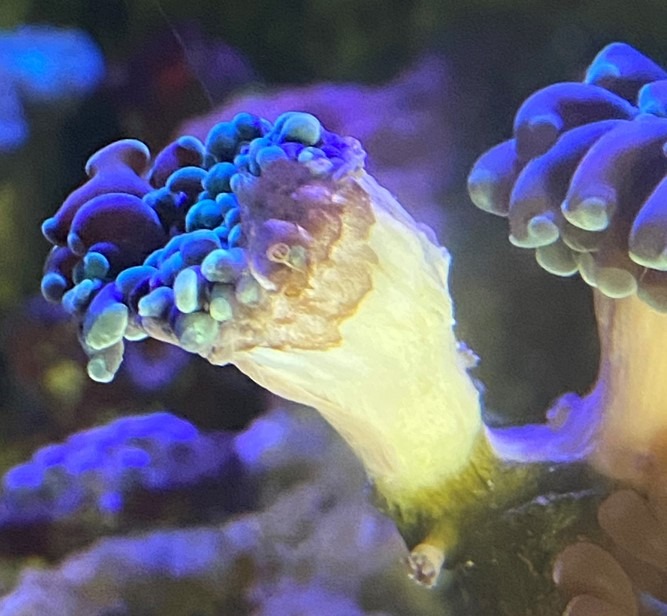
Euphyllia
spp. (Anchor, Frogspawn, Hammer and Torch corals)
Euphyllia
spp. have been listed by leading coral scientists as being
uncommon (Veron 1986, 2000). This designation was considered
in the EU's temporary ban of selected species. We were quite
surprised to find that, at least in the Spermonde Archipelago,
this was not the case. Euphyllia species were found
at all reef sites, and at some sites in high abundance. Although
most of the colonies were small, there were occasions when
we saw very large colonies. We also saw most, if not all of
the species known, including E. glabrescens, E paraglabrescens,
E. cristata, E. yaeyaemaensis, E. ancora, E. parancora, E.
divisa, and E. paradivisa. Only E. cristata
was uncommon in our transect. The primary collection areas
for Euphyllia are patch and fringing reefs from 4-25m
in depth. These are mostly clear water sites, although clear
water in the Spermonde is still somewhat turbid and greenish.
Currents vary with conditions, but were quite calm during
our dives. Surprisingly, I would estimate that half or more
of the colonies were of branching species, considering they
are less common in the trade. Deepwater sites varied in their
abundance of Euphyllia, but deeper sites (>30m)
contained almost exclusively small colonies of the branching
species. Their skeletons are subject to much bioerosion, and
I don't think colonies can get very large as a result. Furthermore,
at a few deepwater sites, there is no hard substrate for them
to form secure attachments above the sediment surface, resulting
in smallish colonies. Unfortunately, there were no other consistent
morphological or skeletal differences to distinguish colonies
between the habitats, and therefore specimens of Euphyllia
found in an aquarium stores may be from very different habitats
and subject to very different conditions (Table 9).
These
Euphyllia are just some of the species photographed
across a range of habitats in the Spermonde Archipelago
Table
9. Euphyllia Size Frequency
Figure
19. E. glabrescens
Figure
20. E. ancora
Figure
21. E. cristata
Figure
22. E. glabrescens ?
Figure
23. E. parancora
Proud
sponsor of this Featured Article
Catalaphyllia
jardinei (Elegance coral)
Habitat
1: Perhaps one of the bigger surprises came from our attempts
to locate Catalaphyllia. We were assured that Catalaphyllia
would be very common and collected from several sites. In
fact, it was quite uncommon at all sites and the locations
given by coral collectors seemed to vastly overstate its abundance.
Fortunately, we did find examples at several different locations
and, like Euphyllia, in very different habitats. Unlike
Euphyllia, we found them to adopt quite distinct morphotypes,
depending on the area of collection. The deepwater sites where
Trachyphyllia were collected were also the area where
we saw the most harvest of Catalaphyllia. To repeat,
this is a very low-light sand and silt seafloor with no hard
substrate and colonized by sparsely populated free-living
corals, macroalgae, and cyanobacterial mats. Here, Catalaphyllia
were found as small, free-living colonies that are generally
the size and shape of the vast majority seen in aquarium stores.
However, every coral seen - and every Catalaphyllia
collected - from this area had purple tentacle tips. None
of the Catalaphyllia at any other site had this characteristic.
Habitat
2: In contrast, the Catalaphyllia we found (rarely)
at fringing, patch, and shallow submerged sites were mostly
medium to large attached colonies. These colonies grew on
the hard reef substrate and seemed to be able to grow much
larger, adopting significantly developed flabello-meandroid
growth forms. Furthermore, their skeleton, being attached,
would be broken off for collection, rather than having the
cone-shaped or unbroken bases typical of free-living colonies
at all other sites. The colonies had the typically seen color
patterns of bright green to brown with radiating stripes on
the oral-disk, and brownish tentacles. Furthermore, the skeletons
were well cleaned and whitish from grazing, and coralline
algae and other typical invertebrates were found colonizing
the skeleton. This is notable, given the next habitat description.
Habitat
3: The same general near shore, silty, shallow area where
the dull colored Trachyphyllia were collected is also
reported to be a prime area of Catalaphyllia collection.
We did find a few specimens using searching and manta-tow
techniques, but none ever appeared on any transects of the
area. Therefore, we must assume a sporadic occurrence of low
density. Like the deepwater habitat, Catalaphyllia
collected here were free-living and never attached. They were
found nearly buried in deep fine silts and were, also like
the deepwater colonies, small and apparently size-limited
by the substrate. More notably, the thick brown silt had discolored
their skeletons from white to a dingy brown. The only notable
growth on the skeleton was from the calcified tubes of polychaete
worms. Their coloration was drabber, being brownish with muted
green-brown oral disks and tentacles.
Figure
24. Catalaphylliajardinei, displaying
the much sought-after purple tentacle tips,
are photographed here between 30 and 35m in
depth. Note the silt deposits on the colony
shown.
Figure
25. Catalaphylliajardinei, displaying the much sought-after
purple tentacle tips, are photographed here
between 30 and 35m in depth. Note the silt deposits
on the colony shown.
Figure
26. Catalaphyllia are displayed in a
flow-through tank at the Baranglompo holding
facility. Note the highly distended oral disks
resulting from extremely low water flow. This
is not, however, the same as the Catalaphyllia
"condition" shown below.
Figure
27. Catalaphyllia are displayed at an
exporter in Jakarta. The colony in the middle
is displaying the condition that characterizes
many Catalaphyllia being imported to
the US in recent years. The swollen and discolored
oral disk with a shriveled fringe of tentacles
is a condition from which few survive. The other
colonies display a normal appearance. We did
not observe this condition underwater, but the
short period of time between their collection
and their arrival here, given our observations
of the entire collection process, makes it likely
that the corals are indeed afflicted in the
wild and not as a result of some collection
or shipping stress. A parasitic gall crab has
recently been found beneath the tissue of almost
all Catalaphyllia examined with this
condition (Shimek pers comm, www.rshimek.com).
Proud
sponsor of this Featured Article
Cynarina
lacrymalis (Button or Meat coral)
Even the coral collectors admitted, that Cynarina were
significantly difficult to find .In fact, they couldn't point
out any areas where one could just go and find them readily;
searching an area - and subsequent collection wherever one
was found - seemed to be the norm for them. We also found
this to be true in our many dives, and transects showed the
coral to be extremely rare to absent at all sites. However,
they were present at patch, fringing and submerged reef habitats,
and in the deepwater habitat as free-living colonies. Most
were very small juveniles, but there was one very large specimen
and several of average collected size. Like Euphyllia,
it is hard to generalize on the preferred habitat. If anywhere,
the density was highest (found by searching but not by transect)
in the 30-40m algal flat deepwater habitats. On the reef,
Cynarina was found occasionally; always attached and
never free-living. Once again, the skeleton will provide clues
as to whether the coral was attached or free-living, and may
therefore be used to approximate the likely collection habitat.
Attached Cynarina were always found lodged into nooks
and crannies of the reef, under overhangs, and under corals.
They appear to prefer or dwell almost exclusively in extremely
protected areas receiving very low light levels. There were
no other determining morphological characters we found that
could be used in assessing habitat.
Figure
28. Collectors preferentially target free-living
Cynarinalacrymalis found in deepwater,
such as this one, because they are easily collected
and are found along with other corals sought
for the trade.
Figure
29.
Collectors preferentially target free-living
Cynarinalacrymalis found in deepwater,
such as this one, because they are easily collected
and are found along with other corals sought
for the trade.
Figure
30. The attached form of Cynarinalacrymalis
was also found in transects on patch and submerged
reefs. It was uncommon, and almost always found
like this one; in shaded and protected niches
within the reef framework.
Figure
31. Unlike its relative Cynarina, Scolymia,
while not abundant, was much more common in
coral collecting areas. It was always found
as solitary attached colonies on patch, fringing,
and submerged reef slopes.