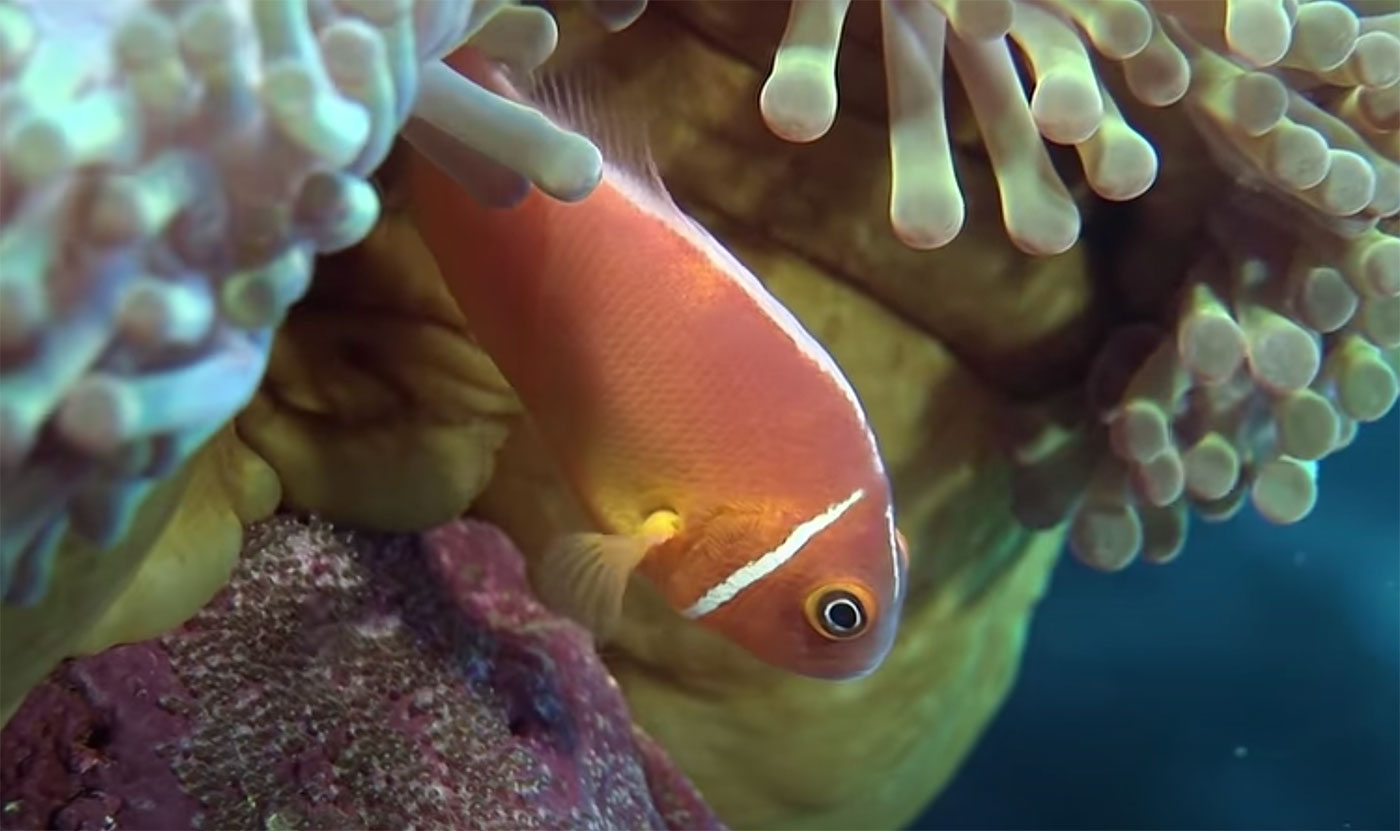
Almost
all marine fish reproduce through production of eggs that
develop and hatch while exposed in some way to the marine
environment. There are exceptions of course; a few live
bearing telosts (bony fishes) like sea horses and brotulids
and many elasmobranchs (sharks and rays) produce live young
from internal incubation, but most marine fish practice
external fertilization and even if the eggs are protected by
the parents until hatch, the eggs are exposed to the marine
aquatic environment. Marine waters have a considerably higher
density than freshwater, and this provides some reproductive
options that few freshwater have, basically, unless they are
attached to something or contained in some way, the eggs of
most marine fish will float. Some species produce eggs that
contain an oil droplet that enhances the buoyancy of the eggs
and use this option to disperse millions of eggs on the
oceanic currents. Some species fight this inherent buoyancy
and attach and/or protect the eggs until embryonic development
is complete and the egg releases a competent larva able to
swim and feed right after hatching. Thus because of the
salinity of the sea, marine fish have been able to develop a
wide variety of modes that adapt their eggs to the marine
environment and ensure survival and dispersion of the young in
ways best suited to survival of their species.
Demersal
eggs that produce demersal postlarvae or juveniles:
This
reproductive mode completely avoids a planktonic pelagic
larval stage. The embryo develops in or on the egg until it
breaks free as a post larva or juvenile and begins a benthic
existence. This mode of reproduction is quite rare in marine
fish. The toadfishes, Batrachoididae, are good examples of
this reproductive mode.
Demersal
eggs that produce pelagic larvae:
A
great many small reef fish produce nests of small demersal eggs that
hatch larvae in various stages of development with various amounts of
nutritive yolk material. The yolk usually sustains the larvae for 12
to 18, sometimes 36 hours before feeding must begin. This allows time
for final development of organ systems and movement of the larvae into
the near surface, plankton rich, oceanic waters. These nests may
contain only a few hundred eggs or many thousands of eggs and may be
well hidden in holes or crevices deep in the reef or placed and
guarded on openly exposed surfaces.Parental care of the nests until the eggs hatch is almost
always present. Potential predation on these nests, especially those
that are exposed to the open reef is always great. Clownfish and other
damsels, dottybacks, grammas, gobies blennies, and triggerfish are
among the reef fish that spawn demersal eggs.
Mouth
brooders that produce demersal postlarvae or juveniles:
Mouth
brooders that produce large postlarval or juvenile young that
do not have a pelagic larval stage must have large eggs that
carry enough nutritive yolk to support development of a large
offspring. Avoidance of a pelagic larval stage greatly reduces
early mortality but it also severely restricts the number of
eggs that can be carried. Mouth brooders that carry the young
entirely through early development and produce the post larval
or juvenile form could also be considered as external
brooders. Marine livebearers and external brooders such as the
sharks, brotulids, and seahorses, do not technically fit into
this category since they nurture their embryos internally or
incubate their eggs differently, but they do produce benthic
young, thus they also do not have a pelagic larval stage and
share the advantages (high survival potential of individual
offspring) and disadvantages of this category (few young,
restricted distribution of progeny). Sea catfish (Ariidae),
and the Banggai cardinalfish (Pterapogon kaudemi,
Apogonidae) are among the few marine fish that mouth brood
large eggs and produce benthic young. Mouth brooding has the
advantage, like pelagic spawning fish, of not having to
prepare or guard a nest site, and also an advantage similar to
the nest makers, of protection during the very vulnerable egg
and early embryonic stages.
Proud
sponsor of this column
Tiny
toadfish, Opsanus beta, only about a week old sit on top
of a large yolk sac that is attached to a piece of
driftwood. This species produces demersal eggs that
develop directly into benthic juveniles.
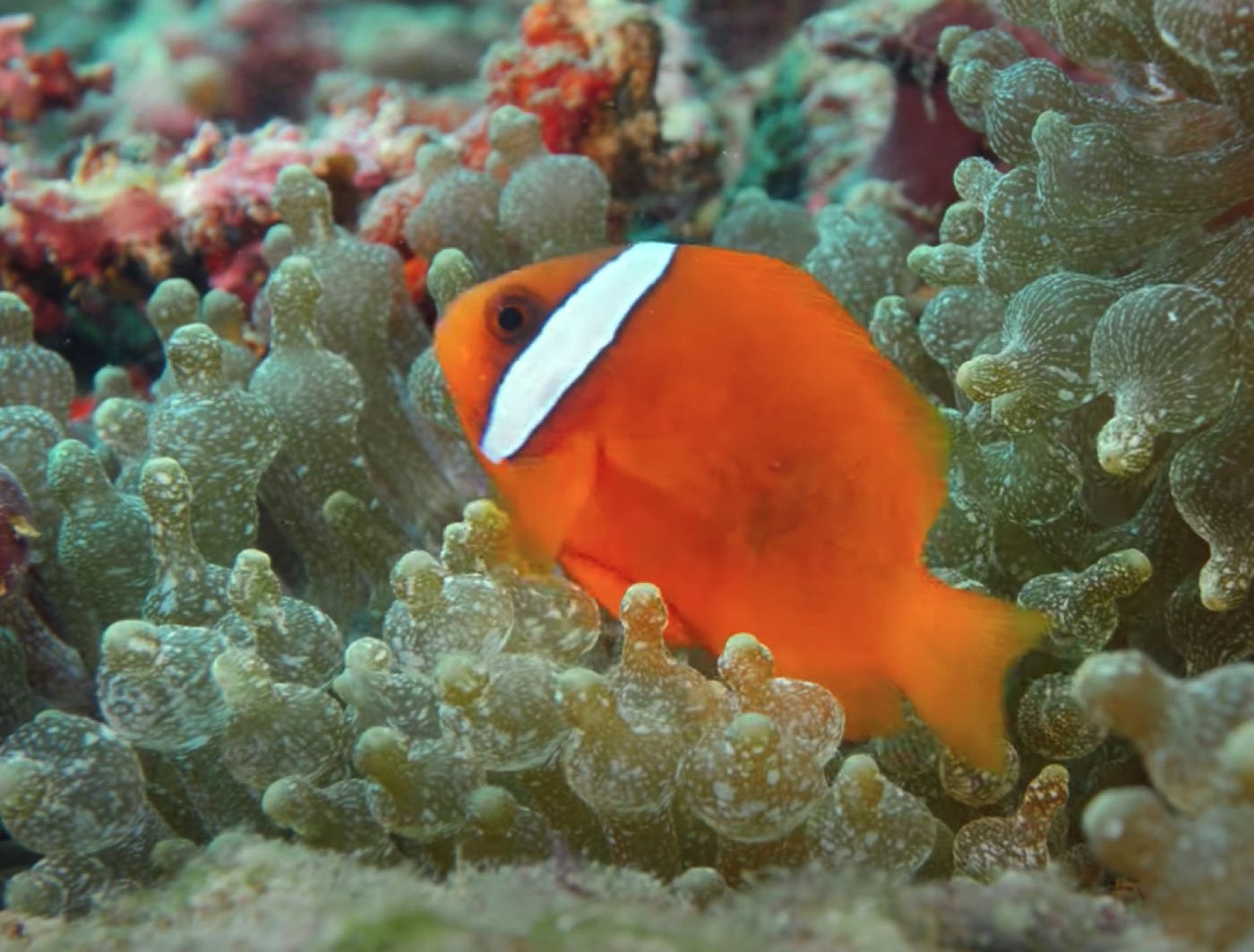
A
pair of tomato clowns, Amphiprion frenatus, with a large
spawn, over a thousand eggs that will hatch into competent
pelagic larva.
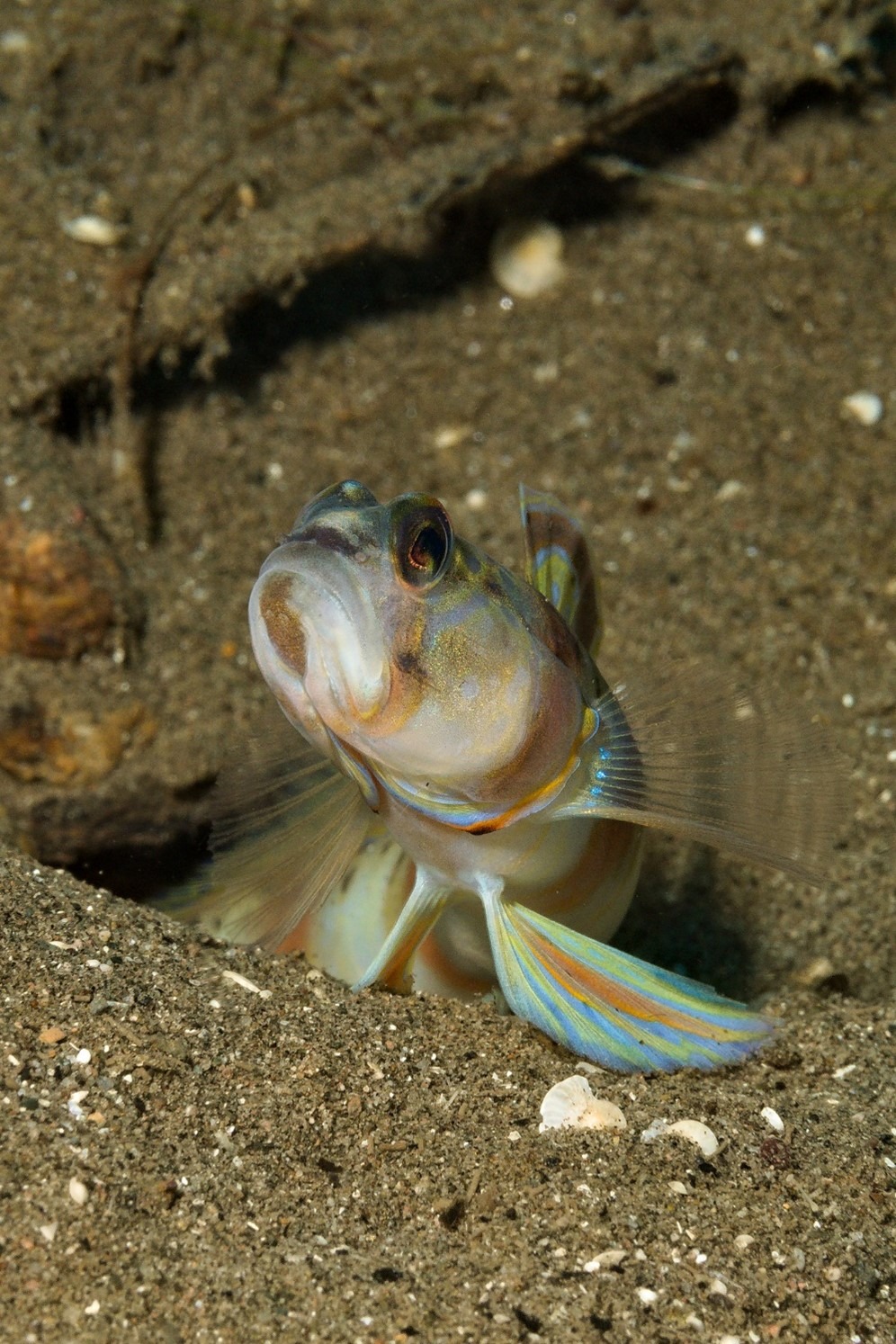
A
yellow head jawfish, Ophistognathus aurifrons, a mouth
brooding species hovers above his burrow.
Mouth brooders that
produce pelagic larvae:
Mouth brooders that
carry relatively small eggs that result in pelagic larvae have
the advantages of a secure brooding method, production of a
relatively large number of eggs per spawn, larvae that are well
developed at hatching, and broad distribution of young in
through dispersal in the plankton. The male is always the
brooding parent in marine mouth brooders. Although the eggs are
kept in the oral cavity of the male, they are still exposed to,
and oxygenated by, the marine waters that pass through the mouth
and gills of the male. Only the jawfishes (Opisotgnathidae) and
the cardinalfishes (Aogonidae) are small egg, mouth brooding
reef fish that produce pelagic larvae.
Pelagic eggs that
produce pelagic larvae:
By far the most common
reproductive mode among tropical marine fish is the production
of vast numbers of small, externally fertilized pelagic eggs
that hatch small pelagic larvae. There is no parental care of
the embryo, larvae or juvenile. Many species spawn on almost a
daily basis during the optimum spawning periods of the year so a
vast number of eggs are produced to make up for the lack of
parental care. Large fish produce many eggs per spawn, perhaps
over a million for the large groupers, while small fish such a
the pigmy angels produce only 300 to 500 per spawn. The large
French and Gray angelfish, Pomacanthus arcuatus and P.
paru, produce 50,000 to 100,000 eggs per spawn. The larger
the female, the more eggs she produces. Fecundity of a species,
however, although strongly influenced by the production of an
average female, is dependent on the number of females producing
eggs. Thus a very abundant species of small fish can produce
more eggs than a rare species of large fish. Typically, tropical
pelagic eggs hatch in 20 to 24 hours after spawning, the
prolarvae require about 72 hours to develop eyes, gut, and fins
before beginning to feed. The larval stage extends from 21 to 40
days depending on species, temperature, available food and
possibly a suitable environment for juvenile survival.
Settlement of the post larvae or juvenile may occur in a shallow
nursery area or on or near the offshore reef environment.
Angelfish, surgeonfish, parrotfish, groupers, moray eels,
snappers, grunts, mullets, reef drums, porgies, wrasses, and
many other species spawn pelagic eggs.
Pelagic eggs rafted
or attached to a floating substrate:
Some
species, scorpionfish, lionfish, frogfish and angler fish,
produce pelagic eggs that are bound to each other in a dense
gelatinous matrix, and others, flying fish, produce eggs that
have long tendrils that catch around floating weed and debris
and keep the egg afloat. These species essentially produce
pelagic “demersal” eggs. The eggs are usually kept together
in the raft or nest until hatching and then the larvae become
pelagic and are dispersed by the currents.
Spawning
methods:
Production
of gametes, eggs and sperm, is not a simple matter. It is biologically
expensive and, of course, biologically necessary. The process of
evolution, survival of a species, demands that each species gets the
biggest “bang for it’s buck” that is possible, considering its
evolutionary history and its current environment, morphology, and
physiology. It would be prohibitively expensive for any species to
simply shed eggs and sperm willy nilly and hope that the two get
together some time for a drink and a pleasant evening. Even sessile
species (organisms attached to place that can not move or have very
limited powers of movement) that produce millions of gametes like
oysters, clams and corals have elaborate timing (moon phases) and
communication (pheromones) methods to insure that the gametes are
released at the same time in the same areas, thus ensuring
fertilization of many eggs.
Mobile
species, on the other hand, have to come together and
coordinate the release of gametes. They have to be sure of
many things before they can spare the expense of gamete
release. A cup of coffee, a little small talk, and some slow
dancing is absolutely essential, of course, but with fish we
call it courtship and spawning. Note that spawning systems are
interdependent and coadapted to all other aspects of the
biology and behavior of the species. Small species that are
adapted to specific sites by feeding behavior, such as
cleaners, or are very territorial because of a relationship
with another species, such as clownfish, or are dependent on
reef cover for protection from predation such as dottybacks,
tend to form pairs or small harems, while more mobile species,
wrasses, tangs, snappers, and jacks, for example, more often
spawn promiscuously from schools or in spawning aggregations.Different species, of course, have different
adaptations to the same conditions, and there are many
exceptions and variations to our categorizations of spawning
methods. According to Thresher (1984), however, there are five
spawning systems for reef fish.
Proud
sponsor of this column
Long term
pairing:
The
first is the long term pairing of a specific male and female, a
monogamous mated pair. This is not a typical mating arrangement for
marine fish, and the definition of monogamy depends on the meaning of
“long term pairing.” Clownfish, for example, establish pairs that
can remain intact for many years, while french and gray angelfish, Pomacanthus
paru and arcuatus, according to my field observations, seem
to form pairs that last for at least a few months, the spawning
season, of each year. Some species of gobies, blennies, hawkfish, and
rabbitfish also form stable pairs. The stability of these pairs in the
wild is unknown, since long term observation in nature is, to say the
least, rather difficult, but is certainly variable from species to
species. What happens on the reef may be very different from the
behavior of a particular species in an aquarium, but the usual total
lack of tolerance of another male or female, by a “mated pair”
(particularly clownfish and gobies) in an aquarium argues strongly for
similar monogamous behavior in the wild. The definition of
“monogamy” in reference to reef fish, in my opinion, requires the
repeated spawning of the same male and female, with exclusion of
spawning with other males or females, for a prolonged period, probably
at least an entire spawning season.
Juvenile
Banggai cardinalfish, Pterapogon kauderni, only a week
since released from the mouth of the male parent, occupy the "spines" of an artificial sea
urchin.
The
flame angel, Centropyge loriculus, one of the many pygmy
angels that readily spawn tiny pelagic eggs in the small
tanks of marine hobbyists.
The
eggs of the flame angel just before hatch. The size of the
egg is about the same size at the letter "O" in
the word GOD in the motto on the US penny
Harem spawning:
Harem spawning is the
second type of spawning system. A single male spawns repeatedly
with several females, perhaps up to dozen, and the entire harem
occupies the same general area of the reef. The male protects
his territory, and its resident females, from other males that
may be passing through or that occupy adjacent territories.
Angelfish in the genus Holocanthus commonly form spawning
harems, one male rock beauty, H. tricolor, for example
will be dominant and control an area of several hundred square
feet of reef structure with 3 to 6 smaller females in residence.
Some species that lay demersal eggs such as some damselfish,
trigger fish and puffers form harems as do some pelagic egg
producers such as angelfish, wrasses, and parrotfish. Sequential
hermaphrodites, both protandrous and protogynous, are often
harem spawners.
Explosive spawning:
Explosive breeding is a
type of promiscuity in that selection of spawning partners is
random and based on presence in a spawning aggregation rather
than individual selection. It is unique, however, in that the
fish migrate to a specific site at a specific time for the
specific purpose of spawning. Once at the site, a place and time
that favors the distribution and survival of the spawn,
intensive spawning occurs over a relatively brief period, and
the spawning aggregation then disburses, often to the specific
reef sites they previously occupied. The defining
characteristics of this category are migration to the spawning
site and the rapid and intense spawning activity. Some species
of grouper, notably the Nassau grouper, Epinephelus striatus,
travel to prominent reef sites year after year and engage in
this type of spawning behavior.
Promiscuous
spawning:
Promiscuous spawning
may involve pair spawning where a pair is formed only for the
immediate spawning and different pairs may form each day or even
at different times on the same day. Many damselfish spawn in
this manner with the male establishing a territory, courting
many females, and spawning sequentially with each on the same
nest site. The male defends his nest site but does not maintain
an established harem of specific females. The females may spawn
with several males at various nest sites over the spawning
season. Male grammas and dottybacks also establish a nest site,
a small hole or crevice in the reef, and entice various females
to enter the nest and deposit eggs. The females may be less
promiscuous than males in some species, choosing to always, or
most frequently, spawn with the same male. Schooling pelagic egg
spawners, wrasses, surgeon fish, and are also promiscuous since
they spawn from schools in pairs or small groups and these pairs
and groups are apparently made up various individuals at each
spawning event. Spawning activity may take place daily or at
least frequently over the weeks or months of the spawning
season.
Lek-like spawning:
Lek
spawning is a term used mostly for some birds and mammals to
describe a reproductive behavior in which males gather at a
specific location and engage in competitive displays to attract
and then mate with females who also come to this location for
mating. In a lek, the strongest, most competitive, and most
desirable males (in the opinion of the females), secure the best
locations and attract and mate with the most females. The
reproductive behavior of some species of fish, some labrids,
acanthurids and pomacentrids, may fit into this description of
lek spawning, but it is a distinction that is more important to
ethologists (behavioral scientists) than marine aquarists.
Thrasher (1984) prefers the term lek-like since there is some
controversy as to whether the term “lek” really applies to
fish behavior and I would agree with his analysis. Andrews, et.
al. (1996) recently studied the reproductive behavior of the
concha wrasse, Nelabrichthys ornatus, at the islands of
Tristian da Cunha in the South Atlantic. They felt that the
reproductive behavior of the concha wrasse could be considered
lekking, even though it was “difficult to estimate the
relative influences that males and females have on mating site
selection”.
References
Andrew,
T. G., C. D. Buxton, T. Hecht. 1996. Aspects of the reproductive
biology of the concha wrasse, Nelabrichus ornatus, at Tristan
da Cunha. Envir. Biol. Of Fishes, 46: 139–149.
Thresher,
R. E., 1984. Reproduction in Reef Fishes. T. F. H. Publications,
Neptune City, NJ. 399 pp.