CLICKING
ON ANY PHOTO WITHIN THIS COLUMN WILL TAKE YOU TO A PAGE
OF THUMBNAILS OF THIS AQUARIUM
Proud
sponsor of this column
This
aquarium is unusual in many ways. Its dimensions are not
what people are used to, the animals are splendid, the
equipment is impressive, and the philosophy driving the
project is quite interesting!
With
a passion for coral reefs, Gabriel began his reef aquarist's
life six years ago with tanks getting bigger and bigger.
He finally maintained two interconnected tanks (1,000
and 600 liters - 260 and 160 US Gallons). The first focused
on SPS, the other on LPS. After a move to a different
house in 2002, he decided to convert is garage into a
room dedicated to a large aquarium. This was the beginning
of a formidable bet: the tank should be 6 meters (20 ft)
long, 1 meter (3.3 ft) wide and 0.65 meter (2.12 ft) high!
Technical features
and maintenance
The display tank holds 4,200 liters (1,110 US Gallons).
It has an overflow box containing three 40 mm (1.6”) pipes,
all leading to a decanter. This decanter was engineered
following the concepts detailed in an article (1) by Joffrey
Dislaire. Its volume and length was computed from the
overflow characteristics so that sediments would be allowed
to settle on the bottom. A set of valves allows the overflowing
water to be redirected straight to the sump during maintenance.
The
decanter then directly force-feeds three H&S skimmers.
These skimmers are equipped with two Eheim pumps with
needle wheels, and were customized by the manufacturer
with bigger inlets, so that flexible 40 mm PVC tubing
could be used.
Another
singularity of these skimmers comes from the air they
are using. All air inputs are connected to a PVC pipe
leading outside the house; this is a real advantage, as
a majority of the gas exchanges in an aquarium setup happen
in the skimmers (2). Ozone is also injected (30 mg/h),
using a Red Sea Aquazone Plus device. The water is also
going through a 55 W UV system from De Bary Aquaristics.
The skimmers have their outputs directed towards a low-rise
sump, used for small equipment (heaters, probes, level
sensors, etc...). The water return is powered by a Black
Devil 12,000 l/h (3,200 GPH) pump.
A shed located outside the house is the home of the water
reserves, for sea and fresh water, and of the Teco chillers.
Water changes are easily done from the decanter using
a dedicated plumbing system and a pump.
In
order to maintain calcium and alkalinity close to natural
values, three Nilsen reactors (Ratz) and a calcium reactor
(Aquacare 4) are used.
The
reactor's plumbing is currently being revised as it has
proven difficult to find a correct location for their
effluents, with a negative impact on their efficiency.
Water movement is provided by Tunze powerheads: six 6100
Streams and two 7410 Turbelles are used. The streams are
positioned so that they create a circular flow, and the
Turbelles are complementing them while fixing some issues
due to the rocks disposition. This setup is as well being
revised as it is too strong in certain places, and too
weak in others. Claude Hug, from Tunze, nicely offered
his expertise in pumps setups. His comments are eagerly
awaited!
Light is provided using nine metal halide pendants. Each
pendant is equipped with two 400 W / 10,000 K bulbs. One
pendant has a mix of 10,000 and 14,000 K bulbs. Some corals
seem to react differently, color-wise, under the different
setups. Ten blue fluorescent tubes (Osram 67) complete
the lighting system and provide transitions.
So
that sediments could be controlled, all the live rocks
are elevated using egg crate. A dedicated Black Devil
pump in a closed loop flushes the sediments using plumbing
located behind the rocks.
The
rock-work is relatively flat, but features some rifts,
ridges and other pinnacles. For aesthetics, a layer of
sand, 7-8 cm (2 to 3”) deep, has been placed around the
rocks. It also offers a habitat for various pistol shrimps
(Alpheus sp.).
Maintenance is simplified through the automation of most
of the recurrent and annoying tasks, like water top-off,
supplementation, water changes, and temperature and sediment
control. Most of the measures are made using specific
instruments (Tunze pH-meter, redox and temperature sensors)
and a specialized computer (IKS Aquastar). Indicative
water parameters are:
Temperature:
26°C
pH:
7.9 - 8.2
NO2
and NO3: Not detected
PO4:
Not detected
Calcium:
420 mg/l
KH:
10
Animals
The system is engineered for keeping a high number of
SPS corals, with nutrients levels in the water as low
as possible, and a strong lighting source in order to
sustain the coloration of the corals. The results are
clearly positive, with many examples of brown frags acquiring
intense coloration after a few weeks or months in the
new environment. Their previous owners simply cannot believe
the results! Many Acroporas are represented,
as well as a selection of Seriatopora, Stylophora
and Pocillopora. Gabriel knows the history of
each of his corals. He always has a thing or two to tell
about a specific animal, some of them having lived in
many aquariums for as long as ten years in captivity.
As
far as fishes are concerned, the tank’s size allows the
maintenance of some species in conditions that are - at
last! - adapted. More that fifteen species of surgeon
fish live in harmony in this large aquarium, showing intra-specific
and inter-specific behaviors that are quite interesting
to witness. Juvenile individuals tend to mature quite
rapidly too.
This
rapid growth is also applicable to the many specimens
of Angel fish hosted in this aquarium. A few mated pairs
even formed: Pomacanthus imperator, Centropyge
loriculus, and Apolemychtis xanthopunctatus.
Some of them tend to feed off corals a little bit, but
they rarely attack the same colony, so damage is not permanent.
Some
associations failed. A pair of adult Naso elegans
was introduced, but, after a month constant fighting,
initiated a mortal disease for one of them.
A pair of Labroides dimidiatus established a
cleaning station on one side of the tank, and many large
fish come regularly for a clean-up. One wrasse can be
seen penetrating entirely inside the Naso's mouth on a
regular basis. The surgeon fish completely changes tint,
getting lighter, indicating his acceptance. Many smaller
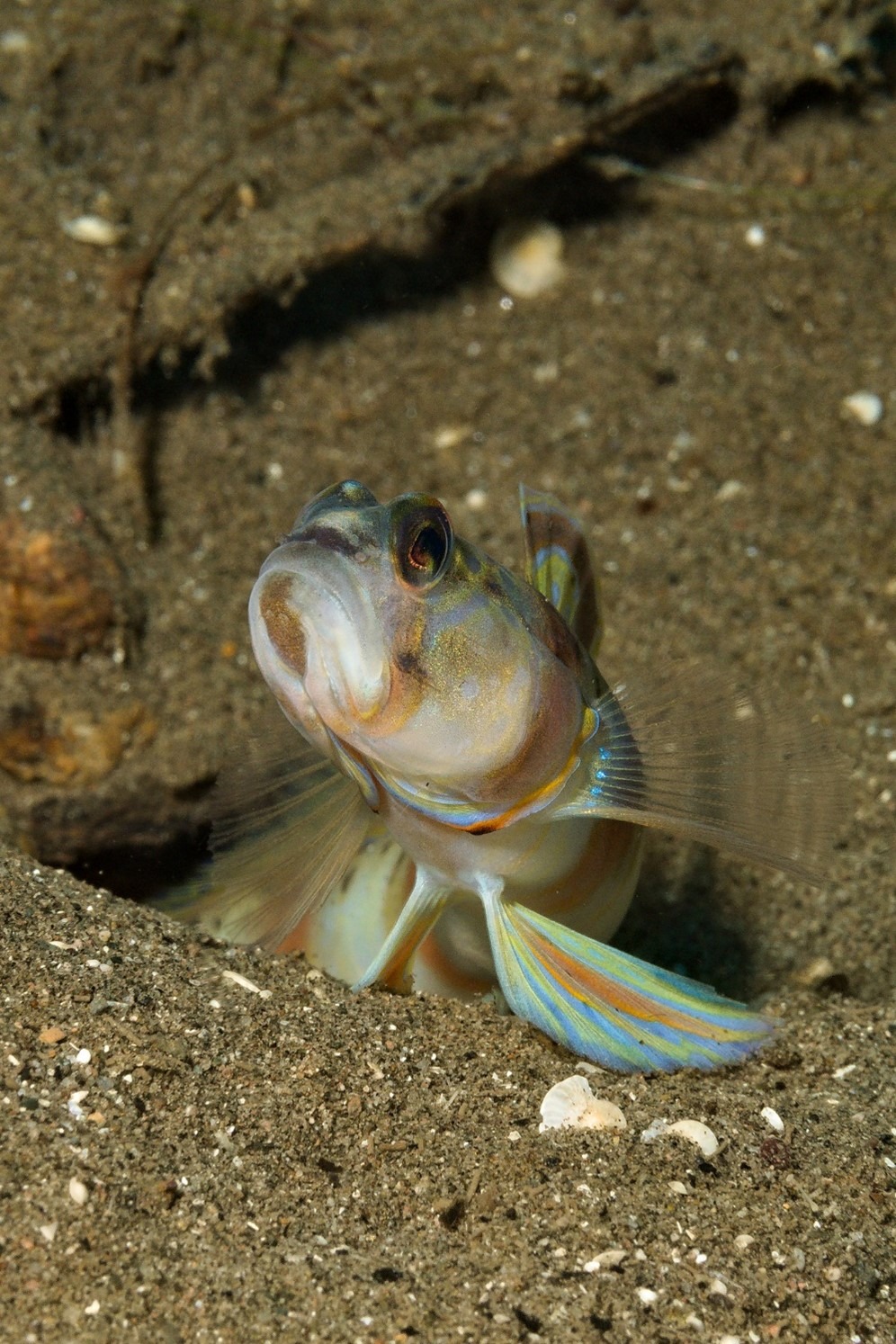
fish were introduced, mostly in sexual pairs, like Amblyeleotris
randalli or Gramma loreto, each finding
a proper habitat somewhere in the tank. Gobies are associated
with Alpheus sp. shrimps, like A. bellulus.
Other invertebrates live in this captive ecosystem, like
that group of Astropecten typicus that shows
regular reproductive behaviors. There are as well the
Dollabela auricularia, 4 to 5 years old, with
oral discs as large as 20 cm (8”).
It
is difficult to name all animals hosted in this aquarium,
as well as describe their particular behaviors, but their
well-being is obvious, mainly due to the tank's volume.
Questions can be raised about the maintenance of certain
species in sizes that are more often associated with our
hobby.
Ten questions
Proud
sponsor of this column
recifs.org
Hi Gabriel. Thank you very much for the presentation of
your impressive aquarium. Could you tell us about what
motivated the creation of a system with such a volume?
Gabriel Fish happiness
above all else! Whatever the animals you are deciding
to keep, I think that their maintenance conditions should
be the main worry. When confronted to the enormous free
space that fish have available to them in the wild, I
didn't hesitate too long. Available length for swimming
is a key element for the proper maintenance of some species
(Acanthurussohal for example). I chose
the maximum length possible with a single glass pane,
6 meters. As for the more standard width of 1 meter… well...
it is already difficult to reach the back of the tank!
The 65 cm height allows strong lighting even at the bottom.
recifs.org What
was the biggest disappointment?
Gabriel None as
far as the technical specifications are concerned. For
sure, a lot of time, maybe too much, has been spent on
that topic alone. Regarding the animals, the loss of one
of the Naso and the xanthopunctatus'
jump saddened me most...
recifs.org What
is you biggest satisfaction, or what makes you most proud?
Gabriel The results
are far beyond my expectations! The system is nevertheless
still young (a bit more than a year old by now), but the
good health of my animals, the corals' rapid growth and
the reproductive behavior of many mated fish pairs are
elements that I am strongly enjoying every day.
Proud
sponsor of this column
recifs.org
What will you change or correct in the short or medium
term? Why?
Gabriel As you mentioned
in the article, water movement needs changes, even if
the current results are not all that bad. They can be
improved, and I am thanking Claude in advance for his
experienced advice. The plumbing for the calcium supplementation
needs work too.
recifs.org With
the experience you acquired, what would you recommend
(or warn against) to aquarists that are planning their
new setups?
Gabriel I'll repeat
what my good friend Joffrey says all the time: “Compute
everything”. A system is born on paper... Everything must
be sized properly; minimums, and more importantly maximums.
A few examples: heaters' capacity should not be above
what is required by the volume, the fresh water reserve
should not be able to “rinse” the system if there is a
problem with the top-off equipment... There are many more
things that must be anticipated. I believe that the rule
of “what can do more can do less” is dangerous when something
goes wrong. Experience can also make mistakes less extensive.
recifs.org What
animals are your “preferred pets”? What are their stories?
Gabriel They mostly
all have some history! Some colonies of Acropora
traveled from aquarium to aquarium, starting from my previous
systems, and came back to me after I had lost the mother
colony. There are the very small frags that grow into
true museum pieces after some time. There are as well
the corals bought brown at an LFS that turn into intensely
colorful colonies. As far as fish is concerned, when a
mated pair is formed, it automatically creates something
different; you become even more attached to the animals!
recifs.org This
must be the thing everybody is wondering about: how do
you achieve such coloration, what is your secret?
Gabriel I think
there are no secrets. Above all else, there is the combination
of light, water movement and skimming that is creating
conditions as close as possible to the wild. Proper feeding
is also a key element in my opinion. Once a month I make
a home-made “soup”, composed of many sea shells, mollusks
and fish meat. The only issue I have with heavy and rich
feeding is when some parasites are present, like Anamonia
majano or Aiptasia. Their spread is then
greatly accelerated because of their opportunistic nature.
I fed a lot of Artemia in my previous aquariums,
but suffered a great Aiptasia invasion as a consequence.
I also add a lot of strontium and iodine.
recifs.org What
are your next projects?
Gabriel They are
many! But first I need to finish the current project at
hand. Finishing, water movement, calcium supplementation...
There is much that needs to be done! Other than that,
I'm starting a plankton culture. My goal is to attempt
the full growth of young fish acquired through natural
reproduction. We may discuss that later, in another article.
recifs.org Are there
additional animals you wish to keep?
Gabriel There are
always species you would like to possess! But is it really
important? Well.... maybe a small colony of Acroporaechinata would be nice, now that you are asking....
recifs.org Is there
anything you would like to ask? Anyone you would like
to thank?
Gabriel Many thanks
to my friend Joffrey Dislaire. Without him I would not
have achieved the same results. His contribution comes
close to the zero-default! It is too bad he took some
distances from the hobby. I also would like to thank Christian
Courcier for his advice when I was a beginner.
This extra eye candy is proposed in Real Media and should
be playable on any platform. Broadband (aDSL, cable) recommended.