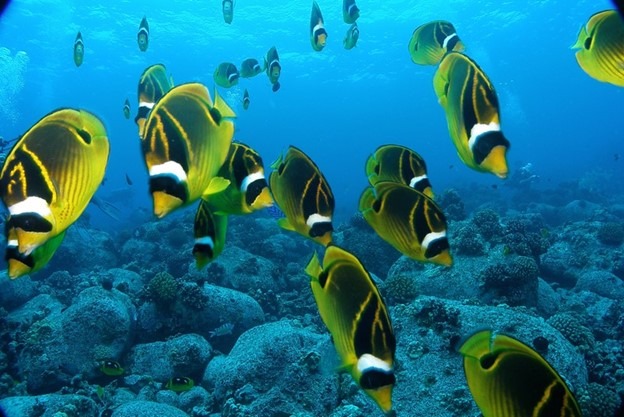
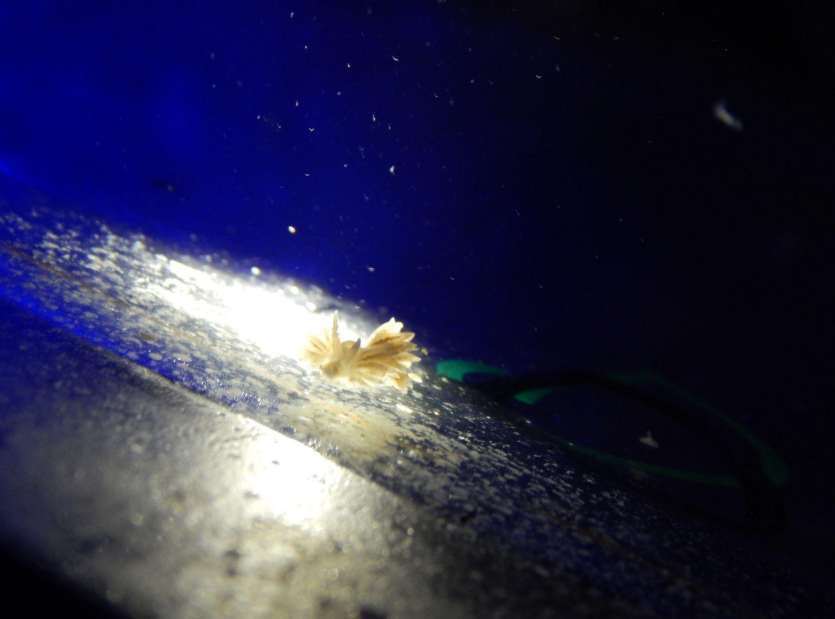
PredatorsThere are a few predators of Caribbean photosynthetic gorgonians that should mentioned. First, the common flamingo tongue snails (Cyphoma spp.) that are sometimes offered for sale to aquarists feed exclusively on photosynthetic gorgonians. Their preferred prey is Plexaurella spp., but they also like the Sea Fans Gorgonia ventalina and G. flabellum. In the absence of these choices they can still survive on species of any of the other genera mentioned in this article. Harvest of these snails for aquariums does not make sense because they can only survive if given photosynthetic gorgonians to feed on. They quickly strip a gorgonian of its live tissue in an aquarium, even though they rarely cause such complete loss of tissue and death of colonies in the natural habitat. Small white frilly seaslugs in the genera Tritonia and Tritoniopsis feed on Pseudopterogorgia spp. and Gorgonia spp., but generally do little damage unless they develop large populations. Their presence does tend to prevent the polyps from expanding, however. Butterflyfishes and some angelfishes will feed on gorgonian polyps or tissue. The latter, however, are often safe to house with gorgonians, while the former will constantly nip the polyps. DiseasePhotosynthetic gorgonians are resilient and resist most diseases that afflict other corals. They can succumb to black band and red band infections, caused by the cyanobacteria. The genus Gorgonia suffers from fungal infections in the natural habitat, an extremely unusual occurrence for the marine environment, and not reported in aquariums. A survey of the common photosynthetic gorgonians from the Caribbean.
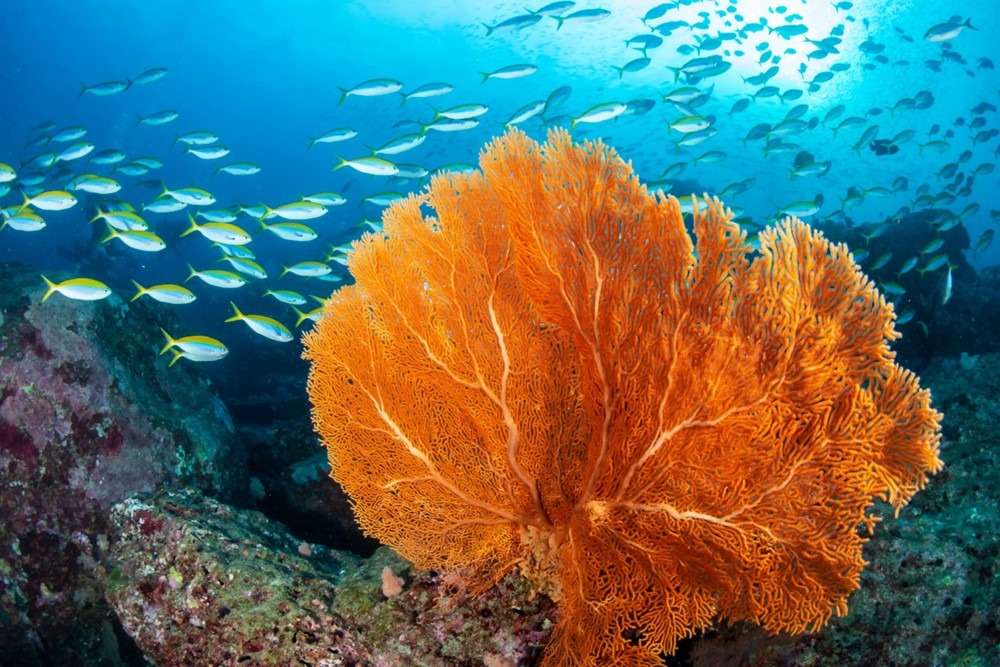
PseudopterogorgiaMembers of the genus Pseudopterogorgia have narrow smooth branches and the colonies are commonly pinnate (feather shaped). The most common colors are pale lavender and brown, but they may be gray, deep purple or yellow. In Florida there are five common species found on the reefs and numerous other species that occur only in backreef areas and in bays. The most popular species that is commercially harvested for aquariums is Pseudopterogorgia elisabethae, known in the aquarium trade as the "Purple Frilly." It occurs on outer oceanic reefs, attached to vertical faces and the undersides of ledges. This contrasts with most other species in this genus, that normally are attached upright on hard flat bottoms, or on the tops of reef structures. Pseudopterogorgia bipinnata occurs with P. elisabethae, attached in the same orientation, and ranges slightly deeper. It looks quite similar to P. elisabethae, but has finer branches. It may be deep purple, but more commonly is pale gray. Pseudopterogorgia americana is a giant species with a rapid growth rate. It may reach heights in excess of six feet and colony diameters of more than eight feet. It is distinctly slimy. The elongate branches, which look like hair blowing in the currents, slip through the fingers if you try to hold them. Potent anti-inflammatory agents have been identified from the Purple Frilly gorgonian, Pseudopterogorgia elisabethae collected in the Florida Keys (Sprung and Delbeek, 1987). New compounds are being discovered from extracts of this species and other members of the same genus. The compounds include novel pseudopterosins, seco-pseudopterosins and elisabethadione. PterogorgiaThe three species of Pterogorgia are common on backreefs and nearshore habitats, growing upright in extremely shallow water. They tolerate very bright illumination, and thrive where other gorgonians would quickly become smothered by algae. Their success is largely due to their capacity to shed a waxy surface coating that prevents algae from gaining a foothold on them. They are not successful at preventing another type of gorgonian from growing on them. The encrusting gorgonian, Briareum asbestinum commonly grows onto and over Pterogorgia, kills it, and uses the former's axis for structural support. Of the various genera covered by this article, Pterogorgia has the poorest long-term survival record in aquariums. This stands in contrast with its position as among the most tolerant of wide fluctuations in temperature and water quality in the habitat where it naturally occurs. It has a very good survival rate in shipping, with mortality being basically non-existent. The poor survival in captivity relates to this genus seeming to require very strong illumination. It also seems to need some supplemental feeding. When strong light is given the members of this genus grow well in captivity, and supplemental feeding keeps them opening the polyps daily. The members of this genus frequently close the polyps for days or weeks at a time, and then shed a waxy skin, which leads a novice aquarist to believe the gorgonian is dying. As mentioned previously, the skin shedding prevents algae from growing on them. This genus grows upright on hardbottoms and should therefore not be positioned as if it was growing out of a wall of rock. It should instead be growing out of a rock on the bottom of the aquarium, with its branches facing upwards. GorgoniaThere are three species of seafans in this genus, G. flabellum, G. ventalina, and G. mariae. This genus is not widely available to aquarists in the USA, although it is very common in nature, fast growing, and easy to keep in the high light high flow aquarium systems employed for keeping sps corals. The reason for its scarcity in the aquarium trade is a ban on its harvest from Florida and most Caribbean locations. The bans were put into effect because large seafans were commonly harvested and dried for the curio trade that was especially popular in the 1950's and 1960's. An aquarium trade in small three inch sized fans would hardly make an impact on the two common species in this genus, but such details cannot easily be accommodated by bureaucracy. Furthermore the fungus Aspergillus sydowii has been responsible for the mass destruction of Gorgonia ventalina especially over the last 15 years (Nagelkerken et al., 1997). This fact is sure to eliminate much hope of someone proposing a commercial harvest of this genus, although I hear that Caribbean-collected specimens are occasionally available to European aquarists. Almost ten years ago I submitted a grant proposal to demonstrate that one inch by one inch squares of Gorgonia ventalina could be harvested from large adult colonies (which can be more than 36 inches across and multi-lobed) using a scissors. The small fragments could be attached to limestone rocks and cultured for sale to the aquarium industry or used in reef restoration as a means of rapidly generating new colonies without having any removal of established colonies. I included the proposal that the idea could be extended to the harvest of small branches from other photosynthetic gorgonians. The grant was submitted as part of a request for applications demonstrating novel harvest approaches. It was rejected on the basis that there was no prior literature that showed my proposed method would work! The recent study by Castanaro and Lasker (2003) mentioned earlier partially fills that literary void. Hopefully the scientist who rejected my proposal has found the time to examine things outside the lint collecting in his navel. PlexauraThe genus Plexaura has two common Caribbean species, P. flexuosa and P. homomalla, and at least a couple additional uncommon species. The former is commonly purple while the latter is a distinctive chocolate brown. This genus, P. homomalla in particular, gained attention in the scientific literature because it produces protaglandins, steroids known usually from mammals. Prostaglandins have also been found in Plexaura nina and the arctic soft coral Gersemia fruticosa. These compounds are believed to be used for defense, to prevent predators from eating the gorgonian. Gerhart (1991) found that although the gorgonians are initially palatable to fish, the prostaglandins may function as defensive toxins by inducing vomiting, and subsequent learned aversions in its potential predators. Members of this genus do not ship well and are therefore rare in captivity. Small colonies (up to four inches tall) can be shipped more successfully than larger colonies. In aquariums purple or chocolate brown ones must be placed where they will receive strong water circulation and bright light. Pale gray P. flexuosa can be kept under lower light intensities. EuniceaMembers of the genus Eunicea typically have knobby protrusions marking the calyces from which polyps emerge. This lends an Acropora-like appearance to their branches. They often have purple sclerites, though the surface color is usually brown or gray. Dark purple Eunicea occur on brightly illuminated shallow back reefs in some localities. Some Eunicea species have very large feathery polyps. Eunicea species prefer surge zones or at least strong currents. They suffer from low oxygen levels in shipping bags, but small colonies can be shipped and they quickly grow into beautiful large colonies in an aquarium.
PlexaurellaThe slit-pore gorgonians belong to the genus Plexaurella. They are all pale brown or yellowish, and form colonies with club-tipped branches. Large specimens may have many branches, but average sized colonies consist of a main axis and just a few branches, giving a shape like a big sahuaro cactus. These are very hardy and can be recommended as a "beginner's" coral. They must not be allowed to rest against the substrate, however, as the portions of branches that lay on the sand or against a rock will suffocate and rot, turning black and falling off the axis. Tips of branches under bright illumination (close to a 250 watt or 400 watt metal halide) may fail to open. This is a response to photosynthetically produced active oxygen. Shading will stimulate expansion of the polyps in this case. PseudoplexauraOne of my all-time favorite gorgonians is Pseudoplexaura. There are three common species in Florida and an unknown number of others in Florida and the Caribbean. Pseudoplexaura species are similar to Plexaurella, but are distinguished by having purple sclerites, and round pores. All Pseudoplexaura spp. have a slimy consistency, while only one species of Plexaurella (that appears to be a mimic of the former genus) does. Pseudoplexaura spp. grow very rapidly, and new branches seem to appear literally overnight sometimes. A swelling of tissue precedes their development. This rapid growth seems to be promoted mostly by the symbiotic zooxanthellae rather than food additions, though this species readily accepts fine particulate foods. It is a simple matter to cut off branches and propagate this species, though the slime production makes them poor shippers. MuriceaThe various members of the genus Muricea, which includes photosynthetic and non-photosynthetic species, are a bit delicate in captivity, so I don't recommend them to the novice. The deepwater fine branched "silver bush" gorgonian from Florida is an exception. It ships well and is hardy in aquariums. Other species require very strong water currents or surge to survive, and they ship poorly, often decomposing a day or so after being transported. MuriceopsisThis genus has two common species in the Caribbean, M. flavida and M. sulfurea. The former is sold under the common name "purple bush." The latter is not harvested commercially for the US and European aquarium trade. It occurs in the southern Atlantic and Caribbean and is common in Brazil, where it attains larger dimensions than elsewhere. Members of this genus are capable of developing sweeper tentacles (Sprung and Delbeek, 1997). Muriceopsis flavida is hardy and easy to propagate in aquariums. Branch fragments of this genus were washed on the shore of Miami Beach shortly after Hurricane Andrew in 1992. I collected some branches from the beach for Peter Wilkens when he visited me in Miami and gave a lecture at a MACNA conference held at that time. Peter doubted the colonies would survive, since they were collected out of water among seaweed and seagrass washed up on shore. Offspring of these branches now grow in numerous aquariums in Europe. BriareumThis genus is well known to aquarists as "green star polyps" from Indonesia. In the Caribbean colonies of Briareum lack the fluorescent green pigment of their Indonesian cousins, but they are nevertheless beautiful and hardy. Reef aquarists should be careful with this genus, because Briareum has a habit of encrusting live rock and then overgrowing other corals attached to the rock. Encrusting forms of Briareum should be kept on the sand and not allowed to grow on the rocks. They are easy to keep when given bright light and strong water currents. Although only one species, Briareum asbestinum, is recorded in the Caribbean, it seems to be a highly variable species, or there seem to be at least two or three undescribed species. One form, which is most common on offshore reefs, is upright with long smooth straight branches attached to a flat base. Other forms are encrusting, and may be smooth or with projecting calyces. The polyps are brown and may or may not have white centers and a white line down the midrib of each pinnate tentacle. The different polyp forms are so different that they seem like different species, in much the same way that different forms of Tubipora musica in the Indo-Pacific appear to be different species. Briareum spp. brood their larvae on the surface of the colony. Erythropodium caribbaeorumThis encrusting soft coral is easily and often confused with encrusting Briareum. In fact they are not closely related, Erythropodium being a closer relative of the knobby gorgonian Diodogorgia nodulifera, which is azooxanthellate. Erythropodium has zooxanthellae, so it is brown. The underside of a colony has a purple color due to purple sclerites. The polyps of Erythropodium caribbaeorum are brown, without stripes, and form elongate hair-like tentacles in strong water motion. When the polyps are withdrawn, the calyces are lighter than the rest of the surrounding tissue, so they appear as light spots. In Briareum asbestinum the closed polyps are darker than the surrounding tissue. Erythropodium caribbaeorum is very easy to keep and propagate. It grows well on the walls of the aquarium, and it is best kept there or on the sand or gravel bottom in a region with strong water flow. If it is allowed to grow on the rocks it will encrust over stony corals. The various photosynthetic gorgonians from the Caribbean lend a refreshing display of motion to a reef aquarium exhibit and include species that are easily maintained and propagated. Their habitat in the wild is a real treat to observe and is an important feature of Caribbean reefs.
References and suggested reading
|
|||||||||||||||||||||||||||||||||||||||||||||||||||||||||||||||||