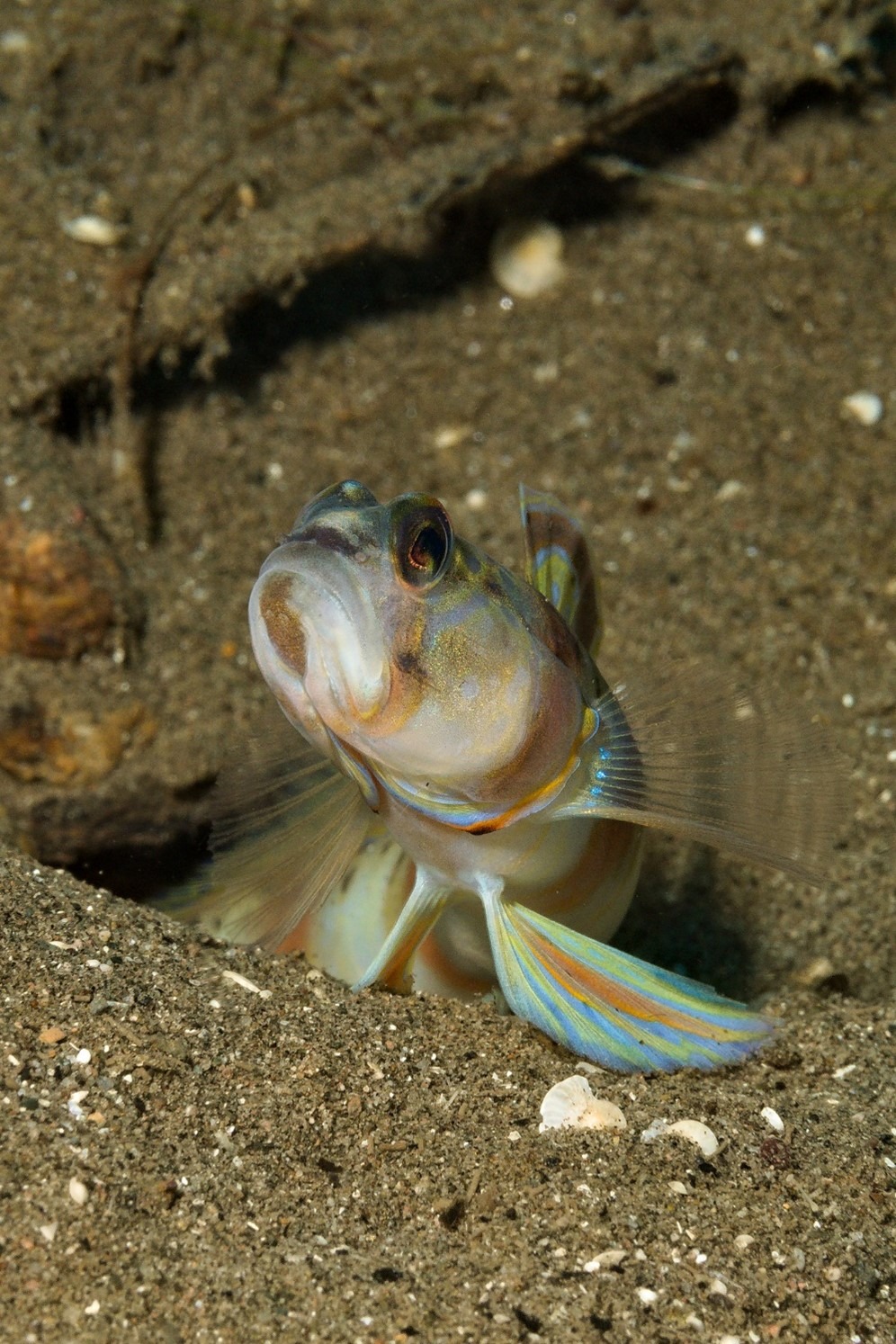
Rainford's goby is a colorful addition
to the reef aquarium, but will do best if some filamentous
algae is present in the aquarium.
The nocturn goby is likely to dig holes
and burrow under rock work. It is less common in the
hobby than some of its congeners.
The crosshatch goby is a sand sifter
that will take small mouthfuls of substrate and filter
it through its gill rakers. It feeds mainly on small
crustaceans and some algae.
The crosshatch goby can vary somewhat
in color, depending on its surroundings (e.g., substrate
hue).
The brownbarred goby is regularly encountered
by aquarists and is a fairly durable aquarium species.
The darker color phase of the brownbarred
goby. This species also "appreciates" some plant material
in its diet.
The Sphynx
goby is similar to A. phalaena in appearance
and behavior. Both of these species are more aggressive
sand-sifters than their smaller congeners (e.g., A.
rainfordi).
The genus Amblygobius is comprised of 14 species that
are distributed in the Indo-Pacific. Two of these gobies are
encountered in the aquarium trade with a great degree of regularity,
while at least four others show-up occasionally. Unlike many
gobies, the Amblygobius spp. spend most of their time
hovering in the water column, not in repose on the substrate.
Most species are also omnivorous, feeding on algae as well
as tiny invertebrates. There are some that acquire these invertebrates
by taking in mouthfuls of substrate and sifting it through
their gill rakers. Rather than examining the husbandry of the
genus as a whole, I think it would be more valuable to look
at the two most common aquarium species in detail.
Rainford's Goby (Amblygobius rainfordi)
Rainford's goby is greenish brown overall with orange lines
and has become a staple in the marine fish trade since about
1990. Its availability in the hobby corresponds with the increased
popularity of reef aquariums. Although this fish will not harm
sessile invertebrates, and is thus a suitable addition to the
reef aquarium, it really does best if kept in a tank with filamentous
algae (something most reef aquarists abhor). If the tank does
not support an algal crop, it will often become emaciated.
If the aquarist is persistent, it is possible to get these
fish to accept introduced fare, like vitamin-enriched live
and frozen brine shrimp, mysid shrimp, and prepared foods for
herbivores. But, as I keep more A. rainfordi I have
come to the conclusion that green and/or red filamentous algae
is almost essential to keep most individuals.
Proud
sponsor of this column
With the exception of closely related species, A. rainfordi is
rarely aggressively toward fish tankmates. I have kept it with
other Amblygobius spp. with varying degrees of success.
If housed with larger forms, it is likely to be picked on if
the tank is small. It may fight with the similarly-shaped Hector's
goby (Amblygobius hectori).
Juvenile Rainford's gobies can be kept together in medium-sized
tank if introduced together, but adults often quarrel. Therefore,
it is best to keep one per tank. Just because you purchase
a "mated pair" of A. rainfordi, it does not mean that
they will get along. For example, I acquired a supposed mated
pair of Rainford's gobies that were happy together when initially
introduced, but after several days one of the animals disappeared.
This individual reappeared after about four days, only to be
picked on incessantly by its supposed "mate." The more dominant
fish displayed at, chase and darted at and rammed the slightly
smaller conspecific every time they came into close proximity
to one another. The subordinate rarely sifted the substrate
while the more aggressive fish, fed more frequently. The subordinate
fish lost weight, began exhibiting a curved back, sunken dorsal
musculature (a sign of malnutrition) and finally perished.
I should point out, that in the wild, this fish usually occurs
singly, not in pairs.
Rainford's goby should be kept with peaceful species. Avoid
housing it with fishes that are prone to picking on small,
substrate-bound fishes, like dottybacks, hawkfishes and sand
perches. Amblygobius rainfordi attains a maximum length
of 2.6 inches and can be housed in very small tanks. All of
the members of this genus will jump out of open aquariums if
they are harassed by aggressive tankmates or if startled when
the lights are turned off.
The Rainford's goby is similar to several other species that
occasionally make it into the aquarium trade. These are: the
crosshatch goby (Amblygobius decussatus), Hector's goby
(A. hectori), and the nocturn goby (A. nocturnus).
The husbandry of these species is quite similar to that of A.
rainfordi. The nocturn goby is more likely to dig burrows
under rock work, while the crosshatch goby seems to be less
dependent on algae to survive and may also be more likely to
tolerate the presence of conspecifics.
Brownbarred Goby (Amblygobius phalaena)
This is a larger member of the genus, attaining a maximum
length of around 6 inches. It can be employed in a utility
role in the reef aquarium as it will help keep the upper layers
of live sand stirred by taking mouthfuls and then expelling
it through its gills. It is a more vigorous substrate-sifter
than the Rainford's goby. It spends more time engaged in this
behavior and also, in part because it is larger, penetrates
deeper into the sand bed. However, it is not as likely to disturb
the deeper sections of sand beds like the sleeper gobies (Valenciennea spp.).
This species tends to be hardier than A. rainfordi.
While a filamentous algae crop will greatly facilitate the
husbandry of the Rainford's goby, it is less important element
in A. phalaena care (although, the latter does feed
heavily on algae in the wild). It can be fed vitamin-enriched
live and frozen brine shrimp and mysid shrimp, as well as prepared
foods for herbivores. If placed in a tank without filamentous
algae, live sand, or live rock, feed at least twice a day,
but if natural foods are present, you can feed it less frequently.
Keep an eye on its weight to determine if you should feed more.
Although not usually considered to be a threat to sessile
invertebrates, I had one A. phalaena that would pull
zoanthids off of a rock, chew on them and then spit them out!
It is a predator on flatworms that can become a real pest in
a reef aquarium.
The brownbarred goby is rarely quarrelsome with heterospecifics,
but they will fight with each other. When quarreling, they
will erect their fins, rub their ventral surfaces together,
and ram each other with their open mouths. Because of their
propensity to fight, it is best to keep it singly -- that is,
unless you can acquire a male-female pair. Achterkamp (1991)
suggests that males have spots on the tail, while females lack
them, however, more study is required to confirm this observation.
Spawning may occur in captivity (Achterkamp 1991, Delbeek and
Michael 1993). When they are ready to spawn, the pair will
dig a burrow that will serve as their nest. In most cases spawning
occurs at night. The male defends the dirty-yellow clump of
eggs, driving off the female and chasing potential egg predators
from the nest site. The eggs hatch in about 6 days. Spawning
can occur as frequently as several times a month, but some
pairs may spawn much less frequently than that.
Do not keep the brownbarred goby with overly aggressive fishes
that stay on or near the substrate. However, if the tank is
large enough, this fish will often be ignored by its tankmates.
The brownbarred goby is very similar to the tailspot goby (Amblygobius
albimaculatus) and Sphynx goby (A. sphynx). The
captive care requirements of these species are very similar
to that of A. phalaena. These three species are likely
to quarrel with one another if they are kept together.
I hope this introduction to the more common members of the
genus Amblygobius will help you in selecting a species
that is best for your aquarium venue. Although they have some
special husbandry needs (e.g., filamentous algae), they can
provide the dedicated aquarist with years of enjoyment. Until
next time, happy fish-watching!
References:
Achterkamp, A. 1991. Bij de voorplaat... Amblygobius
phalaena. Het Zee-Aquarium 41(5):104-105.
Delbeek, J. C. and S. W. Michael. 1993. The substrate sifting
gobies - fishes that earn their keep. Aquarium Fish Magazine5
(11):18-30.
If
you found this article worthwhile, help support future
AAOLM publications with your generous contribution.