Science,
Biology and Terminology of Fish reproduction
Before we get into the nuts and bolts
of rearing marine fish in a closet, spare room or garage, there is some basic science and
biology that one should know about the marine environment and marine fish reproduction.
Most of us are more familiar with the reproductive biology of freshwater fish than marine
fish. Nest making, protection of the spawn, mouth brooding by the male or female, and
little fish hiding in weeds and rocks, being born and growing up in the same environment
that the adults occupy are the natural order of things in fresh water and often, unless we
have studied a bit of marine biology, this is the same scenario that we expect in the
marine world. Although there are similarities, there are also major differences between
the worlds of fresh and salt water, and these differences are very evident in the biology
of the fish and invertebrates that occupy these environments.
Terminology
There are a few terms that you should know, and probably
already do, that will make it easier to understand this article. The marine environment is
made up of two major divisions, the pelagic zone, which is the water column from
the surface to the bottom, and the benthic zone, which is the sea bottom and the
structures that are part of the bottom. Plankton is a collective term for the
mostly very tiny plants, phytoplankton, and animals, zooplankton, that float
freely in both fresh and marine waters. These free-floating organisms are dependent on
wind and tidal currents to move them about, thus they are pelagic organisms. Plants
and animals that live on, in, and near the bottom are benthic or demersal,
and are usually attached to, or live within or near, a benthic surface or structure, or a
substrate. Many species of marine fish produce free floating pelagic eggs with no
parental care of the eggs or larvae, and other species lay demersal eggs that are
attached to a substrate and these species almost always care for the developing eggs. The larval
stage of a fishs life is that period between hatching from the egg and
development of the physical characteristics typical of the juvenile stage. The larval
stage may include a prolarval period that occurs right after hatching while the
larvae is still developing eyes and other organ systems and is unable to swim or feed, and
a postlarval period when the larvae is not yet physically a juvenile, but no longer
feeds or lives as a larval fish. Metamorphosis is the transition between the larval
and juvenile stage and may be a rapid overnight occurrence or may take several days of
gradual physical change
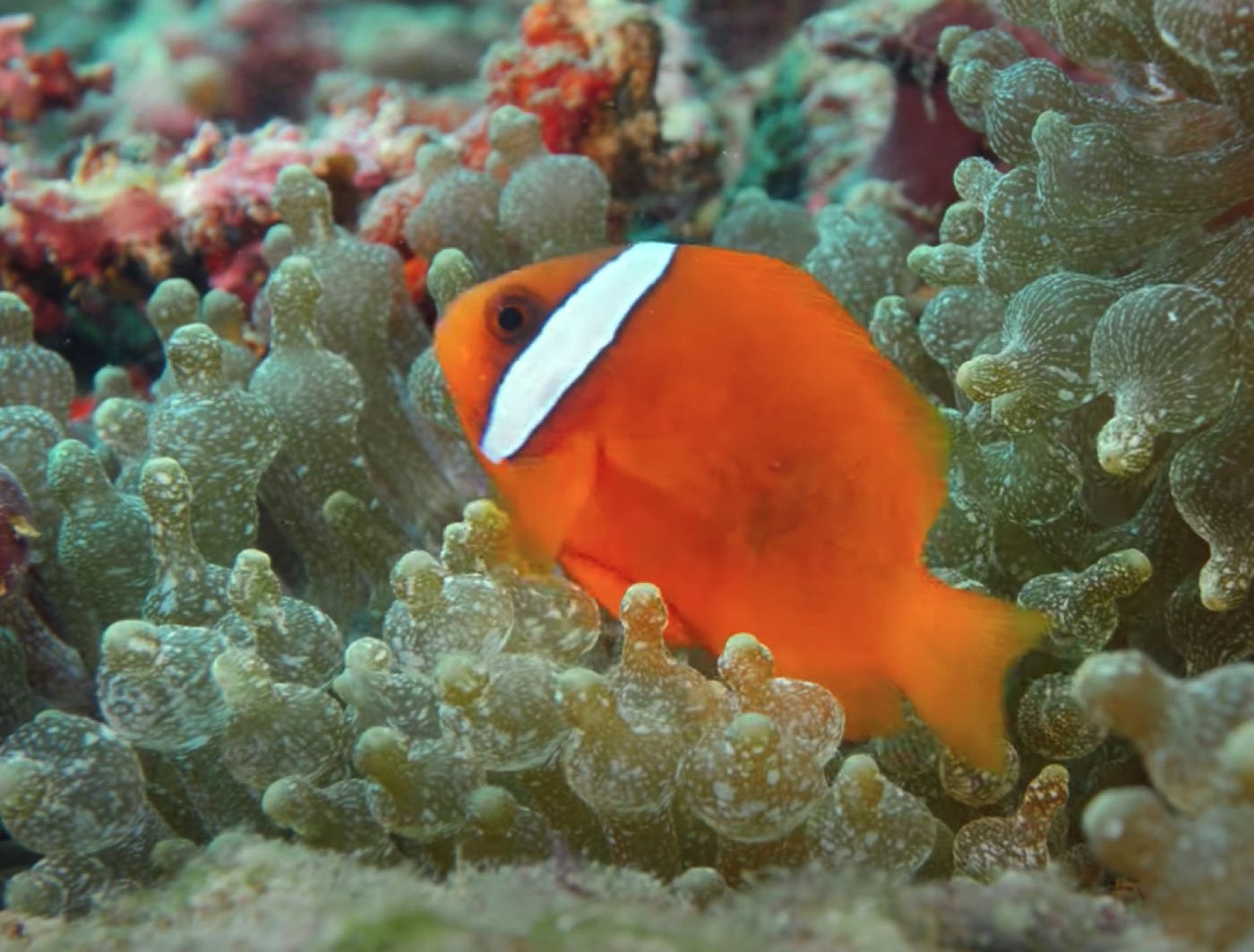
Clownfish are demersal spawners. This photo shows a female
A. leucokranos depositing eggs on the liverock. The male waits nearby to fertilize the
eggs. Photo: James Wiseman
A female banggai cardinalfish(Pteragon kauderni) releasing
eggs to the soon to be mouth brooding male. Photo: saltwaterhobbyist.com
Early in elementary school we learn that there are boys
and there are girls, and that there are very basic differences between the two. Not all
fish, however, even though they may often be found in schools, have learned this lesson.
Individuals of many species change their gender according to age, social standing,
presence or absence of other males or females, and sometimes even just according to who
spawned first. There are terms to describe these various sexual scenarios and if you are
going to work with marine fish reproduction and propagation, you should know about them.
The males and females of some species are genetically firm at birth and their sex does not
change at any point in the life cycle. These fish are termed gonochoristic and the
condition is gonochorism. Many species of marine fish are hermaphroditic, a
condition where both sexes are present in the same individual. This can occur as sequential
hermaphroditism, where male and female organs may mature in a single individual at
different times in the life cycle, or as simultaneous hermaphroditism, where both
sexes are mature at the same time in a single individual.
The belted sandfish, Serranus subligarius, and the
butter hamlet, Hypoplectrus unicolor, are examples of simultaneous hermaphrodites.
Each individual can produce both eggs and sperm, but they always spawn with other
individuals and produce either eggs or sperm according to the social interactions that
occur before and during the daily spawning cycle. In some species, such as groupers, the
female phase occurs first in the life cycle. These fish are known as protogynous
hermaphrodites, and the condition is protogyny. When the male phase occurs
first, as in clownfish, the fish are protandrous hermaphrodites, and the condition
is protandry. Usually, once a sex change has occurred in a fish in either
direction, it is apparently not reversible, but there is some evidence that suggests that
a protogynous Pomacanthid angelfish, Genicanthus lamarck, reared in captivity from
a juvenile may have begun the change from female to male, and then reverted back to
female. Interestingly, some species of wrasses and parrotfish have primary males,
which are born male, and secondary males, which become males after having been
females. Some species of guppies, Poeciliidae, and silversides, Atherinidae, are all
female, and produce eggs with a complete complement of genetic material and do not need to
be fertilized, although sometimes a sperm from a related species is used to stimulate
development.
Proud sponsor of this column
A male banggai cardinalfish (Pteragon kauderni) mouth
brood a new batch of fry. Note the eyes peeking out of the mouth. This male has been
holding for over 20 days. Photo: Adrian
Many fish species show sexual dimorphism, a
condition where males and females are different in form and/or coloration thus the sexes
can be distinguished externally. Perhaps the ultimate in sexual dimorphism occurs in the
deep sea Ceratoid anglerfish. The female is basically a "solitary, floating, baited
fish trap" while the male who found the female when he was still a juvenile, has
attached onto her and soon becomes little more than a permanently joined parasitic
appendage with well developed male sex organs. Those species that show only differences in
coloration between the sexes are said to display sexual dichromatism, and others
show no external characteristics that distinguish sex. The wrasses, Labridae, and the
parrotfishes, Scaridae, are famous for their often very great sexual dichromatism,
sometimes to the extent that males and females were initially described as different
species. There are three classes of sexual morphism; monomorphic fish show no
differences in form or color between the sexes. Fish that are temporarily dimorphic or
dichromic show color differences in color and/or form during the breeding season or
differences in color just during courtship and/or spawning. Permanently dimorphic or
dichromic fish are always different in color and/or form. Sexuality in fish is quite
complex and we still have a great deal to learn about sex and reproduction from fish, but
knowing the above terms will be helpful in sorting out who is who, and what, and when, in
the aquarium.