Marine
worms are one of the most abundant forms of life in the ocean.Their abundance is due to their adaptability.Starting with a basic body plan, evolution has shaped many
different species to occupy many niches, both aquatic and terrestrial.Worms from the Class Polycheata (or “many spines”) alone make
up over 8000 described species.One
Family of polychaete worms, the Amphinomidae have spines, called setae,
that have evolved to contain venom as a form of defense.These are often aptly referred to as “fireworms” because
their spines break off easily and penetrate the skin of an attacker,
which results in a sensation that “burns like fire.”Another term sometimes used is “bristleworm,” but this is a
general term referring to all polychaetes.I will restrict the usage of the term “Fireworms” to those
belonging to the genera Hermodice, Eurythoe, Chloeia, and Amphinome.Although these animals have a bad reputation with aquarists,
especially reef-tank owners, they are actually extremely amazing
creatures. But this hardly quells the concerns of reef-tank owners who
are unlucky enough to have them show up in their aquarium.I use the term “unlucky” because it really is a case of luck
that one would appear in a tank.While the chances are very good for other species of
polychaetes to arrive as epibionts on live-rock, true fireworms are a
rare find.Most cases of
“fireworms” being found in aquaria are actually some other kind of
polychaete, which in most cases may be benign or even beneficial.Since most people are only concerned with getting rid of them,
there is not much information on how to keep them.I think the overall attitude about them would change if people
kept them long enough (in a separate tank of course) to get to know
them. I will give a brief background on them and describe their
husbandry requirements for people who would actually like to keep them
around.
Fig. 1.A twelve inch Fireworm, Hermodice
carunculata, foraging for food.Bristles are not flared.
Fireworms,
especially Hermodice carunculata and Eurythoe
complanata, can be found throughout the Gulf of Mexico,
Bahamas, and the Caribbean.H.
carunculata is a predatory species feeding on almost any
sessile animal it can catch, but having distinct preferences if
given an option.In
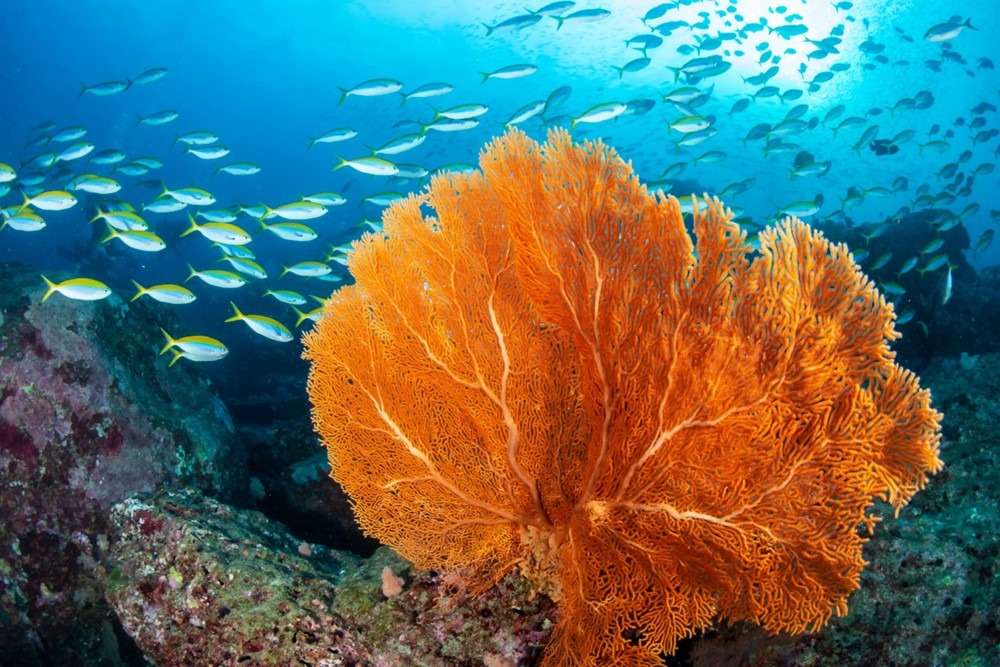
particular they feed on corals, hydrocorals, gorgonians, and
anemones (Is it any surprise that reef-tank owners detest them?).They also have preferences of species within those groups.The effects of predation on certain groups can be
substantial.Witman
(1988) calculated that tissue predation by this worm on Milleporid
Hydrocorals (firecoral) exposed 12.9cm2 per 1.0m2 per day of
skeleton to algal colonization.
Another
favorite food item of H. carunculata is the Atlantic Carpet
anemone, Stoichactis
helianthis.This
anemone has developed a defensive behavior just for dealing with a
fireworm attack.Lizama
and Blanquet (1975) described this behavior after watching H.
carunculata attack numerous anemones.Fireworms feed by everting their buccal mass, a muscular
area comprising the pharynx and esophagus, over a portion of the
anemone.Rippling
muscles and secreted enzymes serve to breakdown the material and
ingest it.The
anemone reacts upon contact with the buccal mass by detaching its
pedal disk from the substrate that it was anchored to.Wave action from the environment causes the anemone to toss
about in the water, eventually dislodging it from the grasp of the
fireworm.
Yet
another favorite food of H. carunculata is gorgonian tissue.In an effort to estimate the effects on gorgonian community
structure due to predation by H. carunculata, Vreeland and Lasker (1989)
performed an experiment to determine preferences that this fireworm had
for various species.Gorgonians
have various types, sizes, and densities of Sclerites (CaCO3
spicules) that Harvell and Suchanek (1987) suggest deter predation.Lack of nutritive value and secondary chemical compounds that may
be distasteful, toxic, or inhibit digestion (Tursch et al., 1978) were
also suggested as predator deterrents (Ciereszko and Karns, 1973).These three factors were analyzed and compared by Vreeland and
Lasker (1989) to the preferences that H. carunculata had for the various
species.What they found is
that there was no single factor could be used to predict preference.However, it is interesting to note that some species with the
highest level of secondary compounds were sometimes the preferred prey
item.The authors suggest that the worms may sequester these toxins
in their body as a source of protection in addition to their venomous
setae.
Most
soft-bodied worms must remain nocturnal, or buried in sediment, or under
rocks during the day in order to avoid predators.H. carunculata, however, is able to be conspicuous by
moving about during the day in search of food.This is due to the protection they receive from their venomous
setae and possibly sequestered gorgonian toxins.Although Marsden (1962) claimed that this animal never appeared
in the middle of the day and could only be seen after 4:00pm or before
9:00a.m, a more intensive survey by Lewis and Crooks (1996) found them
out at all times during the day, with the highest abundance visible at
about 4:00pm.There
appeared to be a cycle to the foraging activity, starting off slow in
the morning, getting more intense towards the afternoon, then
diminishing again as dusk settled.The unusual daytime activity along with their large size,
conspicuous tufts of bristles, and beautiful colors is what made them a
good candidate for public display.
In
April 2001, I set up a 100-gallon display tank at Mote Marine Aquarium
solely for fireworms.To my
knowledge, this is the only fireworm display in the world.It is a 4’tall by 2 ½’ wide half-cylinder tank with an
artificial coral wall, which extends up the entire back, that was
constructed by the aquarium staff especially for these animals.The preferred habitat of fireworms is rocky areas.The wall was made to create small crevices to give the worms a
sense of security without allowing them to be completely hidden from
view.Extra care was taken
when building the fiberglass wall not to leave any open holes where
worms could crawl into and hide.Two
species of fireworm are present in the tank.They are H. carunculata and E. complanata.Even with all the care taken to patch the small holes in the
rockwork, E. complanata was able to find some VERY tiny holes we
overlooked and are rarely visible.This species is a scavenger that, like most other worms, spends
the daytime hiding, emerging at night to feed.For these reasons, I don’t suggest using this species in a
situation where you expect them to be seen.H. carunculata, on the other hand has worked out quite
well.
The lighting on the
display is dim compared to most of the others.While there is only about eighteen watts of light on the
four-foot deep tank, the worms are still very visible.When the display was originally opened, I had set a timer
for the lights to come on earlier than the other display lights,
but still mimic a natural twelve hour cycle.This was to try and induce their 4:00pm peak activity to
occur during our busiest visitor hours to the aquarium, which
actually occurs earlier in the day.Although Marsden (1962) found that these animals retained
this pattern of activity in the laboratory, we did not find this
to be true with our animals.The only stimulus that we found to be reliable for inducing
activity was introducing food to the tank.
Although H.
carunculata prefers the tissue of Cnidarians, it will readily
accept and thrive on alternative foods in captivity.These include: squid, clam, shrimp, krill, mysid shrimp,
mussel, etc.Our
worms are fed once daily and seem to grow at an appreciable rate.They would probably accept more feedings and grow faster if
given the opportunity.Even
with our reserved feeding schedule, our worms obtain a length of
fourteen inches, which is a size that is two inches longer than
what the literature cites as being the maximum.Please note that the worms are capable of stretching out a
great deal when crawling.I
do not know what the standard method for measuring them is, but I
measured them while in a resting position.
Fig. 2.Another color variation of Hermodice
carunculata.Note
rows of white tufts of bristles.They are flared out as a defensive response.
Feeding
behavior is one of the more interesting aspects of keeping these
animals.Measuring the
diameter of the worm and squaring that number makes an estimate for the
size of the food item that they can take.The worm will swallow the piece whole. A specialized head
appendage, called the caruncle, is used to locate food.The worms will become very active and start searching once food
is introduced to the tank.They
have to come into direct contact with the food item before they will
begin their feeding action.Sometimes
they will crawl by a piece of food that is one inch from their head in
their frantic search.For
this reason, it is probably best to stick-feed them if they are in a
large tank so there is no uneaten food remaining.Sometimes they will crawl up the back of the tank and stretch out
so that their mouth is along the surface of the water.By dropping a piece of food directly onto the searching
mouth, it is possible to get an up-close look at how their mouth
functions.
In
addition to being easy to feed, they are quite
tolerant of water quality as well.I have not found them to be demanding with any
respect to water parameters.A salinity of35
(or SG 1.026) is good for them as it is most marine
invertebrates.Temperature
should be between 70F and 82F, although they can
probably tolerate extremes on both ends.They do seem to be delicate when acclimating
them after being shipped overnight.This usually induces a severe spawning response
that sometimes leads to the death of the animals.Fireworms spawn by releasing games through
ruptures in their cuticle.Often this response is so great when
acclimating them into new water that the ruptures can
sever the worms into pieces.Although some of the pieces may heal and
regenerate, they are quite small compared to the
original worm.I
have not pinpointed what parameter change causes this,
but it is interesting to note that they are able to
withstand 75% water changes without the problems
associated with acclimation post-transport.Perhaps it is the pH increase associated with
acclimation after being transported in water where the
pH declines.
Fireworms
do spawn on occasion in the display.It is a good idea to have a protein skimmer to
remove the cloudiness as a result of the waterborne
gametes.Be
sure not to have micro bubbles entering the tank
though.Any
bubbles that are small enough to remain suspended in
the water can become lodged in the tufts of bristles
that span the worms.Although this is not a problem temporarily, it
may cause stress if they are exposed long term.
Any
irritation to the worm, whether it’s from bubbles or
any other kind of physical disturbance, will result in
spines being released.These will drift around in the water for some
time.It
is a good idea to wear full-arm gloves when working in
a tank with a large number of fireworms as even
free-floating spines can cause envenomation.You do not have to contact the worm directly to
experience its defense.Any direct contact should be made with forceps
or another utensil.
If
you do happen to become exposed to fireworm spines,
Nellis (1997) recommends that the spines be removed by
applying adhesive tape on the wound and then removing
it.Rubbing
alcohol my help alleviate some of the pain.Remember, these worms don’t just deserve
respect, they command it.
Proud
sponsor of this column
References
Ciereszko,
L.S. and Karns, T. K. B., 1973.Comparative biochemistry of reef coelenterates.In, Biology and geology of coral reefs, Vol. II, Biology, 1, edited by
O.A. Jones and R. Endean, Academic Press, New York, pp 183-203.
Harvell,
C.D. and Suchanek, T.H., 1987.Partial
predation on tropical gorgonians by Cyphoma
gibbosum(Gastropoda).Mar. Ecol. Prog. Ser., Vol. 19: 181-187.
Lewis,
John B. and Crooks, Richard E.,1996.Foraging cycles of the amphinomid polychaete Hermodicecarunculata preying on the
hydrozoan Millepora complanata.Bull. Mar. Sci., Vol. 58(3): 853-856.
Lizama,
J. and Blanquet, R.S., 1975.Predation
on sea anemones by the amphinomid polychaete Hermodicecarunculata.Bull.
Mar. Sci., Vol. 25: 443-443.
Nellis,
David W.,1997.Poisonous Plants and
Animals of Florida and the Caribbean.Pineapple PressInc.
Sarasota. pp. 259.
Tursch,
B., J.C. Braekman, D. Daloze and M. Kaisin, 1978.Terpenoids from coelenterates. In, Marine
natural products, chemicals and biological perspectives.Vol. II, P. J. Scheuer ed., Academic Press,New York, pp. 247-296.
Vreeland,
H.V. and Lasker, H.R., 1989.Selective
feeding of the polychaete Hermodice
carunculataPallas on
Caribbean gorgonians.J.
Exp. Mar. Biol. Ecol., Vol. 129: 265-277.
Witman,
Jon D., 1988.Effects of
predation by the fireworm Hermodice
carunculata on milleporid hydrocorals.Bull. Mar. Sci., Vol.
42(3): 446-458.