Figure
1) The 75 gallon reef aquarium of Tom Sandercock, Highland
Park, IL USA
(Click
on any of the images in the article below to view it in
full size)
Fig.
2) Complete system in dining room. The empty wine
bottles on the top are used to drip Kalkwasser and
makeup water. The small volume prevents overflow if
(when) the float valve fails.
Introduction
I have set up
several reef tanks. Currently, 5 marine tanks are placed
in various rooms around my house. I find the difference
between the tanks a source of amazement. Each has its individual
personality in terms of behavior of the organisms that dominate
over time. The 75 gallon featured in this article is the
first tank I established. It has been the main source of
material for all of my other tanks. The procedures I used
on this tank are the most conventional. This may be the
reason the tank has remained the most stable and productive
of my tanks.
One of the
goals of this tank was to keep it inexpensive. I initially
spent about a year deciding what size tank to set up. I
wanted to place it in the dining room. I wanted as large
a tank as possible without dominating the room. Because
of its public location there were some constraints—it had
to be self contained and look good. While, my son thought
that large skimmers were cool, my wife was less than enthusiastic
about a large skimmer placed next to the aquarium. There
were endless possibilities. Finally, I was offered a free,
beat up, 75 gallon with pine stand. I thought I would begin
with this and later upgrade the tank. Now I realize that
there is so much effort in setting up a tank that I will
not upgrade until some disaster hits the 75 gallon. Anyway,
by painting the stand and the plastic strips on the tank
to match the paint in the room, it looked pretty good and
fit in with the dining room. I did not have to make a decision
about what tank to buy. I was ready to begin.
Given the theme
that this was a starter tank, it made little sense to spend
a lot on the associated mechanical systems. The tank came
with a wet-dry filter. I removed the media and used it as
a sump. I built the lights and calcium reactor myself. I
purchased a VHO ballast, pumps, protein skimmer, mechanical
float valve, heater, fan, and temperature controller. Total
spent on hardware was well under $1000.
Fig.
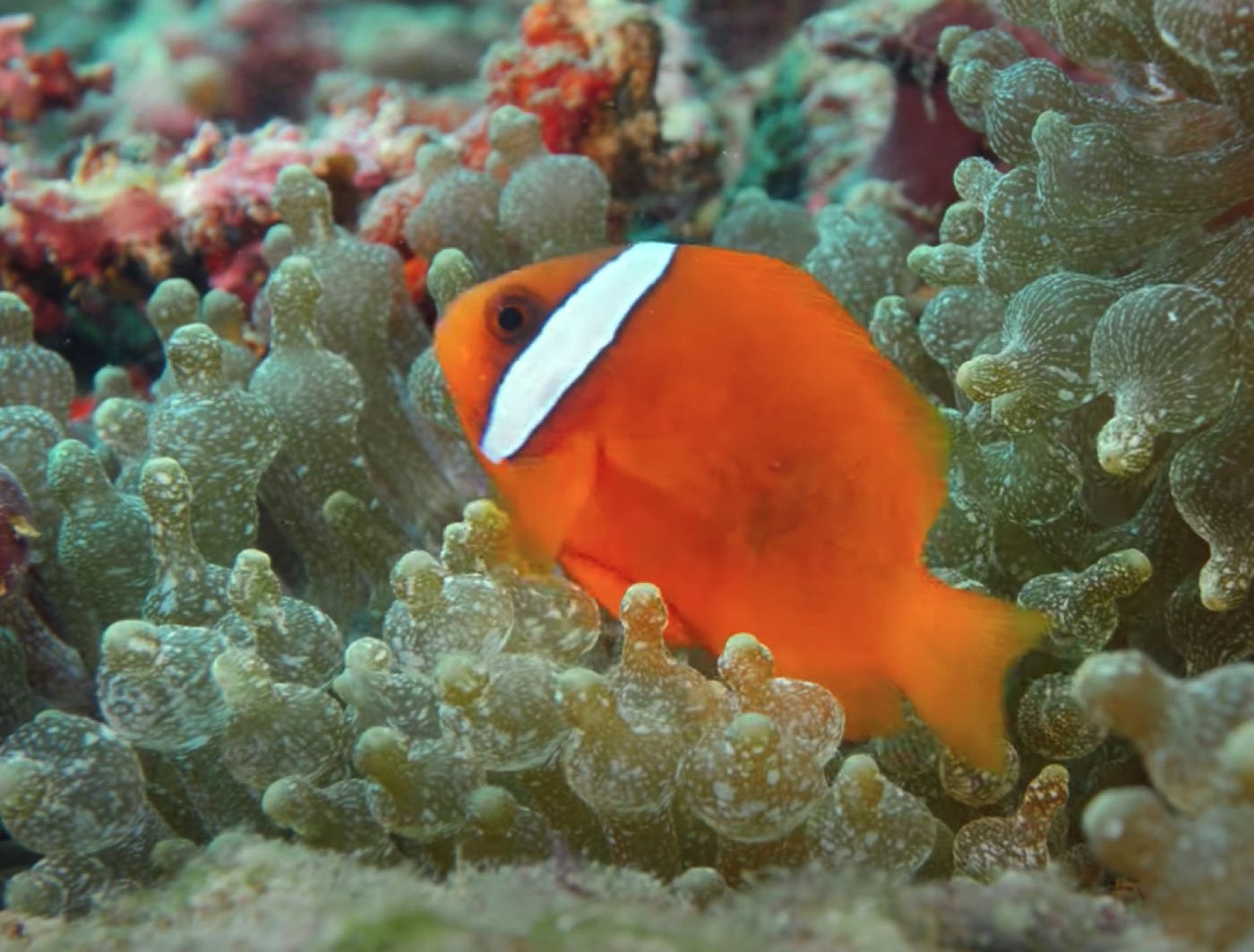
3) A pair of clowns have made the large colt coral
their home. They spawn regularly on one of the aquarium
walls near the coral.
Another goal
was to keep the tank robust and easy to maintain. There
are many reasons to set up a reef tank. I am personally
fascinated with balanced ecosystems. I take great pleasure
in watching the organisms thrive and reproduce. The less
intervention that is needed--the happier I am. In general,
I favor biological solutions compared to technological ones.
I am unwilling to undertake special feeding regimes for
a particular organism. Others are interested in keeping
unusual, in some cases expensive, organisms. I am quite
content to grow the most common corals. For example, my
favorite coral, the Colt Coral, is also one of the easiest
to grow (Fig. 3). Its dominating size has made it a focal
point in the tank. Another favorite is the Green Bali Acropora
(Fig. 4). It has shown spectacular growth over time. I estimate
that I have given away, killed, or discarded about 5 times
the volume of coral shown in Fig. 4.
I
established the tank in the fall of 1998. I purchased 80
lbs of Fiji live rock and waited several months before adding
my first corals. Because I lacked the confidence that I
could keep coral alive, and also, because this was a “cheap
starter tank,” I purchased small frags to start. These corals
came from frags exchanged at out local club (Chicagoland
Marine Aquarium Society) and frags raised at two local stores
(A Splash of Life and Harbor Aquatics). The first photo
(Fig. 5a) shows the aquarium after 7 months. The corals
that later dominate my tank are all present in this photo.
They include: Colt, Brain, Green Bali Acropora, Mushrooms,
Euphyllia sp., Caulastrea sp., Tonga Yellow
Leather, and Pumping Xenia. The picture also shows a Scarlet
Dendronepthia that was sold to me by a local store. They
assured me it was photosynthetic. You might notice it is
not present in the later pictures. After one year I was
confident I could keep corals alive and started to purchase
larger and more expensive specimens. In general, they did
not fare as well as the local frags, and have either died
or been moved to other aquariums. In the first year I also
purchased my first fish. They were locally raised clown
fish (Amphiprion ocellaris). They can be seen in
Fig. 5b and 6b. In Fig. 5b they had not yet discovered that
a Colt Coral could make a satisfying home, but rather hovered
over the Brain coral. My other fish, a Yellow Tang (Zebrosoma
flavescens), and a locally raised Banggai Cardinalfish,
were added at about 2 years.
It is apparent
in Fig. 5, that by the third year, the tank is mature. The
basic appearance of the tank has not changed much since
then. Many of the corals had reached the largest size that
I could maintain in this aquarium. The Colt, mushrooms,
and Pumping Xenia have to be pruned back to prevent damage
to the other organisms. The Euphyllia sp., Caulastrea
sp., and Montipora capricornis are limited
in size by the fragility of their skeletons. They periodically
break and must be restarted with the frags. The SPS corals
would grow large, shade their base, and then catch white
band disease. I used large cuttings from the dying corals
to reestablish the colonies. I now prophylactically chop
them up for frags before they self-destruct. Some SPS corals
have been removed because I could not maintain attractive
large colonies and they were spreading like weeds to undesired
locations. Montipora digitata, Fire Coral, and Pocillopora
damaicornis fall in this category. Some corals, Turbinaria
sp., Brain, Porites sp., Tonga Yellow Leather,
Cynarina sp.,Ricordea florida, and Zooanthids
have slowly grown over time and I have not yet had to face
reducing their size.
Fig.
4) Green Bali Acropora. In this photo the coral is
encrusting the back wall of the tank, giving the overall
green color to the photo. Experience has shown me
that when it encrusts the back wall it is particularly
susceptible to shading followed by white band disease.
I no longer allow the coral to encrust the back wall.
Fig.
5) History of the tank. Left column, from top, age
of tank: a) 0.6, b) 1.2, and c) 2.5 years. Right column
from top: d) 3.0, e) 4.1, and f) 5.1 years. The different
colors are a result of using different cameras, the
lighting has remained constant. All the prominent
organisms shown in the last 2 years appear as frags
in the first photo.
This 75 gal
tank has been my favorite tank to photograph. The combination
of daylight and actinic bulbs provides good color, particular
my digital cameras. Figs. 4 and 6 show my favorite photographs
taken of this tank.
Fig.
6) Pictures of assorted organisms. Left to right
from top row down:
a)
Blue Mushrooms, b) Softie end of the tank, c) Brain
Coral, d) Star Polyps, e) Caulastera sp.,
f) Tang in front of Yellow leather, g) Seriatopora
sp., h) i) Macro of tentacles, j) Clownfish,
k) Green Mushrooms, l) Zooanthids, m) Ricordia
florida
Click
on any image to view it in full size (with captions)
In
summary, this tank has been very rewarding. While spending
little money, at least in reef aquarium terms, I think I
have achieved a very attractive tank. It remains my favorite
tank and the most photographed. It is quite robust. I highly
recommend that someone setting up their first reef tank,
use small frags taken from other hobbyists. They tend to
be hardy and quickly grow into the space available. However,
in spite of the rapid growth and health of the corals in
this tank, I have not fully achieved the goal of an easily
maintained tank. The tank requires weekly maintenance. The
balance of the organisms in the tank is constantly changing
and requires my intervention keep a mixture of organisms.
Filtration:
* Protein skimmer – Top Fathom 100
* 80 lbs of live rock — I started with 80 lbs of Fiji rock.
Since then approximately half has been removed to start
other aquariums. I replaced the rock with dead coral skeletons
or aragonite rocks. The dead rock is now indistinguishable
from the Fiji rock.
* 1" live sand
Lighting:
* 2 x 110 watt VHO, daylight
* 2 x 110 watt VHO, Actinic
* 1 40 watt NO florescent, daylight
Lighting
schedule:
* VHO 9 hours
* NO 14 hours – allows viewing tank during dinner without
blinding the diners
Calcium
and alkalinity (no other additives used):
* homemade Calcium reactor
* Kalkwasser is used for the makeup water
Water
Circulation:
* sump with 700gph pump—overflow in rear center, returns
at both ends
* 2 powerheads—both at one end of the tank to provide a
clockwise flow in the SPS zone (right side of tank)
* no additional circulation in the soft coral zone (left
side of tank)
Cooling:
*3 inch fan in hood—Its purpose is to keep bulbs cool and
prolong their life. It is turned on with the VHO lights.
*4 inch fan blowing across the water—It keeps the tank cool
by evaporation. It is under servo control to maintaine the
temperature at 79 ±1 °F.
Maintenance:
* 5 g water changed weekly
* corals pruned as needed
* glass cleaned weekly
Water
Parameters:
* Calcium 400-450 ppm
* ALK 2.5-3.0 mEq/l
* S.G 1.025
* Temp 78-80 °F
* Nitrate and Phosphate un-measurable with LaMotte test
kits