What
can a hobbyist learn from the natural environments? Many things,
but you have to look closely.
Proud
sponsor of this column
Proud
sponsor of this column
Currently
the marine aquaria hobby is experiencing a growing trend in
natural systems. By this I mean natural filtration, natural
nutrients, compatible inhabitants, natural lighting, and an
overall goal of a simplified self-sustaining system. The tendency
for advanced hobbyists to pursue natural settings makes sense
as these hobbyists begin to learn more about the world's reef
systems. It is a love for the reefs (and for marine life in
general) that causes people to join the hobby, and also to venture
to far off lands to see the wonders of coral reefs. It is important
when viewing natural coral reef systems to see beyond what is
termed the "Charismatic Megafauna". In other words those items
of great color, texture, beauty, intrigue and overall appeal.
Items falling into this category are of course very large fish
(sharks, parrotfishes, and the like), marine mammals (dolphins,
whales, sea lions), and brightly colored corals. After all,
once you see past those items, you can see the small, but important,
items that make a coral reef what it is.
Although
impressive, large animals like this Spotted Eagle Ray
are often distracting to the small wonders seen on a living
coral reef
There
is a great opportunity for hobbyists now taking place. Not only
has the hobby recently progressed to a time where captive marine
animals are possible, but the technology for scuba diving and
distant travel are now available. This opportunity will allow
many current and future hobbyists to see and learn things like
never before. As my saying goes "swim far see more, swim little
learn more". This summing up the experiences of many divers
who after time learn that in the small nooks and crannies of
a reef we find all the interesting elements which contribute
to our love for these wonderful systems.
Fish
Large
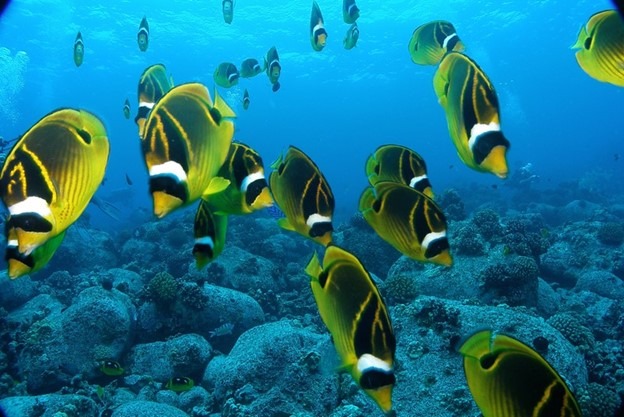
schools of fish are impossible to miss seeing along a healthy
reef. For aquarists accustomed to seeing a few fish in a small
enclosed area the sight of dozens and even hundreds of fish
swimming in a wide open space is exhilarating. Other fish may
live as a pair, and will travel around with their "spouse" continually
searching for food. Other fish will pair up as mates and live
in a solitary location for years. Some fish play an important
role in cleaning other fish, and are found chasing after the
other nearby inhabitants. Other fish simply clean up after fish
as the follow them in search of food. But the most difficult
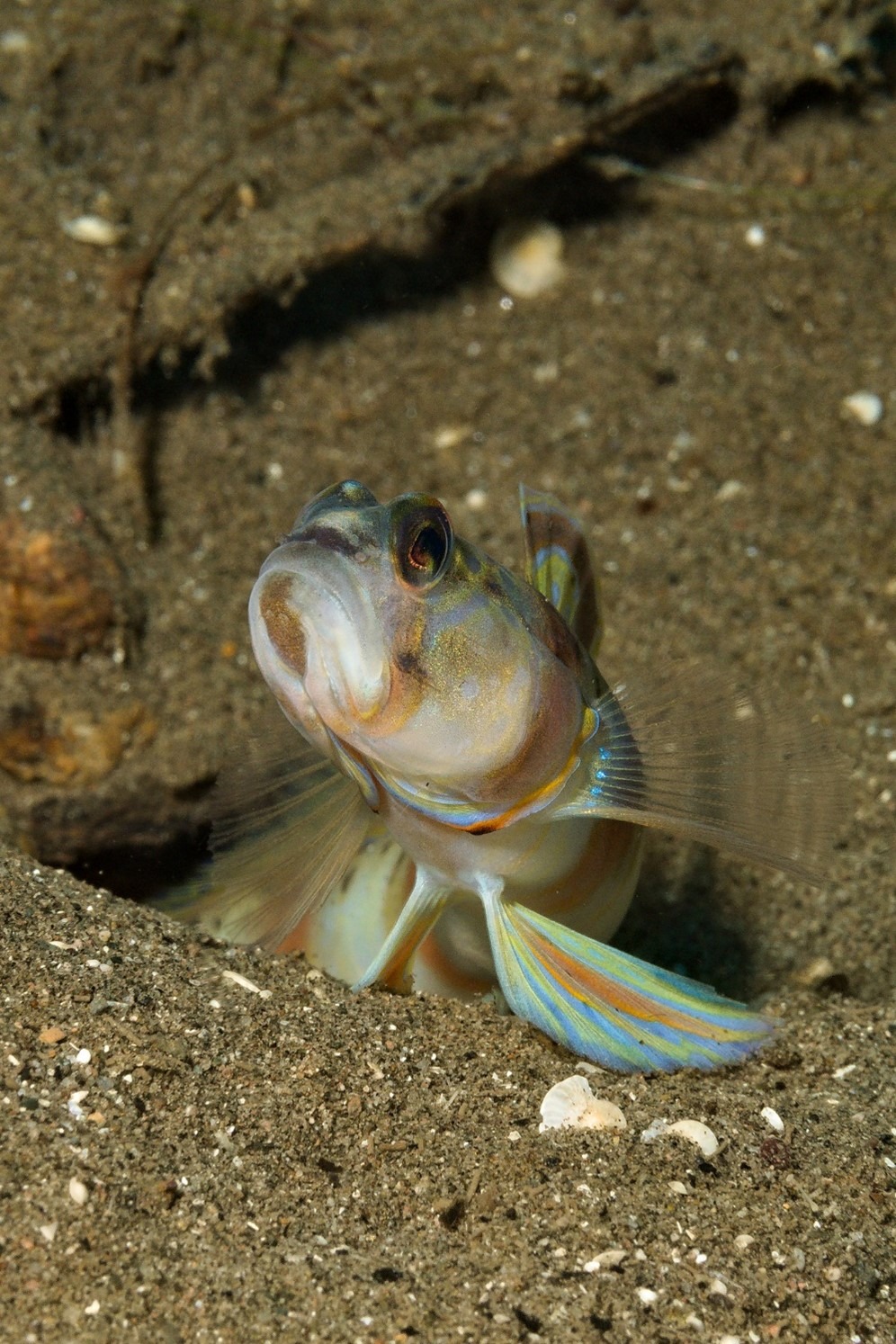
fish to see may be those which are right in front of you. Slowing
down, and training a careful eye, allows a diver to see beautiful
fish sitting motionless as they perch on a coral outcrop and
sit hiding among the coral shelter. Hidden by the cover of corals,
or camouflaged within the fields of macro algae are thousands
of interesting fish. Often easily frightened many of these fish
are only seen by the careful and patient diver.
Proud
sponsor of this column
Proud
sponsor of this column
Algae
Many
aquarists know that algae can play an important role in the
natural aquarium It serves as a food source for many animals,
as a filtration source, a breeding site, and completes the aesthetics
of the captive aquarium. In certain regards algae fulfils those
same aspects on a reef. But how much algae is on a reef? What
does it look like? Only by taking the time to look closely can
we know.
Seeing
the different locations of different algal species helps people
to understand the needs of what we keep. Algae species may be
easy to see, or difficult to find. How and where they grow can
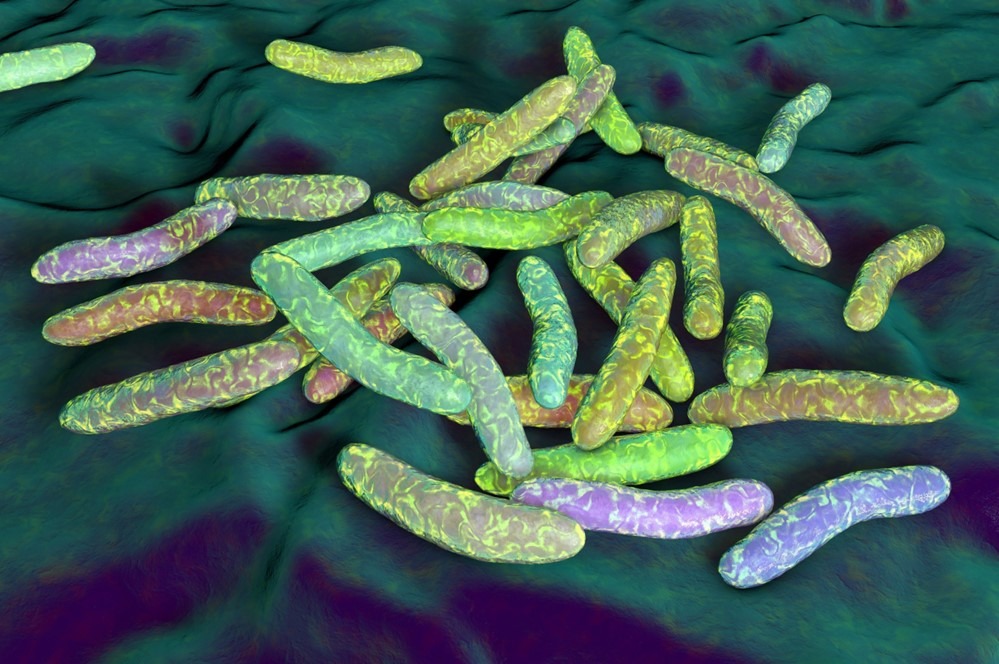
be very insightful. In addition to standard macro algae, cyanobacteria
and types of hair algae are also commonly found on coral reefs.
All of these items contribute to the make up of a reef and serve
as important indicators of the overall health of a reef system.
Many
fishes can be found grazing on algae through out the day. Other
fishes defend an area and allow the algae to grow (basically
acting as "fish farmers"). While herbivory is obviously important
to a given fish, providing nutritional value, it is also important
to have these fish for the corals. Algae often competes with
coral for space and can over take a reef in the absence of herbivorous
fish and invertebrates.
Motile
Invertebrates
Seastars
(previously referred to as Star Fish) are important in their
roles as clean up invertebrates. These are frequently purchased
by aquarists to aid in filtration and consumption of small organic
waste particles. Rightfully so I might add. They serve the same
purpose in many reef systems, even though they are not frequently
seen. Don't let their lack of sighting mislead you, they are
abundant. Underneath rocks and hidden with the substrate of
reef systems are literally thousands of sea stars. They feed
off of small organics and are important in the nutrient breakdown
and recycling processes on a reef.
Sea
Urchins are common on reefs, as well as in the aquarium hobby.
As aggressive herbivores these animals are important to the
overall stability and growth of coral systems. Their spiny ball
appearance makes them truly unique. Combined with their nocturnal
tendencies these echinoderms are very attractive. Many aquarists
note that after the death of an urchin they discover the beauty
of the remaining skeletal structure. However, not surprisingly
these structures are quickly broken down in the aquarium. In
fact even in natural systems that are overly abundant with urchins,
chances of finding the remains of an urchin in tact are very
rare. Shrimp, crabs, lobsters, and more all play important roles.
Although difficult to find and often overlooked, these animals
can all be found by looking closely in the hidden areas of a
reef. Many of these species are defenseless to larger fish,
and are therefore nocturnal. Others may rely upon the defenses
of commensal partners like anemones to offer protection for
them. Striking colors and patterns make many of them of desire
to the home aquarist. When making these purchases it is important
to know the behaviors of the species to understand the habitat
requirements and needs in the captive setting.
Proud
sponsor of this column
Proud
sponsor of this column
Sessile
Invertebrates
Using
living marine sponges in an aquarium is gaining popularity.
The role sponges play on the reef is not well known. Their ability
to filter water as they grow is of interest to the hobbyist.
Unfortunately seeing sponge growing on a reef is not that helpful
to the aquarist. However, seeing where the sponge is growing
may be of great help. Differing sizes, textures, and colors
of sponges are often seen by divers, but rarely used by the
beginning aquarists.
Sponges
growing on reefs are often seen under ledges and overhangs.
Clams,
oysters, and scallops are also frequently found in many reef
settings. These bivalves are unable to travel for food, and
are therefore confined to living in areas where food is brought
to them. This is of huge importance to their life cycles, and
should be of great importance to the hobbyist. Not only do these
animals need phytoplankton and zooplankton fed to the aquarium,
but they need a delivery system to bring the food to them. Water
motion typically serves this role in the aquarium. Considerations
for surge, waves, direct, still, alternating and velocity are
all important when trying to replicate their natural settings.
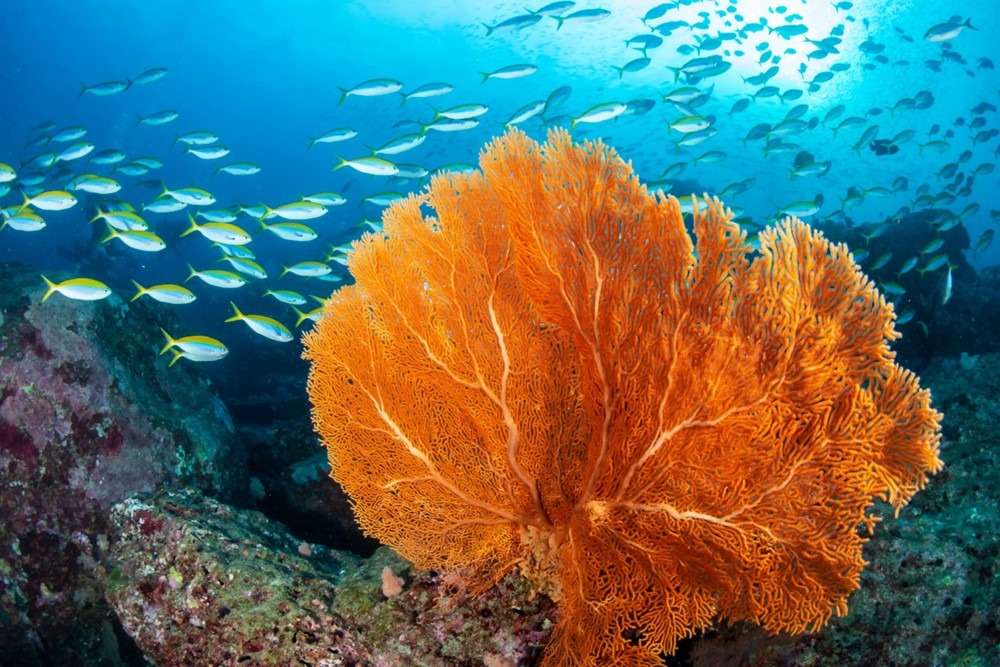
Corals
Of
course the greatest love to most marine hobbyists are the corals.
Whether true "stony" corals or other related cnidarians, the
corals are the main attraction on coral reefs. The first time
you see a healthy coral reef can be overwhelming. Aquarists
who are accustomed to buying and seeing corals the size of their
hands are now surrounded by corals the size of their cars. This
visual experience can be enlightening and educational to say
the least. Yet if you look close you will see that those corals
are comprised of the same small polyps as you've always seen
before. Large pillar corals are captivating to the eye but just
as impressive are fields of small branching stony corals. The
motion of soft corals like fields of corn blowing in the wind
are almost mesmerizing. Looking past these corals, and into
smaller areas, divers can find all sorts of rare and unique
corals. Fighting with each other competing for space these corals
spend thousands of years battling for a chance to grow and reproduce.
All the while building the largest living structures on the
planet. These large creations of small origin are marvelous
as they display a rich mosaic and tapestry of color and shape.
The brilliance of the blue color in some corals is enough to
make any aquarist pause for a moment as they gaze at the beauty
before them. At the same time that this beauty is seen, another
perception can take place. Coral reefs are in fact very "junkyard"
looking when viewed with different intentions. They are a heaping
pile of rubble covered with growth. Upon and within this growth
are masses of bugs and scavengers (which we lovingly call invertebrates
and fish). Coral reefs are truly unique and matched by diversity
and complexity only by the rainforest realms.
Fungiid
corals are often missed by fast swimming divers as they
are found often times tucked in between other corals.
Conclusion
It
is important to look closely at your aquarium, as it is to look
closely at a reef. Many small elements are contributing to those
living ecosystems. The more you see, and the more you learn,
the better you can be at creating the habitats you want.
Acknowledgements
I would
like to first thank Bob Fenner for his generous help and support
of this project. To a dear friend of mine, Thanks Bob. I would
also like to thank Kyrsten Silcox and Mike Kaechele for their
help with computer services and imaging for this article. Finally,
a thank you for the support and publication of this project
by the Advanced Aquarist Online Magazine.
Author
Info
Adam
Blundell M.S. works in Marine Ecology, and in Pathology for
the University of Utah. While not in the lab he is the president
of one of the Nation's largest hobbyist clubs, the Wasatch Marine
Aquarium Society (www.utahreefs.com). He is also Director of The
Aquatic & Terrestrial Research Team, a group which utilizes
research projects to bring together hobbyists and scientists.
His vision is to see this type of collaboration lead to further
advancements in aquarium husbandry. Adam has earned a BS in
Marine Biology and an MS in the Natural Resource and Health
fields. Adam can be found at adamblundell@hotmail.com.
If
you found this article worthwhile, help support future
AAOLM publications with your generous contribution.