AN
ADVANCED AQUARIST SHORT TAKE by TOBY LOWRY D.V.M.
Sponsored
in part by:
Quarantine
of Marine Fish (Teleost) Using Hyposalinity
Hyposalinity
is not new to the aquarium industry and has been used for the
treatment of marine fish diseases for many years. The most common
salinity used and cited in the literature is 16ppt. Hyposalinity
is also commonly used as a relatively short- term bath to shock
osmoconforming parasites, causing them to fall off of the host.
This treatment has had mixed results based on opinions of different
facilities and individuals. Hyposalinity has been extremely
useful at the Oklahoma Aquarium's quarantine facilities. All
of the teleost (bony) fish systems are maintained at 11parts
per thousand salinity (1.008 SG) with the exception of the north
pacific cold water systems. Low salinity is not used or recommended
for elasmobranchs such as sharks or rays. As found at the Okahoma
Aquarium hyposalinity plays a large role in the prevention and
treatment of disease. Hyposalinity is also theorized to help
in the osmoregulation of fish with abrasions and damage to the
mucus layer.
The
quarantine system at the Oklahoma Aquarium
At
the Oklahoma Aquarium, the use of hyposalinity has been modified
from what is commonly used to a longer treatment. This treatment
lasts throughout the time the fish are in quarantine, typically
30 to 45 days pending any disease occurrence. Salinity in the
systems are also maintained at 11ppt. At this salinity, the
Oklahoma Aquarium staff has seen a more rapid resolution of
disease such as cryptocarion. The lowered salinity has also
proven to be more consistent in preventing reoccurrence of a
disease as well as new outbreaks.
When
new acquisitions arrive at the quarantine facility, the main
acclimation concerns are pH, temperature, and detoxifying the
free ammonia. The acclimation process brings the salinity of
the newly arrived fish down gradually although this is not the
determining factor in introduction of the new acusitions. On
several occasions we have received large numbers of fish at
the same time all being introduced into an empty system. In
these cases, the tank in which the new fish are being introduced
to is acclimated to the newly arrived animals. The pH and temperature
are adjusted down according to the arriving transport boxes.
Salinity in the new tank is at 11ppt (1.008 SG) and the new
arrivals are typically between 30 and 33ppt (1.023-1.027 SG).
After adjusting pH, temperature, and detoxification of the ammonia,
the animals are introduced into the tank. This is an immediate
drop of 19 to 22ppt. These animals have shown no signs of shock
or stress outside of what would be considered normal through
shipping and handling. Quite often, species generally considered
delicate and touchy to acclimate have done well in 11ppt and
feed normally the next day. In the two years the quarantine
facility has been in operation, only one case of cryptocarian
has been seen. In this case, the salinity of the system was
at 16ppt through an improper water change. Not only has cryptocarian
been eliminated as a quarantine concern, the external trematode
and protazoal infections have been reduced as well. The significance
of holding all of the quarantine tanks at 11ppt has been the
inability of these parasites to gain a foothold and reproduce.
This has been valuable in preventing the recontamination of
systems that might have occured if salinity was raised at some
point through quarantine. No noticeable difference has been
seen in internal parasitic infestations or bacterial disease.
This was the expected result as the internal tissues would maintain
a static osmolar concentration. More research is ongoing in
these areas, although it is too soon to tell if any significant
changes are occurring.
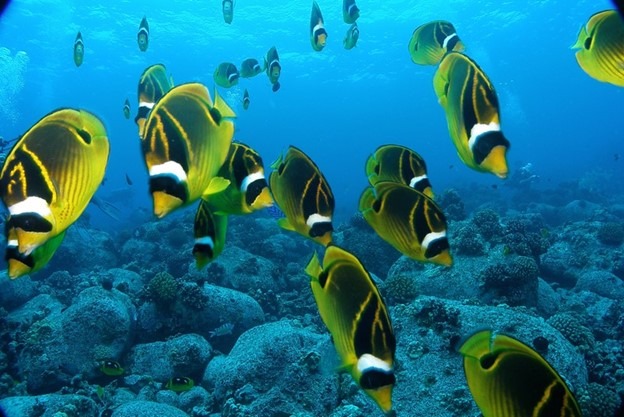
Fish
on exhibit at the Oklahoma Aquarium, all of which went
through the low salinity quarantine described in the
article.
The
other advantage that is of great interest with hyposalinity,
is the reduction of osmotic stress on fish with abrasions or
lesions. In theory, the reduction of the osmolar gradient between
the internal tissues and the surrounding environment would be
beneficial to injured mucus and epidermal tissue. This reduction
in the osmolar gradient, in theory, greatly reduces the loss
of water from the fish to the surrounding environment. The ability
to maintain hydration in an injured marine fish too small to
administer fluids could prove very beneficial. Many more studies,
which are ongoing at this time, and sample collections remain
to prove this theorized aspect of low salinity.
In
conclusion, the benefits we see with 11ppt low salinity water
have proven to be very useful to the quarantine of warm marine
teleost. The advantages it offers the aquarist in disease prevention
and treatment are very promising. The ability to treat multiple
systems through a non-invasive approach for some very common
diseases can also save time and money for a large quarantine
system. Many more studies are needed to fully evaluate the benefits
or disadvantages of 11ppt quarantine.
Suggested
Readings:
Colorni, A.
1985. Aspects of the biology of Cryptocaryon irritans and
hyposalinity as a control measure in cultured gilt-head
sea bream (Sparus aurata). Disease of Aquatic Organisms
Vol 1:19-22.
Colorni, A.
1987. Biology of Cryptocaryon irritans and strategies for
its control. Aquaculture, Vol. 67(1-2): 236-237.
Goodlett, R.
and L. Ichinotsubo, 1997. Salinity and pH adjustments for
quarantine procedures for marine teleost fishes. Drum and
Croaker, Vol 28:23-26.
Editor's Note
(Frakes) 1994. Treatment of Cryptocaryon irritans in aquaria.,
SeaScope Vol. 11, Summer.
Kollman, R.
1998. Low salinity as a quarantine and treatment of marine
fish parasites. SeaScope, Vol 15, Spring.
If
you found this article worthwhile, help support future
AAOLM publications with your generous contribution.