For
the past few months we have examined the staples of the home
fish breeders: the culture of phytoplankton species and the use
of rotifers are fish fry’s first foods. Also we discussed the
fact that a number of fish fry(such as Gobisomas
sp., Centropyge sp.
angels, Scorpaenopsis
sp. and Dascyllus sp. Chromis
sp. damsels) are too small to utilize rotifers as a
primary food item and therefore we needed to consider the
culture of helper food items to assist in the development of the
fish larvae. One such helper organism is ciliates (this species
and its home culture is described in detail below). While the
culture of ciliates is not traditional for the home breeders
they do appear to have useful applications, in so far as
ciliates seem to have potential as a larval food or a bridging
food item for marine fish and also as a planktonic food for some
invertebrates. However, this optimism must be tempered with a dose of reality: rotifers
adequately serve the basic needs of most commercial aquaculture programs and
therefore serious research into ciliate culture has been neglected. Additionally, a species
of ciliate that is suitable as a first food for small marine
larvae may or may not be found, but it seems to be worthwhile to
look for one. So why would we even consider writing a column on
raising a food item which may not be useful to the home breeder?
The answer is that in nature, ciliates are a critical (helper)
food item. Ciliates are important in the transfer of nutrient
material through coastal food webs, as these organisms act as a
link between small phytoplankton and larger zooplanktons (Reid
et al. 1991). Ciliates graze between 30 - 50 % of primary
production in many marine systems and may be the dominant group
(up to 100 %) of micro zooplankton in temperate coastal waters
(Pierce & Turner 1992). The quantitative importance of
protozoa as a food source of zooplankton is well established,
and studies indicate that qualitative aspects of a protozoan
diet may enhance survival and fecundity of some zooplankton
species. Hopefully from this description, you can see the value
of ciliate culture for the home fish breeder and understand why
we dedicated this month’s column to them.
-Introduction
by Frank Marini, Ph.D.
Photomicrographs
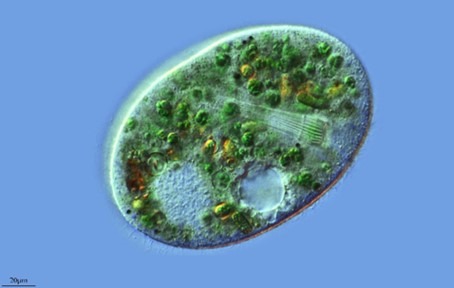
of ciliates. Close up of a single ciliate (a paramecium) with a
number of dark staining food vacuoles (photo courtesy of Mike
Morgan http://ebiomedia.com/gall/ciliates/)
A
group of cultured ciliates (200X) demonstrating internal
structures. Obvious in this photograph are the nucleus, the food
vacuoles, and contractile vacuoles -which are used to export water
and waste out of the ciliate. Photos courtesy of Wim
Van Egmond.
The
Perfect Food
The
perfect food for marine larval fish has the following requirements.
1.
It is just the right size for capture and ingestion by the larval fish.
2.
It displays the proper behavior to stimulate larval fish to feed upon
it.
3.
All larval marine fish will avidly feed on this organism.
4.
It can be cultured with little effort in great numbers in small
containers.
5.
Its reproductive cycle is completed in only a few days so that immense
numbers are quickly attained.
6.
It contains, or can be enriched to contain, all the proper nutrients for
strong and healthy larval development.
7.
The variations in size of the food organism are great enough to
adequately feed a wide size range during development of the larval fish.
8.
It can be maintained with a simple media that does not require extensive
algae culture.
The
perfect food organism for larval marine fish has not yet been
found. At least I don’t know about it if it has. The rotifer, Brachionus
plicatilis, is the closest that fish breeders have come to
this ideal. It fulfils, for the most part, requirements 1, 2, 4,
5, 6, and to some extent 8, but it isn’t perfect. Many first
feeding larval marine fish are too small to take rotifers, the
larvae of some species of fish will not feed on rotifers (although
they are large enough to take them), and most larval fish outgrow
the size range of rotifers before they no longer require a
planktonic food organism. Culture of a substantial algal base as
well as the vast numbers of food organisms required to feed even
modest numbers of marine fish larvae can also be problematic with
rotifers, especially for small hobbyist’s hatcheries. Brine
shrimp, Artemia, are
historically the quintessential food organism for larval fish and
invertebrates. For some species, especially freshwater fish, Artemia
fulfils all the above requirements, but for many species of marine
fish it falls woefully short. Artemia
nauplii are notoriously too large for the early larvae of most
species of marine fish and the nutritive content of the nauplii
are often not compatible with the requirements for normal larval
development. For many species, however, rotifers followed by brine
shrimp is a feeding protocol that can be made to work with
nutritional enrichment and this is currently the paradigm for
feeding marine fish larvae.
A
photomicrograph of brine shrimp nauplii, about 250 microns
long, rotifers, about 125 microns long, and oyster larvae (veliger,
bivalve mollusk larvae), about 20 - 30 microns long. The
oyster larvae are in the
size range of many ciliates. This photo is useful to compare
the size of various
food organisms suitable for various larval fish.
A
range of sieves suitable for sizing food organisms for larval
fish and
various invertebrates. The sieves range from 25 microns to
about 1000 microns in mesh size. A functional sieve with ample
water volume above the mesh for concentrating organisms of the
desired size can be made from various plastic containers by
cutting off the bottom, cutting out the center of the screw on
lid, and then fastening the lid back on the container with the
mesh cloth between the lid and the container.
Obvious to anyone that
has reared, or tried to rear, the larvae of a number of species of
marine fish, it is highly unlikely that any “perfect” food
organism exists. Probably the closest one can come is some species
of copepod since copepods have many desirable characteristics,
especially wide size range and excellent nutritional qualities.
But the long reproductive cycle is a formidable barrier in copepod
culture. Because of the slow reproductive cycle, about 25 days, a
relatively small culture vessel cannot produce enough copepods to
satisfy the demands of very many fish larvae. A single species of
copepod may have a size range from about 50 to 70 microns from the
early instar to about 700 microns or more in the adult. But even
at 50 microns the smallest copepod nauplii may be just a bit too
large for some species of marine fish. Although most marine fish
larvae select first prey organisms in the 50 to 100 micron range,
many marine fish species, pygmy angels, tangs, some wrasses,
parrot fish, butterfly fish, some damsels, and others have eggs
that are between about 500 and 800 microns, and these small eggs
produce small first feeding larvae that seem to require a first
food organism in the 20 to 30 micron range, a bit below a copepod
instar, quite a bit smaller than a rotifer at 100 microns, and
very much smaller than a brine shrimp at 250 microns wide and 400
microns long. There are other issues in rearing these small-egged
species of marine fish, but providing an acceptable first food
organism, of the proper size and nutrition, and available in
acceptable numbers, is the biggest bear in the woods.
All
about Ciliates
Now
it is quite possible for any marine aquarist to easily rear a marine
organism much smaller than rotifers in incredibly vast numbers. These
would be ciliates. There are about 8,000 named species in the Phylum
Ciliophora, Kingdom Protoctista, and many more still unknown. The name
Ciliophora means “bearing eyelashes” and this is a good description
of the tiny, short, whip shaped flagella that cover most species of
ciliates. These short, threadlike cilia function in feeding and
locomotion. Typically, ciliates feed on bacteria and small algal cells,
as well as take up nutrients from the surrounding aquatic environment.
Most are free living, a relative few are parasitic or commensal. Most
ciliates reproduce by transverse binary fission dividing along the
shorter width of the cell, although stalked ciliates that attach to a
substrate usually reproduce by budding. Ciliates are among the most
complex of the eukaryotic single celled microorganisms. Ciliates have
even developed a method for exchange of genetic material called
conjugation. Two cells attach together, sometimes for several hours, and
exchange micronuclei, which results in two individuals with essentially
the same genetic complement. A free living ciliate, rather than a
stalked species, has the greater potential as a first food organism for
the smallest of marine fish larvae. The hypotrichid ciliate, Euplotes
sp. so often found in rotifer cultures measures about 20 by 40 microns,
a size that seems to be in the range of many small fish larvae.Dinoflagellates are also a potential food organism. Ciliates are
animals and Dinoflagellates are classed as algae, but their rRNA relates
these diverse groups. Many dinoflagellates are in the same size range as
ciliates and are photosynthetic, but dinoflagellatesmay be more difficult to culture and some species are quite
toxic, which could be a problem.
Both ciliates and dinoflagellates are part of the
“microbial loop” in the marine food web. The microbial loop is
relatively new concept developed to explain and explore the
interactions of the smallest elements of life in the sea,
essential minerals, viruses, bacteria, small phytoplankton, etc.,
that are too small to be consumed by copepods, but are actively
consumed by ciliates and flagellates. This cyclic food web at the
foundation of the food chain supports the copepods that fuel the
classical food chain. The point is that the sea is full of
organisms that are below the average size of copepod instars and
that these organisms may form a food base for the early larvae of
the smallest egged fish. And on an elemental basis, the
understanding of this microbial loop in the food web of the sea
may have some bearing on the basic functions of marine aquariums,
but I digress.
There
are many species of ciliates capable of living in the marine
environment, both planktonic and benthic, and some, particularly
in the genera Tintinnopsis and Euplotes, have potential as food
organisms for very small fish larvae and perhaps invertebrates as
well. One of the key requirements of any good larval food organism
is that it must be capable of rapid reproduction, and must be able
to sustain dense cultures in order to supply the quantity of food
required to feed large numbers of larvae. Ciliates reproduce by
division and so in the proper culture environment, reproduction
can be very rapid. Other requirements, however, such as nutritive
value and acceptability by larval fish as food organisms, are not
as encouraging.
Proud sponsor of this column
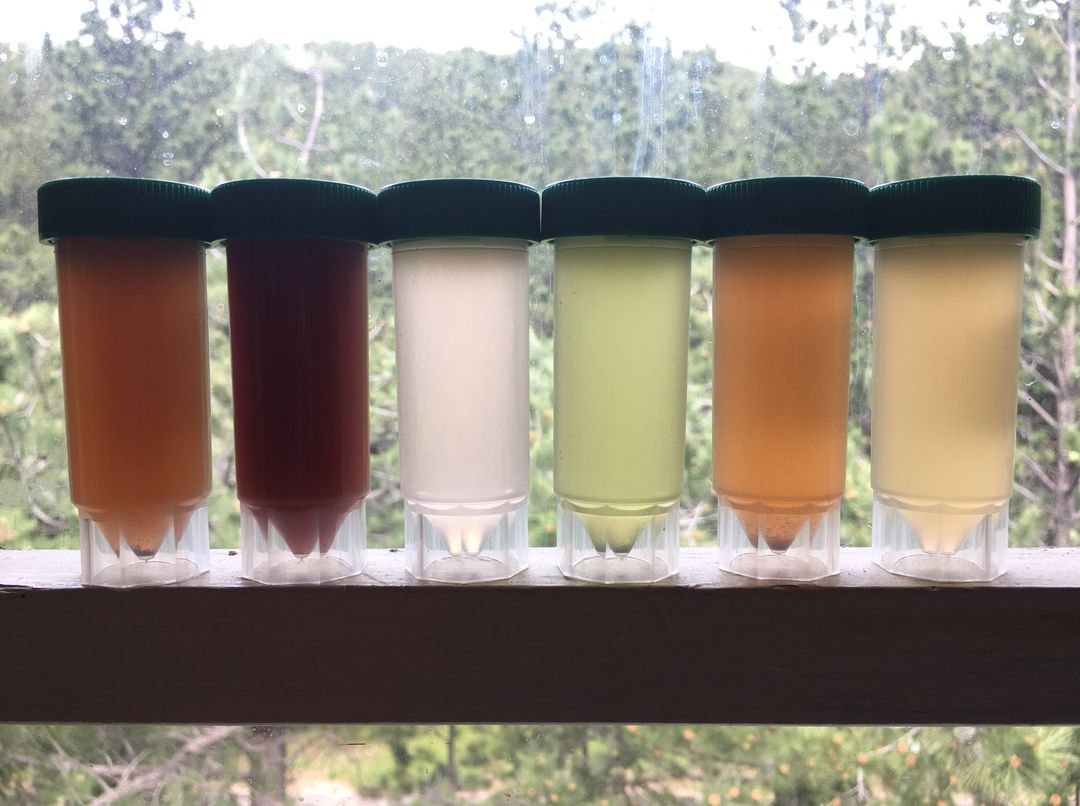
The
vegetable juice formula for culturing ciliates and
rotifers can be handled much like a rotifer culture based
on a phytoplankton food source. Instead of feeding the
phytoplankton, the vegetable juice based formula is added
periodically. In the photo, the upper jars are
phytoplankton cultures and the two lower jars are young,
about 3 days old, vegetable juice rotifer culture; and an
old, about 2 weeks, vegetable juice culture. These
vegetable juice cultures are generally useful for about
two weeks.
Whether
ciliates would work as an initial food to rear the tiniest of
marine fish larva, or various invertebrates, is entirely another
story. I have not had success with ciliates as a first food for
marine fish larvae and I don’t know of anyone else that has had
success with them, but this certainly does not mean that no one
has been successful with ciliates or that it is not possible to
utilize ciliates as a first food. There are many variables. It may
not be possible under relaxed culture conditions to maintain a
specific species of ciliate. Contamination from other species may
reduce or eliminate the target species in the culture, a species
of the proper size or nutritive value may not develop in the
culture, and ciliate cultures, just as rotifer cultures, can crash
for no apparent reason. And even if the ciliates cultured are of
the right size and have adequate nutrition and are actually
consumed by the larvae, bacterial and/or fungal contamination of
the ciliates may destroy the ciliate culture and/or the larva
within a day or two. But if a species of ciliate is found that can
serve as a first food organism for small fish larvae, all these
difficulties can be resolved.
I
don’t think that a current culture of an acceptable ciliate
species exists. As far as I know, aquaculture labs do not have a
useful species of ciliate (or dinoflagellate) under culture that
is shared or researched as is rotifers. To this point, most
aquacultured species do not require a food organism smaller than a
rotifer and thus not much effort has been expended in finding and
developing a smaller version of the rotifer. Marine ornamental
breeders may have to find a suitable species of small food
organism and develop the culture techniques for this species with
little help from the commercial food fish and scientific sectors
if the small-egged ornamental fish are to be widely bred. A small
organism is needed that will thrive within the nutritional,
temperature, and salinity parameters of a captive marine breeding
system. So it makes sense to use these parameters as the
foundation for efforts to find and maintain such an organisms. For
the most part, ciliate culture is very similar to rotifer culture.
This
reminds me of an incident that occurred at the Aqualife Research
Corporation facility at Walker’s Cay in the Bahamas some years
ago. We were culturing macro algae in some of the 300 gallon
fiberglass grow-out tanks and on one morning when I was scheduled to
return to Ft. Lauderdale for the weekend, I observed something
interesting in one tank that had been scheduled for cleaning and
had remained several days with aeration, but no water exchange. It
was swarming with a tiny creature, apparently a ciliate, about
half the size of a rotifer. The plane was warming up on the runway
so all I had time to do was to leave strict instructions that the
tank was not to be touched and to leave a sign on the tank, “Do
Not Clean.” All weekend I thought of those little creatures and
wondered if they could be the “Holy Grail” of small fish
larval culture. Of course you know what I found when I returned in
a few days. The tank was clean, the sign was still on the tank,
and no one knew who cleaned the tank. I never saw that organism
again, even though I tried a few times to replicate the situation
that had developed that culture.
This
is a clue, however, as to how to go about finding a microorganism that
might, just might, fill that gap before rotifers or copepods. I ran
across another potential piece to this puzzle during the time that I was
working with culture of the orchid dottyback (Moe, 1997). I cultured
this species, Pseudochromis
fridmani, as a hobbyist would, in a small, modified bathroom in a
house far from the sea (OK, just 20 miles). I started with the typical
phytoplankton cultures for rotifers but early on, as do many hobbyists
with limited time and facilities, I had difficulty maintaining the
quality and quantity of phytoplankton cultures required to produce the
vast numbers of rotifers that hordes of hungry larval dottybacks
required. So during that project I developed a formula based on a
popular commercial vegetable juice that I used to feed and maintain
rotifer populations without, or at least greatly reducing, dependency on
phytoplankton cultures. The formula for this vegetable juice based
rotifer food is reproduced below with permission from the publisher of
my dottyback book (Barbara).
“Preparing the rotifer feeding formula”
1.
Take one 11.5 oz. (340 ml) can of XX juice (I suppose any brand of
vegetable juice would be acceptable) and strain it through a 500 micron
sieve. Typical window screening is 1000 microns and those little
stainless steel strainers you can buy in the supermarket are about 500
microns. This straining removes the larger particles that do not help
the culture.
2.
Dilute the strained juice with about one quart (950 ml) of cold fresh
water. It is easier to strain the juice if it is diluted first or during
the straining process.
3.
Add two teaspoons of bakers yeast. The yeast is optional, it is mainly a
feeding supplement to the juice particles, but I find that the culture
is more stable in that food remains in suspension longer and this helps
the rotifers maintain high population levels, and reduces the need for
more frequent feedings. The amount, or even the use of yeast is a
subject for future experimentation.
4.
I then add several drops of an omega-3 fatty acid supplement (Super
Selco, another type of fish food supplement or even an Omega-3 or fish
oil supplement from a health food store) to the juice solution and also
add a pre dissolved B vitamin complex tablet and a vitamin C tablet. Put
the top tightly on the container and shake very well. It may well be
that different supplements or different amounts of these supplements
will produce a better rotifer food. Much experimentation remains to be
done.
This
mixture is then kept in the refrigerator and a portion is fed to the
rotifer cultures each day in an amount fitting to the purpose of the
culture. I feed about 30 to 50 ml per day to each gallon jar of rotifers
to maintain rotifer populations at low levels during periods between
breeding projects. High production would require at least two, perhaps
three similar feedings each day. Stir the formula well before
feeding.”
One
of the good news/bad news developments in working with this rotifer
formula was that it was a superb media for ciliates, several different
species, and several different sizes. One was approximately 10 microns
and one was about 30 microns with some in-between and they occasionally
flourished in vast numbers. I had to develop methods for screening out
the rotifers and beginning new cultures when the rotifers begin to
diminish. Allowing the culture to settle, siphoning off the
rotifer/ciliate mix above the sediment and then passing the culture
through a mesh of 53 microns separated the rotifers and ciliates quite
well. (An interesting aside is that some aquaculture interests in Japan
use ciliates to enhance the health of rotifer cultures since the
ciliates feed on the bacteria in the cultures.)
This
gives us a tool to use in the search for a ciliate that may be useful in
culture of some marine fish larvae. Other organic preparations,
potatoes, straw, fruit juice, algae, etc., could also be used and there
may well be a better base, but I would start with the vegetable juice
formula above just because it worked well before.
After
preparation of the vegetable juice formula, the next step would be to
make up several gallon jars of the formula and add light aeration to
keep the mixture suspended and oxygenated. Only 30 to 50 ml of the mix
is needed in each jar of salt water. Now all we have to do is to find a
source for a species of ciliate that may be useful. Some ciliate species
may be available from commercial educational cultures, such as Didinium,
Paramecium, and Euplotes,
and these can be tried, but a better possibility for a marine species
may be a natural source. These experimental cultures can be seeded with
live sand, live rock, or even water from a natural marine source. A bit
of live sand and/or rock from an old established reef tank could also be
tried. Experimentation with different salinities, temperatures, and
sources of potential ciliates will probably result in a wide variety of
cultured ciliates, which can be selected for the larger species. A
microscope will be a most useful tool for this work, but a 10x loop
might be adequate.
Once
a possible candidate species is found, right size, large numbers, one
should try to develop a pure culture of that species. Seeding a new
culture with a pure sample of only that organism should be attempted.
However, without good laboratory technique, this may not be possible. In
fact, it may be that ciliate cultures do better when some rotifers are
present in the culture. Under primitive conditions, sometimes the best
one can do is to start a new culture with as massive an inoculation of
the target organism as is possible and hope that the head start given to
the desired species will be enough to out grow the competition, at least
initially.
Keep
the culture rolling gently with an air stone and watch it for a
week or so. I'm sure you will get a wild culture of ciliates (who
knows what species). Whether they will work as a successful larval
food is another story. It is not difficult these days to keep a
breeding pair or harem of pigmy angelfish, damselfish,
occasionally mandarinfish, maybe a wrasse species or two, and some
of the small egged gobies. These species, and others, can provide
plenty of larvae for experimental first feeding trials. Add the
food organisms at about 3 per ml to the larval tank maybe a day or
the night before first feeding is expected. This is about the time
the yolk sac on the demersally spawned larva is absorbed and about
three days after pelagically spawned larvae hatch. At the time
first feeding begins, two things should happen. The larval fish
should have a full gut at all times except first thing in the
morning, and the larval fish should grow noticeably in two or
three days after feeding begins. Again, a 10X loop or better
still, a dissecting microscope is very important. If these two
things happen then the fish larvae are able to take the food
organism and the food organism is at least nutritionally adequate.
It is then time to break out the Champagne.
Excellent resource on cilates (homepage of ciliate researcher denis
Lynn,
Department of Zoology, University of Guelph Guelph, ON, CANADA) http://www.uoguelph.ca/%7Eciliates/
Moe,
M. A., (1997). Breeding the Orchid
Dottyback, Pseudochromic fridmani:
An
aquarist's
journal. Green Turtle
Publications, Islmorada FL. 285 pp.
Pierce
RW, Turner JT (1992) Ecology of
planktonic ciliates in marine food webs. Reviews in Aquat Sci
6:139-181 Reid PC et al. (1991) Protozoa and their role in marine
processes. NATO ASI publication, Springer, New York
Reid
PC (1987) Mass encystment of a planktonic oligotrich ciliate. Mar Biol
95:221-230