Recently,
a visitor to our discussion boards started the following thread,
“I was wondering if doing water changes is even necessary. I
don't have a calc reactor but I’m planning on adding b-ionic
for calcium supplementation. Should I change my water and how
often? This fell under the topic of Water Changes. For the whole
thread see http://www.reefs.org/phpBB2/viewtopic.php?t=38015.
This exchange reminded
me what our web site is really all about – questions, answers,
choices, and ultimately sharing information about how to best
treat our aquatic guests. However, what is the quality of advice
offered, especially when one’s confronted with many different
opinions. Whether accessing our online magazine or participating
in one of our discussion groups readers often ask questions,
only to be confronted with a variety of seemingly mutually opposing
answers. One of the reasons for this is that though some questions
appear to be asking for a simple yes or no, the answer to many
seemingly straight forward questions is more complex than it
appears, and implies choices. One such question is, “should
I change water, and if so, how much and how often?
It is possible to
answer this question using the scientific method. One would
have to set up a statistically large enough number sampling
of tanks where everything (light, salt, circulation, temperature,
specimens, etc.) about them is exactly the same, then change
water in half of the tanks and not in the other half. The health
of the genetically identical animals after a significant period
of time would then be compared. Perhaps then one could answer
whether water changes are beneficial. All this assumes that
the water changes used pristine water; using poor quality replacement
water might very well worsen the situation. Clearly, this would
represent a considerable investment in time and equipment. This
is one of the reasons that we offer a media column, where our
columnists Delbeek and Robbins, keep us informed about current
scientific research. In fact, in this issue Delbeek summarizes
some surprising information about growth patterns of wild corals
in water with a relatively high nutrient content, caused by
environmental run-off.
With that said,
experienced reef aquarists can offer some valuable anecdotal
insight into the water changing questions described above. The
question about whether to change water, especially in large
reef tanks where it requires a lot of new water to make it meaningful,
is both hard work and expensive. Changing less than 20-% every
few months is not meaningful in my opinion, and if you have
more than a 500-gallon system we are talking about a lot of
new water. Greg Schiemer and I have been experimenting with
this issue over the last year. In fact, I hadn’t changed water
in my 700-gallon system for over a year, and the same was true
for Greg. Recently, we both went back to changing water and
compared notes. Both of us saw clear indications that the overall
health of our sessile invertebrates improved. For example, after
the water change polyp extension obviously increased.
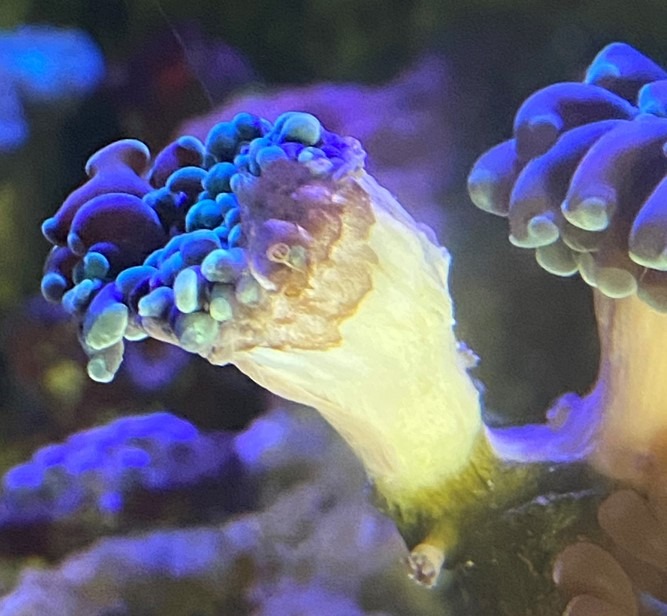
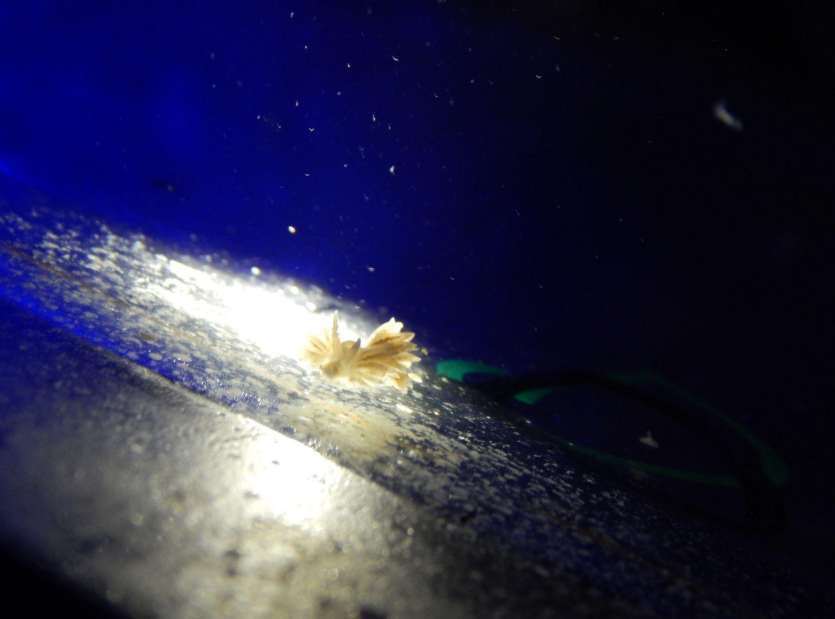
I also noticed that
my Duncanopsammia axifuga had for at least a month
stopped opening its polyps. After the water change, as you can
see form the photo, it is now open and feeding again.
This
specimen of Duncanopsammia axifuga was given
to my Julian Sprung.
How long can one
go without changing water to the point where most animals began
to die I cannot answer. Different species would probably die
off at different rates, because some species are more tolerant
of adverse conditions than others. Some conditions are favorable
to some species and not others. However, my experience tells
me that if you want to keep the greatest variety of animals
keep the quality of your reef water as optimal as possible,
and to that end water changes help. Finally, be sure to use
a good salt mix, and prepare it with RO/DI water, or its equivalent.