Editors
note: Clicking on any image in this article will take you to
a gallery of all the images in this article.
I am
really pleased to be able to bring you an update on the status
of “Pratt Reef” the 210-gallon reef system located
on the campus of Pratt Institute in Brooklyn, NY. The project’s
conception and development was the subject of an article I wrote
for the 2001 Marine Fish and Reef USA Annual. At its
core, the idea was to build a thriving, beautiful captive reef
in as environmentally friendly way as possible. To this end,
I can claim with confidence that the rock work is almost entirely
of aquacultured origins, the corals are over 90% tank raised,
and the fish population is carefully chosen to include as many
aquacultured and responsibly harvested species as possible.
As the accompanying photographs will show, the system has gone
through several changes over the past three years, but I hope
you will agree that the integrity and promise of the original
ideal has been maintained and realized.
I’d
also like to take the opportunity to thank Abbey Braden for
the use of some of her beautiful photographs, and to acknowledge
the considerable time commitments of my College Work Study students,
Samantha Lopez, Tristan Wilson and Dan James, without whose
help, “Pratt Reef” would not be what it is today.
Tank:
A custom made 210 gallon acrylic aquarium and stand ( 84”x
24”x 24”) with built in over flow from Aqua Clear
Aquatics. A 40-gallon acrylic sump from ETS is plumbed directly
below the main display.
Proud
sponsor of this column
Filtration:
Skimming is provided by an ETSS Evolution 750 downdraft skimmer
driven by an Iwaki 40 RLT water pump. Together they provide
for very productive waste removal and easy maintenance. Carbon
is run continuously in a Magnum HOT canister and is changed
roughly once a month.
Circulation:
The main system pump is a Gen X Mak 4. It circulates at a rate
of 1190 gallons per hour and returns water to the main display
via two flexible modular hoses in the center overflow. Two Tunze
Turbelle Stream 6060 pumps located at opposite ends of the aquarium
provides additional current.
Water
Purification: All water used in this system passes
through a Spectrapure Spectra+ 2000 75GPD RO/DI unit.
Lighting:
The system is lit by 3 Iwasaki 250 watt 6500K metal halide bulbs
in combination with 2 160-watt Actinic VHO florescent bulbs
from URI, all mounted in a PFO reflector. Icecap electronic
ballasts power all bulbs. Two Icecap variable speed fans cool
the hood.
Additives:
Alkalinity and Calcium are maintained via daily additions of
ESV B-Ionic in combination with a rather sporadic dosing with
Kalkwasser. Even more sporadic additions of iodine and strontium
are used.
Sand
Substrate: There is a roughly 4” layer of ESV
fine aragonite sand covering the bottom of the aquarium. This
bed was initially seeded with 10 pounds of live sand from the
Florida gulf coast.
Liverock:
The rockwork in the system is comprised of 100 lbs. of aquacultured
rock from Florida that was supplemented by approximately 30
lbs. of Indo Pacific rock.
Maintenance:
The skimmer is cleaned weekly. Approximately 45 gallons of water
exchanged monthly using Instant Ocean salt mix. All other tasks
are done as needed.
Feeding:
The system is fed twice daily with a combination of frozen and
dried foods. Frozen feed includes Mysis shrimp. Brine shrimp
enriched with Selcon, Pacifica Plankton and Cyclopeeze. Dried
food includes both Pellet and Flake foods from Ocean Nutrition,
Omega Sea and OSI. Herbivores are given additional supplements
of Dried seaweed several times a week.
Water
Chemistry:
Temperature:
76-82 degrees depending on the season, controlled by two Ebo
Jager heaters, fans and room air conditioner as needed.
Salinity: 1.025 specific gravity.
Calcium: 400- 450 ppm.
Alkalinity: 2.5-3.0 mEq/l.
Phosphate: < 0.1 ppm.
Nitrate: < 2.5 ppm.
pH: 8.3 to 8.5 measured by a pinpoint monitor.
Inhabitants:
Fish:
The system contains 4 larval reared Hippo Tangs (Paracathurus
hepatus), 4 Lyretail Anthias (Pseudanthias squamipinnis),
a mated pair of Red Sea Lyretail Angels (Genicanthus caudovittatus),
1 Yellow Tang (Zebrasoma flavescens), 1 Naso Tang (Naso
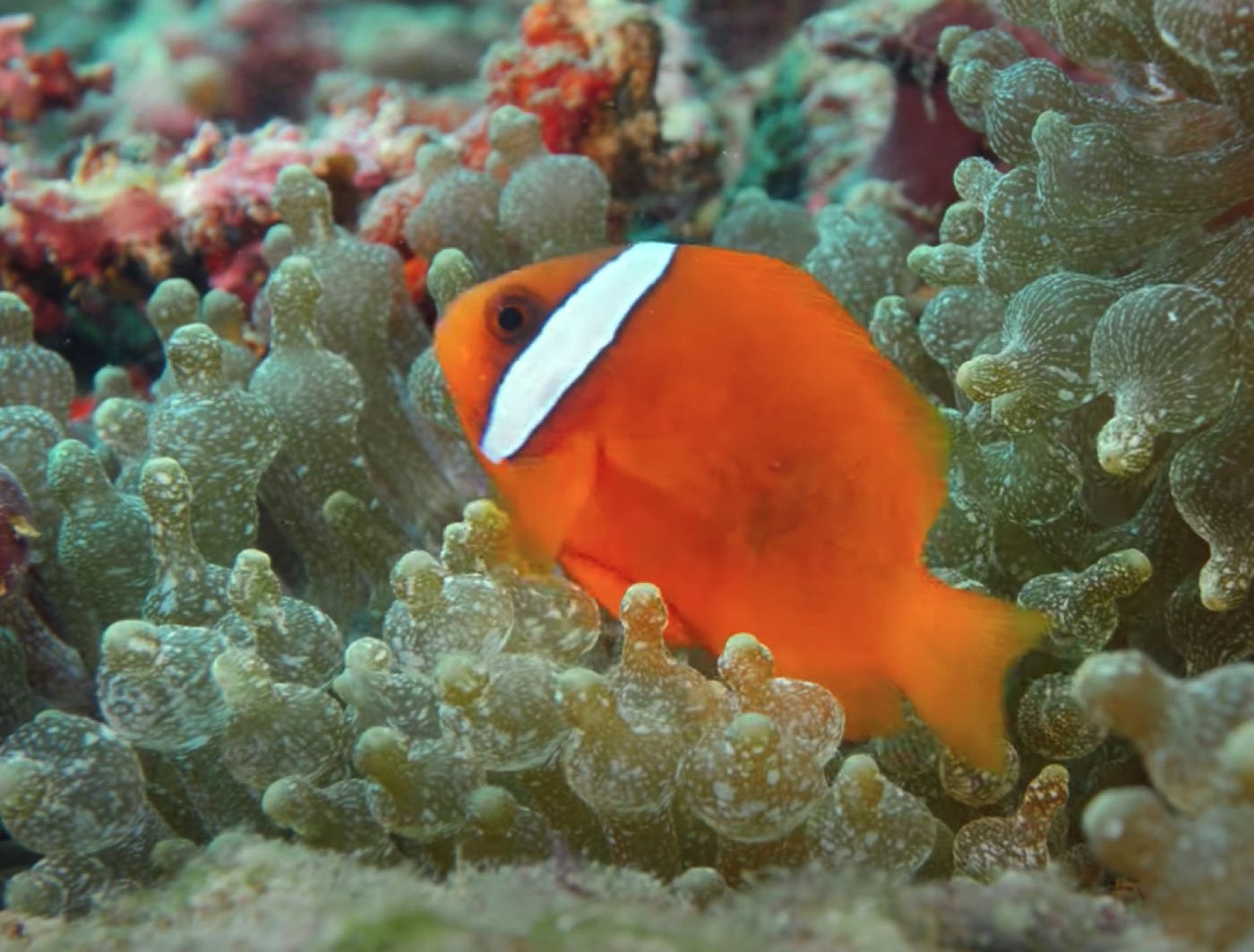
literatus), a pair of Ocellaris clownfish (Amphiprion
ocellaris), 1 Iridis Wrasse (Halichoeres iridis),
a pair of Orchid Dottybacks (Pseudochromis friedmani),
a pair of Arabian Dottybacks (Pseudochromis aldabraensis),
a trio of Sankey’s Dottybacks (Pseudochromis sankeyi),
and a school of 6 Green Chromis (Chromis virdis).
Corals: Coral colonies are numerous and varied
with over 90% originating from aquacultured or home propagated
sources.
Acropora
species include Acropora pulchra, A.formosa,
A. millepora (pink), A. millepora (green),
A. millepora (green and pink), A. humilis
(purple), and A. Yongei (green Bali Staghorn).
Montipora
species include Montipora capricornis (red), M.
spumosa, M. digitata (red), and M. digitata
(green).
Also
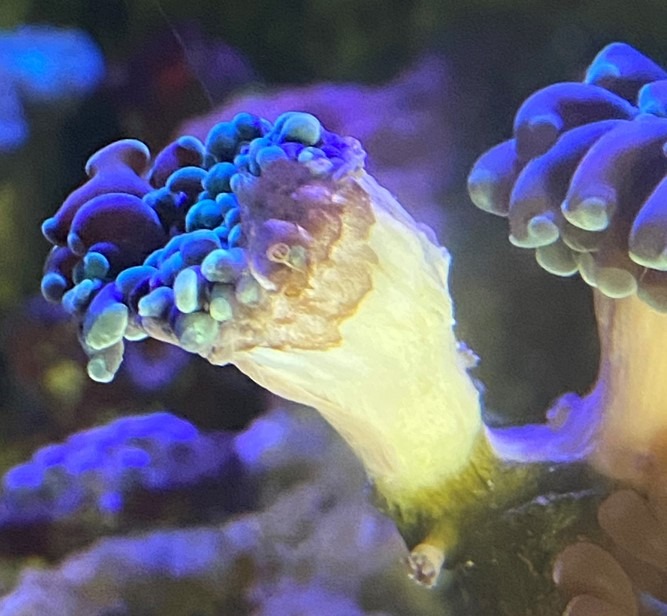
present are Euphyllia parancora, E. divisa,
and E. glabrescens, Cynarina lacrymalis, Echinophyllia
sp., Caulastrea, 2 Fungia, Blastomussa
wellsi, B. merleti, Favia, Hydnophora
exesa, Leptoseris scabra, Heliopora coerulea,
and Psammacora contigua.
There
are also numerous Mushroom Anemones and Zooanthid colonies,
as well as a Tridacna squamosa clam, several Serpent
Stars, sand sifting Cucumbers, Snails and Hermit Crabs.