This
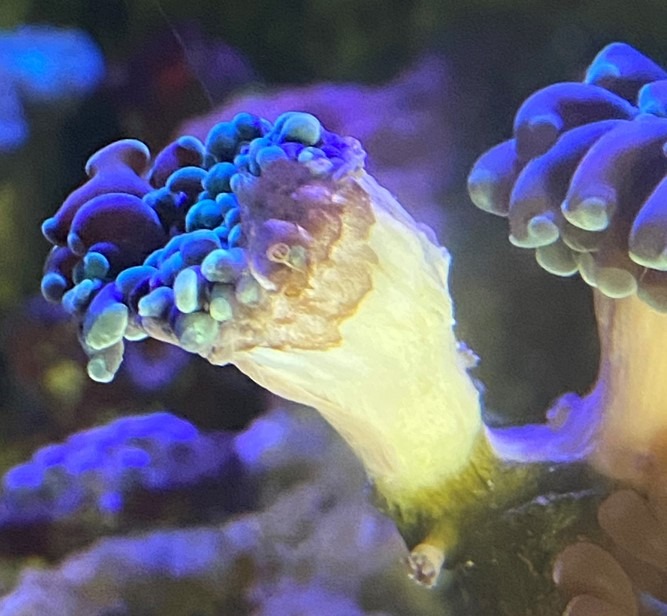
is a nice specimen of Cavernularia obesa, the species
best suited to life in a reef aquarium. They are fully
expanded during the day, and are an attractive addition
to an open area of a sandbed.
Photo
by Mitch Gibbs
I was
trying to decide what to cover for this article, and realized
that there is not much information out there about sea pens.
These beautiful animals are occasionally seen in pet shops,
but if there is any information about them provided at all,
my experience has been that information is usually wrong. There's
a brief introduction to these animals in Eric Borneman’s
Aquarium Corals book (2001), and a couple of pages in
The Reef Aquarium, Volume Two (Delbeek and Sprung 1994),
but in general these unusual corals are overlooked or omitted
from all but the most detailed aquarium texts. Therefore, I
decided to write this article to try to provide some useful
information to people who are interested in keeping one of these
amazing and unusual animals. I kept one in my office display
at UC Davis for many years before I moved away, and found it
to be a fascinating and rewarding addition to my tank. However,
having said that, I also want to have a strong warning right
up front that these animals have a very poor history of survival
in the aquarium. They should be only considered by experienced
hobbyists with well-established tanks in which they also have
a deep sandbed, and even then must be considered very difficult
to keep. Sea pens are often mishandled and damaged during shipping,
they have very specific needs in the aquarium, and they a sensitive
and easily stressed. Therefore, while I am trying to present
the best case scenario below for trying to keep one of these
animals in the aquarium, you should also seriously ask yourself
if your aquarium and husbandry skills are up to the challenge
before you consider adding one of these animals to your aquarium!
Proud
sponsor of this column
Sea
Pen Biology
OK,
now that I have that out of the way, let’s start off with
explaining what exactly is a sea pen. Well, they are cnidarians
and along with the true soft corals and gorgonians, they form
the Subclass Octocorallia. Pennatulacids (the
technical names for sea pens and sea pansies) are actually colonies
of many polyps (like a coral head) rather than a single animal
(like an anemone), and there is some pretty cool division of
labor among the polyps (for details see Brusca and Brucsa 1990).
When a larva first settles, it metamorphoses into “founder
polyp” which becomes the stalk from which the other polyps
in the colony arise via asexual proliferation (in much the same
way that other coral colonies grow by asexual replication of
their polyps). The colony is composed of a series of gastrozoids
(the feeding polyps responsible for capturing food and nourishing
the colony), and siphonozoids (respiratory
polyps responsible for moving water into and out of the colony
to allow for gas exchange). The entire colony is typically arranged
into a bulb, which is buried in soft sediments (very fine sands
and muds on the sea floor) and an exposed portion along which
the remainder of the polyps are found. Individual colonies can
consist of tens of thousands of individual polyps, and a large
sen pen can easily have 40,000 or more polyps on it (Erhardt
and Moosleitner 1997). Both the bulb and the upper portion of
the animal are strengthened by an axial rod that consists of
a mixture of hard organic material (like a gorgonian) and calcium
carbonate (like a stony coral), but the animals are highly contractile
and can expand or contract greatly depending on conditions.
There are about 300 species of sea pens found in the sea, and
they range from shallow waters surrounding coral reefs to the
deep ocean at depths below 5000 m! Many of these species are
colorful and capable of spectacular bioluminescent
light displays in the dark when disturbed (Erhardt and Moosleitner
1997). Although these displays are impressive to behold, you
should never encouraged a sea pen to luminesce intentionally
– the production of light is an expensive stress response
that will lead to decreased growth and health of your animal
if it happens too frequently.
The
“feather-like” shape of sea pens is an adaptation
for increasing the spread of gastrozoids into the water column
to maximize the prey capture rate of a colony while also minimizing
drag in the turbulent water in which these animals are typically
found. Each gastrozoid is capable of producing gametes for sexual
reproduction but all polyps in a given colony are either male
or female (Brusca and Brucsa 1990). Most of these animals spawn
their gametes (both sperm and eggs) freely into the water column
and fertilization occurs in the sea after spawning (Eckelbarger
et al. 1998). Fertilized gametes develop to produce planktonic
larvae that must feed and develop in the water column, so reproduction
in the aquarium is highly unlikely. However, some in species
only the males free-spawn, while the females hold onto the eggs
and fertilization occurs internally. For these species, the
females brood the developing embryos until they have reached
an advanced larval stage, at which point they are released into
the water (Erhardt and Moosleitner 1997). These late stage larvae
swim around for up to a few days, actively searching for an
appropriate place to settle and metamorphose into a founder
polyp. Once they locate an appropriate location, they settle
onto the sand and metamorphose into an elongate polyp that will
eventually form the axial stalk (the elongate
rod on which the remainder of the polyps will grow), as described
above. For these few species that brood their young, reproduction
in captivity may be possible, but to the best of my knowledge,
no one has yet bred sea pens in captivity, either through sexual
or asexual reproduction of the coral.
Proud
sponsor of this column
How
do sea pens make a living?
OK,
so having explained what a sea pen is, now let’s talk
about how they live. There are many different species of sea
pens out there, but the most commonly imported for the aquarium
trade is Cavernularia obesa (Borneman 2001). I have
overheard pet shop employees explaining the specific lighting
requirements for keeping this specific sea pen in the aquarium
on many occasions over the years. I have to grit my teeth each
time I hear that, because despite the fact that this particular
sea pen is a rich brown color similar to many zooxanthellate
corals, they do not have any symbionts. In fact sea pens in
general lack photosynthetic symbionts, and as a result are generally
uncaring of lighting conditions (Erhardt and Moosleitner 1997).
Furthermore, many (if not most) sea pens are nocturnal
(active only at night) and even the species that are expanded
during the day are unlikely to be bothered by whatever your
ambient lighting happens to be. Given that they are completely
nonphotosynthetic, it should be simple to deduce two things:
1) lighting needs are probably not a big concern, and 2) they
need to be fed!
In
this case, not only do they need to be fed, but they need to
be fed quite a lot. These animals typically prey on an abundance
of tiny plankton (such as invertebrate larvae, suspended detritus
and larger phytoplankton), and their efficiency of capturing
such particles is directly influenced by the flow rate of water
in the aquarium (Best 1982; Best 1988). I’ll come back
to the specific types of food in a while, but first I’ll
talk about how they actually feed. These animals typically live
in regions of relatively high and constant flow, and without
such conditions their ability to feed is dramatically hampered.
So, there are really two critical factors to keeping one of
these animals successfully. The first is that you need to provide
the appropriate food, and the second is that you need a consistent
and relatively strong bulk water flow for these animals to really
flourish. These animals require a large amount of water moving
past them consistently to be able to feed properly, and that
does not mean simply having a powerhead pointed in their general
direction. Richard Harker has an article on turbulent
water flow in the reef aquarium online if you’re looking
for more information regarding water flow in captive reef aquaria.
I won’t go into detail on the issue of bulk water flow
in the aquarium, but suffice to say that without a substantial
amount of ambient flow past these animals, it won’t matter
whether they are fed or not – they need the flow to effectively
capture their prey, and without it they will starve even if
there is plenty of food in the aquarium.
In
order for them to start feeding at all, however, you first need
to make them happy enough to extend fully. In addition to the
obvious requirements of excellent water conditions, making a
sea pen happy generally involves two primary things: 1) proper
current, and 2) deep, and very fine, sand (or better yet mud).
These animals are found most commonly in areas that have moderate
flow rates. So to make that into something concrete for you,
something on the order of 5-10 cm/s of bulk water flow would
be a reasonable guesstimate for the conditions you should be
trying to duplicate in your aquarium to keep one of the species
commonly imported for the hobby alive in your aquarium. The
other important consideration besides the water flow rate is
the particle size and depth of the sediment bed in the aquarium.
The majority of sea pen species require 20 cm or more of muddy
sand in which to bury their “foot” (as I explained
above, this is really a highly modified polyp that provides
the attachment point for other polyps in the colony) or they
will not be at all happy in your aquarium (I’ll come back
to this below). Crushed coral (especially stuff in the 3-5mm
range) is simply too coarse for the animals to borrow, and if
it tries to burrow at all (which I doubt), it will likely fail
or injure itself due to laceration of the bulb by this coarse
sediment. Most sea pens seem to go through a period where they
extend fully on top of the sand before burying into it completely,
so seeing a fully expanded sea pen on the bottom of your dealer's
tank is generally a good sign. Because the animals are rarely
given appropriate habitat in a petshop, a fully expanded animal
is the best you can hope for: even if it is not buried in the
sediments yet, a fully-expanded sea pen is more likely to be
reasonably healthy and likely to try burrowing if presented
with the proper conditions in your tank at home. Furthermore,
if the sediments are too coarse or the flow too low to be “rippled”
by the currents in your tank, then the conditions are likely
not appropriate to keep a sea pen. In experiments in nature
where researcher put out trays of various sediment size to look
at colonization of infauna (sea pens were one of the groups
considered), they found that areas with finer sediments that
were disturbed slightly by the currents had the highest rate
of infaunal colonization and the greatest density of animals
(Levin et al. 1994; Levin and Dibacco 1995).
Although
some species (such as the unusual Cavernularia, which
looks more like a bottle brush than a typical sea pen) could
thrive in a bed as shallow as 3-4", and with particles
as coarse as sugar-sized sand, most species need at least a
full body length (and something closer to 1.5-2 body lengths
of the fully extended animal is probably better for them) of
very fine sand or mud for them to burrow and establish properly.
A sea pen with too shallow or too coarse of a sandbed will show
a characteristic behavior of curling up on the bottom of the
aquarium rather than burrowing in (Erhardt and Moosleitner 1997).
They may also expand and float dangerously around the aquarium,
where they are often stung by other corals and may be sucked
into a pump intake. In either case, a sea pen that does not
stay put is a major danger to itself and to your aquarium. Although
a sea pen is unlikely to sting another coral and seriously injure
it, they do produce a variety of nasty chemicals that they use
to defend themselves. Many of these compounds are unknown in
function, but some have been shown to have antimicrobial, cyto-toxic
or other effects, and at least one looks to be useful in the
treatment of cancer (e.g., Wratten et al. 1977; Hendrickson
and Cardellina 1986; Datta et al. 1990; Fu et al. 1999; Chen
et al. 2001). Many of these compounds have also been shown to
be highly toxic to brine shrimp or fish in aquaria, and are
unlikely to be good for your animals in your aquarium if the
sea pen is being damaged by bouncing around the tank being stung
and/or injured by pump intakes.
Cavernularia
obesa is actually an unusual sea pen because it
has polyps sticking out of all sides, as you can see
from this photo taken from above. Unlike most sea pens,
this species looks like a bottle brush when expanded.
Photo
by Mitch Gibbs
Sea
pens are all capable of greatly expanding and contracting their
body such that they will often pull in completely beneath the
sand surface to rest, and then expand up to full height to feed.
This pattern typically occurs on a daily basis and most species
have a strong intrinsic rhythm that involves expanding to feed
at night and then deflating and retracting completely below
the surface of the sediment during the day (Dickinson 1978;
Langton et al. 1990). Because most of the species are only expanded
at night when no one is watching the aquarium, they are not
of much interest to most aquarists. Also, given that most sea
pens average something on the order of 30-60cm in height (and
some may be over a meter tall) when fully-expanded, a sandbed
on the order of a 20cm or more deep is the absolute minimum
to have a reasonable hope that one of these animals will survive
long-term in your aquarium. Fortunately, the unusual species
I mentioned above (Cavernularia obesa) happens to be
a shallow water species that not only survives in shallower
beds (on the order of 3-4” depending on the size of the
sea pen itself), but also tends to follow a diurnal
pattern of expansion and contraction (open and feeding during
the day, contracted below the sediments at night). Perhaps,
then it is no coincidence that this species is also the one
most commonly imported for the hobby (Borneman 2001). This is
the species of sea pen that I kept in my aquarium in Davis successfully,
and the one that you are most likely to encounter if shopping
for a sea pen for your tank. Although C. obesa can thrive in
shallower sandbeds than most other sea pens, they still require
the right size of particles (again, think mud rather than gravel!),
the right depth of bed, and the correct amount of water flow
before they are likely to survive in your aquarium. They want
to be able to retract completely within the sediments for protection
at night, and are rarely happy unless they can do this. If your
sea pen pulls out of the sediments or moves after you have introduced
it to your aquarium, then you can be confident that one of these
factors is not yet right…
Feeding
a Sea Pen
As
I said above, most of these animals feed on a variety of tiny
plankton such as invertebrate larvae, rotifers, ciliates, suspended
detritus, bacterioplankton and probably phytoplankton as well.
To date, there has been no research to show whether or not these
animals capture and digest phytoplankton, so the best I can
offer you is a guess that they do, based on observation of my
single sea pen in my tank in Davis. Obviously that is not very
reliable evidence and until someone conducts a study along these
lines, I will leave it at that – a guess. However, almost
every reference I have mentioned in this article (Delbeek and
Sprung 1994; Erhardt and Moosleitner 1997; Borneman 2001) suggests
that you feed enriched brine shrimp to your sea pen , and you’ll
probably notice that I did not include newly hatched brine in
this list (enriched or otherwise). That is because my experience
with this species suggests that even newly hatched Artemia
nauplii are too large for the animal to eat. I feed my aquarium
with newly hatched brine on a regular basis for years, and never
once saw my sea pen capture a baby brine shrimp in my tank.
I definitely saw it capture and appear to ingest a variety of
other foods with smaller particle sizes in my tank, so I am
assuming that at least my sea pen was feeding entirely on smaller
prey than baby brine shrimp.
Proud
sponsor of this column
So,
if you’re planning to try a sea pen, you’ll probably
want to look into setting up a feeding culture of rotifers,
or obtaining some artificial plankton food such as SDMP (ESV’s
spray-dried marine phytoplankont), APR (Artificial Plankton
- Rotifer), or “Size I” (50-100µm) Golden
Pearls to provide to your new pet on a regular basis. In addition
to these smaller plankton sizes, I found that supplementing
the feedings with DT’s live phytoplankton stimulated a
better feeding response, although I am not sure whether or not
it fed the colony directly. For readers interested in a more
detailed description of planktonic foods, I have a review article
of available planktonic foods (Toonen et al. 2002) and an online
presentation about feeding planktonic foods to reef aquaria
(Toonen 2000). I also found that the freeze-dried copepod product,
Cyclop-Eeze, was readily accepted if I ground the copepods first
to reduce the size to the order of the plankton foods mentioned
above. Given that most marine animals cultured to date seem
to do better when copepods are included as a regular component
of the diet, I felt that this was worth the effort from time
to time…
Like
most particle-feeders in the sea, sea pens are adapted to feeding
almost continuously while fully expanded. That means that almost
all such animals do best when offered a small amount of food
on a very regular basis rather than a huge dose of food once
in a while (Toonen 2000). However, that is rarely how people
feed their tanks – most people dose their tank heavily
with food every few days rather than using smaller amounts two
or three times per day to try to simulate continuous feedings.
Heavy feedings at irregular intervals are not the best strategy
for any suspension-feeding animals, and tends to increase the
likelihood that some food goes uneaten and contributes to a
decrease in water quality. Thus, whether it is a sea pen, a
feather duster or a bivalve that you are trying to feed, you’re
almost always better off providing smaller feedings on a more
regular basis than dumping large amounts of food into your tank
once in a while.
The
prepared foods are obviously the easiest choice to provide on
a regular basis, but enriched rotifers can be easily cultured
or purchased from many sources now, and ultimately a variety
of food is always preferable to any single food item to ensure
the long-term health of your animals (Toonen 2003). By providing
the proper sized particles and a healthy mixture of food for
your new critter once it establishes itself, you’ll give
it the nutrition that it needs to thrive in your aquarium.
Despite
those drawbacks, I really think that these unusual octocorals
can be a fascinating addition to a reef aquarium, and as I said
above, I have been keeping one successfully for years in my
own tank. I think that the primary hurdles to keeping these
animals are: 1) getting a healthy animal to introduce to your
aquarium; and 2) providing for the unusual and very specific
needs in terms of sediment type, depth, water flow and food.
If you know exactly what these needs are in advance, and prepare
for them, my experience has been that the animal is an unusual
and very attractive addition to my reef tank – in fact,
it has been one of my personal favorites. I hope that this article
has been useful to anyone who wants to get one of these animals
(either to convince you to leave it alone or to give it a try,
depending on your aquarium setup)…
Best
BA (1982) An integrative analysis of passive filter feeding
- the sea pen, Ptilosarcus gurneyi, as a model system.
American Zoologist 22: 968
Best
BA (1988) Passive suspension feeding in a sea pen - effects
of ambient flow on volume flow-rate and filtering efficiency.
Biological Bulletin 175: 332-342
Borneman
E (2001) Aquarium Corals: Selection, Husbandry, and Natural
History. Microcosm, T.F.H. Professional Series, Neptune
City, NJ
Chen
SP, Sung PJ, Duh CY, Dai CF, Sheu JH (2001) Junceol A, a new
sesquiterpenoid from the sea pen Virgularia juncea.
Journal of Natural Products 64: 1241-1242
Datta
PK, Ray AK, Barua AK, Chowdhuri SK, Patra A (1990) Isolation
of a Bioactive Sterol from a Sea Pen, Pteroeides esperi.
Journal of Natural Products 53: 1347-1348
Delbeek
JC, Sprung J (1994) The Reef Aquarium, Vol. 2. Ricordea
Publishing, Coconut Grove, FL
Dickinson
P (1978) Conduction systems controlling expansion & contraction
behavior in the sea-pen Ptilosarcus gurneyi. Marine
Behaviour & Physiology 5: 163-183
Eckelbarger
KJ, Tyler PA, Langton RW (1998) Gonadal morphology and gametogenesis
in the sea pen Pennatula aculeata (Anthozoa : Pennatulacea)
from the Gulf of Maine. Marine Biology 132: 677-690
Fu
X, Schmitz FJ, Williams GC (1999) Malayenolides A-D, novel diterpenes
from the Indonesian sea pen Veretillum malayense. Journal
of Natural Products 62: 584-586
Hendrickson
RL, Cardellina JH (1986) Structure and stereochemistry of insecticidal
diterpenes from the sea pen Ptilosarcus gurneyi. Tetrahedron
42: 6565-6570
Langton
RW, Langton EW, Theroux RB, Uzmann JR (1990) Distribution, behavior
and abundance of sea pens, Pennatula aculeata, in the
Gulf of Maine, USA. Marine Biology 107: 463-470
Levin
LA, Dibacco C (1995) Influence of sediment transport on short-term
recolonization by seamount infauna. Marine Ecology Progress
Series 123: 163-175.
Levin
LA, Leithold EL, Gross TF, Huggett CL, Dibacco C (1994) Contrasting
effects of substrate mobility on infaunal assemblages inhabiting
two high-energy settings on Fieberling Guyot. Journal of
Marine Research 52: 489-522
Toonen
R, Batchelor K, Mai T (2002) Planktonic Foods for Reef Aquaria:
If you feed the tank, are these foods for you? Marine Fish
& Reef USA Annual 2002: 18-31