<?xml version="1.0" encoding="utf-8" ?>
<rdf:RDF xmlns:rdf="http://www.w3.org/1999/02/22-rdf-syntax-ns#" xmlns:dc="http://purl.org/dc/elements/1.1/" xmlns:syn="http://purl.org/rss/1.0/modules/syndication/" xmlns="http://purl.org/rss/1.0/">


<channel rdf:about="http://www.advancedaquarist.com/magazine/index.html/RSS">
  <title>Latest Articles</title>
  <link>http://www.advancedaquarist.com</link>

  <description>


  </description>


            <syn:updatePeriod>hourly</syn:updatePeriod>
            <syn:updateFrequency>1</syn:updateFrequency>
            <syn:updateBase>2011-01-23T14:57:16Z</syn:updateBase>
        

  <image rdf:resource="http://www.advancedaquarist.com/logo.png"/>

  <items>
    <rdf:Seq>
      
        <rdf:li rdf:resource="http://www.advancedaquarist.com/2013/5/aquarium"/>
      
      
        <rdf:li rdf:resource="http://www.advancedaquarist.com/2013/5/corals"/>
      
      
        <rdf:li rdf:resource="http://www.advancedaquarist.com/2013/4/aquarium"/>
      
      
        <rdf:li rdf:resource="http://www.advancedaquarist.com/2013/4/inverts"/>
      
      
        <rdf:li rdf:resource="http://www.advancedaquarist.com/2013/4/review"/>
      
      
        <rdf:li rdf:resource="http://www.advancedaquarist.com/2013/4/fish"/>
      
      
        <rdf:li rdf:resource="http://www.advancedaquarist.com/2013/3/corals"/>
      
      
        <rdf:li rdf:resource="http://www.advancedaquarist.com/2013/3/review"/>
      
      
        <rdf:li rdf:resource="http://www.advancedaquarist.com/2013/3/fish"/>
      
      
        <rdf:li rdf:resource="http://www.advancedaquarist.com/2013/2/fish"/>
      
      
        <rdf:li rdf:resource="http://www.advancedaquarist.com/2013/2/equipment"/>
      
      
        <rdf:li rdf:resource="http://www.advancedaquarist.com/2013/2/aafeature"/>
      
      
        <rdf:li rdf:resource="http://www.advancedaquarist.com/2013/1/aquarium"/>
      
      
        <rdf:li rdf:resource="http://www.advancedaquarist.com/2013/1/review"/>
      
      
        <rdf:li rdf:resource="http://www.advancedaquarist.com/2013/1/aafeature"/>
      
    </rdf:Seq>
  </items>

</channel>


  <item rdf:about="http://www.advancedaquarist.com/2013/5/aquarium">
    <title>Feature Aquarium: Behind the scenes at The Deep Part 1</title>
    <link>http://www.advancedaquarist.com/2013/5/aquarium</link>
    <description>In the first of a two part investigation, Richard Aspinall has a behind the scenes tour of The Deep in Hull, one of Europe’s largest and most well respected public aquariums.</description>
    <content:encoded xmlns:content="http://purl.org/rss/1.0/modules/content/"><![CDATA[<p><em><strong>Click through to see the images.</strong></em></p> <br /><div id="body">
<p><img src="aquarium_album/thedeep2.jpg" alt="thedeep2.jpg" class="image-inline" /></p>
<p><span class="dropcap">Y</span>ou may remember a thing called the Millennium; it caused a lot of fuss and cost a lot of money and things pretty much carried on as before. To celebrate, several large scale, publically funded projects were established across the UK. Some of these were notable failures, yet there were quite a few successes. One thinks of the Eden Project and the London Eye as two of the most successful, both being commercially viable and well received by those who footed the bill – us. Opening just a little after the official millennium celebrations in 2002, a new contender for success achieved its annual visitor number target in just 3 months, precipitating a whole new extension. It is one that is proudly in the North of England: The Deep in Hull.</p>
<p>The Deep is one of the most respected public aquaria in the country, its research and conservation programs are second to none and its charitable trust status means that all the profits from its 350,000 visitors per year go straight back into creating new displays, the well-being and care of its collection and its worldwide and local education as well as awareness raising projects.</p>
<div class="photo-wrapper"><a class="popup" href="aquarium_album/1.jpg" rel="gallery" title="The Deep is built on a former dockside on the estuary of the river Humber. It is an outstanding piece of architecture in its own right. The Humber estuary is still important for trade, but also supports huge numbers of wading birds amongst other wildlife."><img src="aquarium_album/1.jpg/image_full" alt="1.jpg" class="image-inline" /></a>
<p class="caption">The Deep is built on a former dockside on the estuary of the river Humber. It is an outstanding piece of architecture in its own right. The Humber estuary is still important for trade, but also supports huge numbers of wading birds amongst other wildlife.</p>
</div>
<p>I was lucky enough to have a behind the scenes tour in the company of Linda Martin The Deep’s Communications Director and Katy Duke the visitor attraction’s curator, who led me through a maze of rooms and behind the scenes spaces that were fascinating, mind boggling or both. In this two part piece I’m going to focus on the tanks themselves, the filtration and care requirements of the fish and will explore the Deep’s captive breeding programmes and conservation work in the next edition.</p>
<div class="photo-wrapper"><a class="popup" href="aquarium_album/2.jpg" rel="gallery" title="A varied diet, each tank and often each fish has a unique feeding plan."><img src="aquarium_album/2.jpg/image_full" alt="2.jpg" class="image-inline" /></a>
<p class="caption">A varied diet, each tank and often each fish has a unique feeding plan.</p>
</div>
<div class="photo-wrapper"><a class="popup" href="aquarium_album/3.jpg" rel="gallery" title="What a menu!"><img src="aquarium_album/3.jpg/image_full" alt="3.jpg" class="image-inline" /></a>
<p class="caption">What a menu!</p>
</div>
<p>Linda led us through numerous fire doors and we emerged into one of the main service rooms that sit amongst three floors of plant and equipment that services the main tank, known as ‘Endless Oceans’, where we met Katy Duke the aquarium’s highly experienced Curator. The first thing Katy showed us and talked about was the Deep’s insistence on feeding the best quality ingredients to her charges. Some ingredients on the menu would be familiar to the average hobbyist such as mysis, krill, cockles and so forth, but items such as hermit crab tails might not be. This matching of diets to those found naturally is important, in Katy’s opinion, for the health, growth and vigour of the fish. All the food is enriched with FishVits from Zoolife and is sourced as locally and sustainably as possible. The amount of food given is very closely monitored, based on estimates of energy usage and individual species requirements, to ensure good healthy growth, but to avoid metabolic and physical disorders from over feeding. Physically feeding the fish is a science/art form in its own and we’ll come onto that later.</p>
<p>Just past the food prep area is the Deep’s water mixing tank - all 30m<sup>3</sup> of it! That’s 30,000 litres of reverse osmosis (RO) water to be mixed with a ton of salt, by hand, twice a week! Needless to say, the RO filters are of a prodigious size as well. The Deep uses Tropic Marin salt and enjoys a close working relationship with the company, using several of their larger commercial ultra violet steriliser systems in some tanks and displays.</p>
<div class="photo-wrapper"><a class="popup" href="aquarium_album/4.jpg" rel="gallery" title="An emperor angel (Pomacanthus imperator) awaits returning to the Lagoon."><img src="aquarium_album/4.jpg/image_full" alt="4.jpg" class="image-inline" /></a>
<p class="caption">An emperor angel (<i>Pomacanthus imperator</i>) awaits returning to the Lagoon.</p>
</div>
<div class="photo-wrapper"><a class="popup" href="aquarium_album/5.jpg" rel="gallery" title="One of several Kreisel tanks designed by the Deep team and manufactured locally. Raising jellies takes an awful lot of time and commitment (to be explored in the next issue of UltraMarine)."><img src="aquarium_album/5.jpg/image_full" alt="5.jpg" class="image-inline" /></a>
<p class="caption">One of several Kreisel tanks designed by the Deep team and manufactured locally. Raising jellies takes an awful lot of time and commitment (to be explored in the next issue of UltraMarine).</p>
</div>
<p>This room also holds several large isolated systems for caring for individual fish, acclimation of new arrivals and quarantine, each one serviced by a filtration system that in normal circumstances would be described as enormous and would be beyond the wildest dreams of most aquarists, yet they contain the same basic ingredients as we have at home; physical filtration, carbon reactor, heater, ozoniser and so forth. Nothing that we aren’t used to, it’s just on a grander scale. This level of the building also houses a series of quarantine tanks and the Kreisel tanks used to raise jellyfish.</p>
<p>On leaving this room, we found ourselves looking down onto the Deep’s pride and joy, ‘Endless Oceans’. This tank is simply vast, holding a staggering 2.4 million litres and takes a whopping 87 tons of salt to achieve a salinity of 33ppt. Carrying out a monthly water change of 12%, through several daily changes and backwashes of the filters, involves a significant amount of effort in itself. They cannot dispose of this amount of water without a licence and the Deep are very keen to ensure the water is ‘nuked’ with ozone to an ORP of between 700-800 mV to ensure there is no harm to the estuary.</p>
<div class="photo-wrapper"><a class="popup" href="aquarium_album/6.jpg" rel="gallery" title="‘Endless Oceans’ was until recently the deepest aquarium in Europe at over ten metres deep. Visitors can take a lift which appears to pass through the tank."><img src="aquarium_album/6.jpg/image_full" alt="6.jpg" class="image-inline" /></a>
<p class="caption">‘Endless Oceans’ was until recently the deepest aquarium in Europe at over ten metres deep. Visitors can take a lift which appears to pass through the tank.</p>
</div>
<p>‘Endless Oceans’ holds a fantastic assortment of large pelagic fishes, including shoals of trevally and jacks such as the crevalle jack (<i>Caranx hippos</i>), horse eye jack (<i>C. latus</i>) and golden trevally (<i>Gnathanodon speciousus</i>), a still growing hump head wrasse (<i>Cheilinius undulatus</i>) and The Deep’s most popular residents; its collection of elasmobranchs. The sharks and rays range from a white tip reefs (<i>Triaenodon obesus</i>), grey reefs (<i>Carcharhinus amblyrhyrichos</i>), zebra sharks (<i>Stegostoma fasciatum</i>), a wobbegong (<i>Orectolobus maculates</i>) and a nurse shark (<i>Ginglymostoma cirratum</i>), several ray species and The Deep’s most important and very rare residents, a pair of green sawfish (<i>Pristis zijsron</i>).</p>
<div class="photo-wrapper"><a class="popup" href="aquarium_album/7.jpg" rel="gallery" title="Introducing new fish isn’t easy with so many potential predators around. Here, shoals of naso tang (Naso tuberosus) and Goldman’s sweet lips (Plectorhinchus goldmani) are safely adjusting after acclimation to their surroundings before being released into the ten metre deep tank. These fish, imported by TMC, have spent a substantial time in QT on site and look in excellent health."><img src="aquarium_album/7.jpg/image_full" alt="7.jpg" class="image-inline" /></a>
<p class="caption">Introducing new fish isn’t easy with so many potential predators around. Here, shoals of naso tang (Naso tuberosus) and Goldman’s sweet lips (Plectorhinchus goldmani) are safely adjusting after acclimation to their surroundings before being released into the ten metre deep tank. These fish, imported by TMC, have spent a substantial time in QT on site and look in excellent health.</p>
</div>
<p>The shark and ray collection is certainly impressive and particularly fascinating to younger visitors. To ensure the fish aren’t stressed, photographers are not allowed to use flash so, getting a good shot wasn’t easy.</p>
<div class="photo-wrapper"><a class="popup" href="aquarium_album/8.jpg" rel="gallery" title="A white tip reef shark and a green sawfish patrol the tank."><img src="aquarium_album/8.jpg/image_full" alt="8.jpg" class="image-inline" /></a>
<p class="caption">A white tip reef shark and a green sawfish patrol the tank.</p>
</div>
<p>It’s worth returning to the issue of feeding here. Over and above the four daily scatter feeds from the top of the tank, the fourteen aquarists also hand feed (using SCUBA) four times per week.</p>
<p>Understandably, this activity forms part of The Deep’s education programme and was fascinating to young and old alike. To feed the fish takes months of training (I was politely but firmly denied permission to don my scuba gear), for the humans and for the fish to ensure safety for all. To ensure the fish are fed correctly and calmly, they are trained to adopt certain behaviour and position in the water before food is offered and these protocols are strictly adhered to, in order to make hand feeding as safe as possible. The rays for example have learnt that they will only be fed if they are resting on the substrate in front of the diver who is feeding.</p>
<div class="photo-wrapper"><a class="popup" href="aquarium_album/9.jpg" rel="gallery" title="A zebra shark approaches for a feeding. The amount of food given is memorised by the diver and then recorded onto a spreadsheet at the end of the dive."><img src="aquarium_album/9.jpg/image_full" alt="9.jpg" class="image-inline" /></a>
<p class="caption">A zebra shark approaches for a feeding. The amount of food given is memorised by the diver and then recorded onto a spreadsheet at the end of the dive.</p>
</div>
<p>The vast size of ‘Endless Oceans’ means it requires equally vast filtration and what was, when constructed, the world’s largest protein skimmer! As Katy led me towards the skimmer I was expecting to see a large acrylic tube, but there was a wall in the way... no, this was the skimmer itself! At over eleven metres tall the skimmer actually protrudes slightly from the top of the building and has an air intake of 115m<sup>3</sup> per hour, using 5m<sup>3</sup> of ozone per hour. Needless to say, the main ozoniser was enormous too and electronic ‘sniffers’ constantly monitor the air in the plant rooms in case ozone is released though, as the ozoniser uses vacuum generation, this is highly unlikely.</p>
<div class="photo-wrapper"><a class="popup" href="aquarium_album/10.jpg" rel="gallery" title="The skimmer can be accessed on three floors. Here Katy Duke poses next to the water/air injection manifold on floor two."><img src="aquarium_album/10.jpg/image_full" alt="10.jpg" class="image-inline" /></a>
<p class="caption">The skimmer can be accessed on three floors. Here Katy Duke poses next to the water/air injection manifold on floor two.</p>
</div>
<div class="photo-wrapper"><a class="popup" href="aquarium_album/11.jpg" rel="gallery" title="Skimmed water is fed back to the main system through five huge pumps."><img src="aquarium_album/11.jpg/image_full" alt="11.jpg" class="image-inline" /></a>
<p class="caption">Skimmed water is fed back to the main system through five huge pumps.</p>
</div>
<p>The team members service much of the equipment themselves including the various pumps that feed the baffling array of pipe work and have been involved at all stages of the design and construction of the various systems. Katy admits she sometimes wakes up at four a.m. wondering if she turned off such and such a valve – it must be an awesome responsibility. You can understand why 24 hour security cover and a computerised SCADA monitoring system on all the life support systems are essential.</p>
<div class="photo-wrapper"><a class="popup" href="aquarium_album/12.jpg" rel="gallery" title="A small soft coral dominated reef system."><img src="aquarium_album/12.jpg/image_full" alt="12.jpg" class="image-inline" /></a>
<p class="caption">A small soft coral dominated reef system.</p>
</div>
<div class="photo-wrapper"><a class="popup" href="aquarium_album/13.jpg" rel="gallery" title="Along with ‘Endless Oceans’, The Deep has many other tanks, terrariums and paludariums too numerous to mention here, both freshwater and marine. Displays range from deep ocean fauna such as nautilus, a large Amazon biotope system, Kreisel type jellyfish tanks, a very relaxing and enjoyable UK (North Sea) native biotope system and among other smaller tanks a system for garden eels (Heterogonger cobra), which I found thoroughly charming and a lot easier to photograph in captivity than in the wild."><img src="aquarium_album/13.jpg/image_full" alt="13.jpg" class="image-inline" /></a>
<p class="caption">Along with ‘Endless Oceans’, The Deep has many other tanks, terrariums and paludariums too numerous to mention here, both freshwater and marine. Displays range from deep ocean fauna such as nautilus, a large Amazon biotope system, Kreisel type jellyfish tanks, a very relaxing and enjoyable UK (North Sea) native biotope system and among other smaller tanks a system for garden eels (<i>Heterogonger cobra</i>), which I found thoroughly charming and a lot easier to photograph in captivity than in the wild.</p>
</div>
<p>The second largest marine system on site and the one which would be of most interest to marine aquarists is likely to be ‘The Lagoon'. Visitors can walk around a curved acrylic wall which replicates conditions on a tropical back reef, before they walk down to view the reef wall itself. This system has some beautiful shoals of tangs among other reef fishes. There are no invertebrates here - the corals are reproductions - but even so, the tank is certainly impressive and it was great to watch cleaner wrasse operating a cleaning station as they would in the wild.</p>
<div class="photo-wrapper"><a class="popup" href="aquarium_album/14.jpg" rel="gallery" title="Yellow tang (Zebrasoma flavescens), regal tang (Paracanthurus hepatus), brown tang (A. nigrofuscus) and other species such as a gorgeous emperor angel and a large lined surgeon (A. lineatus) are found in the shallow section of ‘The Lagoon’ system."><img src="aquarium_album/14.jpg/image_full" alt="14.jpg" class="image-inline" /></a>
<p class="caption">Yellow tang (<i>Zebrasoma flavescens</i>), regal tang (<i>Paracanthurus hepatus</i>), brown tang (<i>A. nigrofuscus</i>) and other species such as a gorgeous emperor angel and a large lined surgeon (<i>A. lineatus</i>) are found in the shallow section of ‘The Lagoon’ system.</p>
</div>
<div class="photo-wrapper"><a class="popup" href="aquarium_album/15.jpg" rel="gallery" title="Drop down a storey and you can enjoy the lower section of ‘The Lagoon’."><img src="aquarium_album/15.jpg/image_full" alt="15.jpg" class="image-inline" /></a>
<p class="caption">Drop down a storey and you can enjoy the lower section of ‘The Lagoon’.</p>
</div>
<p>‘The Lagoon’ is run through its own dedicated filtration system and, whilst Katy was showing us the ‘off’ button, I asked her whether she had a fish tank at home. She told me that she used to - as did most of the staff at one time - but now even dreads looking after her neighbour’s goldfish!</p>
<div class="photo-wrapper"><a class="popup" href="aquarium_album/16.jpg" rel="gallery" title="Katy shows us the control system from IAT, for ‘The Lagoon’. If The Deep’s power supply goes off they have about eight hours before things get critical, which fortunately has never happened. If the team need to turn off these systems, it can take over two hours to get the water where it should be and the flows balanced again. Automatic fail-safes help ensure things don’t go too wrong in case of emergency and backup generators are on hand. The control panels allow everything from pump speed, skimmer height and temperature to be adjusted by touch screen."><img src="aquarium_album/16.jpg/image_full" alt="16.jpg" class="image-inline" /></a>
<p class="caption">Katy shows us the control system from IAT, for ‘The Lagoon’. If The Deep’s power supply goes off they have about eight hours before things get critical, which fortunately has never happened. If the team need to turn off these systems, it can take over two hours to get the water where it should be and the flows balanced again. Automatic fail-safes help ensure things don’t go too wrong in case of emergency and backup generators are on hand. The control panels allow everything from pump speed, skimmer height and temperature to be adjusted by touch screen.</p>
</div>
<p>There is no doubt that the commitment of The Deep’s staff, and its creation as a conservation and education-led operation, make it one of the best aquariums in Europe. Open for 363 days a year, and with a very nice restaurant, and gift shop I really would recommend The Deep to anyone with even a passing interest in the marine world. In the next instalment of this article I’ll look more closely at some of The Deep’s conservation projects.</p>
<p>For further information, opening times and prices, how to book school visits, weddings, or even enjoy a meal in front of the main tank, please see The Deep’s website: <a href="http://www.thedeep.co.uk/">http://www.thedeep.co.uk/</a>. <br /> iPhone and Android users can also download an app called iDeep, packed with information about the exhibits.</p>
<div class="photo-wrapper"><a class="popup" href="aquarium_album/17.jpg" rel="gallery"><img src="aquarium_album/17.jpg/image_full" alt="17.jpg" class="image-inline" /></a></div>
<div class="photo-wrapper"><a class="popup" href="aquarium_album/18.jpg" rel="gallery"><img src="aquarium_album/18.jpg/image_full" alt="18.jpg" class="image-inline" /></a></div>
</div> <br /><br /> <script type="text/javascript"><!-- google_ad_client = "ca-pub-5170032844807535"; /* Square250x250 */ google_ad_slot = "6862474606"; google_ad_width = 250; google_ad_height = 250; //--></script><script type="text/javascript" src="http://pagead2.googlesyndication.com/pagead/show_ads.js"></script>]]></content:encoded>
    <dc:publisher>No publisher</dc:publisher>
    
    <dc:creator>Richard Aspinall</dc:creator>
    <dc:rights>Pomacanthus Publications, Inc.</dc:rights>
    
      <dc:subject>Richard Aspinall</dc:subject>
    
    
      <dc:subject>Behind the scenes at The Deep Part 1</dc:subject>
    
    <dc:date>2013-05-15T15:00:00Z</dc:date>
    <dc:type>Page</dc:type>
  </item>


  <item rdf:about="http://www.advancedaquarist.com/2013/5/corals">
    <title>Feature Article: Zooxanthellae: Biology and Isolation for Scientific Study</title>
    <link>http://www.advancedaquarist.com/2013/5/corals</link>
    <description>The mutualistic symbiosis between corals and zooxanthellae is a well-known fact amongst aquarists. To improve our understanding of zooxanthellae biology, scientists isolate these symbionts from the coral host under a variety of environmental conditions. This article will provide an overview of zooxanthellae biology, and how these dinoflagellates are isolated for scientific study. This will give the aquarist more insight into, and hopefully appreciation for, the symbiosis between zooxanthellae and the corals they grow in their home aquaria.</description>
    <content:encoded xmlns:content="http://purl.org/rss/1.0/modules/content/"><![CDATA[<p><em><strong>Click through to see the images.</strong></em></p> <br /><div id="body">
<p><img src="corals_album/zooxtimw2.jpg" alt="zooxtimw2.jpg" class="image-inline" /></p>
<p><span class="dropcap">W</span>hen we think about marine aquaria, we often think about light. And lots of it. To satisfy the needs of their precious corals, aquarists ensure their tanks are well lit by powerful lamps. Most people realize this is mostly for the benefit of the so-called zooxanthellae, which grow inside coral polyps. But what are zooxanthellae exactly? First, let's have a look at their name. The term zooxanthellae stems from the Greek <i>zoon</i>, or animal, and <i>xanth</i>, meaning yellow or golden. In other words, they are gold-colored cells that grow in animals. The name zooxanthella (singular) was first coined by Brandt in 1881.</p>
<div class="photo-wrapper"><a class="popup" href="corals_album/Fungia_zoox.jpg" rel="gallery"><img src="corals_album/Fungia_zoox.jpg/image_full" alt="Fungia_zoox.jpg" class="image-inline" /></a></div>
<div class="photo-wrapper"><a class="popup" href="corals_album/Caulastrea_zoox.jpg" rel="gallery"><img src="corals_album/Caulastrea_zoox.jpg/image_full" alt="Caulastrea_zoox.jpg" class="image-inline" /></a></div>
<div class="photo-wrapper"><a class="popup" href="corals_album/Trachyphyllia_zoox.jpg" rel="gallery" title="Zooxanthellae are found in many coral species, spanning countless genera and families. From top to bottom: Fungia sp. (Fungiidae), Caulastraea sp. (now a member of the Merulinidae) and Trachyphyllia geoffroyi (Trachyphylliidae)."><img src="corals_album/Trachyphyllia_zoox.jpg/image_full" alt="Trachyphyllia_zoox.jpg" class="image-inline" /></a>
<p class="caption"><i>Zooxanthellae</i> are found in many coral species, spanning countless genera and families. From top to bottom: <i>Fungia</i> sp. (Fungiidae), <i>Caulastraea</i> sp. (now a member of the Merulinidae) and <i>Trachyphyllia geoffroyi</i> (Trachyphylliidae).</p>
</div>
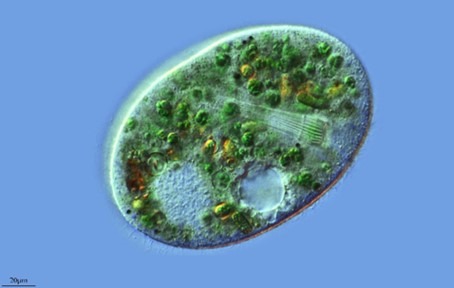
<p>At present, it is clear that zooxanthellae are not true algae, but rather members of the phylum Dinoflagellata (from the Greek word <i>dinos</i>, for whirling, and the Latin word <i>flagellum</i>, for whip). The phylum Dinoflagellata forms a very large group of unicellular organisms, most of which are classified as marine plankton. Some live in a symbiotic relationship with animals, such as corals. This includes dinoflagellates from the genus <i>Symbiodinium</i>, which are found in the tissues of the phyla Mollusca (Tridacna clams, nudibranchs), Platyhelminthes (flatworms), Porifera (sponges), Protozoa (foraminifera), and Cnidaria (corals, sea anemones, hydroids, jellyfish) (Stat et al. 2006; Venn et al. 2008).</p>
<p><i>Symbiodinium</i> spp. possess an important trait, namely the ability to photosynthesize. Photosynthesis is the conversion of inorganic carbon dioxide to organic compounds, such as glycerol and glucose, by using the energy from (sun)light. Corals harboring <i>Symbiodinium</i> require light to grow properly, as the nutrients produced by photosynthesis not only sustain the zooxanthellae, but also fuel the energy-demanding process of calcification (skeleton buildup) in corals. The importance of the animal-dinoflagellate symbiosis to the success of coral reefs is profound; the appearance of reefs in the Triassic period (250-200 million years ago) is thought to be a direct result of the evolution of this symbiosis (Muscatine et al. 2005).</p>
<h2>Biology of the animal-dinoflagellate symbiosis</h2>
<h3><i>Onset, stability and breakdown of the symbiosis</i></h3>
<p>When <i>Symbiodinium</i> live freely in the ocean, they exist in two interchangeable forms (Freudenthal 1962). The first is a motile zoospore, which propels itself forward with a flagellum. The second form is a vegetative cyst, and is not motile as it lacks a flagellum. Vegetative cysts can reproduce asexually, when they are free-living or in symbiosis, by cell division that yields two or three daughter cells. There are indications that <i>Symbiodinium</i> spp. can also reproduce sexually (Stat et al. 2006). The vegetative cyst is the dominant form when dinoflagellates live in symbiosis with animals, and evidence suggests that the animal host uses chemical signaling to keep them in this non-motile state (Koike et al. 2004). In most cases of symbiosis, zooxanthellae live inside an animal host cell, bounded by an animal membrane, known as the symbiosomal membrane (Venn et al. 2008). In Tridacnid clams, however, zooxanthellae live extracellularly, in between the clam's own cells (Ishikura et al. 1999). In corals, the zooxanthellae reside in the gastroderm, the cell layer which covers the coelenteron, or stomach of the polyps. In recent years, the mechanisms underlying the onset of the coral-zooxanthellae symbiosis have been studied in the lab. Currently, scientists have divided the symbiosis between cnidarians and algae into six phases; initial contact, engulfment, sorting, proliferation, stability, and finally dysfunction (Davy et al. 2012).</p>
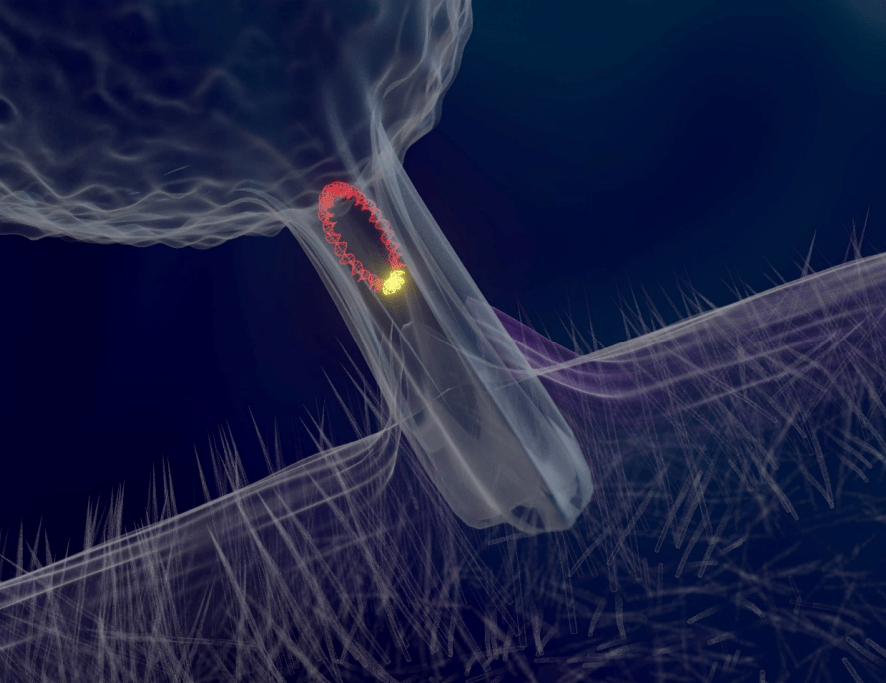
<p>First, free-living zooxanthellae have to encounter potential hosts such as corals. Although some coral species transfer their zooxanthellae to their offspring via eggs, a process called vertical transmission, many species need to acquire new symbionts every generation. Coral larvae and polyps do so by taking them up from the water column, which is called horizontal transmission. The recognition of zooxanthellae as potential symbionts by corals is not completely understood, but it requires a myriad of signaling molecules present on the cell surface of both partners. After the coral's cells have successfully recognized potentially compatible zooxanthellae, the cells engulf them through a process called phagocytosis (from Greek <i>phagein</i>, or to devour, <i>kytos</i>, or cell, and <i>osis</i>, meaning process). Next, a sorting process commences, leading to digestion of unwanted zooxanthellae, and persistence of others. The coral's preference for a specific zooxanthellae type, or clade, depends on many factors, including species. When a coral encounters incompatible zooxanthellae, an immune response is triggered, and the dinoflagellates destroyed and expelled. Suitable zooxanthellae will proliferate throughout the coral's gastroderm, and a stable symbiosis will ensue. Once a stable symbiosis is established, the zooxanthellae and coral are able to mutually benefit from the collaboration by exchanging nutrients (also see below). However, when the coral is stressed, by elevated water temperatures or high light intensity for example, a phenomenon known as coral bleaching can occur. This is caused by dysfunction of the symbiosis, the sixth and last known phase. Dysfunction during heat or light stress is thought to occur due to damage sustained by the photosynthetic machinery (or photosystems) of the zooxanthellae, which causes toxic molecules to flow into the coral's tissue (Venn et al. 2008). These toxic molecules are so-called reactive oxygen species, and they include superoxide radicals (O<sub>2</sub><sup>-</sup>) and hydrogen peroxide (H<sub>2</sub>O<sub>2</sub>). As a response to these toxins, the zooxanthellae are probably destroyed by and ejected from the gastrodermal cells, and next through the mouth of the coral.</p>
<div class="photo-wrapper"><a class="popup" href="corals_album/zooxanthellae_scheme.jpg" rel="gallery" title="Overview of the six known phases of the cnidarian-algal symbiosis. 1: initial surface contact between the zooxanthella and animal host cell; 2: symbiont engulfment by the host cell; 3: sorting of the symbionts, now enclosed by a membrane of host origin, leading to rejection or acceptance of the symbiont; 4: growth of the symbiont via cell division within the host tissue; 5: stability, with a stable symbiont population; 6: dysfunction and breakdown of the symbiosis due to stress. Redrawn from Davy et al. (2012)."><img src="corals_album/zooxanthellae_scheme.jpg/image_full" alt="zooxanthellae_scheme.jpg" class="image-inline" /></a>
<p class="caption">Overview of the six known phases of the cnidarian-algal symbiosis. 1: initial surface contact between the zooxanthella and animal host cell; 2: symbiont engulfment by the host cell; 3: sorting of the symbionts, now enclosed by a membrane of host origin, leading to rejection or acceptance of the symbiont; 4: growth of the symbiont via cell division within the host tissue; 5: stability, with a stable symbiont population; 6: dysfunction and breakdown of the symbiosis due to stress. Redrawn from Davy et al. (2012).</p>
</div>
<div class="photo-wrapper"><a class="popup" href="corals_album/breakdown_symbiosis.jpg" rel="gallery" title="Mechanism thought to underlie the coral-symbiosis breakdown. Heat and light stress cause damage to the photosystems within the zooxanthella, leading to the production of superoxygen radicals (O2-) and hydrogen peroxide (H2O2). This causes damage to the zooxanthella and the coral host cell, which triggers destruction and expulsion of the zooxanthella, and finally bleaching. Redrawn from Venn et al. (2008)."><img src="corals_album/breakdown_symbiosis.jpg/image_full" alt="breakdown_symbiosis.jpg" class="image-inline" /></a>
<p class="caption">Mechanism thought to underlie the coral-symbiosis breakdown. Heat and light stress cause damage to the photosystems within the zooxanthella, leading to the production of superoxygen radicals (O<sub>2</sub><sup>-</sup>) and hydrogen peroxide (H<sub>2</sub>O<sub>2</sub>). This causes damage to the zooxanthella and the coral host cell, which triggers destruction and expulsion of the zooxanthella, and finally bleaching. Redrawn from Venn et al. (2008).</p>
</div>
<p>Disruption of the animal-dinoflagellate symbiosis by environmental factors is nothing trivial. When corals are in a bleached state, they are no longer sustained by the vital nutrients from their zooxanthellae, and they have to reacquire their symbionts quickly to stay alive. Unfortunately, long, warm summers often prevent corals from doing just that, and massive coral mortality ensues. In aquaria, similar observations have been made. Many aquarists have seen the effects of heat and light stress at home, during warm summers or after the aquarium lights were upgraded. After several days of increased water temperature or light intensity, corals and anemones may bleach completely, resulting in a pale, colorless aquarium. It is therefore important to keep the aquarium temperature stable, and to increase light intensity slowly to allow the zooxanthellae to adapt.</p>
<p>The sensitivity of zooxanthellae to heat and light stress is known to vary between clades, with clade D being the most heat-tolerant (Baker et al. 2004). This is possibly due to the fact that these zooxanthellae have photosynthetic membranes which remain stable even at temperatures around 93°F (32°C), and do not release toxic reactive oxygen species into coral tissue at this elevated temperature (Tchernov et al. 2004). This explains why some corals bleach during hot summers, and others do not.</p>
<h3><i>Nutrient exchange within the symbiosis</i></h3>
<p>As long as the symbiosis between zooxanthellae and corals is intact, both partners benefit from an intricate exchange of nutrients. The coral cells provide the zooxanthellae with inorganic carbon and nitrogen (carbon dioxide, ammonium), produced by the breakdown of organic compounds obtained from the zooxanthellae (glycerol, glucose, amino acids, lipids) and the surrounding water (plankton, detritus, dissolved organic matter). The zooxanthellae, in turn, use inorganic compounds obtained from the coral and seawater (carbon dioxide, bicarbonate, ammonium, nitrate, hydrogen phosphate) to produce organic molecules through the process of photosynthesis. A major part of these organic molecules, now called photosynthates, is then transferred back to the host. This nutrient exchange between corals and zooxanthellae allows them to use the scarcely available nutrients in the ocean efficiently. The translocation of energy-rich compounds from zooxanthellae to their host has allowed corals to build vast reefs, through the secretion of calcium carbonate skeletons.</p>
<p>It is clear that zooxanthellae do not simply transfer any excess substances to their coral host. The release of photosynthates from the zooxanthellae is cleverly induced by the coral with a so-called "host release factor", or HRF. This HRF is a substance produced by the coral, possibly a cocktail of specific amino acids, which triggers the release of nutritious glycerol and glucose by the zooxanthellae (Gates et al. 1995; Wang and Douglas 1997). Indeed, when a drop of coral tissue slurry is added to a <i>Symbiodinium</i> culture, it will quickly induce nutrient release by the dinoflagellates (Trench 1971). However, Davy et al. (2012) point out that the HRF must not be generalized across host species, as evidence suggests that different species may use different types of HRF's.</p>
<p>Even though corals receive significant amounts of organic compounds from their zooxanthellae, research strongly suggests that an external food source is required to sustain optimal growth (reviewed by Houlbrèque and Ferrier-Pagès 2009). This is because corals require additional protein and lipid to grow tissue and the organic matrix, a proteinaceous "scaffold" that provides sites for calcium carbonate crystals to precipitate. Providing corals with a daily batch of zooplankton, such as copepods or brine shrimp nauplii, not only provides them with nourishment; the slight increase in inorganic nutrients will also feed the zooxanthellae. In addition, the cycling of nutrients within the symbiosis is stimulated. Some aquaria are so devoid of nutrients, owing to the use of heavy filtration combined with scarce feeding, that the zooxanthellae stop growing and die. This makes corals appear bleached, and when this occurs, it is essential that the filtration rate is reduced and/or feeding increased.</p>
<div class="photo-wrapper"><a class="popup" href="corals_album/zooxanthellae_coral_nutrient_exchange.jpg" rel="gallery" title="Overview of the nutrient exchange between a single coral and zooxanthella cell. The coral takes up organic compounds as plankton, detritus (or Particular Organic Matter, POM), urea, amino acids, and glucose (or Dissolved Organic Matter, DOM) from the seawater. In addition, it receives organic molecules from the zooxanthellae, such as glycerol. The coral cell breaks these down to ammonium and carbon dioxide, which are subsequently absorbed by the zooxanthella. The zooxanthella also takes up inorganic compounds from the water, as ammonium (NH4+), nitrate (NO3-), hydrogen phosphate (HPO42-), bicarbonate (HCO3-) and carbon dioxide (CO2), and converts these to organic molecules, mainly through photosynthesis. A major part of these compounds is again exuded into the coral host cell. This cycling of nutrients between coral host cells and their symbiotic zooxanthellae allows corals to grow in nutrient-poor environments. Redrawn from Davy et al. (2012)."><img src="corals_album/zooxanthellae_coral_nutrient_exchange.jpg/image_full" alt="zooxanthellae_coral_nutrient_exchange.jpg" class="image-inline" /></a>
<p class="caption">Overview of the nutrient exchange between a single coral and zooxanthella cell. The coral takes up organic compounds as plankton, detritus (or particulate Organic Matter, POM), urea, amino acids, and glucose (or Dissolved Organic Matter, DOM) from the seawater. In addition, it receives organic molecules from the zooxanthellae, such as glycerol. The coral cell breaks these down to ammonium and carbon dioxide, which are subsequently absorbed by the zooxanthella. The zooxanthella also takes up inorganic compounds from the water, as ammonium (NH<sub>4</sub><sup>+</sup>), nitrate (NO<sub>3</sub><sup>-</sup>), hydrogen phosphate (HPO<sub>4</sub><sup>2-</sup>), bicarbonate (HCO<sub>3</sub><sup>-</sup>) and carbon dioxide (CO<sub>2</sub>), and converts these to organic molecules, mainly through photosynthesis. A major part of these compounds is again exuded into the coral host cell. This cycling of nutrients between coral host cells and their symbiotic zooxanthellae allows corals to grow in nutrient-poor environments. Redrawn from Davy et al. (2012).</p>
</div>
<h2>How to study zooxanthellae: the tools and protocol</h2>
<p>As zooxanthellae are essential to the existence of reef-building corals, it naturally follows that studying these dinoflagellates is important. To extract zooxanthellae, and thus valuable information from the coral, some equipment is required. The first step during isolation is weighing the coral, use the so-called buoyant weighing method. Each colony is weighed in seawater with a constant density (at a temperature of 26°C and salinity of 35 g L<sup>-1</sup>), by suspending it from a wire that is connected to a sensitive weighing scale. This is most accurate, as weighing above water would obscure the coral's real air weight as a small layer of seawater would be attached to the coral. As each coral was weighed before and after it was glued onto a PVC plate, the net weight of the coral can be calculated when it is weighed again at any point in time, by simply subtracting the weight of the plate and epoxy resin.</p>
<p>When the buoyant weight of the coral is known, the next step is removing tissue from the skeleton. With a fine jet of air, this is done easily. Small coral fragments (about 0.5-1 inches in size) are put in plastic tubes, and an air nozzle is inserted in the space between the tube and its cap. Depending on the coral's morphology, the air jet is applied from 1 to 3 minutes, effectively removing all tissue. When the coral skeleton is completely bare, it is removed from the tube. The skeleton can be used itself for other types of analyses, such as determining the proteins that make up the organic matrix.</p>
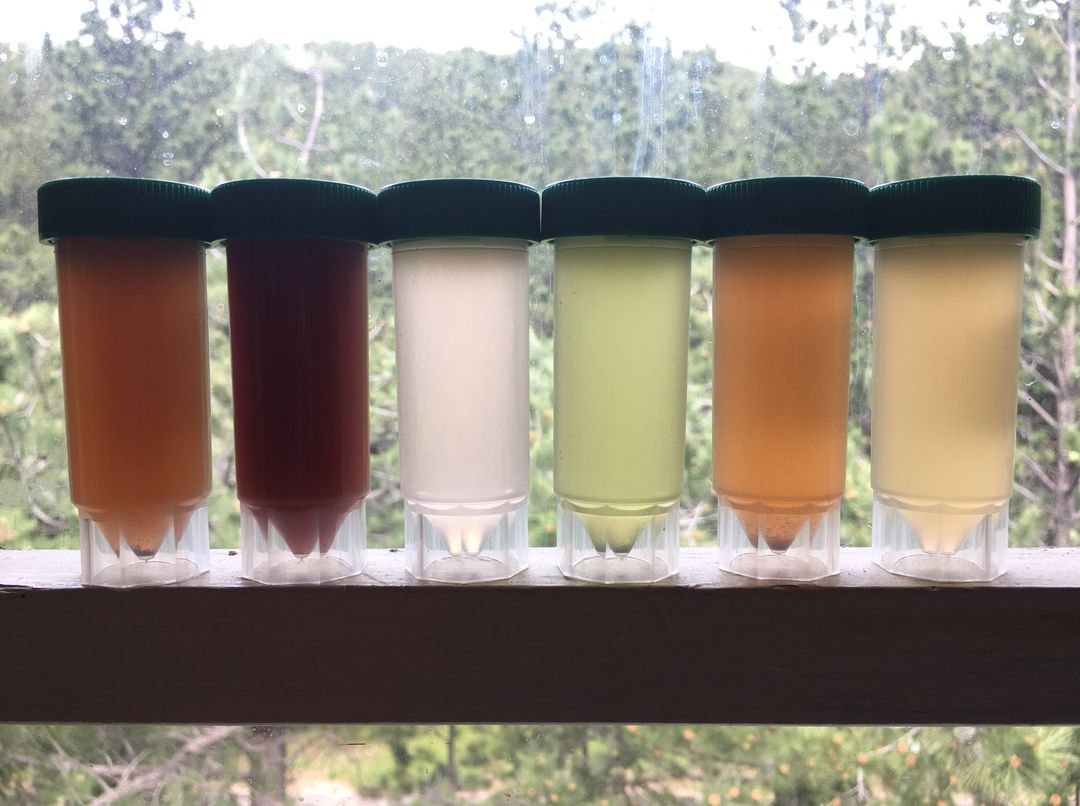
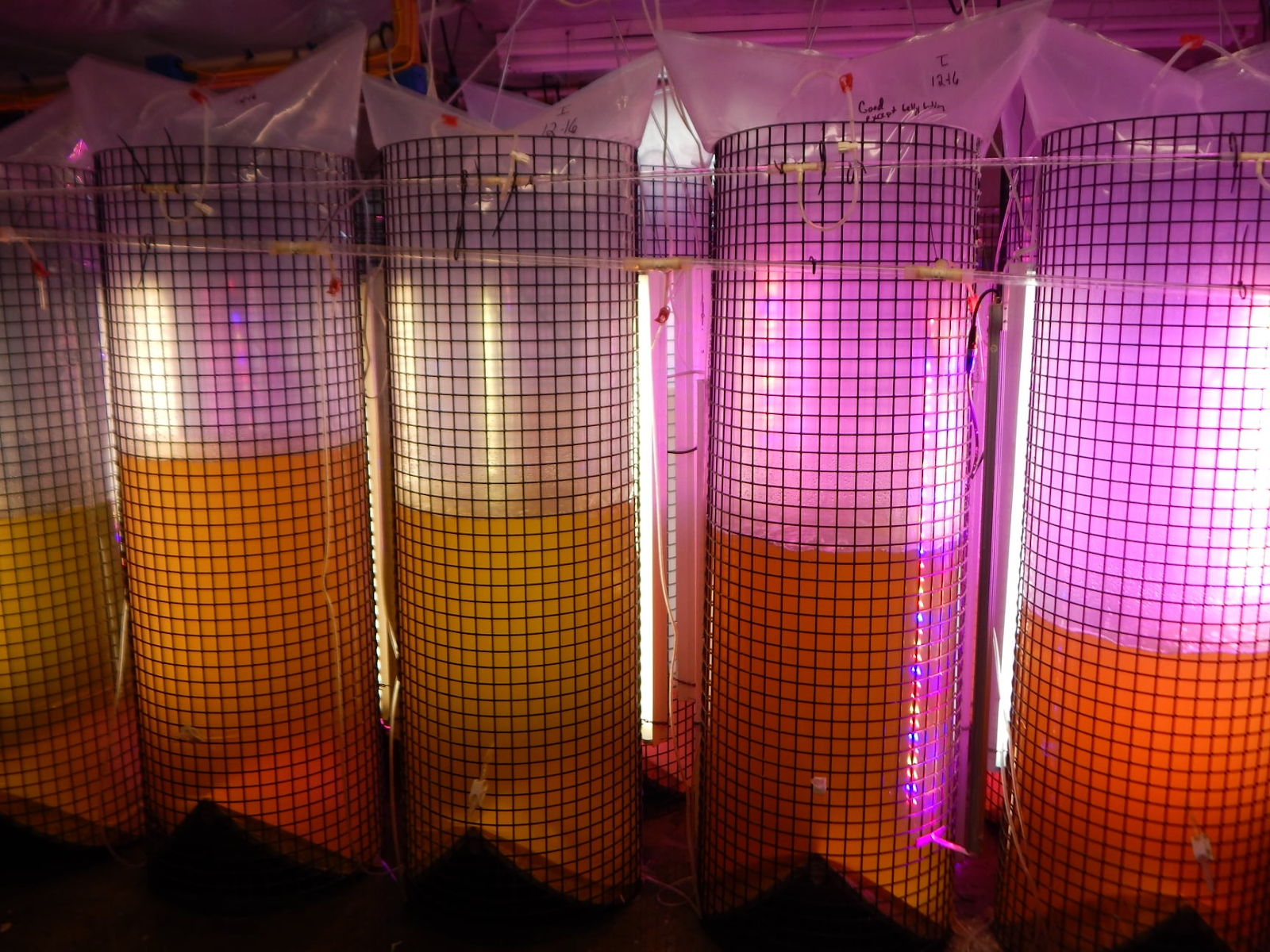
<p>After the tissue has been separated from the skeleton, artificial seawater is added, and the tube is shaken until a tissue suspension is obtained. With a centrifuge, coral tissue and zooxanthellae are then separated. The zooxanthellae are heavier and will sink to the bottom of the tube, creating a brownish pellet. The coral tissue forms a slightly opaque solution above the pellet, called a supernatant. This supernatant can be removed with a pipette, or poured, and the zooxanthellae pellet can be resuspended in seawater. Both fractions can be analyzed for enzymatic activity, protein content, or even DNA. The zooxanthellae fraction can also be used to establish live cultures of free-living dinoflagellates for research.</p>
<p>To obtain the zooxanthellae density in the coral, a small volume from the zooxanthellae suspension is applied on a haemocytometer with a pipette. A haemocytometer is a small chamber which contains a counting grid, and is also used to count bacteria, algae and blood cells. Under a microscope, the amount of zooxanthellae per unit of sample volume is then determined. Because the total sample volume is known, the total amount of zooxanthellae isolated from a piece of coral can be calculated. By dividing this number by the weight (or surface area) of the coral, the zooxanthellae density is obtained. This method allows researchers to find out how the growth of zooxanthellae is affected by the coral's environment. With some basic laboratory equipment, zooxanthellae can even be isolated at home.</p>
<div class="photo-wrapper"><a class="popup" href="corals_album/IMG_4720.JPG" rel="gallery" title="A coral is suspended from a wire for underwater, or buoyant, weighing."><img src="corals_album/IMG_4720.JPG/image_full" alt="IMG_4720.JPG" class="image-inline" /></a>
<p class="caption">A coral is suspended from a wire for underwater, or buoyant, weighing.</p>
</div>
<div class="photo-wrapper"><a class="popup" href="corals_album/DSC00547.JPG" rel="gallery" title="With pressurized air, coral tissue can be effectively removed from the skeleton."><img src="corals_album/DSC00547.JPG/image_full" alt="DSC00547.JPG" class="image-inline" /></a>
<p class="caption">With pressurized air, coral tissue can be effectively removed from the skeleton.</p>
</div>
<div class="photo-wrapper"><a class="popup" href="corals_album/DSC00544.JPG" rel="gallery" title="A centrifuge allows for separation of coral tissue and symbiotic zooxanthellae."><img src="corals_album/DSC00544.JPG/image_full" alt="DSC00544.JPG" class="image-inline" /></a>
<p class="caption">A centrifuge allows for separation of coral tissue and symbiotic zooxanthellae.</p>
</div>
<div class="photo-wrapper"><a class="popup" href="corals_album/DSC00543.JPG" rel="gallery" title="Important tools of the trade: a pipette, tips and a haemocytometer."><img src="corals_album/DSC00543.JPG/image_full" alt="DSC00543.JPG" class="image-inline" /></a>
<p class="caption">Important tools of the trade: a pipette, tips and a haemocytometer.</p>
</div>
<div class="photo-wrapper"><a class="popup" href="corals_album/microscope_haemocytometer.jpg" rel="gallery" title="The haemocytometer is placed under a microscope to determine the zooxanthellae density in the coral tissue sample."><img src="corals_album/microscope_haemocytometer.jpg/image_full" alt="microscope_haemocytometer.jpg" class="image-inline" /></a>
<p class="caption">The haemocytometer is placed under a microscope to determine the zooxanthellae density in the coral tissue sample.</p>
</div>
<div class="photo-wrapper"><a class="popup" href="corals_album/DSC00554.JPG" rel="gallery" title="First described by Brandt in 1881: zooxanthellae. Here, they have been isolated from the reef coral Stylophora pistillata. Magnification is 100x (excluding camera zoom). "><img src="corals_album/DSC00554.JPG/image_full" alt="DSC00554.JPG" class="image-inline" /></a>
<p class="caption">First described by Brandt in 1881: zooxanthellae. Here, they have been isolated from the reef coral <i>Stylophora pistillata</i>. Magnification is 100x (excluding camera zoom).</p>
</div>
<h2>Future research</h2>
<p>Even though quite a lot is known about zooxanthellae, many future avenues of research exist. These are focused on understanding more about the onset and breakdown of the symbiosis between corals and zooxanthellae. By now, it is clear that the world's reefs are deteriorating, and the fragile coral-zooxanthellae symbiosis lies at the heart of this issue. Factors which determine the sensitivity of zooxanthellae and corals to stressful conditions, such as high water temperatures, will remain a subject of thorough scientific study. Of major interest are so-called interactive effects, where the interplay between e.g. water temperature, pH, light intensity and nutrients determines coral bleaching.</p>
<div class="photo-wrapper"><a class="popup" href="corals_album/overzichtrasq.jpg" rel="gallery" title="Coral reefs (here at Ra's Qul`an, Egypt) are quickly deteriorating, and the symbiosis between corals and zooxanthellae lies at the heart of this issue. "><img src="corals_album/overzichtrasq.jpg/image_full" alt="overzichtrasq.jpg" class="image-inline" /></a>
<p class="caption">Coral reefs (here at Ra's Qul`an, Egypt) are quickly deteriorating, and the symbiosis between corals and zooxanthellae lies at the heart of this issue.</p>
</div>
<p>The next time you gaze at your corals through the aquarium glass, think about the intricate, delicate partnership they have formed with zooxanthellae, how this allows them to build the largest natural structures on earth, and how easily their alliance with zooxanthellae fails if environmental conditions are unfavorable.</p>
<h2>References</h2>
<ol>
<li>AC Baker, CJ Starger, TR McClanahan, PW Glynn (2004) Coral reefs: corals' adaptive response to climate change. Nature 430:741</li>
<li>Brandt K (1881) Ueber das Zusammenleben von Algen und Tieren. Biologisches Zentralblatt 524-527</li>
<li>Davy SK, Allemand D, Weis VM (2012) Cell Biology of Cnidarian-Dinoflagellate Symbiosis. MMBR 76:229-261</li>
<li>Freudenthal HD (1962) <i>Symbiodinium</i> gen. nov. and <i>Symbiodinium microadriaticum</i> sp. nov., a Zooxanthella: Taxonomy, life cycle, and morphology. J Protozool 9:45-52</li>
<li>Gates RD, Hoegh-Guldberg O, McFall-Ngai MJ, Bil KY, Muscatine L (1995) Free amino acids exhibit anthozoan host factor activity: they induce the release of photosynthate from symbiotic dinoflagellates <i>in vitro</i>. Proc Nat Ac Sc USA 92:7430-7434</li>
<li>Houlbrèque F, Ferrier-Pagès C (2009) Heterotrophy in tropical scleractinian corals. Biol Rev Camb Philos 84:1-17</li>
<li>Ishikura M, Adachi K, Maruyama T (1999) Zooxanthellae release glucose in the tissue of a giant clam, <i>Tridacna crocea</i>. Marine Biology 133:665-673</li>
<li>Koike K, Jimbo M, Sakai R, Kaeriyama M, Muramoto K, Ogata T, Maruyama T, Kamiya H (2004) Octocoral chemical signalling selects and controls dinoflagellate symbionts. Biol Bull 207:80-86</li>
<li>Muscatine L et al. (2005) Stable isotopes (13C and 15N) of organic matrix from coral skeleton. Proc Natl Acad Sci USA 102:1525-1530</li>
<li>Stat M, Carter D, Hoegh-Guldberg O (2006) The evolutionary history of Symbiodinium and scleractinian hosts-Symbiosis, diversity, and the effect of climate change. Persp Plant Ecol Evol Syst 8:23-43</li>
<li>Tchernov D, Gorbunov MY, de Vargas C, Narayan Yadav S, Milligan AJ, Häggblom M, Falkowski PG (2004) Membrane lipids of symbiotic algae are diagnostic of sensitivity to thermal bleaching in corals. Proc Natl Acad Sci USA 37:13531-13535</li>
<li>Trench RK (1971) The physiology and biochemistry of zooxanthellae symbiotic with marine coelenterates. III. The effects of homogenates of host tissues on the excretion of photosynthetic products <i>in vitro</i> by zooxanthellae from marine coelenterates. Proc Roy Soc Lond B 177:251-264</li>
<li>Venn AA, Loram JE, Douglas AE (2008) Photosynthetic symbioses in animals. J Exp Bot 59:1069-1080</li>
<li>Wang J-T, Douglas AE (1997) Nutrients, signals and photosynthate release by symbiotic algae: the impact of taurine on the dinoflagellate alga Symbiodinium from the sea anemone <i>Aiptasia pulchella</i>. J Plant Phys 114:631-636<a name="_GoBack"></a></li>
</ol></div> <br /><br /> <script type="text/javascript"><!-- google_ad_client = "ca-pub-5170032844807535"; /* Square250x250 */ google_ad_slot = "6862474606"; google_ad_width = 250; google_ad_height = 250; //--></script><script type="text/javascript" src="http://pagead2.googlesyndication.com/pagead/show_ads.js"></script>]]></content:encoded>
    <dc:publisher>No publisher</dc:publisher>
    
    <dc:creator>Tim Wijgerde</dc:creator>
    <dc:rights>Pomacanthus Publications, Inc.</dc:rights>
    
      <dc:subject>Tim Wijgerde</dc:subject>
    
    
      <dc:subject>Feature Article</dc:subject>
    
    <dc:date>2013-05-01T15:00:00Z</dc:date>
    <dc:type>Page</dc:type>
  </item>


  <item rdf:about="http://www.advancedaquarist.com/2013/4/aquarium">
    <title>Feature Aquarium: Bryn Roberts' 360-gallon reef aquarium</title>
    <link>http://www.advancedaquarist.com/2013/4/aquarium</link>
    <description>Conventional reefkeeping wisdom says live corals should not coexist with big angelfish and butterflyfish.  Don't tell that Bryn Roberts.  With careful selection of fish, corals, and invertebrates, Bryn pushes the boundaries of "reef safe."  Large, colorful coral colonies thrive in the presence of rare angels and butterflies.</description>
    <content:encoded xmlns:content="http://purl.org/rss/1.0/modules/content/"><![CDATA[<p><em><strong>Click through to see the images.</strong></em></p> <br /><div id="body">
<p><img src="aquarium_album/bryn2.jpg" alt="bryn2.jpg" class="image-inline" /></p>
<p><span class="dropcap">M</span>y name is Bryn and I'm an alcoholic … oops … sorry wrong AA article! In all seriousness my true addiction is to this hugely rewarding, massively frustrating and at times, all-consuming hobby of ours. Sometimes, when its 3 a.m., I've accidentally set my reactor CO<sub>2</sub> rate too high, my media has melted causing my skimmer to overflow, which I've forgotten is linked to the main drain, meaning my tank is slowly going down the sewers, prompting my kalkstirrer to pour limewater into my sump at a rate of knots, and now my skimmer is fizzing up to such an extent that my garage floor now looks like an Ibiza foam party, the low water alarm is belting out, the wife is up and going nuts, I wonder … is it really worth it? Then a week later when the tank finally clears and the bruises the Mrs. gave me for making such a mess are starting to fade, I stand back, drink in the view and realize yes, actually it is!</p>
<div class="photo-wrapper"><a class="popup" href="aquarium_album/DSC01778.JPG" rel="gallery"><img src="aquarium_album/DSC01778.JPG/image_full" alt="DSC01778.JPG" class="image-inline" /></a></div>
<p>I've been keeping fish on and off since I was 9 years old. I graduated to the salty world around a decade ago. Since then I've had three tanks. The first was an extremely poor and ill-conceived 190l fish only system complete with internal filter, air stone skimmer and tufa rock. I committed cardinal sins in fish choice/compatibility, buying on impulse based on the advice of the kid in the fish shop who assured me on many occasions that all of the fish they stocked were community friendly. Funnily enough my wolf eel, miniatus grouper and lunar wrasse didn't share the same conviction!</p>
<p>For the second tank I decided to step back and do my homework. I joined several online forums and was astounded at the true works of art people were producing. Then I saw an SPS tank being featured as tank of the month and I knew then I'd found what I wanted to achieve. This was it. I could see this guy's equipment list. All I had to do was copy him and I was home free! Simple. I then spent the next 4 years making every mistake possible in the reefkeeping world! Every algae, pest, parasite and bacterium known to man took their turns to make my life a misery. Somehow though, I eventually managed to achieve the beautiful SPS reef I had dreamed of.</p>
<p>At that point I decided that the best thing to do was tear it all down and start again!</p>
<p> </p>
<h2>The Tank</h2>
<p>The current tank is nearing 2 years old now and has been a comparable dream to maintain. It hasn't been stress-free by any means but overall I am very happy with the result. The display is situated in our kitchen and stands on a box steel frame which I DIY-cladded with white acrylic panels. The tank overflows and runs underneath our bathroom to the sump and filtration system located in my garage (notice the deliberate use of the word "my" here).</p>
<p><a class="popup" href="aquarium_album/DSC01798.JPG" rel="gallery"><img src="aquarium_album/DSC01798.JPG/image_full" alt="DSC01798.JPG" class="image-inline" /></a></p>
<h2>Specifications</h2>
<h4>Display tank:</h4>
<ul>
<li>Dimensions: 66"L x 42"W x 30"H</li>
<li>Volume: Approx. 300 UK gallons (360 US gallons)</li>
<li>Euro braced, opti-white front and side viewing panels</li>
</ul>
<h4>Garage:</h4>
<ul>
<li>60"L x 18"W x 24"H split into 4 sections, each with its own drain</li>
<li>400l plastic sump</li>
</ul>
<h4>Filtration Equipment:</h4>
<ul>
<li>Deltec SC2560 protein skimmer</li>
<li>TMC commercial UV filter.</li>
<li>6x in-line DI pod phosphate filter</li>
<li>DIY floss filter</li>
</ul>
<div class="photo-wrapper"><a class="popup" href="aquarium_album/DSC01303.JPG" rel="gallery"><img src="aquarium_album/DSC01303.JPG/image_full" alt="DSC01303.JPG" class="image-inline" /></a></div>
<h2>Nutrient Export</h2>
<p>My nutrient export methodology is very simple. I have tried many approaches in the past: ULNS, vodka dosing, lanthanum chloride etc. However, I have found that for my tank, if I drop the nutrients too low I lose the vibrant colours. Many people have found the opposite but for my tank low nutrients are not the top priority.</p>
<p>I don't dose anything, no blue bottles or carbon source of any kind. I have a DSB that has existed in my sump since the birth of my second tank and cheato that I grow on top of it. I also run a DIY phosphate reactor that consists of 6 slim in-line de-ionisation pods, the first of which is filled with carbon and the five that follow with GFO. The reason I use the slim canisters is that I've yet to find GFO media that doesn't clump and channel so by extending the horizontal run I stand a better chance of making the most of it. I run a reasonably slow flow through this, I've never measured it but I'd guess it's about 10 - 20 litres an hour.</p>
<p> </p>
<h2>Lighting</h2>
<p>My experience with lighting has taught me that as long as you acclimatise your SPS slowly, most of them just can't get enough. As mentioned above nutrients aren't my top priority, lighting however definitely is. I'm no expert on the scientific side of the hobby. However, it seems logical to me that for animals that draw most of their sustenance from photosynthesis this has to be the key.</p>
<p>I run 2 x 400w metal halide lamps in Lumenarc reflectors powered by electronic ballasts. My bulb of choice is Radium 20,000K. I've tried many others but once I ignited the Radiums I knew I'd probably never change brand again. I supplement this with 8 x 54 w T5 with a mix of different bulbs that I change when the mood suits me. I love the flexibility T5 gives you to tweak and change the appearance of the tank. My current blend is all ATI with 2x aquablue special, 2x purple plus, 2x true actinic and 2x blue plus.</p>
<div class="photo-wrapper"><a class="popup" href="aquarium_album/DSC01479.JPG" rel="gallery"><img src="aquarium_album/DSC01479.JPG/image_full" alt="DSC01479.JPG" class="image-inline" /></a></div>
<p>The halides come on at 12:00 and go off at 22:00. The purple and actinic t5's come on at 14:00 and go off at 22:30 while the aquablue and blue plus bulbs come on at 18:00 and go off at 21:30. I really enjoy the different hues and colours that the lights bring out at different times of the day. A further twist on the lighting is that I have two large skylights directly above the tank so in the summer especially (on the odd occasion we get a summer in the UK) the lighting effects can be spectacular.</p>
<p> </p>
<h2>Supplementation</h2>
<ul>
<li>Schuran Jetstream 1 calcium reactor.</li>
<li>Deltec kalkstirrer.</li>
<li>Marine Colour dosing pump.</li>
</ul>
<p>For calcium I run a reactor with ARM media combined with all top off water running through a Kalkstirrer. Until recently this was sufficient for my needs however the rate at which some of my corals are now growing means I have to add a little bicarbonate of soda daily through a dosing pump. Magnesium and Calcium are occasionally corrected manually using Randy Holmes Farley's recipes although this is probably only a few times a year.</p>
<div class="photo-wrapper"><a class="popup" href="aquarium_album/DSC01480.JPG" rel="gallery"><img src="aquarium_album/DSC01480.JPG/image_full" alt="DSC01480.JPG" class="image-inline" /></a></div>
<div class="photo-wrapper"><a class="popup" href="aquarium_album/DSC01761.JPG" rel="gallery"><img src="aquarium_album/DSC01761.JPG/image_full" alt="DSC01761.JPG" class="image-inline" /></a></div>
<h2>Parameters</h2>
<p>I have to admit this is one area of the hobby I have always loathed. I find the process of testing tedious and this is probably my biggest downfall. Like many I tend to base my corrective actions on the look of my tank. Certain corals I find a giveaway of something being out of step. For instance I have a particular acro that will stop producing its purple growth tips if the phosphate levels go beyond what many of the other corals can tolerate. I use this coral to tell me when I need to change my GFO rather than a test result. The only test I do with any reasonable regularity is KH, the rest I only test on occasion but for those I do test for here are the ranges I usually find.</p>
<ul>
<li>SG: 1.026 - 1.027</li>
<li>Calcium: 380 - 500</li>
<li>KH: 7 - 9</li>
<li>Magnesium: 1300 - 1500</li>
</ul>
<p> </p>
<p><a class="popup" href="aquarium_album/DSC01709.JPG" rel="gallery"><img src="aquarium_album/DSC01709.JPG/image_full" alt="DSC01709.JPG" class="image-inline" /></a></p>
<ul>
</ul>
<div class="photo-wrapper"><a class="popup" href="aquarium_album/DSC01637.JPG" rel="gallery"><img src="aquarium_album/DSC01637.JPG/image_full" alt="DSC01637.JPG" class="image-inline" /></a></div>
<p>With my filtration system being located in the garage, and the climate here cold for most of the year, keeping the temperature up rather than down is my issue. I have 2 x 300 watt heaters in the display tank and a further two in the sump. My sump is well insulated but the garage tank isn't at all, so for this reason I shut it down around November then get it back on-line around April. As it isn't heated it acts to keep my main tank at a reasonable temperature in the summer months. If we are lucky enough to ever hit some warm weather I have a large DIY twin pipe "bong" chiller that I can connect up but I've not needed to in the last couple of years.</p>
<p>Temperature: Winter 22C (71.6F) - 24C (75.2F), Summer 24C (75.2F) - 27C (80.6F).</p>
<p> </p>
<h2>Fish</h2>
<p>Now were talking! Fish to me are what brought me into the hobby and to this day they are what keeps me in it. I'll never forget the first time I saw a Royal Gramma in a terrible local garden centre aquarium and was blown away by the contrast in colours. To this day it remains one of my favourite fish however over the years my tastes have changed and developed as I have started to yearn the more unusual animals.</p>
<p><a class="popup" href="aquarium_album/DSC01357.JPG" rel="gallery"><img src="aquarium_album/DSC01357.JPG/image_full" alt="DSC01357.JPG" class="image-inline" /></a></p>
<p>I've always loved angels and butterflies. To my mind they are the ultimate reef fish. I always envisioned filling a reef tank with them. However, from my initial investigations it appeared the accepted wisdom was that they were massive reef no-no's. Then I came across John Coppolino's tank on a reef forum and it gave me the permission I had been craving to just go for it!</p>
<p>I think many people approach fish choice based on the corals they keep. My approach is the opposite. I select the corals with an eye on the fish I have or plan to keep in the near future. The term reef-safe is one we hear applied to fish all of the time but we never hear corals described in terms of the fish that won't eat them. I think it's a common misconception that fish are either "reef safe" or not. In my experience there are few fish that are totally incompatible with any corals at all,; It's just a case of finding the right blend.</p>
<p>For my own personal taste in fish it helps hugely that I've always preferred SPS as I've yet to keep an angel that has caused any real damage to them. My LPS choice is certainly limited and I can't keep much in the way of Zoa's or fleshy corals such as open brains but this is a trade-off I'm happy to accept.</p>
<p><a class="popup" href="aquarium_album/DSC01632.JPG" rel="gallery"><img src="aquarium_album/DSC01632.JPG/image_full" alt="DSC01632.JPG" class="image-inline" /></a></p>
<p><a class="popup" href="aquarium_album/DSC01435.JPG" rel="gallery"><img src="aquarium_album/DSC01435.JPG/image_full" alt="DSC01435.JPG" class="image-inline" /></a></p>
<h3>Fish List</h3>
<p>In this tank my aim has always been to keep a member of each of the main Angel genus along with some other favourites.</p>
<ul>
<li>Regal Angel - <i>Pygoplites diacanthus</i></li>
<li>Emperor Angel - <i>Pomacanthus imperator</i></li>
<li>Pair of Watanebe Angels - <i>Genicanthus watanabei</i></li>
<li>Goldflake Angel - <i>Apolemichthys xanthopunctatus</i></li>
<li>Spectacle Angel - <i>Chaetodontoplus conspicillatus</i></li>
<li>Flame Angel - <i>Centropyge loriculus</i></li>
<li>True Queen Angel - <i>Holacanthus ciliaris</i></li>
<li>5 x Royal Gramma - <i>Gramma loreto</i></li>
<li>Tinkers Butterfly - <i>Chaetodon tinkeri</i></li>
<li>Mitratus Butterfly- <i>Chaetodon mitratus</i></li>
<li>Achiles Tang - <i>Acanthurus Achilles</i></li>
<li>Approx 10 x Green Chromis - <i>Chromis viridis</i></li>
<li>Midas Blenny - <i>Ecsenius midas</i></li>
<li>Red Headed Jawfish - <i>Opistognathus spp</i>.</li>
<li>Watchman Goby - <i>Cryptocentrus pavoninoides</i></li>
<li>Coral sea percula clownfish - <i>Amphiprion percula</i></li>
</ul>
<p> </p>
<h3>Feeding</h3>
<p>I love my fish so I feed heavy. I have two auto-feeders containing pellets, both come on 3 times a day. The first holds 1mm NLS pellets; all of my fish love these. The second holds a 50/50 mix of medium size Ocean Nutrition Formula 1 and 2. I also keep a jumbo tub of unbranded marine flake near the tank and they get a large pinch of this probably 3 or 4 times a day. I feed D&amp;D reef paste, RS Mysis, lobster eggs, cyclopeze and red plankton but there is no real schedule. It's just as I feel like it.</p>
<div class="photo-wrapper"><a class="popup" href="aquarium_album/DSC01766.JPG" rel="gallery"><img src="aquarium_album/DSC01766.JPG/image_full" alt="DSC01766.JPG" class="image-inline" /></a></div>
<p><a class="popup" href="aquarium_album/DSC01628.JPG" rel="gallery"><img src="aquarium_album/DSC01628.JPG/image_full" alt="DSC01628.JPG" class="image-inline" /></a></p>
<p> </p>
<h2>Inverts</h2>
<p>One of the things I love about this hobby is the phenomenal range of inverts that are now available to us. We have shrimps that clean fish, shrimps that live in anemone's, shrimps that live in a burrow with fish, shrimps that ride on the back of sea cucumbers, shrimps that prey only on starfish and that's just shrimps! I keep a reasonable range of inverts but this is something I'm keen on expanding in the future. When we have friends or family over the fish that get the initial attention but it's the crabs, snails and urchins that really hold their interest. The added bonus of these animals is the services they perform in keeping our aquariums clean and controlling pests. If there's a biological solution to a problem I'll always pick that over chemical.</p>
<h3>Current Inverts</h3>
<ul>
<li>2 x tuxedo urchins.</li>
<li>4 x pincushion urchins in various colours.</li>
<li>3 x cleaner shrimps.</li>
<li>Boxing shrimp.</li>
<li>2 x pistol shrimps.</li>
<li>Unknown number of crabs, there are crabs in virtually every acro.</li>
<li>Various different snails.</li>
</ul>
<p> </p>
<p><a class="popup" href="aquarium_album/DSC01738.JPG" rel="gallery"><img src="aquarium_album/DSC01738.JPG/image_full" alt="DSC01738.JPG" class="image-inline" /></a></p>
<ul>
</ul>
<h2>Corals</h2>
<p>As the photos demonstrate, the aquarium is heavily dominated by SPS corals. My personal favourites are Montipora species. I just love the solid colours and interesting structures they form, that and the fact that they are easy to keep! I also keep some LPS, mostly Euphyllia, as mentioned previously those that my fish don't like the taste of. I'm not going to attempt to name all the species as frankly I haven't a clue.</p>
<p> </p>
<h2>Plans for the future</h2>
<p>Unsurprisingly my plans surround fish. I'm happy with the corals I have now so I don't see myself adding many more. If anything I can see myself removing some. To me reefs with large colonies look so much more natural. Ralph Prehn's is probably the best example of this point. Fish-wise I feel I'm nearly where I want to be. However, deep down I know I'll never be fully satisfied and that can only mean one thing: a bigger tank!</p>
<p>I love the Roaps subgenus of butterflies. They are hardy and the ones I have kept haven't proved any danger to my corals. I have two but I plan on adding at least a couple more, I'm also keen on broadening my butterfly horizons and attempting some of the more risky choices such as <i>C. paucifasciatus</i>. There is also one angel that has eluded my attempts to obtain it although I'm not going to mention which one so I don't jinx my chances!</p>
<p><a class="popup" href="aquarium_album/DSC01788.JPG" rel="gallery"><img src="aquarium_album/DSC01788.JPG/image_full" alt="DSC01788.JPG" class="image-inline" /></a></p>
<h2>Acknowledgements</h2>
<p>First and foremost I'd like to publicly thank my family for tolerating my piscine insanity! I'd also like to extend gratitude to Steve at Burscough Aquatics for providing the majority of my corals and the team at Abyss Aquatics for sourcing my fish. A big thanks also to Leonard Ho for inviting me to share my aquarium with the magazine.</p>
<p style="text-align: center; ">Click on the link below to see more photos.<br /> <a class="external-link" href="aquarium_album"><img src="../../magazine/photoicon.jpg" alt="photoicon.jpg" class="image-inline" /></a></p>
</div> <br /><br /> <script type="text/javascript"><!-- google_ad_client = "ca-pub-5170032844807535"; /* Square250x250 */ google_ad_slot = "6862474606"; google_ad_width = 250; google_ad_height = 250; //--></script><script type="text/javascript" src="http://pagead2.googlesyndication.com/pagead/show_ads.js"></script>]]></content:encoded>
    <dc:publisher>No publisher</dc:publisher>
    
    <dc:creator>Bryn Roberts</dc:creator>
    <dc:rights>Pomacanthus Publications, Inc.</dc:rights>
    
      <dc:subject>Bryn Roberts</dc:subject>
    
    
      <dc:subject>Feature Aquarium</dc:subject>
    
    <dc:date>2013-04-24T15:00:00Z</dc:date>
    <dc:type>Page</dc:type>
  </item>


  <item rdf:about="http://www.advancedaquarist.com/2013/4/inverts">
    <title>Aquarium Invertebrates: A Look at the Giant Clam Tridacna squamosa</title>
    <link>http://www.advancedaquarist.com/2013/4/inverts</link>
    <description>There are several species of giant clam available to us, all of which belong to the family Tridacnidae, with each being unique in its own ways. Of these, Tridacna squamosa, is one of the hardiest and easiest to care for, and can be one of the most attractive, too. So, this month I'll give you some information about T. squamosa, which is commonly called the squamosa clam, scaly clam, scaled giant clam, or fluted clam.</description>
    <content:encoded xmlns:content="http://purl.org/rss/1.0/modules/content/"><![CDATA[<p><em><strong>Click through to see the images.</strong></em></p> <br /><div id="body">
<p><img src="inverts_album/squamosa2.jpg" alt="squamosa2.jpg" class="image-inline" /></p>
<p><span class="dropcap">T</span>o start, <i>T. squamosa</i> ranges from the east coast of Africa across the Indo-Pacific to the Marshall Islands and Polynesia, and has been found as far north as the southern islands of Japan to as far south as the west coast of Australia and the Great Barrier Reef, and in the Red Sea, too. However, this species' abundance in the Indian Ocean isn't well known, and it has been over-fished for food in some areas, making it rare to extinct in some parts of its natural range.</p>
<p>This species can also be found in a wide variety of environments within its range, from steep walls to reef flats, to patch reefs, and inside and outside of lagoons, etc. Basically, these clams aren't very picky, and I've seen them living in basically all of these settings around Indonesia and Australia. Regardless, they typically live at depths less than 50 feet, and occur in greatest numbers at depths less than twenty feet.</p>
<div class="photo-wrapper"><a class="popup" href="inverts_album/squamosa_range.jpg" rel="gallery" title="The geographic distribution of T. squamosa."><img src="inverts_album/squamosa_range.jpg/image_full" alt="squamosa_range.jpg" class="image-inline" /></a>
<p class="caption">The geographic distribution of <i>T. squamosa</i>.</p>
</div>
<p>While this species can be found living amongst coral groves and on rubble and sandy/soft bottoms at times, it's most often found attached to hard substrates, especially when relatively young. To form such an attachment, they produce a structure called a byssus, which is made by an organ found on the underside of the body. This byssal organ secretes a liquid substance that hardens quickly to form a number of tough fibers, and these extend from an opening in the bottom of the shell, with one end of the fibers solidly attached to a rock, coral, etc. and the other held inside the shell by the byssal organ. This keeps a clam from being knocked over or moved around by waves until it's large enough to stay in place due to its weight. Still, even at large sizes, a clam can be knocked over at times, but giant clams can usually self-right themselves by repeatedly opening and closing their bottom-heavy shell. Each time the shell is opened fully, it rocks a bit more into the correct orientation.</p>
<p>While the byssal opening at the bottom of the shell may be prominent when a clam is young, it can be closed up by the addition of new shell material when a clam gets large enough to release its byssal hold. So, small clams typically (but not always) have a relatively large opening in the bottom of the shell while large ones have no opening at all.</p>
<div class="photo-wrapper"><a class="popup" href="inverts_album/squamosa_substrate.jpg" rel="gallery" title="T. squamosa is often found living amongst corals or attached to hard substrates, but may also live unattached on soft bottoms."><img src="inverts_album/squamosa_substrate.jpg/image_full" alt="squamosa_substrate.jpg" class="image-inline" /></a>
<p class="caption"><i>T. squamosa</i> is often found living amongst corals or attached to hard substrates, but may also live unattached on soft bottoms.</p>
</div>
<p>Staying in an upright orientation is critical because, like all the other members of the family, <i>T. squamosa</i> harbors large populations of zooxanthellae. These single-celled photosynthetic algae live in the tissues of a host clam primarily within a specialized system of tubes that permeate the fleshy, colorful, mantle tissue that extends from the top of the shell, and when given enough light, they can make far more food than they need for themselves. The extra food (in the form of carbon and energy-packed glucose) is then given to the clam host, which is the same thing that occurs within most reef-dwelling corals.</p>
<p>Under optimal conditions these zooxanthellae are constantly multiplying within a tridacnid, and some of these live algal cells can be digested by specialized amoeboid cells within the host, too. So, a host clam can rely on its zooxanthellae for more than just sugar, and is considered to be a "farmer" to some degree since it can consume these surplus zooxanthellae grown inside its body.</p>
<p>In addition, all tridacnids can also absorb a variety of nutrients directly from seawater. Their fleshy mantle is covered by a specialized tissue that can very effectively take in dissolved nutrients like ammonia, nitrate, and phosphates. So, here they have a third means of nutrient acquisition, with one more to go.</p>
<p>The last way they cover their nutritional needs is through filter-feeding. All tridacnids can eat fine particulate matter strained from surrounding waters by their specialized gills, which not only work to exchange carbon dioxide and oxygen, but can also act as sieves that can collect such particles. A tridacnid, like most other clams, pumps water into its body chamber, where it flows over the finely-branched gills and then flows out the other end of the body chamber, minus some particulates. These collected bits can include phytoplankton, zooplankton, and detritus, meaning they can make use of a broad range of things.</p>
<p> </p>
<h2><b>Identification</b></h2>
<p>When it comes to identification, once you know what to look for <i>T. squamosa</i> is usually pretty easy to distinguish from all other tridacnids with the possible exception of <i>T. maxima</i>. So, I'll go over the basic features used to identify <i>T. squamosa</i>, and give you a couple of tips on how to differentiate them from <i>T. maxima</i>, too.</p>
<p><i>T. squamosa's</i> shell is typically rather fan-shaped, can reach a maximum length of just over sixteen inches (Rosewater, 1965), and is usually white to grayish-white. However, at times it may be partially or even entirely yellowish, orangish, or pink, and having a yellow band along the upper edge is common, as well. Keep in mind that 16 inches is the world's record, though. So, it's unlikely that a specimen you might buy would get nearly this big in an aquarium, as even a twelve inch specimen would normally be considered particularly large.</p>
<p><i>T. squamosa's</i> shell is also covered with prominent scutes, which are the blade or petal-like structures that cover the ridges on the shells of some species. However, in <i>T. squamosa's</i> case, these are especially large in size, relatively heavy/strong, and widely-spaced, unlike those of any of the other species. Many scutes, particularly near the bottom of the shell, may be broken/missing, but larger scutes are typically quite durable. So, having a fan shaped shell with notably large scutes is usually all you need to look for when trying to positively identify a specimen.</p>
<div class="photo-wrapper"><a class="popup" href="inverts_album/squamosa_shells_1_and_2.jpg" rel="gallery" title="T. squamosa's shells are typically fan-shaped and covered with prominent scutes."><img src="inverts_album/squamosa_shells_1_and_2.jpg/image_full" alt="squamosa_shells_1_and_2.jpg" class="image-inline" /></a>
<p class="caption"><i>T. squamosa's</i> shells are typically fan-shaped and covered with prominent scutes.</p>
</div>
<div class="photo-wrapper"><a class="popup" href="inverts_album/squamosa_scutes.jpg" rel="gallery"><img src="inverts_album/squamosa_scutes.jpg/image_full" alt="squamosa_scutes.jpg" class="image-inline" /></a></div>
<p>Aside from differences in the mantle, the scutes lining the shell of <i>T. squamosa</i> (L) are larger and widely spaced relative to those of <i>T. maxima</i> (R). Also, while there are exceptions<i>, T. maxima's</i> shell is typically elongated rather than fan-shaped.</p>
<p>Still, most folks will look at the fleshy mantle more than the shell, so I should say something about it too, of course. The mantle most commonly has a brown base color, which is covered by numerous golden brown, cream, and/or white lines and splotches. However, there can also be other colors and patterns, as some have various stripes, spots, and blotches of green, orange, and/or blue. Some less common specimens also have a predominantly blue mantle with dark markings.</p>
<div class="photo-wrapper"><a class="popup" href="inverts_album/squamosa.jpg" rel="gallery" title="Here's another look at how diverse the mantle coloration of various specimens can be."><img src="inverts_album/squamosa.jpg/image_full" alt="squamosa.jpg" class="image-inline" /></a>
<p class="caption">Here's another look at how diverse the mantle coloration of various specimens can be.  (<i>click photo to enlarge</i>)</p>
</div>
<div class="photo-wrapper"><a class="popup" href="inverts_album/squamosa_blues.jpg" rel="gallery" title="Specimens with lots of blue on their mantles are much harder to come by, and are typically very expensive."><img src="inverts_album/squamosa_blues.jpg/image_full" alt="squamosa_blues.jpg" class="image-inline" /></a>
<p class="caption">Specimens with lots of blue on their mantles are much harder to come by, and are typically very expensive. (<i>click photo to enlarge</i>)</p>
</div>
<p>When healthy, the mantle reaches well beyond the edges of the shell, and usually extends far enough to completely cover the shell when viewed from above. And, the inhalent siphon, the large opening in the mantle where water is brought into the body, is almost always ringed with numerous relatively large tentacles that have prominent branches.</p>
<div class="photo-wrapper"><a class="popup" href="inverts_album/squamosa_siphons.jpg" rel="gallery" title="The tentacles surrounding T. squamosa's inhalent siphon are relatively large and have prominent branches."><img src="inverts_album/squamosa_siphons.jpg/image_full" alt="squamosa_siphons.jpg" class="image-inline" /></a>
<p class="caption">The tentacles surrounding <i>T. squamosa's</i> inhalent siphon are relatively large and have prominent branches.</p>
</div>
<p>And lastly, there are typically rows of dark-colored simple eyes found along the edge of the mantle, which is why they often react by jerking into their shell when something swims over them. Healthy specimens will do this if you pass your hand between them and the lights, too.</p>
<div class="photo-wrapper"><a class="popup" href="inverts_album/squamosa_eyes.jpg" rel="gallery" title="The dark, circular spots on the fringes of T. squamosa's mantle are simple eyes."><img src="inverts_album/squamosa_eyes.jpg/image_full" alt="squamosa_eyes.jpg" class="image-inline" /></a>
<p class="caption">The dark, circular spots on the fringes of <i>T. squamosa's</i> mantle are simple eyes.</p>
</div>
<h2><b>Aquarium Care</b></h2>
<p>Alright, with that stuff out of the way, we can get to some husbandry info. To start, as far as water quality goes, it should always be within the limits of what is considered appropriate for any reef aquarium. When specimens are very small in size, the maintenance of calcium and alkalinity isn't any particular problem, but that can change as clams get bigger. This is due to the fact that when a tridacnid adds on shell material, it doesn't just make the shell longer and taller at the edges. When growing, these clams also add on a significant amount of material to the inside of its shell. It gets thicker and thicker and is quite dense, so a large specimen can really suck up the calcium/alkalinity in a tank, depleting it surprisingly quickly. This is especially the case if there are lots of corals to compete with. So, make sure you keep up with their demands.</p>
<p>Other than that, providing sufficient lighting is really the most important aspect of their care.</p>
<p>Again, <i>T. squamosa</i> lives at relatively shallow depths where they receive intense light, so fluorescent lighting is a poor choice for anything other than rather shallow tanks, unless a specimen is placed high up on the rockwork near the water's surface in a deeper tank. I would try fitting as many bulbs into a fluorescent canopy/fixture as possible at that, and mount the bulbs close to the water, too.</p>
<p>Some giant clams, like <i>T. derasa</i> and <i>T. gigas</i> in particular, may be able to get by at times with less light, or further down in deeper tanks, but you shouldn't take any chances with <i>T. squamosa</i>. Metal halide lighting or comparable LED systems are your best option, with standard 175 watt metal halide bulbs typically being sufficient for any small to medium size tanks. For deeper tanks you may need to move up to higher-intensity bulbs, though.</p>
<p>This might sound like a lot of light to many successful coral keepers, but that's because giant clams aren't corals. Corals are very simple organisms that have no real "guts" to speak of, while giant clams have all the organs you'd expect to find in more complex animal. Like the other species, <i>T. squamosa</i> has gills, a heart, a stomach, kidneys, and gonads, etc., so it needs far more calories than a coral needs to get through a day. I can assure you that it's entirely possible to have plenty of light for corals to grow very well, but still not have enough to keep a giant clam. Each individual clam has its own requirements at that, with some needing more light than others, even at the same size. To add, you cannot give a tridacnid too much light as long as a specimen is given time to adapt to intense lighting, so it's better to err on the bright side than the dim side. Don't take any chances!</p>
<p>When it comes to water flow, these clams typically live where they're regularly exposed to strong currents and wave activity. So, they're quite used to strong, surging water motion. Thus, it's perfectly okay to expose them to a surging or turbulent flow, but putting a specimen in a spot where a pump blasts it with a strong, non-stop linear current is not recommended. Basically, what you need to avoid is putting a specimen anywhere that currents cause its mantle to fold upwards or over onto itself all the time, or an even stronger flow that makes a specimen chronically retract its mantle. On the other hand, it's hard to have it too slow as long as the water constantly flows over/around them.</p>
<p>With that said, when it comes to placement in a tank, you obviously don't have to worry about putting a specimen in exactly the right spot on the right substrate, either. While <i>T. squamosa</i> is most commonly found on hard substrates, placing a specimen on any substrate seems to work fine. Again, I've seen them living on rubble, sand, and muddy sand in the wild.</p>
<p>Lastly, <i>T. squamosa</i> doesn't need to be fed anything as long as a specimen is kept under sufficient lighting in a well-stocked aquarium with several fishes. Again, all giant clams are very good at absorbing many of the nutrients they require directly from surrounding waters, and the fishes in an aquarium are the source of these nutrients. Basically, you feed the fishes, and the wastes they give off become a food source for any clams present. So, as long as you have several fishes and feed them well, there won't be any need to provide <i>T. squamosa</i> with any sort of food. You may have heard otherwise, but I assure you this is true, as I've had many, many clams over the years and haven't had to feed them anything. If you're curious, more details on this particular topic can be found in my article <i>Tridacnid Clams (Usually) Don't Need to Be Fed in Aquaria</i> in the July 2010 issue, and even more related information is included in <i>Giant Clams in the Sea and the Aquarium</i> (Fatherree, 2006).</p>
<p> </p>
<h2><b>References and sources for more information</b></h2>
<ol>
<li>Fatherree, J.W. 2006. <i>Giant Clams in the Sea and the Aquarium</i>. Liquid Medium. Tampa, FL. 227pp.</li>
<li>Fatherree, J.W. 2010. <i>Tridacnid Clams (Usually) Don't Need to Be Fed in Aquaria.</i> Advanced Aquarist, URL: http://www.advancedaquarist.com/2010/7/inverts</li>
<li>Rosewater, J. 1965. The family Tridacnidae in the Indo-Pacific. <i>Indo-Pacific Mollusca</i> 1:347-396.</li>
</ol></div> <br /><br /> <script type="text/javascript"><!-- google_ad_client = "ca-pub-5170032844807535"; /* Square250x250 */ google_ad_slot = "6862474606"; google_ad_width = 250; google_ad_height = 250; //--></script><script type="text/javascript" src="http://pagead2.googlesyndication.com/pagead/show_ads.js"></script>]]></content:encoded>
    <dc:publisher>No publisher</dc:publisher>
    
    <dc:creator>James W. Fatherree M.Sc.</dc:creator>
    <dc:rights>Pomacanthus Publications, Inc.</dc:rights>
    
      <dc:subject>Aquarium Invertebrates</dc:subject>
    
    
      <dc:subject>James W. Fatherree M.Sc.</dc:subject>
    
    <dc:date>2013-04-17T15:00:00Z</dc:date>
    <dc:type>Page</dc:type>
  </item>


  <item rdf:about="http://www.advancedaquarist.com/2013/4/review">
    <title>Equipment Review: Propeller Pump Performance, A Different Look: Tunze Nanostream Pumps</title>
    <link>http://www.advancedaquarist.com/2013/4/review</link>
    <description>Dana provides a very in-dept look at the Tunze Nanostream pumps, their flow characteristics, and water velocities and compares them to various water velocity zones found on reefs.</description>
    <content:encoded xmlns:content="http://purl.org/rss/1.0/modules/content/"><![CDATA[<p><em><strong>Click through to see the images.</strong></em></p> <br /><div id="body">
<p><img src="review_album/proppump2.jpg" alt="proppump2.jpg" class="image-inline" /></p>
<p><span class="dropcap">P</span>erhaps the most popular metric used in evaluating the performance of aquarium pumps has been rate of flow, usually expressed in gallons or liters per hour (g.p.h., or l.p.h., respectively). However, there is more (or correctly, less) to the story. Although oceanographers and limnologists may on occasion be interested in flow rates, the metric most often reported is simply velocity (inches per second, centimeters per second, etc.).</p>
<p style="text-align: center; "><img src="review_album/image001.jpg" alt="image001.jpg" class="image-inline" /></p>
<p>As aquarists, we know the rate of flow from aquarium pumps depends upon many factors, including the size of the pump's discharge area (or diameter, since most pump discharges are round). Since the equation for calculating a Flow Rate (g.p.h. /l.ph.) = <i>Area</i> (of the pump discharge) <i>* Velocity</i> (or <i>Q = V*A</i>), increasing or decreasing the discharge area affects the velocity of the water flow exiting the pump. Hence, velocity is the most critical parameter. This is important - velocity that is too high can cause harm to sessile invertebrates' tissues. On the other hand, low velocity fails to deliver the desired effects of having a pump in the first place. This article will look at water motion based simply on velocity as tested within a relatively large home aquarium and briefly examine water velocities seen in real reefs and lagoons. Together this information will allow hobbyists to make informed decisions on pump selection and pump &amp; invertebrate placement.</p>
<h2>Pumps Tested</h2>
<p>All pumps tested for this article are manufactured by Tunze Aquarientechnik GmbH (Penzburg, Germany) and are of the 'nanostream' series, including models 6015, 6025, 6045 (with a mechanical discharge adjustment), 6055, and 6095. These pumps use small electric motors connected to a propeller to move water.</p>
<h2>Water Velocity Categories</h2>
<p>Water velocity has long been recognized as an important factor on natural coral reefs and there is much valuable information available to hobbyists. The categories chosen for this article were developed by one of the more prolific researchers of coral reef water flow dynamics - Kenneth Sebens. In his 1997 work, Seben's categorized water velocities into 4 zones.</p>
<ul>
<li>Low: Velocity of &lt;1 to 5 centimeters per second (&lt;~1/2" to 2" per second). This zone is periodically found on deeper (&gt;25m, or ~82 feet depth) fore-reefs, isolated tide pools (such as at low tide), lagoons, and back-reefs.</li>
<li>Moderate: Velocity of 6 to 20 centimeters per second (~2" to 8" per second). Mid- to shallow-fore reefs often experience these flows.</li>
<li>High: Water speed of 21 to 50 centimeters per second (~8" to 20" inches per second). High velocities found in surf zones.</li>
<li>Very High: Velocity exceeds 50 centimeters per second (&gt;20" per second). Also found in some surf zones, storm surges, reef spur and grooves, etc.</li>
<li>Note that these categories are not all inclusive - oceanic water velocity can sometimes be measured in <i>meters per second.</i></li>
</ul>
<p>See Figure 1.</p>
<div class="photo-wrapper"><a class="popup" href="review_album/image003.jpg" rel="gallery" title="Figure 1. A simplified diagram of water motion seen on natural reefs. See definitions (above) for water velocities often found in these reef components."><img src="review_album/image003.jpg/image_full" alt="image003.jpg" class="image-inline" /></a>
<p class="caption">Figure 1. A simplified diagram of water motion seen on natural reefs. See definitions (above) for water velocities often found in these reef components.</p>
</div>
<h2>Testing Protocol</h2>
<p>Pumps were testing in a 240-gallon aquarium (24"x24"x96") filled with saltwater at a specific gravity of 1.025. Water velocities were measured by a FloMate 2000 electronic water velocity meter (Marsh-McBirney, Maryland, USA). The meter's probe was held in place by a jig to measure water velocity on a horizontal plane at depth equal to that of the center of the pump's discharge. The jig was designed to also measure velocities on the x- and y- axes. Measurements were taken at approximately 2 inch increments on the x- and y-axes (the z-axis being fixed at one depth). These measurements were logged into MS Excel, with a surface area chart selected, and printed. Outlines of the rough flow patterns were traced, scanned, and exported to MS Paint where the different velocity zones were colored. These drawings were further enhanced in MS PowerPoint.</p>
<p>Velocity attenuation (weakening) charts were made using velocity data collected at distances from the highest velocity recorded (generally at the center of the pump discharge). Bear in mind that these measurements were made in a bare aquarium where no aquascaping offered obstruction to flow.</p>
<h2>Tunze Pump Flow Discharge Characteristic</h2>
<p>An important first step in the visualization of a pump's discharge is its basic shape in an unrestricted environment. In all cases reported here (except for the model 6045, when the throttle is positioned neat the pump's motor), Tunze pumps produce jet-like streams (as opposed to a diffusive fan-like pattern). See Figure 2.</p>
<div class="photo-wrapper"><a class="popup" href="review_album/image005.png" rel="gallery" title="Figure 2. Water exiting these pumps does so in a jet-like manner (right) and not as seen on the left."><img src="review_album/image005.png/image_full" alt="image005.png" class="image-inline" /></a>
<p class="caption">Figure 2. Water exiting these pumps does so in a jet-like manner (right) and not as seen on the left.</p>
</div>
<p>With the preliminaries out of the way, we will begin our examination of Tunze nanostream pumps, starting with:</p>
<h2>Pump: 6015 nanostream</h2>
<ul>
<li>Maximum Discharge Velocity: 1.49 feet/sec</li>
<li>Manufacturer Recommends for Tanks: 11 to 53 gallons</li>
<li>Volts: 120.8</li>
<li>Amps: 0.05</li>
<li>Watts: 4.1</li>
<li>Hertz: 60</li>
</ul>
<p>See Figures 3 and 4.</p>
<div class="photo-wrapper"><a class="popup" href="review_album/image007.png" rel="gallery" title="Figure 3. Visualization of water flow velocities of the 6015 nanostream."><img src="review_album/image007.png/image_full" alt="image007.png" class="image-inline" /></a>
<p class="caption">Figure 3. Visualization of water flow velocities of the 6015 nanostream.</p>
</div>
<div class="photo-wrapper"><a class="popup" href="review_album/image009.png" rel="gallery" title="Figure 4. The smallest of the nanostream pumps offers high flow at the discharge."><img src="review_album/image009.png/image_full" alt="image009.png" class="image-inline" /></a>
<p class="caption">Figure 4. The smallest of the nanostream pumps offers high flow at the discharge.</p>
</div>
<h2>Pump: 6025 nanostream</h2>
<ul>
<li>Maximum Discharge Velocity: 1.69 feet/sec</li>
<li>Manufacturer Recommends for Tanks: 11 to 53 gallons</li>
<li>Volts: 120.4</li>
<li>Amps: 0.10</li>
<li>Watts: 8.0</li>
<li>Hertz: 60</li>
</ul>
<p>See Figures 5 and 6.</p>
<div class="photo-wrapper"><a class="popup" href="review_album/image011.png" rel="gallery" title="Figure 5. Visualization of water flow velocities of the 6025 nanostream."><img src="review_album/image011.png/image_full" alt="image011.png" class="image-inline" /></a>
<p class="caption">Figure 5. Visualization of water flow velocities of the 6025 nanostream.</p>
</div>
<div class="photo-wrapper"><a class="popup" href="review_album/image013.png" rel="gallery" title="Figure 6. The 6025 nanostream provides slightly higher water velocity at its discharge than the 6015."><img src="review_album/image013.png/image_full" alt="image013.png" class="image-inline" /></a>
<p class="caption">Figure 6. The 6025 nanostream provides slightly higher water velocity at its discharge than the 6015.</p>
</div>
<h2>6045 nanostream</h2>
<p>This pump is of a different design than the other nanostreams in that it has a sliding collar within the discharge nozzle that be moved to regulate flow. Interesting, this device has an impact on flow velocity and flow pattern.</p>
<h2>Pump: 6045 nanostream , adjustable throttle towards motor</h2>
<ul>
<li>Maximum Discharge Velocity: 1.31 feet/sec</li>
<li>Manufacturer Recommends for Tanks: 11 to 132 gallons</li>
<li>Volts: 121.6</li>
<li>Amps: 0.12</li>
<li>Watts: 10.4</li>
<li>Hertz: 60</li>
</ul>
<p>See Figure 7.</p>
<div class="photo-wrapper"><a class="popup" href="review_album/image015.png" rel="gallery" title="Figure 7. Visualization of water flow velocities of the 6045 nanostream (with the throttle positioned towards the pump motor)."><img src="review_album/image015.png/image_full" alt="image015.png" class="image-inline" /></a>
<p class="caption">Figure 7. Visualization of water flow velocities of the 6045 nanostream (with the throttle positioned towards the pump motor).</p>
</div>
<p>Pump: 6045 nanostream , adjustable throttle towards discharge Maximum Discharge Velocity: 2.44 feet/sec Manufacturer Recommends for Tanks: 11 to 132 gallons Volts: 121.3 Amps: 0.10 Watts: 7.8 Hertz: 59.9</p>
<p>See Figures 8 and 9.</p>
<div class="photo-wrapper"><a class="popup" href="review_album/image017.png" rel="gallery" title="Figure 8. Visualization of water flow velocities of the 6045 nanostream (with the throttle positioned towards the discharge nozzle)."><img src="review_album/image017.png/image_full" alt="image017.png" class="image-inline" /></a>
<p class="caption">Figure 8. Visualization of water flow velocities of the 6045 nanostream (with the throttle positioned towards the discharge nozzle).</p>
</div>
<div class="photo-wrapper"><a class="popup" href="review_album/image019.png" rel="gallery" title="Figure 9. The 6045 (with the throttle towards the discharge) is a powerful little pump."><img src="review_album/image019.png/image_full" alt="image019.png" class="image-inline" /></a>
<p class="caption">Figure 9. The 6045 (with the throttle towards the discharge) is a powerful little pump.</p>
</div>
<h2>Pump: 6055 nanostream</h2>
<ul>
<li>Maximum Discharge Velocity: 2.67 feet/sec</li>
<li>Manufacturer Recommends for Tanks: 11 to 264 gallons</li>
<li>Volts: 120.5</li>
<li>Amps: 0.21</li>
<li>Watts: 13</li>
<li>Hertz: 59.9</li>
</ul>
<p>See Figures 10 and 11.</p>
<div class="photo-wrapper"><a class="popup" href="review_album/image021.png" rel="gallery" title="Figure 10. Visualization of water flow velocities of the 6055 nanostream."><img src="review_album/image021.png/image_full" alt="image021.png" class="image-inline" /></a>
<p class="caption">Figure 10. Visualization of water flow velocities of the 6055 nanostream.</p>
</div>
<div class="photo-wrapper"><a class="popup" href="review_album/image023.png" rel="gallery" title="Figure 11. The water velocity provided by the 6055 is similar to that of the 6045 (above)."><img src="review_album/image023.png/image_full" alt="image023.png" class="image-inline" /></a>
<p class="caption">Figure 11. The water velocity provided by the 6055 is similar to that of the 6045 (above).</p>
</div>
<h2>Pump: 6095 nanostream</h2>
<ul>
<li>Maximum Discharge Velocity: 3.36 feet/sec</li>
<li>Manufacturer Recommends for Tanks: 26 to 264 gallons</li>
<li>Volts: 120.7</li>
<li>Amps: 0.30</li>
<li>Watts: 17.6</li>
<li>Hertz: 59.9</li>
</ul>
<p>See Figure 12 and 13.</p>
<div class="photo-wrapper"><a class="popup" href="review_album/image025.png" rel="gallery" title="Figure 12. The most powerful Tunze nanostream pump tested - the 6095."><img src="review_album/image025.png/image_full" alt="image025.png" class="image-inline" /></a>
<p class="caption">Figure 12. The most powerful Tunze <i>nanostream</i> pump tested - the 6095.</p>
</div>
<div class="photo-wrapper"><a class="popup" href="review_album/image027.png" rel="gallery" title="Figure 13. The 6095 is the most powerful of the nanostream series."><img src="review_album/image027.png/image_full" alt="image027.png" class="image-inline" /></a>
<p class="caption">Figure 13. The 6095 is the most powerful of the nanostream series.</p>
</div>
<div class="photo-wrapper"><a class="popup" href="review_album/image029.png" rel="gallery" title="Figure 14. A comparison of Tunze nanostream water velocities."><img src="review_album/image029.png/image_full" alt="image029.png" class="image-inline" /></a>
<p class="caption">Figure 14. A comparison of Tunze nanostream water velocities.</p>
</div>
<h2>Comments</h2>
<p>The nanostream series offers a variety of options for hobbyists. Interestingly, the pump motor's wattage does not necessarily indicate the degree of performance.</p>
<p>An aquarist must first determine the requirements of the captive invertebrates. This could include close observations of other aquaria and reading aquaria (or scientific) literature. An in-depth analysis of requirements is well beyond the scope of this article but general guidelines can be offered. Non-photosynthetic corals (such as the stony coral <i>Tubastrea</i> and soft corals of the genus <i>Dendronepththya</i>) will probably require very good water movement in order to facilitate feeding. Coral tentacles would show some movement - larger polyps should move as wheat in a field while smaller polyps should 'ripple' in the flow. This may require some work to find the 'sweet spot' - if water flow is too low, the coral will eventually not extend its tentacles at all (some researchers believe the energy required to keep polyps extended for food capture in low flow is greater than the energy required to keep polyps contracted, and the coral responds with energy conserving measures). On the other hand, flow that is too great may cause the coral to protect itself through polyp retraction. Bear in mind that some corals do not extend tentacles at all hours and some specialize in day (or night) feeding. Some researchers have described required water motion based on the structure and interstitial spaces of stony corals' skeletons (called the porosity index). This means a stony coral with widely spaced branches will require less water flow than a coral that has multiple, tightly packed branches. Keep in mind that water motion requirements will change as corals grow (especially some of the SPS corals such as <i>Acropora</i> species). And while on the subject of <i>Acropora</i> specimens, I have wondered if reports of branch tips losing tissue could be due to them growing into areas of strong water flow. With that said, using the information above, we can make further general recommendations.</p>
<h2>Definition of Aquarium Sizes</h2>
<p>Manufacturers often recommend minimum/maximum tank sizes for their pumps based on gallon capacity. Tunze owns an electronic flow meter and bases their recommendations on actual data; however, the <i>type</i> of tank (fish-only, reef, etc.) is not specified. When discussing tank sizes in this article, the following dimensions will be assumed for tanks of the following capacities:</p>
<ul>
<li>10 gallon = 20"L x10"W x12"D</li>
<li>15 gallon = 24"x12"x12"</li>
<li>29 gallon = 30"x12"x18"</li>
<li>55 gallon = 48"x12"x21"</li>
<li>140 gallon = 72"x24"x19"</li>
<li>180 gallon = 72"x24"x24"</li>
<li>265 gallons = 96"x26"x24"</li>
<li>10 gallon hexagonal = 14"x13"x18"</li>
<li>20 gallon hexagonal = 19"x16"x21"</li>
<li>60 hexagonal = 27"x24"x29"</li>
</ul>
<p>It will be assumed that a fish-only aquarium will require the least amount of flow/velocity while a full-blown reef aquarium stocked with numerous stony corals will require the most (although the same could be said for a tank containing non-photosynthetic corals require strong water motion is required to facilitate food delivery). However, resist the temptation to utilize the largest pump available - this can result in some really odd flow patterns in an aquarium. More is not always better.</p>
<p>It appears that the water velocities produced by these pumps is more than adequate for the smallest aquaria applications recommended by Tunze (that is, 11 gallon size for the 6015, 6025, 6045, 6055, and 26 gallons for the 6095). For the largest aquaria recommendations (53 gallon size for the 6015 &amp; 6025; 132 gallons for the 6045, and 264 gallons for the 6055 and 6095), the velocities seen at the most distal point possible from the discharge of the pump will be in Seben's low range of 2" or less per second). This might be fine for fish-only tanks or reef tanks where careful selection of invertebrates tolerant of low water velocity has been deliberate. More than one nanostream pump will be necessary to provide adequate circulation in larger tanks. Use of the information provided on each nanostream pump (above) should help in your decision-making process.</p>
<p>This information is reflective of Tunze equipment available in January, 2012.</p>
<p>Questions? Comments? Leave them in the Comment section below, or, for a quicker response, email me at <a href="mailto:RiddleLabs@aol.com">RiddleLabs@aol.com</a>.</p>
<h2>References</h2>
<ol>
<li>Sebens K.P. and T.J. Done, 1993. Water flow, growth form and distribution of scleractinian corals: Davies Reef (GBR), Australia. Proc. 7th Int. Coral Reef Symp., Guam. 1: 557-568.</li>
<li>Sebens, K.P., 1997. Adaptive responses to water flow: morphology, energetics and distribution of coral reefs. Proc. 8<sup>th</sup> Int. Coral Reef Symp., Panama. II: 1053-1058.</li>
<li>Sebens, K., J. Witting and B. Helmuth, 1997. Effects of water flow and branch spacing on particle capture by the reef coral <i>Madracis mirabilis</i> (Duchassaing and Michelotti). J. Exp. Mar. Biol. Ecol., 211(1):1-28 (Abstract).</li>
</ol></div> <br /><br /> <script type="text/javascript"><!-- google_ad_client = "ca-pub-5170032844807535"; /* Square250x250 */ google_ad_slot = "6862474606"; google_ad_width = 250; google_ad_height = 250; //--></script><script type="text/javascript" src="http://pagead2.googlesyndication.com/pagead/show_ads.js"></script>]]></content:encoded>
    <dc:publisher>No publisher</dc:publisher>
    
    <dc:creator>Dana Riddle</dc:creator>
    <dc:rights>Pomacanthus Publications, Inc.</dc:rights>
    
      <dc:subject>Dana Riddle</dc:subject>
    
    
      <dc:subject>Equipment Review</dc:subject>
    
    <dc:date>2013-04-10T15:00:00Z</dc:date>
    <dc:type>Page</dc:type>
  </item>


  <item rdf:about="http://www.advancedaquarist.com/2013/4/fish">
    <title>Aquarium Fish: An Overview of Stingrays of the genus Potamotrygon, Part Two</title>
    <link>http://www.advancedaquarist.com/2013/4/fish</link>
    <description>Stingrays of the genus Potamotrygon can be stunning aquarium animals. While they have a much better record of captive survivability than other batoids, their husbandry is hardly undemanding or uncomplicated. In actual fact, properly caring for these unusual creatures requires a considerable amount of preparation and resources.</description>
    <content:encoded xmlns:content="http://purl.org/rss/1.0/modules/content/"><![CDATA[<p><em><strong>Click through to see the images.</strong></em></p> <br /><div id="body">
<p><img src="fish_album/stingray2b.jpg" alt="stingray2b.jpg" class="image-inline" /></p>
<p><span class="dropcap">R</span>ays of the genus <i>Potamotrygon</i>, the river stingrays, are among the most extraordinary animals that are available to the freshwater aquarist. They are also among the most challenging to keep. While the likelihood of lasting success with these species is considerably greater than that of other rays (whether freshwater, marine or anything in between), a serious attempt to keep them should begin with a large measure of research, planning and patience. This involves:</p>
<ol>
<li>developing an understanding of how these highly specialized creatures have physically and physiologically adapted to their natural environment, and</li>
<li>learning how to simulate this environment in a manner that meets the unique needs of each target species. With time and the necessary resources, river stingray keepers can construct a captive environment in which their animals can not only thrive, but in due course reproduce.</li>
</ol>
<p>This piece discusses the morphology, reproduction and husbandry of the river stingrays. A previous piece discussed river stingray classification, distribution, ecology and conservation.</p>
<h2>Morphology</h2>
<p>Species of the genus<i>Potamotrygon</i> are roughly average in size among the batoids (i.e., rays and skates), ranging from approximately 25 cm in disc width to 100 cm or more. The smallest species of the genus, <i>P. scobina</i>, reaches 20.5 to 27 cm in disc width; <i>P. brachyura</i>, the largest species of the genus, is known to reach a disc width of as much as 150 cm. Generally, the disc is slightly longer than it is wide. Note that disc width (or DW) and disc length (or DL) are standard measurements of stingrays. Total length is generally not used, given that a portion of the tail is often missing.</p>
<div class="photo-wrapper"><a class="popup" href="fish_album/9_p_motoro_karel_jakubec.jpg" rel="gallery" title="River stingrays (such as these P. motoro) require a deep bed of fine substrate. Photo by Karel Jakubec. "><img src="fish_album/9_p_motoro_karel_jakubec.jpg/image_full" alt="9_p_motoro_karel_jakubec.jpg" class="image-inline" /></a>
<p class="caption">River stingrays (such as these <i>P. motoro</i>) require a deep bed of fine substrate. Photo by Karel Jakubec.</p>
</div>
<div class="photo-wrapper"><a class="popup" href="fish_album/10_p_motoro_gu_rin_nicolas.jpg" rel="gallery" title="Small openings located on the top of the head (or spiracles) take the place of the mouth to draw water into the gill chambers while resting in the substrate. Photo by Guérin Nicolas."><img src="fish_album/10_p_motoro_gu_rin_nicolas.jpg/image_full" alt="10_p_motoro_gu_rin_nicolas.jpg" class="image-inline" /></a>
<p class="caption">Small openings located on the top of the head (or spiracles) take the place of the mouth to draw water into the gill chambers while resting in the substrate. Photo by Guérin Nicolas.</p>
</div>
<p>The disc is formed mainly by greatly enlarged pectoral fins, which are fused to the head. Posteriorly it overlaps most of the pelvic fins. Although there are no dorsal or caudal fins, membranous skin folds (or finfolds) are present on both the upper and lower tail midlines. Compared to other members of their family, river stingrays have a tail (or caudal appendage) that is stout and short (typically shorter than disc length). The dorsal surfaces of the disc and tail are often quite spiny, being covered with denticles, thorns and tubercles.</p>
<p>Like other stingrays, fishes of this genus have <a href="http://en.wikipedia.org/wiki/Venom">venomous</a> barbs (or caudal stings) located on the dorsal surface of their tails. Stings are hardened sections of dermal tissue with acute distal tips. They are continuously shed and replaced. An individual may bear up to four stings at a time. The sting is well developed in <i>Potamotrygon</i>. It is comprised of a spine, an integumentary sheath and venom glands. The spine, which gives the surface of the sting its stiffness, is composed of dentin. It contains several small, lateral serrations oriented toward the base. Special glands at the base produce venom that is carried along longitudinal grooves. When the spine is relaxed, it rests on a wedge-shaped piece of tissue that keeps it bathed in venom and mucus.</p>
<p>Most potamotrygonids bear highly distinctive markings. These include various spots, reticulations and ocelli under a grey, black or brown background coloration. Patterns of pigmentation are presumed to be species-specific.</p>
<h2>Reproduction</h2>
<p>The Potamotrygonidae are similar to marine elasmobranchs in that they are characterized by late maturation, slow growth and low fecundity. The hydrologic cycle appears to exert an appreciable influence on the reproductive cycle of potamotrygonids. Studies suggest that the reproductive cycle includes a resting interval in at least some populations. As males reach spawning condition, they begin to seek out and chase females. Courtship can become violent, particularly if a chosen female is unreceptive to a male's advances; males will resort to biting and wrestling in order to assume a belly-to-belly position. Copulation transpires quickly, with the male inserting a clasper into the female's cloaca and releasing milt. If a successful fertilization occurs, the oviduct undergoes changes that allow it to function as a uterus.</p>
<div class="photo-wrapper"><a class="popup" href="fish_album/11_p_henlei_stan_shebs.jpg" rel="gallery" title="Barbs on the caudle sting (as on this P. henlei) cause severe exit wounds that are highly susceptible to infection. Photo by Stan Shebs."><img src="fish_album/11_p_henlei_stan_shebs.jpg/image_full" alt="11_p_henlei_stan_shebs.jpg" class="image-inline" /></a>
<p class="caption">Barbs on the caudle sting (as on this <i>P. henlei</i>) cause severe exit wounds that are highly susceptible to infection. Photo by Stan Shebs.</p>
</div>
<div class="photo-wrapper"><a class="popup" href="fish_album/12_p_motoro_steven_g_johnson.jpg" rel="gallery" title="Just after birthing, females may be removed from a breeding group for a recovery period. Photo by Steven G. Johnson."><img src="fish_album/12_p_motoro_steven_g_johnson.jpg/image_full" alt="12_p_motoro_steven_g_johnson.jpg" class="image-inline" /></a>
<p class="caption">Just after birthing, females may be removed from a breeding group for a recovery period. Photo by Steven G. Johnson.</p>
</div>
<div class="photo-wrapper"><a class="popup" href="fish_album/13_p_hystrix_rafael_ruivo.png" rel="gallery" title="Sexing adult river stingrays is uncomplicated; as in other chondrichthyans, males (left) can be identified by the presence of claspers on their pelvic fins. Illustration by Rafael Ruivo."><img src="fish_album/13_p_hystrix_rafael_ruivo.png/image_full" alt="13_p_hystrix_rafael_ruivo.png" class="image-inline" /></a>
<p class="caption">Sexing adult river stingrays is uncomplicated; as in other chondrichthyans, males (left) can be identified by the presence of <a href="http://en.wikipedia.org/wiki/Clasper">claspers</a> on their pelvic fins. Illustration by Rafael Ruivo.</p>
</div>
<p>All known freshwater stingrays employ a reproductive strategy called matrotrophic viviparity, wherewith uterine milk (or histotrophe) secreted by specialized uterine filaments (or trophonemata) nourishes the developing embryo during gestation. Gestation may take place either intermittently or throughout the year. The gestation period is variable among wild populations, lasting from 3-12 months; however, in captive populations, this stage generally lasts from 9-12 months. The birthing season can last from 3-4 months. Depending upon species, environmental conditions and the fitness of the mother, the number of offspring produced from each gestation is usually from 2-7, though litters as large as 15 have been reported. The pups are born live and are fully formed. In captivity, pups are best transferred immediately after birth to a dedicated system for solitary grow-out. Absorption of the yolk sac lasts up to 7 days. By this time, pups can be offered a variety of live and frozen foods. With proper nutrition, excellent water quality and ample living space, growth is rapid.</p>
<h2>Husbandry</h2>
<p>One of the most important elements of a river stingray aquarium is the tank itself. Here, the best tank is a big tank. Some sources recommend minimum tank volumes of 90 gallons. Even so, one would do best to use a volume of 120 gallons or more. A "long" tank is preferable to a "tall" tank, as the inhabitants will make better use of horizontal (i.e., bottom) space than vertical space. Thus, even the smaller species need a minimum tank size of 48 in long x 30 in wide x 20 in tall per trio (i.e., one male and two females).</p>
<p>A river stingray aquarium should have a sandy substrate. The sand bed should be deep enough that the rays can completely bury themselves (i.e., such that only their eyes will be visible).</p>
<p>Sub-gravel heaters should never be used, as they may burn the animal. Conventional heaters (either submersible or non-submersible) should instead be used, albeit with a protective cover (such as a Hagen® heater guard).</p>
<p>As river stingrays are somewhat sensitive to suboptimal water conditions, they require highly effectual water treatment/filtration. Only an efficient biofilter (such as a trickle filter with high surface area media) should be relied upon to carry out biofiltration. Aggressive mechanical filtration (and frequent cleaning of sponges/pads) is advisable, as rays can be unusually messy eaters. Chemical filtration (particularly those types that remove metals) can be very useful in protecting the animals from contaminants and bioaccumulations.</p>
<div class="photo-wrapper"><a class="popup" href="fish_album/14_p_leopoldi_noel_weathers.jpg" rel="gallery" title="Because river stingrays (such as this P. leopoldi) have relatively small mouths, some food items are best chopped down to a manageable size. Photo by Noel Weathers."><img src="fish_album/14_p_leopoldi_noel_weathers.jpg/image_full" alt="14_p_leopoldi_noel_weathers.jpg" class="image-inline" /></a>
<p class="caption">Because river stingrays (such as this <i>P. leopoldi</i>) have relatively small mouths, some food items are best chopped down to a manageable size. Photo by Noel Weathers.</p>
</div>
<div class="photo-wrapper"><a class="popup" href="fish_album/15_p_hystrix_jim_capaldi.jpg" rel="gallery" title="It is said that South American natives fear stingrays (such as this P. hystrix) more than they do the piranha. Photo by Jim Capaldi."><img src="fish_album/15_p_hystrix_jim_capaldi.jpg/image_full" alt="15_p_hystrix_jim_capaldi.jpg" class="image-inline" /></a>
<p class="caption">It is said that South American natives fear stingrays (such as this <i>P.</i> <i>hystrix</i>) more than they do the <a href="http://en.wikipedia.org/wiki/Piranha">piranha</a>. Photo by Jim Capaldi.</p>
</div>
<p>River stingrays are not especially territorial; provided that a large enough aquarium is used, they may be kept in groups or with certain other types of fish. They cohabitate especially well with surface dwelling fishes such as gars, which tend to stay out of their way. They should not be housed with aggressive or nippy fishes such as piranhas, puffers and certain cichlids. Caution should be exercised if they are to be housed with plecos (e.g., <i>Plecostomus</i> sp.), which tend to irritate them by sucking at their disc. While fast and flighty little fishes such as tetras will generally be safe, river stingrays will eat any small fish that they can catch.</p>
<p>River stingrays benefit from a highly varied diet. They may be offered some combination of live items such as blackworms, earthworms (chopped), bloodworms, ghost shrimp and/or grass shrimp, with frozen items such as clam, mussel, silversides, krill and/or mysis shrimp.</p>
<p>Great care must be taken at all times when handling stingrays. It is far more preferable to capture them with a bucket or bowl than with a net. Never lose sight of these animals when handling or working around them. River stingray injuries are extremely painful and potentially life threatening. If a blood vessel is punctured, apply hard pressure directly to the wound to minimize any bleeding. The affected area should immediately be placed under water that is as hot as the victim can tolerate. After most of the pain has subsided, the wound can be cleaned by way of Betadine™ treatment followed by a rinse with disinfectant soap. Then--no matter how minor the injury appears to be--seek immediate medical attention. The examination should include radiology to locate any fragments of the sting that may be embedded in the wound. Return to the physician at the first sign of any infection.</p>
<div class="photo-wrapper"><a class="popup" href="fish_album/16_cardinal_tetra_axel_rouvin.jpg" rel="gallery" title="Though river stingrays are not a major target of the ornamental fishery in the State of Amazonas, they are credited with helping to increase sales of the cardinal tetra (Paracheirodon axelrodi). Photo by Axel Rouvin."><img src="fish_album/16_cardinal_tetra_axel_rouvin.jpg/image_full" alt="16_cardinal_tetra_axel_rouvin.jpg" class="image-inline" /></a>
<p class="caption">Though river stingrays are not a major target of the ornamental fishery in the State of Amazonas, they are credited with helping to increase sales of the cardinal tetra (<i>Paracheirodon axelrodi</i>)<i>.</i> Photo by Axel Rouvin.</p>
</div>
<div class="photo-wrapper"><a class="popup" href="fish_album/17_p_sp_pearl_stingraywebshop_com.jpg" rel="gallery" title="A beautiful example of Potamotrygon sp. pearl. Photo by www.stingraywebshop.com."><img src="fish_album/17_p_sp_pearl_stingraywebshop_com.jpg/image_full" alt="17_p_sp_pearl_stingraywebshop_com.jpg" class="image-inline" /></a>
<p class="caption">A beautiful example of <i>Potamotrygon</i> sp. pearl. Photo by <a href="http://www.stingraywebshop.com">www.stingraywebshop.com</a>.</p>
</div>
<h2>Conclusion</h2>
<p>Stingrays of the genus <i>Potamotrygon</i> can be stunning aquarium animals. While they have a much better record of captive survivability than other batoids, their husbandry is hardly undemanding or uncomplicated. In actual fact, properly caring for these unusual creatures requires a considerable amount of preparation and resources. Moreover, one must take precautions to avoid serious injury while handling or working around them. Still, a healthy river stingray is an exceptionally fascinating, beautiful creature and is definitely worth the extra effort. The relative ease with which <i>Potamotrygon</i> spp. can be successfully bred and reared makes them even more appealing. Breeding river stingrays is not only an interesting (and potentially very lucrative) activity, but is also important for conservation efforts in that it reduces demand for wild-caught specimens. With growing commercial production, one could hope that more river stingray species and varieties may be available to home aquarists in the very near future.</p>
<h2>Sources</h2>
<ol>
<li>Kuba, Michael J., Ruth A. Byrne and Gordon M. Burghardt. (2010). A new method for studying problem solving and tool use in stingrays (<i>Potamotrygon castexi</i>). <i>Animal Cognition</i>, <i>13(3)</i>, 507-513.</li>
<li>Toffoli, Daniel, Tomas Hrbek, Maria Lúcia Góes de Araújo, Maurício Pinto de Almeida, Patricia Charvet-Almeida. (2008). A test of the utility of DNA barcoding in the radiation of the freshwater stingray genus <i>Potamotrygon</i> (Potamotrygonidae, Myliobatiformes). <i>Genetics and Molecular Biology 31(1),</i> 1-116.</li>
<li>de Araújo, Maria, Lúcia Góes, Patricia Charvet-Almeida, Mauricio Pinto de Almeida and Henrique Pereira, Brazil. (2004). Conservation perspectives and management challenges for freshwater stingrays. <i>Ichthyology at the Florida Museum of Natural History. 14,</i> 10-12.</li>
<li>Charvet-Almeida, Patricia, Maria Lúcia Góes de Araújo, Ricardo S. Rosa and Getúlio Rincón. (2002). Neotropical Freshwater Stingrays: diversity and conservation status. <i>Ichthyology at the Florida Museum of Natural History. 14,</i> 10-12.</li>
<li>de Araújo, Maria, Lúcia Góes, Patricia Charvet-Almeida, Mauricio Pinto de Almeida and Henrique Pereira, Brazil. (2004). Conservation perspectives and management challenges for freshwater stingrays. <i>Ichthyology at the Florida Museum of Natural History. 14,</i> 10-12.</li>
<li>Charvet-Almeida, Patricia, Maria Lúcia Góes de Araújo, Ricardo S. Rosa and Getúlio Rincón. (2002). Neotropical Freshwater Stingrays: diversity and conservation status. <i>Ichthyology at the Florida Museum of Natural History. 14,</i> 1-4.</li>
<li><a href="http://www.monsterfishkeepers.com/forums/showthread.php?t=172190">http://www.monsterfishkeepers.com/forums/showthread.php?t=172190</a></li>
<li><a href="http://fishbase.org/summary/FamilySummary.php?ID=21">http://fishbase.org/summary/FamilySummary.php?ID=21</a></li>
<li><a href="http://www.cites.org/common/com/ac/20/e20-inf-08.pdf">http://www.cites.org/common/com/ac/20/e20-inf-08.pdf</a></li>
<li><a href="http://www.raylady.com/Potamotrygon">http://www.raylady.com/Potamotrygon</a></li>
</ol></div> <br /><br /> <script type="text/javascript"><!-- google_ad_client = "ca-pub-5170032844807535"; /* Square250x250 */ google_ad_slot = "6862474606"; google_ad_width = 250; google_ad_height = 250; //--></script><script type="text/javascript" src="http://pagead2.googlesyndication.com/pagead/show_ads.js"></script>]]></content:encoded>
    <dc:publisher>No publisher</dc:publisher>
    
    <dc:creator>Kenneth Wingerter</dc:creator>
    <dc:rights>Pomacanthus Publications, Inc.</dc:rights>
    
      <dc:subject>Stingray</dc:subject>
    
    
      <dc:subject>Aquarium Fish</dc:subject>
    
    
      <dc:subject>Kenneth Wingerter</dc:subject>
    
    <dc:date>2013-04-03T15:00:00Z</dc:date>
    <dc:type>Page</dc:type>
  </item>


  <item rdf:about="http://www.advancedaquarist.com/2013/3/corals">
    <title>Aquarium Corals: Corals of the Genus Sarcophyton: The Toadstools</title>
    <link>http://www.advancedaquarist.com/2013/3/corals</link>
    <description>Overall toadstools are attractive, hardy, and easy to propagate, making it easy to see why they are a long-time hobby favorite.</description>
    <content:encoded xmlns:content="http://purl.org/rss/1.0/modules/content/"><![CDATA[<p><em><strong>Click through to see the images.</strong></em></p> <br /><div id="body">
<p><img src="corals_album/sarcophyton2.jpg" alt="sarcophyton2.jpg" class="image-inline" /></p>
<p><span class="dropcap">T</span>he genus <i>Sarcophyton</i> is comprised of several soft corals belonging to the Subclass Octocorallia and Order Alcyonacea. Depending on where you look, there are between 41 and 46 species altogether (ex. Aratake <i>et al</i>., 2012 &amp; WoRMS, undated), with all of them being commonly known as toadstool corals. The name comes from the fact that they look much like large toadstool mushrooms, and they're generally fast growing and hardy corals, too. They can also be easily propagated by cutting, all in all making them a good choice for aquarists looking for an attractive and oftentimes large addition to a reef aquarium. So, I'll give you some good information about them.</p>
<div class="photo-wrapper"><a class="popup" href="corals_album/IMG_1396.jpg" rel="gallery" title="A grove of Sarcophyton on the Great Barrier Reef, Australia."><img src="corals_album/IMG_1396.jpg/image_full" alt="IMG_1396.jpg" class="image-inline" /></a>
<p class="caption">A grove of <i>Sarcophyton</i> on the Great Barrier Reef, Australia.</p>
</div>
<p>To start, toadstool corals usually have a rounded trunk that stays firmly attached to the substrate. This trunk can be relatively tall and slender compared to the size of the whole, but may also be rather short and fat to non-existent depending on the species and size of a particular specimen. This trunk is topped by a generally rounded and typically flattened cap called a captitulum, although the capitulum often becomes rather ruffled or folded when some species grow to a large size. This does make them look much like an aquatic toadstool mushroom though, and makes it easy to see where these corals got their common name from. These are also called toadstool leather corals at times, as their body has something of a wet leather-like feel and is relatively stiff for a skeleton-less coral. This is in part due to the presence of numerous tiny hard carbonate structures called sclerites, which are found throughout them.</p>
<div class="photo-wrapper"><a class="popup" href="corals_album/trunks.jpg" rel="gallery" title="The trunk can vary in size relative to the capitulum, and may even be essentially absent at times."><img src="corals_album/trunks.jpg/image_full" alt="trunks.jpg" class="image-inline" /></a>
<p class="caption">The trunk can vary in size relative to the capitulum, and may even be essentially absent at times.</p>
</div>
<p>Regardless of overall form and feel, toadstools have numerous polyps that arise from the capitulum, oftentimes being long and slender and waving back and forth in currents. Here again there is some variability though, as some have long polyps possessing relatively large tentacles, while others may be rather short and/or have tiny tentacles at their tips, or anything in between. And, unlike those of stony corals, the tentacles are pinnate with each being lined by small branches that can make them look much like little feathers.</p>
<div class="photo-wrapper"><a class="popup" href="corals_album/polyps.jpg" rel="gallery" title="The polyps can also vary a great deal with respect to length and the size of their tentacles."><img src="corals_album/polyps.jpg/image_full" alt="polyps.jpg" class="image-inline" /></a>
<p class="caption">The polyps can also vary a great deal with respect to length and the size of their tentacles.</p>
</div>
<p>When it comes to coloration, toadstools are most commonly cream to light brown, but may also be green, pinkish, or yellow. The base/stalk of the polyps that emerge from the capitulum may be the same color as the rest of the body, or sometimes a bit darker, but the tentacle-bearing tops of the polyps frequently have different colored tips/tentacles. Typically they're much lighter in color, being light cream, white, or rarely light blue, providing some contrast and making many specimens especially attractive.</p>
<div class="photo-wrapper"><a class="popup" href="corals_album/colors.jpg" rel="gallery" title="While the majority of toadstools are cream to light brown in color, there are other colors available."><img src="corals_album/colors.jpg/image_full" alt="colors.jpg" class="image-inline" /></a>
<p class="caption">While the majority of toadstools are cream to light brown in color, there are other colors available.</p>
</div>
<p>Regardless of coloration, do note that a toadstool's polyps won't always be out, though. The capitulum is dotted with little pores that the polyps can retract down into, so there are times when it may be smooth looking and apparently polyp-free. In fact, it's common to see the polyps fully expanded during the day/when the lights have been on for a while, and then completely retracted within the capitulum at night. If a specimen is in good health, the polyps will emerge regularly though, which is often called "polyping out", and won't stay hidden long-term. There may be a period when they stay retracted for several days when first introduced to an aquarium, but once a specimen has settled in you should observe the coral's very slow polyping out reaction to the aquarium lights being turned on in the morning.</p>
<div class="photo-wrapper"><a class="popup" href="corals_album/polyps2.jpg" rel="gallery" title="Here you can see numerous slender polyps emerging from the capitulum of this specimen."><img src="corals_album/polyps2.jpg/image_full" alt="polyps2.jpg" class="image-inline" /></a>
<p class="caption">Here you can see numerous slender polyps emerging from the capitulum of this specimen.</p>
</div>
<p>Still, there's an odd exception. Toadstools can also produce a waxy coating that usually covers most of the coral, but is especially thick on the capitulum. This is normal behavior though, and the coating is generally thought to be a mechanism to remove any unwanted detritus that has settled onto a specimen, or algae that has grown on it. The coating is typically sloughed away after a few days, allowing the polyps to emerge.</p>
<p>While in most cases this seems to be a harmless process, on occasion it has been observed that the coating material can strongly irritate other corals that it may come to rest upon in an aquarium. So, it's a good idea to watch closely and when a toadstool begins to shed its coating you should net and remove any bits and pieces that you can.</p>
<div class="photo-wrapper"><a class="popup" href="corals_album/IMG_2511.jpg" rel="gallery" title="The periodic production of a waxy coating is normal, and is typically nothing to worry about."><img src="corals_album/IMG_2511.jpg/image_full" alt="IMG_2511.jpg" class="image-inline" /></a>
<p class="caption">The periodic production of a waxy coating is normal, and is typically nothing to worry about.</p>
</div>
<p>In the event that the polyps won't emerge for long periods, or a coating won't slough away after several days, you can try moving the specimen to an area where the lighting and/or current is different. While toadstools can thrive under intense lighting, it is possible to "light shock" a specimen if it has been under relatively low-intensity lighting for some time and is then put right under something much, much brighter. A specimen can adapt to an increase in lighting, but it can take time. Likewise, water flow to be inappropriate, so you can use some judgment and try a different spot where the current is stronger or weaker depending on the situation. In my experience, a change of current is typically all it takes to get a positive response from non-responsive polyps, unless a specimen is really in poor health after collection, shipping, and handling.</p>
<p>However, I do have to add that over the years I've come across a couple of toadstools that kept their polyps retracted no matter what. Even in exceptionally well-maintained tanks, there are such times when a healthy, growing specimen has just refused to polyp out. This is uncommon though, and is likely a sign that it is being stung or irritated by another coral(s). I'll say more about this momentarily.</p>
<p>Some hobbyists have also reported that the use of phosphate-removing products that contain aluminum can have strongly adverse effects on a variety of soft corals, including toadstools. Apparently some phosphate removers release aluminum into the water, and if concentrations get too high, specimens may retract their polyps and shrivel up. So, if such a product is used and a previously healthy-looking toadstool starts to look bad, this might be the reason. Take a look at Holmes-Farley (2003) for more on this.</p>
<div class="photo-wrapper"><a class="popup" href="corals_album/DSC02015.jpg" rel="gallery" title="At times a toadstool may retract its polyps and take on a rather shriveled up look. This is not unusual though, even when healthy and growing, and they typically " recover="recover"><img src="corals_album/DSC02015.jpg/image_full" alt="DSC02015.jpg" class="image-inline" /></a>
<p class="caption">At times a toadstool may retract its polyps and take on a rather shriveled up look. This is not unusual though, even when healthy and growing, and they typically "recover" from such states within a few days unless there's a real problem.</p>
</div>
<p>Moving along, it's important to note that toadstools can get big, too. So big, in fact, that they can literally fill up a large portion of any but the largest home aquariums. Be aware that many can develop a capitulum that's well over a foot (or two) across, with hundreds of polyps emerging from the top. So, they'll need plenty of room in an aquarium and usually won't last long in small tanks before needing more space. It's difficult to figure out how big a specimen will get though, as it varies depending on environmental conditions and from species to species, with the species identification being difficult to figure out, at best.</p>
<div class="photo-wrapper"><a class="popup" href="corals_album/size.jpg" rel="gallery" title="Here's a look at a few big specimens in Australian and Indonesian waters, all of which are obviously more than a foot across."><img src="corals_album/size.jpg/image_full" alt="size.jpg" class="image-inline" /></a>
<p class="caption">Here's a look at a few big specimens in Australian and Indonesian waters, all of which are obviously more than a foot across.</p>
</div>
<div class="photo-wrapper"><a class="popup" href="corals_album/IMG_6983.jpg" rel="gallery" title="Don't think they can't get so large in an aquarium. This toadstool is taking the whole end of this 150 gallon aquarium, but started as a relatively small specimen."><img src="corals_album/IMG_6983.jpg/image_full" alt="IMG_6983.jpg" class="image-inline" /></a>
<p class="caption">Don't think they can't get so large in an aquarium. This toadstool is taking the whole end of this 150 gallon aquarium, but started as a relatively small specimen.</p>
</div>
<p>In fact, most all of them are identified only at the genus level (especially in the hobby), because species-level identification usually requires the collection of a few sclerites from a specimen and a good look at them under a microscope, and/or genetic and chemical analyses. Even the pros have difficulty identifying many soft corals, and as noted in Sprung and Delbeek (1997), "Their appearance is highly variable, and the same species from slightly different locations can look radically different." So, given that sclerite/genetic analysis obviously aren't an option for us, don't expect to see too many species names on offered specimens. There are exceptions though, as the yellow variety is quite distinct and is known to be <i>Sarcophyton elegans</i>.</p>
<div class="photo-wrapper"><a class="popup" href="corals_album/IMG_0748.jpg" rel="gallery" title="The yellow toadstool, Sarcophyton elegans."><img src="corals_album/IMG_0748.jpg/image_full" alt="IMG_0748.jpg" class="image-inline" /></a>
<p class="caption">The yellow toadstool, <i>Sarcophyton elegans</i>.</p>
</div>
<p>Regardless, I mentioned environmental conditions above because water quality and lighting will strongly affect their health growth. Poor water quality is detrimental to the health of all aquarium inhabitants, and all species of <i>Sarcophyton</i> contain symbiotic zooxanthellae like almost all of the other reef-dwelling corals and thus rely on light for survival. Using high-output fluorescent lighting will work fine and will typically result in good growth, but they can be kept under very intense LED or metal halide lighting, as well. Then there are the tankmates…</p>
<p>As hardy as toadstools are, they most certainly can be irritated or even outright burned up by other corals that can come into direct contact with them, or reach them with stinging tentacles. So, it's best to leave plenty of space between any corals that may harm a toadstool at the time of placement, or in the future as each grows.</p>
<p>A wide variety of corals can also produce and exude a range of toxic chemicals into surrounding waters, producing a flow of nasty compounds that can irritate, stunt the growth of, or even kill other types of corals growing nearby. Things like terpenoids, diterpenoids, and acetates can be released, and all of the corals in any aquarium can be bathed in a low concentration, but potentially never ending flow of these. Soft corals generally lack the powerful tentacles that stony corals posses, but essentially all of them carry a chemical punch, and I suspect that these chemicals are responsible for the lack of growth I've witnessed at times.</p>
<p>For example, I have a 125 gallon reef aquarium that is dominated by soft corals, and there's a lot of diversity at that. I've placed four different toadstools in the aquarium, but only one has grown well, while the others have grown little or none. The specimen of <i>Sarcophyton elegans</i> pictured above is one of them.</p>
<p>While it looks perfectly fine, this specimen is a cutting from a much larger one, which was growing very well under similar lighting, but in an aquarium with only a few other soft corals in it. When the cutting was made it quickly increased in size, but after being moved into my aquarium, it just stopped growing. It hasn't had any problems that I know of, but it hasn't grown even an inch in over two years. Likewise, two of the other smaller cuttings from other types of toadstools that haven't grown very much, despite the fact that ALL other types of soft coral in the aquarium have been growing well - including a fourth toadstool cutting from yet another very different-looking specimen. It has grown as expected. So, that's why I'm under the impression that there's some form of chemical warfare going on in the aquarium, which shouldn't be a surprise, really. Water changes and the use of fresh activated carbon and a big skimmer haven't had any affect that I could see, so I guess I'm just stuck with a few small toadstools and one bigger one.</p>
<div class="photo-wrapper"><a class="popup" href="corals_album/problems.jpg" rel="gallery" title="Toadstools are generally very tough corals, but they can be irritated or injured by some others. Be mindful of this when placing one in an aquarium."><img src="corals_album/problems.jpg/image_full" alt="problems.jpg" class="image-inline" /></a>
<p class="caption">Toadstools are generally very tough corals, but they can be irritated or injured by some others. Be mindful of this when placing one in an aquarium.</p>
</div>
<p>Anyway, like many other corals, toadstools are colonial organisms that can reproduce by releasing parcels of themselves. In particular, they sometimes "auto-fragment" by dropping off bits and pieces of their own capitulum, which can readily grow into whole new colonies. While it's far less common, they can sprout bud-like projections on their trunks that can drop off and produce new colonies, as well. Even more uncommon, at times a large specimen may very slowly migrate along a surface, leaving small parts of itself attached to the substrate to form a trail of new colonies. Or, these buds may instead slowly migrate away from a stationary parent. Regardless of how they form, it should be obvious that a little piece of a specimen can grow to a full size specimen.</p>
<div class="photo-wrapper"><a class="popup" href="corals_album/reproduction.jpg" rel="gallery" title="Here you can see one of the ways toadstools reproduce. They can auto-fragment, dropping off pieces of themselves, which typically attach to the substrate near the base of the parent colony and grow from there."><img src="corals_album/reproduction.jpg/image_full" alt="reproduction.jpg" class="image-inline" /></a>
<p class="caption">Here you can see one of the ways toadstools reproduce. They can auto-fragment, dropping off pieces of themselves, which typically attach to the substrate near the base of the parent colony and grow from there.</p>
</div>
<p>This is a good thing, as toadstools are yet another coral that can be easily propagated by hobbyists. Any of them can be cut up to produce more specimens, and the parent specimen typically heals quickly and without problems. To do so simply cut away a small piece of the top of a toadstool using a razor blade. Or, for a bigger piece you can actually cut off the whole capitulum by slicing through the trunk. The parent specimen should then be placed in an area with a good current to ensure that the cut area stays clean and free of detritus, and the cutting produced should be given something to attach to in a low-current area, or affixed to something manually.</p>
<p>Using cyanoacrylate glue to stick a cutting onto a rock or frag pug often doesn't work so well. But, I've had good luck using some monofilament fishing line and a needle to do the job. All you have to do is run the line right through the bottom of the piece then tie it onto a piece of substrate. The line can then be snipping and carefully pulled out of the specimen later, after it has developed a firm attachment.</p>
<p>You can also purchase and use a perforated breeder box which is usually used to separate baby fish from larger fish in freshwater aquariums. One of these boxes can be hung inside the aquarium with the bottom covered with some pieces of rock, and a cutting can be placed onto them. After anywhere from a few days to a few weeks, cuttings will usually take firm hold of one of the pieces of rock and can then be moved out. Easy.</p>
<p>So, while there can be some issues from time to time, overall toadstools are attractive, hardy, and easy to propagate, making it easy to see why they are a long-time hobby favorite.</p>
<div class="photo-wrapper"><a class="popup" href="corals_album/sarco_fish.jpg" rel="gallery" title="By the way, when no host anemone is around, don't be surprised if a clownfish takes up residence in the polyps of a toadstool. A number of other fishes will do this, too."><img src="corals_album/sarco_fish.jpg/image_full" alt="sarco_fish.jpg" class="image-inline" /></a>
<p class="caption">By the way, when no host anemone is around, don't be surprised if a clownfish takes up residence in the polyps of a toadstool. A number of other fishes will do this, too.</p>
</div>
<h2>References</h2>
<ol>
<li>Aratake S., <i>et al</i>. 2012. Soft Coral <i>Sarcophyton</i> (Cnidaria: Anthozoa: Octocorallia) Species Diversity and Chemotypes. PLoS ONE 7(1).</li>
<li>Delbeek, J.C. and J. Sprung. 1997. <i>The Reef Aquarium: Volume Two</i>. Ricordea Publishing, Coconut Grove, FL. 546pp.</li>
<li>Holmes-Farley, R. 2003. Aluminum in the Reef Aquarium. Advanced Aquarist's Online Magazine, URL: http://www.advancedaquarist.com/issues/july2003/chem.htm</li>
<li>World Register of Marine Species, undated. URL: http://www.marinespecies.org/aphia.php?p=taxdetails&amp;id=205483</li>
</ol></div> <br /><br /> <script type="text/javascript"><!-- google_ad_client = "ca-pub-5170032844807535"; /* Square250x250 */ google_ad_slot = "6862474606"; google_ad_width = 250; google_ad_height = 250; //--></script><script type="text/javascript" src="http://pagead2.googlesyndication.com/pagead/show_ads.js"></script>]]></content:encoded>
    <dc:publisher>No publisher</dc:publisher>
    
    <dc:creator>James W. Fatherree</dc:creator>
    <dc:rights>Pomacanthus Publications, Inc.</dc:rights>
    
      <dc:subject>Aquarium Corals</dc:subject>
    
    
      <dc:subject>James W. Fatherree</dc:subject>
    
    <dc:date>2013-03-20T15:00:00Z</dc:date>
    <dc:type>Page</dc:type>
  </item>


  <item rdf:about="http://www.advancedaquarist.com/2013/3/review">
    <title>Product Review: Build My LED 48" Strip Light: Custom LED Lighting for Freshwater and Reef Aquaria</title>
    <link>http://www.advancedaquarist.com/2013/3/review</link>
    <description>"I want a reliable lighting device and Build My LED seems to have hit the right note."  Dana evaluates the construction, performance, and customer service of a custom-configured LED light from the new company, Build My LED.</description>
    <content:encoded xmlns:content="http://purl.org/rss/1.0/modules/content/"><![CDATA[<p><em><strong>Click through to see the images.</strong></em></p> <br /><div id="body">
<p><img src="review_album/buildmyled2.jpg" alt="buildmyled2.jpg" class="image-inline" /></p>
<p> </p>
<p><span class="dropcap">B</span>uild My LED is a newcomer to the aquarium lighting market. This company, based in Austin, Texas, is unique in that they offer the consumer the option of custom-configuring their lighting system. With 18 different LEDs to choose from, this allows a choice of 565,000,000 light combinations according to the website. Their lighting fixtures can also be used for horticulture, commercial and light therapy applications, in addition to aquarium lighting.</p>
<div class="photo-wrapper"><a class="popup" href="review_album/image001.jpg" rel="gallery"><img src="review_album/image001.jpg/image_full" alt="image001.jpg" class="image-inline" /></a></div>
<p>These options are currently available, and their tutorial will walk you through making your choices.</p>
<p>Lighting fixtures (luminaires) are available in lengths of:</p>
<ul>
<li>12" (30cm)</li>
<li>24" (60cm)</li>
<li>36" (90cm)</li>
<li>48" (120cm)</li>
</ul>
<p>Lens options allow the hobbyist to choose beam angles of:</p>
<ul>
<li>30</li>
<li>45</li>
<li>60</li>
<li>75</li>
<li>90</li>
</ul>
<h2>LEDs</h2>
<p><i>Build My LED</i> uses LEDs from Luxeon Rebel and Rebel ES Philips Lighting along with those made by Everlight Shuen Electronics. While Philips is a household name, the latter company may need an introduction - Everlight is based in Taipei, Taiwan and has had an international presence since 1983. Everlight is one of the 10 largest LED companies in the world. 'Shuen' is Chinese for 'shiny' or 'bright'.</p>
<p>A multitude of LED spectrum options are available enabling the user to select almost any conceivable color. These include:</p>
<ul>
<li>Warm White (2,700K, 3,000K, 3,500K)</li>
<li>Neutral White (4,000K, 4,500K)</li>
<li>Cool White (5,000K, 5,700K, 6,500K)</li>
<li>Ultraviolet (405nm)</li>
<li>Royal Blue (450nm)</li>
<li>Blue (470nm)</li>
<li>Cyan (505nm)</li>
<li>Green (525nm)</li>
<li>Amber (590nm)</li>
<li>Orange (615nm)</li>
<li>Red (625nm)</li>
<li>Deep Red (660nm)</li>
<li>Far Red (730nm)</li>
</ul>
<p>Fifteen LEDs are installed per foot (30cm) of fixture length.</p>
<h2>Luminaire Dimensions</h2>
<p>The fixture tested in this review has the following dimensions:</p>
<ul>
<li>1.25" tall (32mm)</li>
<li>1.97" wide (50mm)</li>
<li>48.03" long (~122 cm)</li>
<li>Cord length (luminaire to transformer) = 104" (~2.6m)</li>
<li>Transformer to plug = 28" (71cm)</li>
</ul>
<h2>Optical Design</h2>
<p>While Build My LED offers five beam angles to handle various lighting applications, I selected the 60 degree beam angle for my fixture.</p>
<h2>Reason for Choosing Particular Colored LEDs</h2>
<p>I get many emails asking a simple question: <i>What is the best light?</i> Unfortunately, there is no simple answer. If we discount the highly subjective personal preferences of light quality, the answer involves doing some homework on which types of photosynthetic organisms are maintained. For instance, the light quality required for terrestrial plants differs slightly from that needed by, say, zooxanthellae. The question of showcasing the variable fluorescence found in many corals is often a consideration. I offer the following in order to briefly touch on the subject.</p>
<p>Ultraviolet (Max. Wavelength ~405nm): Although Photosynthetically Active Radiation (PAR) is defined as those wavelengths 400 nanometers and above, chlorophyll <i>a</i> absorbs wavelengths to at least 350nm (Jeffrey et al., 1997). These wavelengths will also excite fluorescence in many of the coral fluorescence proteins.</p>
<h2>Effect of Lens on UV Transmission</h2>
<p>Acrylic materials often attenuate (weaken by absorption) ultraviolet wavelengths. This is not the case with the material used by Build My LED - no cutoff point is apparent at wavelengths below 380nm. Most of the radiation generated by the UV LED is in the visible range. See Figure 1.</p>
<div class="photo-wrapper"><a class="popup" href="review_album/image003.png" rel="gallery" title="Figure 1. Spectral signatures of the ultraviolet, blue, green, and white LEDs used by Build My LED"><img src="review_album/image003.png/image_full" alt="image003.png" class="image-inline" /></a>
<p class="caption">Figure 1. Spectral signatures of the ultraviolet, blue, green, and white LEDs used by Build My LED</p>
</div>
<p>Royal Blue/Blue (Max. Wavelength ~450/470nm): Chlorophylls found in zooxanthellae (chlorophylls <i>a</i> and <i>c²)</i> absorb blue wavelengths. Chlorophyll <i>a</i> (also found in terrestrial and freshwater plants) absorbs blue light at ~430nm while chlorophyll <i>c²</i> absorbs maximally at 450nm. These numbers shift by a few nanometers according to the solvent used to dissolve chlorophylls for testing. The accessory pigment peridinin absorbs light at a maximum of ~460nm. Chlorophyll <i>b</i> (found in terrestrial and aquatic plants) absorbs blue light at ~457nm. See Figure 2.</p>
<p>Cyan/Green (Max. Wavelength ~505/525nm): Peridinin (an accessory pigment found in zooxanthellae and associated with chlorophyll <i>a</i>) absorbs light at a maximum of 456nm and up to ~485nm (green-blue). This wavelength falls between the maximum produced by blue and green (or white LEDs). Cyan or green LEDs would be a good choice for those wishing to mimic a turbid coral reef environment. See comments on limits of light production by green LEDs below.</p>
<p>Red (Max. Wavelength ~625nm): Chlorophyll <i>a</i> absorbs red wavelengths at a maximum of ~662nm with a small shoulder at ~617nm. Chlorophyll <i>c²</i> has a small absorption peak at ~630nm.</p>
<p>Deep Red (Max. Wavelength ~660nm): Chlorophyll <i>a</i> absorbs light at a maximum of ~662nm. For terrestrial and freshwater plant enthusiasts, chlorophyll <i>b</i> absorbs red light at a maximum of ~646nm.</p>
<p>Far Red (Max. Wavelength ~730nm): Under conditions of saturating or super-saturating light intensities, far red light (absorbed mostly by photopigments associated with Photosystem I) will prevent a 'traffic jam' of electrons within Photosystem II. The use of this light by zooxanthellae is speculative on my part, but remains an interesting possibility.</p>
<p>White (Broad Spectrum,400-700nm): LEDs emitting 'white' light are actually blue LEDs coated with a phosphor that absorb blue light and fluoresce it in a broad bandwidth. 'White' LEDs are quite popular in luminaires built for aquaria. I chose these to offset the blueness of the light and to add small amounts of light in the yellow to red portion of the spectrum. Interestingly, the first luminaire I ordered contained green LEDs to excite the zooxanthellae accessory photopigment peridinin. After a discussion with Build My LED co-owner Nick Klase, I was advised to add neutral white LEDs to the blue ones, as these would be a more efficient source of green light (and the spectrum of this fixture is subjectively very pleasing). In the LED industry, the low quantum efficiency of green LEDs is known as the 'Green Gap'. Blue and Red LEDs are very efficient, but scientists have yet to produce green LEDs that exhibit similar radiometric efficiencies. As a footnote, I tested the cool white LEDs and found them to be 7,123K with a CRI of 87.</p>
<div class="photo-wrapper"><a class="popup" href="review_album/image005.png" rel="gallery" title="Figure 2. Spectral signature of a custom-built LED fixture containing 450nm, 470nm and 4,500K 'neutral white' LEDs."><img src="review_album/image005.png/image_full" alt="image005.png" class="image-inline" /></a>
<p class="caption">Figure 2. Spectral signature of a custom-built LED fixture containing 450nm, 470nm and 4,500K 'neutral white' LEDs.</p>
</div>
<h2>Light Intensity of a Custom LED Fixture</h2>
<p>Although the two are closely linked, calculating light intensity required for corals or other photosynthetic organisms is much a much less complicated subject than spectral quality. I have written on this subject and reported data obtained by Pulse Amplitude Modulation (PAM) fluorometry. Generally, most corals will do quite well when maintained light fields of intensities ranging from 100 to 500 µmol·m²·sec (~5,000 to 25,000 lux). <i>Tridacna</i> clams (with their thick mantles and self-shading of zooxanthellae) are generally tolerant of more light.</p>
<p>Figure 3 demonstrates the light intensity of a 48" custom luminaire from Build My LED containing LEDs generating light at 450nm, 470nm and 4500K neutral white.</p>
<p>The 60 degree beam angle on my fixture was able to produce PAR values in excess of 550 µmol·m²·sec, which is a very high number considering the fixture only consumes approximately 75 electrical watts. If you need even more PAR, the intensity maps on the company's website claim the 30 degree beam angle can deliver over 1,300 µmol·m²·sec at the same mounting height across the length of the fixture.</p>
<p>In addition to high light levels, Build My LED has been able to solve two of the issues prevalent with LED fixtures in the aquarium industry. Looking at Figure 3, you will not see any lateral hotspots in the intensity map. Build My LED fixtures produce very uniform light across the entire aquarium, which is in contrast to the hotspots associated with the LED 'cluster' design currently utilized by many fixture manufacturers. The cluster design is used to avoid color separation in the aquarium (which is often referred to as the disco effect), but Build My LED utilizes a proprietary optical system design that eliminates the disco effect in the aquarium.</p>
<p>See Figures 4 and 5 for information on light intensities at various depths in an aquarium.</p>
<div class="photo-wrapper"><a class="popup" href="review_album/image007.png" rel="gallery" title="Figure 3. Light Distribution (PPFD) of a 48" build="Build" my="My" led="LED" luminaire="luminaire" situated="situated"><img src="review_album/image007.png/image_full" alt="image007.png" class="image-inline" /></a>
<p class="caption">Figure 3. Light Distribution (PPFD) of a 48" Build My LED luminaire situated 3" (1.2 cm; in air) above the quantum sensor.</p>
</div>
<div class="photo-wrapper"><a class="popup" href="review_album/image009a.png" rel="gallery" title="Figure 4. Light intensity (PAR, µmol·m²·sec) at depth (17.5"><img src="review_album/image009a.png/image_full" alt="image009a.png" class="image-inline" /></a>
<p class="caption">Figure 4. Light intensity (PAR, µmol·m²·sec) at depth (17.5", or 6.9 cm) and fixture 2.5" (1 cm) above water level. Note this displays a cross section of the aquarium.</p>
</div>
<div class="photo-wrapper"><a class="popup" href="review_album/image011a.png" rel="gallery" title="Figure 5. PPFD values at depth. LED fixture is 2.5"><img src="review_album/image011a.png/image_full" alt="image011a.png" class="image-inline" /></a>
<p class="caption">Figure 5. PPFD values at depth. LED fixture is 2.5" (1 cm) above the water surface.</p>
</div>
<h2>Dimming</h2>
<p>If you want to adjust your light levels, Build My LED fixtures are dimmable with 0-10V controllers. The company offers a manual dimmer for $39.99, and the fixtures can also be dimmed with many of the control systems in the aquarium market.</p>
<h2>Effect of Temperature on Light Production</h2>
<p>Heat is an enemy of LEDs. Light output decreases with increasing temperature (the same can be said for fluorescent lamps), so care must be taken in order to maintain a proper temperature range. Build My LEDs has taken an approach that does <i>not</i> utilize cooling fans but instead relies upon dissipation of heat through a heat sink. This sink, an array of cooling fins, does a good job of getting heat away from the luminaire.</p>
<p>I was interested in examining how well this heat sink worked and conducted a simple experiment. The luminaire was plugged in and its temperature was monitored with an infrared non-contact thermometer every five minutes. A small fan was aimed at the fixture when temperature had reached its maximum (96F in an air-conditioned room).</p>
<p>See Figures 6 and 7.</p>
<div class="photo-wrapper"><a class="popup" href="review_album/image009b.png" rel="gallery" title="Figure 6. Temperature of the luminaire. Room temperature was maintained at 74F. A small fan was directed at the luminaire at the 35 minute mark. See Figure 7 for details."><img src="review_album/image009b.png/image_full" alt="image009b.png" class="image-inline" /></a>
<p class="caption">Figure 6. Temperature of the luminaire. Room temperature was maintained at 74F. A small fan was directed at the luminaire at the 35 minute mark. See Figure 7 for details.</p>
</div>
<div class="photo-wrapper"><a class="popup" href="review_album/image011b.png" rel="gallery" title="Figure 7. Effects of luminaire temperature on PPFD. Heat dissipation is very good and results in minimal light loss."><img src="review_album/image011b.png/image_full" alt="image011b.png" class="image-inline" /></a>
<p class="caption">Figure 7. Effects of luminaire temperature on PPFD. Heat dissipation is very good and results in minimal light loss.</p>
</div>
<p>I also checked the temperature of the driver during this procedure and found it to be about the same as the luminaire.</p>
<h2>Construction</h2>
<p>The luminaire is constructed of aluminum with plastic end caps. Ingress Protection Code (sometimes called the International Protection Code) is a system to describe an electrical component housing's ability to exclude dust and moisture. It consists of two digits - the first is for dust (scale of 0 - 6), and the second is for moisture (scale of 0 - 8). The rating for the luminaire itself is IP66, meaning the enclosure is dust tight and allows no ingress. In addition, the moisture resistance rating of '6' means the enclosure allows no ingress of water when water is sprayed from a water jet of 12.5mm (or ½") diameter from any direction at a pressure of 100 kPa (14.5 psi) and a flow rate of 100 liters (26 gallons) per minute at a distance of 3 meters (10 feet) for at least 3 minutes without harmful effect. IP66 is equivalent, in respect to dust and water ingress, to a NEMA (National Electrical Manufacturers' Association) 4 or 4X enclosure. A rating of IP66 does not mean protection against immersion or mean 'waterproof'. The driver/ ballast carries a rating of IP67, meaning it can be immersed in water of up to 1 meter (~3 feet) deep for a short period of time without harmful effects.</p>
<p>I don't mean to suggest that reasonable care shouldn't be exercised in order to avoid water ingress into any electrical device, but it is nice to know that these fixture and driver are built to tight standards.</p>
<h2>Discussion</h2>
<p>It is often advertised that LEDs have a useful life of 50,000 hours and it would be easy for a hobbyist to expect a light fixture to last something on the order of 10 years. Unfortunately, this has not been the case with many LED fixtures. Too often, cooling fans fail or the power supply dies. In a day where many LED fixtures are being offered with more and more frills, Build My LED offers no-nonsense lighting at reasonable prices. The design and engineering allows the fixture to remainrelatively cool. The electronic driver is waterproof (meaning no switches). No display of time or built-in timer is incorporated. While some may see these as disadvantages, I personally see them as strengths. It has long been my contention that the more complicated device is, the more likely it is to break. My luminaire boneyard contains more than few LED luminaires which finally failed when a cooling fan broke (often blowing humid, salt-laden air across sensitive internal electronics), or when a driver died (sometimes permanently wired into the fixture). I would much rather supply my own separate fan to cool a luminaire (if needed) than to have to disassemble a fixture and wire in a new computer-type fan, and use an inexpensive aftermarket timer. The driver with these units has a heavy-duty connector which allows driver replacement if necessary.</p>
<p>The anodized aluminum finish is attractive and more resistant to the effects of salt spray than some of the luminaires in painted iron boxes. In short, I want a reliable lighting device and Build My LED seems to have hit the right note.</p>
<h2>Tips for Taking PAR Measurements</h2>
<p>Many hobbyists use an Apogee quantum meter for taking PPFD (or PAR) measurements. Some Apogee quantum meters (Logan, Utah, USA) offer the option of 'sun' and 'electrical' measurements leaving the hobbyists wondering which to choose. After comparing the Apogee's measurements to those obtained by a 'lab-grade' quantum meter (Li-Cor Biosciences, Lincoln, Nebraska, USA), I recommend using the 'sun' mode.</p>
<h2>Options</h2>
<p>At the time of this writing, Build My LED offers three pieces of optional equipment. One is a dimmer switch (capable of dimming LEDs to 10% of total output and available for $39.99; See Figure 8) while another is a kit for hanging the luminaire from the ceiling; $24.95). A recently available option is a kit for attaching the fixture to the aquarium and allowing you to aim it (available for $14.99).</p>
<div class="photo-wrapper"><a class="popup" href="review_album/image013.jpg" rel="gallery" title="Figure 8. An optional dimmer is available."><img src="review_album/image013.jpg/image_full" alt="image013.jpg" class="image-inline" /></a>
<p class="caption">Figure 8. An optional dimmer is available.</p>
</div>
<h2>Pricing and Ordering</h2>
<p>At the time of this writing, a 12" luminaire is priced at $119, a 24" at $179, the 36" at $229, and the 48" at $269 (discounts are available for multiple orders). Online ordering allows selection and submittal of all options - simply click-and-drag the LED options into the luminaire template, and click on other options. There is a tutorial for using the ordering portion of the website, but I found it unnecessary as the site is intuitive.</p>
<h2>Website</h2>
<p><a href="http://www.buildmyled.com/">www.buildmyled.com</a> is one of the most impressive I have seen. Over the years, I have programmed more than a few Excel files for analyzing light and I can appreciate the amount of work this site has in it. For example, a few keystrokes can show you:</p>
<ul>
<li>Beam angle intensity map</li>
<li>Lumens</li>
<li>Micromoles</li>
<li>Input watts</li>
<li>CIE x-coordinate</li>
<li>CIE y-coordinate</li>
<li>Electrical watts</li>
<li>Radiometric watts</li>
<li>Correlated Color Temperature (CCT, where applicable)</li>
<li>Color Rendition Index (CRI, where applicable)</li>
<li>Operating Temperature</li>
<li>Predicted Life</li>
<li>Spectral content (%blue, green, red, far red)</li>
<li>Spectral content at various depths in an aquarium</li>
</ul>
<h2>Certifications</h2>
<p>All products meet RoHS (Restriction of Hazardous Substances) requirements and are CE (Conformité Européenne) certified for distribution within the European Union.</p>
<h2>Warranty</h2>
<p>Build My LED offers a 3 year warranty.</p>
<h2>Customer Service</h2>
<p>Customer service before and after the sale is an important consideration. Co-owner Nick Klase has taken time from his busy schedule to answer my questions. I am impressed with the depth and breadth of his lighting knowledge. It has been my experience that delivery (from Texas to Hawaii) takes about 7 days (very quick considering the luminaire is custom built).</p>
<h2>Testing Protocol</h2>
<p>Spectral characteristics of the LEDs were measured with an Ocean Optics fiber optic spectrometer. Kelvin and Color Rendition Indices (CRIs) were determined through use of Ocean Optics' SpectraSuite software after the spectrometer had been calibrated to a LS-1-Cal 2,800K halogen-tungsten light source. Photosynthetic Photon Flux Density (PPFD, 400-700nm) was measured with a Li-Cor 1400 quantum meter/datalogger equipped with an underwater quantum sensor (calibrated to 'air') , while underwater measurements were taken with an Apogee quantum meter.</p>
<h2>Reference</h2>
<ol>
<li>Jeffrey, S., R. Mantoura, and S. Wright, 1997. <i>Monographs on Oceanographic Methodology: Phytoplankton Pigments in Oceanography.</i> United Nations Educational, Scientific and Educational Organization (UNESCO). Paris, France. 661 pp.</li>
</ol></div> <br /><br /> <script type="text/javascript"><!-- google_ad_client = "ca-pub-5170032844807535"; /* Square250x250 */ google_ad_slot = "6862474606"; google_ad_width = 250; google_ad_height = 250; //--></script><script type="text/javascript" src="http://pagead2.googlesyndication.com/pagead/show_ads.js"></script>]]></content:encoded>
    <dc:publisher>No publisher</dc:publisher>
    
    <dc:creator>Dana Riddle</dc:creator>
    <dc:rights>Pomacanthus Publications, Inc.</dc:rights>
    
      <dc:subject>Dana Riddle</dc:subject>
    
    
      <dc:subject>Product Review</dc:subject>
    
    <dc:date>2013-03-13T15:00:00Z</dc:date>
    <dc:type>Page</dc:type>
  </item>


  <item rdf:about="http://www.advancedaquarist.com/2013/3/fish">
    <title>Aquarium Fish: In Search of Chrysogaster</title>
    <link>http://www.advancedaquarist.com/2013/3/fish</link>
    <description>Richard Aspinall travels to Mauritius to photograph Amphiprion chrysogaster, the exotic and beautiful Mauritian Clownfish.</description>
    <content:encoded xmlns:content="http://purl.org/rss/1.0/modules/content/"><![CDATA[<p><em><strong>Click through to see the images.</strong></em></p> <br /><div id="body">
<p><img src="fish_album/Chrysogaster2.jpg" alt="Chrysogaster2.jpg" class="image-inline" /></p>
<p><span class="dropcap">T</span>he Amphiprion genus continues to offer some of the most well-loved and sought after species for the marine tank, and is ideally suited for commercial and hobbyist scale captive breeding, The genus contains some real beauties from Mother Nature's stable as well as some captive bred morphs that divide opinion on occasion.</p>
<div class="photo-wrapper"><a class="popup" href="fish_album/RCA_3884.jpg" rel="gallery"><img src="fish_album/RCA_3884.jpg/image_full" alt="RCA_3884.jpg" class="image-inline" /></a></div>
<p>If we combine the genus' usual good nature (through a pair can be very territorial) and ease of propagation in captivity, then no wonder the group is so well represented in aquaria and LFS across the world. There are though, a few rarities that are rarely imported and not yet commonly bred, one such species is <i>Amphiprion chrysogaster</i> the Mauritian Clownfish.</p>
<p>Chrysogaster sits within the Clarkii complex of clowns and is very similar to clarkii, sebae and allardi for example, though its limited geographical range makes for easy identification in the field. The fish reaches 15cm in length and can be recognised by the black tail with white upper band and white stripe to the upper rear portion of the dorsal. Juvenile specimens are much lighter in colour and present difficulties to easy identification.</p>
<div class="photo-wrapper"><a class="popup" href="fish_album/image003.jpg" rel="gallery" title="Large numbers of squirrelfish shelter within a wreck, the yellow background is almost entirely Tubastrea"><img src="fish_album/image003.jpg/image_full" alt="image003.jpg" class="image-inline" /></a>
<p class="caption">Large numbers of squirrelfish shelter within a wreck, the yellow background is almost entirely Tubastrea</p>
</div>
<h2>To Mauritius</h2>
<p>I've been keeping marine fish for a number of years now and I've been lucky enough to combine my hobby with a passion for scuba diving and seeing 'real' coral reefs. Not only does this hobby inspire my aquascaping attempts, but it has encouraged me to value wild reefs and to value them for their intrinsic value and ultimately the source of what has become a life-consuming passion.</p>
<p>Recently, I had the opportunity to travel to the small island of Mauritius. This tiny speck in the Indian Ocean, off the coast of Madagascar, is of course well known for its now extinct species - the Dodo being the one we all think of immediately - but it is also the subject of intense international efforts to save many more species that remain on the brink of extinction today.</p>
<div class="photo-wrapper"><a class="popup" href="fish_album/RCA_1888.jpg" rel="gallery" title="The Echo Parakeet - one of several endemic birds that has been brought back from the brink of extinction by the Mauritius Wildlife Foundation"><img src="fish_album/RCA_1888.jpg/image_full" alt="RCA_1888.jpg" class="image-inline" /></a>
<p class="caption">The Echo Parakeet - one of several endemic birds that has been brought back from the brink of extinction by the Mauritius Wildlife Foundation</p>
</div>
<p>I'd been lucky enough to visit some of the Island's last remaining patches of natural forest amidst seas of sugar cane and I was lucky enough to photograph Pink Pigeons, Echo Parakeets and the Mauritian Kestrel, all birds that were until a few years ago represented by a handful of specimens.</p>
<p>These threatened birds illustrate the problems faced by island species across the globe: islands hold many species that have developed in splendid isolation and are highly unsuited to compete with aggressive colonisers introduced from other parts of the world, be they hungry sailors, mongoose or rats - the native endemic species suffer. Small islands, atolls and isolated reefs are underwater mirrors of the terrestrial world and as eager as I was to see rare birds of prey I was also very keen to explore the reefs of Mauritius to see what could be seen.</p>
<p>I have to admit, i'd not been aware of chrysogaster before this trip became a reality. It was my good friend Dale Pritchard of Ecoreef UK who suggested I should make them a priority and even asked me to squeeze a few into my hand luggage (sorry Dale, you were joking right?) - Photos would have to suffice! This wasn't to be so easy though, but we'll come back to that...</p>
<p>Like most tropical islands, Mauritius is surrounded by barrier reefs with associated lagoon systems, the barrier reefs can be as little as a few hundred metres off shore or a few kilometres depending on topography, though in general the eastern side of the island has more extensive lagoon systems. The lagoons are subject to a great deal of pressure from tourism associated development and are in many areas now devoid of the large expanses of hermatypic corals they once held. Water sports activities and the need to provide easy swimming opportunities for guests have in the past won out over conservation efforts. There are some hints that this might be changing though and the recent tsunami have reminded Mauritians that their reefs and mangrove swamps are of significant import in protecting them from the ravages of the oceans in a world where sea level rise is likely.</p>
<p>The mangrove systems and of course the sea grass and Caulerpa beds of Mauritius are fascinating and deserve an article in themselves - I was lucky enough to explore these whist snorkelling and at low tide and witnessed the extraordinary habitat they offer for young fish that will later be found on the reef - but for now it is further out and deeper that I turn my attentions.</p>
<div class="photo-wrapper"><a class="popup" href="fish_album/RCA_2763.jpg" rel="gallery" title="Ile aux Aigrettes - a coral island, home to giant Skinks, sits within a lagoon complex"><img src="fish_album/RCA_2763.jpg/image_full" alt="RCA_2763.jpg" class="image-inline" /></a>
<p class="caption">Ile aux Aigrettes - a coral island, home to giant Skinks, sits within a lagoon complex</p>
</div>
<div class="photo-wrapper"><a class="popup" href="fish_album/RCA_2532.jpg" rel="gallery" title="Mangrove saplings compete with older specimens"><img src="fish_album/RCA_2532.jpg/image_full" alt="RCA_2532.jpg" class="image-inline" /></a>
<p class="caption">Mangrove saplings compete with older specimens</p>
</div>
<p>My first dives were on the south coast of the Island, an area still considered 'wild' by many. I'd discussed my desire to see the local clownfish with my guide from the Cabana Water Sports Centre at the Telfair hotel and he promised to take me to Anemone Pass, which sounded just what I was looking for. The visibility was poor but as we descended into a wide crack in the reef, the numbers of anemone became apparent and I was looking at scores of square metres of rock carpeted with <i>Heteractis magnifica</i> specimens. At first I couldn't see many hosting fish, there were good numbers of <i>Dascyllus trimaculatus</i>, but no clowns to be seen - darn this was going to be annoying so I switched on my camera and looked to the Dascyllus for a shot.</p>
<p>But no, there was no shutter noise, no flash firing and I looked in horror to see my camera housing was full of water and my Nikon was slowly turning to electronic soup. Needless to say I expressed my disappointment with some choice language but decided to complete the dive. Did I see any chrysogaster? no idea really.</p>
<p>To cheer me up I visited Mauritius' aquarium which featured the local undersea fauna - the stock is caught within metres of the bay under license from the authorities. Here I met Rasheed Ramjhun who guided me though the collection and here I met my first chrysogaster.</p>
<div class="photo-wrapper"><a class="popup" href="fish_album/RCA_3489.jpg" rel="gallery" title="My first 'gaster, and no cameras were ruined! This image illustrates the reason for the genus name Amphiprion which derives from the Greek 'amphi' for both sides and 'prios' for saw. This refers to the serrated edges to the fishes' opercula."><img src="fish_album/RCA_3489.jpg/image_full" alt="RCA_3489.jpg" class="image-inline" /></a>
<p class="caption">My first 'gaster, and no cameras were ruined! This image illustrates the reason for the genus name Amphiprion which derives from the Greek '<i>amph</i>i' for both sides and 'prios' for <i>saw</i>. This refers to the serrated edges to the fishes' opercula.</p>
</div>
<div class="photo-wrapper"><a class="popup" href="fish_album/RCA_3759.jpg" rel="gallery" title="This wasn't the highest tech aquarium you'd ever see, but Rasheed certainly cared for his charges and they were all in apparent good health."><img src="fish_album/RCA_3759.jpg/image_full" alt="RCA_3759.jpg" class="image-inline" /></a>
<p class="caption">This wasn't the highest tech aquarium you'd ever see, but Rasheed certainly cared for his charges and they were all in apparent good health.</p>
</div>
<p>After several days of rinsing, stripping down and careful drying I decided to risk my housing again and managed to wedge my other Nikon (a D300s) into the housing originally made for a D200. It worked, to a certain extent, I could focus and fire the trigger and that was it, flash would be manual only. With some trepidation I took it snorkelling to ensure it was water tight before taking the plunge again.</p>
<p>By this time we'd moved to the North West of the Island and I was diving with EasyDive at the Le Meridien Hotel. My guide Jonathan Cesar was also a photographer, so he was happy to guide me and then leave me to my own devices once we were on the dive site. Our first port of call was a small bommie system called Emily reef.</p>
<p>"Why Emily?" I asked. Jonathan looked at me with a sad face and said, "Well, she was a diver and... here she drowned..." He kept this up for a few seconds before cracking up into laughter and said 'no, it is named after a ship wreck". This was going to be fun.</p>
<p>The visibility here was a little better and I managed to get several shots to piece together to show the reef in its entirety.</p>
<div class="photo-wrapper"><a class="popup" href="fish_album/reef.jpg" rel="gallery" title="Several shots stitched together in Photoshop"><img src="fish_album/reef.jpg/image_full" alt="reef.jpg" class="image-inline" /></a>
<p class="caption">Several shots stitched together in Photoshop</p>
</div>
<p>We toured the reef and bommie system for half an hour so before finding our target, a small outcrop that held three anemones and here the fun began. The first anemone we spotted was firmly 'planted' on the rock itself, complete with a resident pair of 'gasters and I was able to get some acceptable shots.</p>
<div class="photo-wrapper"><a class="popup" href="fish_album/RCA_3863.jpg" rel="gallery"><img src="fish_album/RCA_3863.jpg/image_full" alt="RCA_3863.jpg" class="image-inline" /></a></div>
<p>However, as anyone who has photographed clownfish in the wild will know they are tough customers and will attack the dome ports of cameras. I looked over to see Jonathan gesticulating wildly at the larger of the two that refused to sit in its host and was more interested in trying to chase his camera away.</p>
<div class="photo-wrapper"><a class="popup" href="fish_album/RCA_3909.jpg" rel="gallery"><img src="fish_album/RCA_3909.jpg/image_full" alt="RCA_3909.jpg" class="image-inline" /></a></div>
<p>I spotted another anemone, another <i>H. magnifica</i>, that had taken up residence atop a former coral outgrowth, as I headed towards it to photograph its bright red column one of the two 'gasters shot over to it and nestled into its tentacles and I also noted another to the right of me - two fish were hosting in three anemones. To add to their annoyance, every time they moved from one to another, they had to chase out a small shoal of <i>Dascyllus trimaculatus</i>.</p>
<div class="photo-wrapper"><a class="popup" href="fish_album/RCA_3891.jpg" rel="gallery"><img src="fish_album/RCA_3891.jpg/image_full" alt="RCA_3891.jpg" class="image-inline" /></a></div>
<p>All of this commotion didn't go unnoticed and within a few minutes a Lionfish had swum over to see what all the fuss was about. Now in my experience lionfish always keep a respectful distance away, but not this one, he was within inches of my face and arm, so I bid a hasty retreat, right into the sand and well, the next photo shows what happened.</p>
<div class="photo-wrapper"><a class="popup" href="fish_album/RCA_3881.jpg" rel="gallery" title="The photographer's nightmare, lots of particles in the water causing backscatter."><img src="fish_album/RCA_3881.jpg/image_full" alt="RCA_3881.jpg" class="image-inline" /></a>
<p class="caption">The photographer's nightmare, lots of particles in the water causing backscatter.</p>
</div>
<p>After what seemed like an age the vis cleared and I looked over to see Jonathan, I'm not sure how I could tell, but he was laughing at me. The Lionfish was still hungrily eyeing up the clownfish and I realised this had played itself out before. Every time the clowns move they were at risk form predation and every time the Dascyllus were ousted they too were at risk, my presence was just giving the lionfish the distraction he needed. Either way I managed to get some good shots.</p>
<div class="photo-wrapper"><a class="popup" href="fish_album/RCA_3889.jpg" rel="gallery" title="A very tame lionfish"><img src="fish_album/RCA_3889.jpg/image_full" alt="RCA_3889.jpg" class="image-inline" /></a>
<p class="caption">A very tame lionfish</p>
</div>
<p>Our next dive took us to a pair of barges that were sunk in the 1980s to become artificial reefs - the afore mentioned Emily and the Water Lilly. These ships were never going to be classed as the world's greatest wreck dives but they were replete with fish including the only Anthias I saw on my entire trip and a beautiful pair of Moorish Idols.</p>
<div class="photo-wrapper"><a class="popup" href="fish_album/RCA_4259.jpg" rel="gallery"><img src="fish_album/RCA_4259.jpg/image_full" alt="RCA_4259.jpg" class="image-inline" /></a></div>
<div class="photo-wrapper"><a class="popup" href="fish_album/RCA_4180.jpg" rel="gallery"><img src="fish_album/RCA_4180.jpg/image_full" alt="RCA_4180.jpg" hspace="12" class="image-inline" /></a></div>
<p>The wrecks were surrounded by shoals of blue lined snapper and also had a few anemones with resident 'gasters, including a specimen a few inches across within a tyre. I cursed my earlier camera disaster for ruining my macro lens, this would have make a superb shot.</p>
<p>Later that day we moved onto the wreck of the Stellar Maru, a larger ship sunk in the 1980s that landed on its side and was later 'righted' by a cyclone and now sits on its hull as intended, but it shows the power of the ocean and why most of the corals I'd seen were of the more massive and robust species and growth patterns outside the lagoon.</p>
<div class="photo-wrapper"><a class="popup" href="fish_album/RCA_4029.jpg" rel="gallery"><img src="fish_album/RCA_4029.jpg/image_full" alt="RCA_4029.jpg" class="image-inline" /></a></div>
<p>The Stellar Maru is a fishkeepers' delight; various species of butterfly and angel are common place, with one large Emperor posing for photos. What I was hoping for though, was a chance to photograph Gem Tangs in the wild - another native of these parts, but this wasn't to be and Jonathan said he very rarely saw them. Other Acanthurus and many Naso species were very common and were targeted by fishermen using large traps, baited with shoreline algae. I was told that commercial fishing was heavily regulated and licensed and the guides told me they thought the pollution from agriculture and industry was more responsible for the drop in fish stocks than overfishing.</p>
<div class="photo-wrapper"><a class="popup" href="fish_album/RCA_4251.jpg" rel="gallery" title="A stunning example of A. chrysogaster in the ship wreck. Note the dark tail with white band and white band atop the trailing edge of the dorsal. The species is very similar to A. Allardi, though this has a white tail."><img src="fish_album/RCA_4251.jpg/image_full" alt="RCA_4251.jpg" class="image-inline" /></a>
<p class="caption">A stunning example of <i>A. chrysogaster</i> in the ship wreck. Note the dark tail with white band and white band atop the trailing edge of the dorsal. The species is very similar to <i>A. Allardi</i>, though this has a white tail.</p>
</div>
<div class="photo-wrapper"><a class="popup" href="fish_album/RCA_4011.jpg" rel="gallery" title="An Emperor tours the hull of the Stellar Maru"><img src="fish_album/RCA_4011.jpg/image_full" alt="RCA_4011.jpg" class="image-inline" /></a>
<p class="caption">An Emperor tours the hull of the Stellar Maru</p>
</div>
<div class="photo-wrapper"><a class="popup" href="fish_album/RCA_3834.jpg" rel="gallery" title="Jonathan photographs the 'robust' corals - currents can be strong and damaging especially during a cyclone."><img src="fish_album/RCA_3834.jpg/image_full" alt="RCA_3834.jpg" class="image-inline" /></a>
<p class="caption">Jonathan photographs the 'robust' corals - currents can be strong and damaging especially during a cyclone.</p>
</div>
<p>So was it worth it? Undoubtedly yes, I am one camera and one lens down, but to see species that exist no where else is always an experience to cherish, both on land and underwater. Will I ever see 'gasters available in my LFS? Not for a while I imagine, but if they were be added to a CB programme they would make a welcome addition to any stock list.</p>
<p>I was disappointed not to see gemmatus, but maybe I'll have to return and I must say I'm very tempted to try to reach the Chagos archipelago to photograph <i>Amphiprion chagosensis</i>, but that may be a more difficult proposition.</p>
</div> <br /><br /> <script type="text/javascript"><!-- google_ad_client = "ca-pub-5170032844807535"; /* Square250x250 */ google_ad_slot = "6862474606"; google_ad_width = 250; google_ad_height = 250; //--></script><script type="text/javascript" src="http://pagead2.googlesyndication.com/pagead/show_ads.js"></script>]]></content:encoded>
    <dc:publisher>No publisher</dc:publisher>
    
    <dc:creator>Richard Aspinall</dc:creator>
    <dc:rights>Pomacanthus Publications, Inc.</dc:rights>
    
      <dc:subject>Clownfish</dc:subject>
    
    
      <dc:subject>Fish</dc:subject>
    
    
      <dc:subject>Aquarium Fish</dc:subject>
    
    
      <dc:subject>Richard Aspinall</dc:subject>
    
    <dc:date>2013-03-06T16:00:00Z</dc:date>
    <dc:type>Page</dc:type>
  </item>


  <item rdf:about="http://www.advancedaquarist.com/2013/2/fish">
    <title>Aquarium Fish: Chloroquine: A "New" Drug for Treating Fish Diseases</title>
    <link>http://www.advancedaquarist.com/2013/2/fish</link>
    <description>While not a panacea or miracle drug, chloroquine is experiencing resurgence in popularity for use in fish-only aquariums and quarantine systems to treat a variety of problems ranging from Cryptocaryon to Aiptasia anemone infestations.</description>
    <content:encoded xmlns:content="http://purl.org/rss/1.0/modules/content/"><![CDATA[<p><em><strong>Click through to see the images.</strong></em></p> <br /><div id="body">
<p><img src="fish_album/Chloroquine2.jpg" alt="Chloroquine2.jpg" class="image-inline" /></p>
<p><span class="dropcap">I</span>n early the 1970's, when I was just 13 or so, <i>Cryptocaryon irritans</i> ("marine ich") and <i>Amyloodinium</i> <i>ocellatum</i> ("marine velvet") were a bit less of a problem for my fish than they are now when I quarantine new fish as an aquarium curator. The reason was a product called Marex from the Aquatronics Corporation (they have long ceased operations). Marex was sort of a wonder drug for us back then - simply adding a single $1.99 dose protected the fish in a 50 gallon aquarium from many diseases plus it killed the unsightly algae that grew all over the tank decorations back in those days! When the company went out of business I moved on to using other products. For the past 25 years, I've been using ionic copper measured with a spectrophotometer twice a day to control marine ich and other protozoan diseases. Copper is slow to affect a cure, and the difference between a therapeutic dose and a dose harmful to some fish species is slight. Still, it seemed to be the best method for quarantining or treating active diseases in fish. Thinking back to when I was a youngster, I did some research and discovered that the active ingredient in Marex was chloroquine, and I was familiar with that drug as it was being used by other public aquariums. Acquiring some myself five years ago, I've begun incorporating it into my arsenal of aquarium fish disease treatments. A few home aquarists have begun re-exploring its uses as well, often calling it by the shorthand name of "CP" which stands for chloroquine phosphate. This article provides those aquarists with additional background information to enable them to be better able to use this "new" drug if they wish - having options is always a good.</p>
<div class="photo-wrapper"><a class="popup" href="fish_album/green_chromis.jpg" rel="gallery" title="Green chromis with Uronema infection that might have responded to chloroquine if treatment was started soon enough."><img src="fish_album/green_chromis.jpg/image_full" alt="green_chromis.jpg" class="image-inline" /></a>
<p class="caption">Green chromis with Uronema infection that might have responded to chloroquine if treatment was started soon enough.</p>
</div>
<h2></h2>
<h2>Chemical properties</h2>
<p>Chloroquine was developed for human medicine in the 1930's at Bayer laboratories. It was first thought to be too toxic for any practical use, but decades later, it was shown in clinical trials to have significant value as an anti-malarial drug. However, its subsequent wide-spread use allowed the malaria disease organism to become resistant to it, requiring the development of other treatments.</p>
<p>There are at least three forms of the drug available:</p>
<p>Chloroquine diphosphate (Aralen): C<sub>18</sub>H<sub>26</sub>ClN<sub>3</sub> <sup>.</sup> 2H<sub>3</sub>PO<sub>4</sub></p>
<p>Chloroquine hydrochloride (Aralen HCL): C<sub>18</sub>H<sub>26</sub>ClN<sub>3</sub> <sup>.</sup> 2HCl</p>
<p>Chloroquine sulfate (Plaquenil): C<sub>18</sub>H<sub>26</sub>ClN<sub>3</sub> <sup>.</sup> H<sub>2</sub>O<sub>4</sub>S</p>
<p>The Chloroquine base also goes by the name; 7-chloro-4-[[4- (diethylamino)-1-methylbutyl]amino] quinolone. The most commonly available version of the drug for aquarium use is the diphosphate salt. This compound is a fine white fine powder that is readily soluble in water. In dry environments it seems to build up a static charge, and the granules tend to become airborne and then stick to nearby objects. This can create problems when weighing out small amounts of the drug, as it tends to stick to the storage container, the weighing pan as well as nearby objects. Always dissolve the prescribed amount of chloroquine in distilled water before adding it to an aquarium.</p>
<p>English pronunciation of the compound varies between "KLOR-oh-kwin" and "Klor-oh-KWEEN", with the former used by most aquarists, while the latter is listed on some word pronunciation web sites.</p>
<h2></h2>
<h2>Uses and dosages</h2>
<p>Chloroquine is typically dosed at a rate of 10 to 20 milligrams per liter (mg/l), with 15 mg/l being considered a "standard dose" (Hemdal 2006). Note: in most instances, solutions measured in "milligrams per liter" are equivalent to "parts per million" or ppm.</p>
<p>The 10 mg/l dose should be used as a quarantine preventative (not for active diseases), or for treating delicate species (although little is known about the sensitivity of different fish species to this medication). A dose of 15 mg/l is considered the normal dose for treating most protozoan infections, while the 20 mg/l dose would be reserved for attempting to eradicate difficult-to-treat <i>Uronema marinum</i> infections.</p>
<div class="photo-wrapper"><a class="popup" href="fish_album/hach_dr5000_uv_spec.jpg" rel="gallery" title="Hach DR5000 UV spectrophotometer with non-UV DR-2000 on the right."><img src="fish_album/hach_dr5000_uv_spec.jpg/image_full" alt="hach_dr5000_uv_spec.jpg" class="image-inline" /></a>
<p class="caption">Hach DR5000 UV spectrophotometer with non-UV DR-2000 on the right.</p>
</div>
<p>The first step in preparing to use any drug that will be added to an aquarium at a specific dose is to determine the true water volume of the aquarium. This is often less than an aquarium's advertised volume (or it could be more if there is a sump attached to the system). The most accurate means to determine the volume of an aquarium system is to measure the amount of water it takes to fill the total system, with all decorations in place. As this is usually not possible to do except when the aquarium is first filled, the following method will give accurate enough results in most instances (this method uses US volume measurements combined with metric dosages):</p>
<ul>
<li class="ListParagraph">Measure (in inches) the length, width and height of the water inside the aquarium from the top of the gravel layer to the water's surface, and inside the glass front to back and side to side. Multiple these three numbers to get the gross volume in cubic inches and then divide by 231 to determine the volume in gallons (there are 231 cubic inches in a US gallon).</li>
<li class="ListParagraph">Deduct an estimated percentage for tank decorations. If you are unsure, the decorations in a typical marine aquarium with artificial coral and rock displace about 15% of the water volume, so you would multiply the gross volume from step 1 by 0.85</li>
<li class="ListParagraph">Use the same technique to measure the volume of the gravel layer (if any), but multiply the result by 0.30, as only about 30% of the gravel layer is water, the rest of the volume is the gravel itself.</li>
<li class="ListParagraph">Use the same technique to measure the volume of the sump (if any).</li>
<li class="ListParagraph">Except for very large systems, the amount of water contained in the filtration system is inconsequential, but you might want to add a couple of gallons to the estimate if the tank uses a large canister filter.</li>
<li class="ListParagraph">Add these measurements together to arrive at the estimated net aquarium volume in gallons.</li>
<li class="ListParagraph">Once you have estimated the aquarium system volume, multiply the number of gallons by the target dose of the drug (in mg/l or parts per million). Dividing this by 266 will give the number of grams of medication that needs to be added to the water.</li>
<li class="ListParagraph">Always run these calculations TWICE to ensure accuracy. If you arrive at different numbers, stop and determine where the mistake was made.</li>
</ul>
<p> </p>
<p>One grave issue when dosing medications occurs if a decimal place is lost through an error in calculation. This can result in a dose many times higher or lower than is called for. Aquarists who are not familiar with using a particular drug may not realize that the dose they have calculated is so far off. For a frame of reference, to dose 100 net gallons of aquarium water with chloroquine at 15 mg/l, you would add 5.6 grams of the drug (100 gal. * 15 mg/l / 266 = 5.639, which rounds down to 5.6 grams of chloroquine).</p>
<p>Home aquarists may have difficulty in measuring minute amounts of a drug to treat small tanks. Avoid guessing or trying to use volume measurements for these weights. Small electronic balances are available for relatively low cost, but may not have sufficient resolution to measure amounts of a drug in the milligram range. One trick to improve accuracy of a measurement is to make a stock solution, and then use a small quantity of that to dose the tank. The reason this works well is that home aquarists generally can measure small volumes of a liquid easier than they can weigh small amounts of a powder. For example, if you need to treat a 10 gallon aquarium with chloroquine at 10 mg/l, you would need to add 376 mg of the drug to the tank, a very small amount to try and weigh out. If you can more easily weigh out a single gram (a nice round amount), you can dissolve that into 12 teaspoons of distilled water, and then add 4 ½ teaspoon of that solution to the 10 gallon tank. For increased accuracy, you can buy a volumetric medicine dosing spoon. These can be used much like a graduated cylinder for measuring accurate amounts of a stock solution. For this example, you would add one gram of chloroquine to 100 milliliters of distilled water, and then add 37.6 ml of that stock solution to the aquarium.</p>
<div class="photo-wrapper"><a class="popup" href="fish_album/simple_measuring_spoons.jpg" rel="gallery" title="Simple measuring spoons can be used to dose a chloroquine stock solution for smaller aquariums."><img src="fish_album/simple_measuring_spoons.jpg/image_full" alt="simple_measuring_spoons.jpg" class="image-inline" /></a>
<p class="caption">Simple measuring spoons can be used to dose a chloroquine stock solution for smaller aquariums.</p>
</div>
<p>Why the concern about such an accurate dosage when chloroquine has a plus or minus 33% margin of error when using the 15 mg/l dose? The reason is that there are two primary chances for error; in the tank volume calculation and when weighing of the drug itself. Two small errors may more or less cancel each other out, but if the errors are in the same direction, they are additive or subtractive and the dose you add to the aquarium could then be outside reasonable limits.</p>
<p>In addition to controlling protozoan parasites, chloroquine also has some use in eradicating certain metazoan (multi-celled) fish parasites. The Georgia Aquarium has used it to control turbellarian worm infestations at a dose of only 10 mg/l (Tonya Claus, personal communication). These worms have been shown to be resistant to treatment with Praziquantel and formalin, so an alternative treatment such as this is much needed.</p>
<p>A single dose of chloroquine at 15 mg/l was found to be effective at eradicating <i>Aiptasia</i> sp. glass anemones within 48 hours. In one test, no reinfestation of these pest anemones was seen in two months following treatment (personal observation). However, this method cannot be used in aquariums housing other invertebrates as this dose also eradicated algae and sponges that were growing alongside the <i>Aiptasia</i> sp. anemones.</p>
<p>In an effort to isolate the drug from sensitive invertebrates, some aquarists have administered the drug orally to their fish. Chloroquine is very bitter, and if the drug isn't masked by strong flavors in the food used to bind it with, fish will soon learn to avoid it. In addition, for oral medications to work, the fish still needs to be feeding normally, and acutely ill fish often refuse to feed. Finally, dosage is very difficult to control in oral medication for aquarium fishes. The drug must be mixed into a gelatin food binder at 6 to 10 milligrams of drug per gram of food, and then that has to be fed to the fish at a rate of around 3% of its body weight per day - and few, if any aquarists know the actual weight of their fishes.</p>
<p>Activated carbon has been widely reported to remove chloroquine from aquarium water at the conclusion of a treatment, but be aware that carbon has been implicated in the development of head and lateral line erosion in marine surgeonfish (Hemdal &amp; Odum 2011). If you do decide to use carbon to remove chloroquine, it would be advisable to use a premium pelleted carbon, rinse it well with deionized water prior to use, and remove all of the carbon when finished. The amount of carbon needed to remove all of the chloroquine will be a guess. A starting point would be 4 to 6 grams of well-rinsed carbon per gallon of aquarium water, placed in a fine mesh bag and added to the aquarium's power filter for 48 hours. If the aquarium will be using delicate invertebrates at the conclusion of the treatment, it would be more prudent to change all of the water first.</p>
<p>There is no test kit to measure the chloroquine concentration in water as there is for many copper medications. Public aquariums and laboratories with access to a UV spectrophotometer can use it to measure chloroquine in the water directly. How this works is that at 329 nm, chloroquine in water absorbs ultraviolet light in proportion to its concentration. Using a quartz cuvette that is transparent to UV, a blank sample of untreated water is first measured. Then, a sample of that water is dosed with a serial dilution of chloroquine in the range to be treated, typically 2.5, 5, 10, 20 and 25 mg/l and the percent transmittance is measured for each sample. Once this standard trend line is graphed, the chloroquine concentration of any water sample within that range can be measured. Because other organic compounds can be present in aquarium water that may also absorb UV light, it is best to create a standard curve for each water system prior to treatment.</p>
<p>In one test attempting to measure the ability of carbon to remove chloroquine, a spiked sample actually showed an increase in absorbance at 329 nm after filtering through carbon for 24 hours. Since the chloroquine level couldn't have risen, it is presumed that something in the carbon dissolved into the water and that obscured the reading. However, this also made it impossible to determine if the carbon actually removed any of the chloroquine, so this aspect remains open to questioning. In a second test, 20 mg of chloroquine was dissolved in a liter of distilled water. This sample was then exposed to 4 g of rinsed activated carbon for a week. Measured at 329 nm, the sample only dropped by a calculated 5 mg/l chloroquine according to the standard curve. Since something in the carbon seems to be obscuring any chloroquine measurements, it is difficult to understand how any of the reports that carbon removes chloroquine could have been substantiated, at least by using a UV spectrophotometer.</p>
<div class="photo-wrapper"><a class="popup" href="fish_album/image001.png" rel="gallery" title="An example of four serial dilutions of chloroquine measured on a Hach UV spectrophotometer. The results are % absorbance (the inverse of the % transmittance) at 329 nm. The linear trend line can be used in subsequent tests to measure the amount of chloroquine in aquarium water."><img src="fish_album/image001.png/image_full" alt="image001.png" class="image-inline" /></a>
<p class="caption">An example of four serial dilutions of chloroquine measured on a Hach UV spectrophotometer. The results are % absorbance (the inverse of the % transmittance) at 329 nm. The linear trend line can be used in subsequent tests to measure the amount of chloroquine in aquarium water.</p>
</div>
<h2>Preliminary <i>in vitro</i> study</h2>
<p>Two very basic qualitative <i>in vitro</i> tests were conducted to test the efficacy of chloroquine phosphate as a potential treatment against the ciliate <i>Uronema marinum</i> (Hemdal 2010). <i>Uronema</i> is a fairly common ciliate that is difficult to treat as these parasites can burrow into the fish's skin and therefore isolate themselves from many external bath treatments such as formalin, copper and hyposalinity. These informal tests show that this drug is effective at killing <i>Uronema</i> when it is used as a bath, but it is unknown if enough of the drug would taken up by the fish in order to raise the level in the blood to therapeutic levels.</p>
<p>In the first test, the body of a small parrotfish fish that had succumbed to a <i>Uronema</i> infection was cut in half. One section of the fish was placed in tank water, the second section was placed in tank water dosed with Chloroquine at 40 mg/l (a higher than normal dose). After six hours, the number of Uronema in the treated sample had been markedly reduced, while the numbers in the untreated sample had actually increased.</p>
<p>In a second test, the bodies of two green chromis that had died from acute <i>Uronema</i> infections were exposed to chloroquine at 35 mg/l. A marked reduction of the numbers of the ciliate was seen within three hours, and only one surviving <i>Uronema</i> was seen on the body of one of the fish after eight hours. Using deceased fish for these bio-assays is problematic in that there is difficulty obtaining specimens "as-needed" and room temperature tests longer than 24 hours cannot be performed as the fish flesh begins to putrefy.</p>
<h2></h2>
<h2>Contraindications</h2>
<p>At doses typically used to treat fish diseases, chloroquine is also toxic to many invertebrates, algae and bacteria. Seriously high ammonia levels ( &gt; 1 mg/l NH<sub>3</sub>) are sometimes seen a few days to a week after dosing an aquarium with chloroquine. It is unknown why this is seen in some aquariums but not others. One hypothesis is that the chloroquine has a direct antibiotic effect on the nitrifying bacteria. Another idea is that the chloroquine kills so much microscopic life in the aquarium that the beneficial bacteria are overwhelmed, and an ammonia spike develops. Most likely, it is a combination of both of these factors causing this issue. Always monitor the ammonia levels in aquariums during treatment with chloroquine. Freshwater aquariums should also be monitored for subsequent rise in nitrite levels as well.</p>
<p>Ultraviolet light seems to alter the chemical make-up of chloroquine in water. This is particularly a concern when UV sterilizers are employed. The UV light causes changes in the chloroquine that can turn the aquarium water a murky brown (Tiffany Adams, Shedd Aquarium, personal communication). The presumption is that the effect of the drug is also altered, so UV sterilizers (and probably ozone generators) must be turned off during treatment. Some aquarists go to the extreme of blocking all light entering the aquarium during treatment, but this is not necessary unless the aquarium is open to natural sunlight.</p>
<p>As mentioned, the use of chloroquine to treat malaria in humans has long been known to lose effectiveness as the Plasmodium protist that causes the disease developed a resistance to the drug. Purely speculation, but the same mechanism could cause resistance to aquarium disease-causing protists as well. If this problem ever develops, it will most likely appear in public aquariums or fish importers as they use the drug repeatedly in the same centrally filtered systems. Home aquarists are unlikely to administer the high number of treatments required to cause such a resistance to develop. <br /> The Material Safety Data Sheet (MSDS) for chloroquine phosphate is difficult to interpret. Much of the toxicity data listed were derived from chronic exposure in humans taking the drug for control of malaria; retinal damage, nervous system disruption, and liver damage. Acute exposure of the amounts typically used in home aquariums can cause irritation to the eyes and respiratory tract. Always use gloves, eye protection and a dust mask when handling this material, and keep it away from children and pets.</p>
<h2></h2>
<h2><span class="c1">The Phosphate Connection</span></h2>
<p>Most, if not all of the chloroquine available for aquarium use is in the form of chloroquine diphosphate (as opposed to chloroquine hydrochloride or sulfate). This means that dosing an aquarium with this drug will also add some phosphate (PO<sub>4</sub>) to the water when the compound dissociates as it dissolves. Theoretically, using the molecular weights of its components, chloroquine will release about 20% of its weight as PO<sub>4</sub> . This means that for a typical 20 mg/l dose of chloroquine, one would expect the phosphate level in the aquarium to rise by around 4 mg/l. Empirically, a series of tests on chloroquine at 20 mg/l in distilled water resulted in a concurrent rise in PO<sub>4</sub> of 4 to 6.1 mg/l, a bit higher than expected*. A rule of thumb might be that for any dose of chloroquine, you could expect to see a rise in phosphate levels of around 20 to 30% of the total dose of chloroquine. Therefore, a single dose of chloroquine at 10 mg/l would increase the PO<sub>4</sub> concentration in the water by about 2 to 3 mg/l. This is would be a major concern in reef aquaria, but as chloroquine is typically used in fish-only aquariums, or quarantine systems, the residual phosphate is less of an issue and can be reduced by water changes.</p>
<p><i>*Please note that phosphate is difficult to measure, even using a spectrophotometer, and there was a large variation in the measurements taken in these tests, with no real explanation.</i></p>
<h2></h2>
<h2>Availability</h2>
<p>The current major drawback to using chloroquine to treat fish diseases is locating a commercial source of the drug. Public aquariums, buying large quantities, have no difficulty in acquiring it from online companies at around $185 per kilogram. Hobbyists, needing much less of the drug, have not been able to find it easily available in lesser amounts - but that should be changing, now that its use has become more popular again. Until an aquarium manufacturer starts marketing it again, you may be able to acquire it from your veterinarian, or perhaps go in for a "group buy" with other hobbyists. Recent online prices for non-prescription chloroquine vary depending on the amount purchased from .185 cents per gram up to $2.40 per gram. One gram of chloroquine will dose 18 gallons of water at 15 mg/l.</p>
<h2></h2>
<h2>Conclusion</h2>
<p>While not a panacea or miracle drug, chloroquine is experiencing resurgence in popularity for use in fish-only aquariums and quarantine systems to treat a variety of problems ranging from <i>Cryptocaryon</i> to <i>Aiptasia</i> anemone infestations. Chloroquine remains active in aquariums for many weeks, seems to have low toxicity to fish and may be removed using activated carbon. In critical applications, treatment levels can be measured with a UV spectrophotometer, and the dose adjusted accordingly.</p>
<h2></h2>
<h2>References</h2>
<ol>
<li>Hemdal, J.F. Odum, R.A. 2011. The Role of Activated Lignite Carbon in the Development of Head and Lateral Line Erosion in the Ocean Surgeonfish. North American Journal of Aquaculture 73:4, 489-492</li>
<li>Hemdal, J.F. 2010. Red Band Syndrome. Aquarium Fish International 22(1):26-30</li>
<li>-- 2009. Mortality Rates of Fishes in Captivity. Advanced Aquarist's Online Magazine. 8(12): <a href="http://www.advancedaquarist.com/2009/12/fish2">http://www.advancedaquarist.com/2009/12/fish2</a></li>
<li>-- 2006. Advanced Marine Aquarium Techniques. 352pp. TFH publications, Neptune City, New Jersey</li>
</ol></div> <br /><br /> <script type="text/javascript"><!-- google_ad_client = "ca-pub-5170032844807535"; /* Square250x250 */ google_ad_slot = "6862474606"; google_ad_width = 250; google_ad_height = 250; //--></script><script type="text/javascript" src="http://pagead2.googlesyndication.com/pagead/show_ads.js"></script>]]></content:encoded>
    <dc:publisher>No publisher</dc:publisher>
    
    <dc:creator>Jay Hemdal</dc:creator>
    <dc:rights>Pomacanthus Publications, Inc.</dc:rights>
    
      <dc:subject>Fish</dc:subject>
    
    
      <dc:subject>Medication</dc:subject>
    
    
      <dc:subject>Aquarium Fish</dc:subject>
    
    
      <dc:subject>Jay Hemdal</dc:subject>
    
    <dc:date>2013-02-20T16:00:00Z</dc:date>
    <dc:type>Page</dc:type>
  </item>


  <item rdf:about="http://www.advancedaquarist.com/2013/2/equipment">
    <title>Aquarium Equipment: PAR Meters and LEDs - How Accurate are the Measurements? A Comparison of Three Meters and Lux to PAR Conversion Factors for LEDs</title>
    <link>http://www.advancedaquarist.com/2013/2/equipment</link>
    <description>How do PAR meters stack up to one another? Dana delves into the data comparing and contrasting three light meters and gives us his take on the results.</description>
    <content:encoded xmlns:content="http://purl.org/rss/1.0/modules/content/"><![CDATA[<p><em><strong>Click through to see the images.</strong></em></p> <br /><div id="body">
<p><img src="equipment_album/LEDPAR2.jpg" alt="LEDPAR2.jpg" class="image-inline" /></p>
<p><span class="dropcap">I</span>t was 2005 when I last wrote an article presenting results of a comparison between Photosynthetically Active Radiation (PAR) meters, and the lamps used during testing were metal halides of various kelvin ratings (see Riddle, 2007). In those days, the use of light-emitting diodes (LEDs) for aquaria was something discussed by only a few. Nowadays, use of metal halide lamps is much less popular and usually seen over larger aquaria or those of die-hard fans, yet, to my knowledge, there have been no updates on the utility of different brand PAR meters and their responses when judging output of LEDs.</p>
<p>This article will compare the responses of three quantum meters when measuring LED light output. Specifically, these are meters manufactured by Apogee Instruments™ (model QMSW-SS; Logan, Utah), Li-Cor Biosciences™ (LI-1400 datalogger and LI-189 sensor; Lincoln, Nebraska) and Spectrum Technologies™ (FieldScout; Plainfield, Illinois).</p>
<div class="photo-wrapper"><a class="popup" href="equipment_album/image001.jpg" rel="gallery"><img src="equipment_album/image001.jpg/image_full" alt="image001.jpg" class="image-inline" /></a></div>
<h2><b>Product Details</b></h2>
<p>Li-Cor LI-1400 Quantum Meter and LI-189 Sensor Li-Cor Biosciences (Lincoln, Nebraska, USA) is noted for quality instruments, and their meter/sensor combinations have gained wide acceptance within the scientific community. Quality comes at a price (the referenced combination currently costs more than $3,000). The sensor construction is an intricate one - see Figure 1. In addition, the sensor is relatively large and the cord exits the bottom. These facts restrict its use to larger aquaria.</p>
<div class="photo-wrapper"><a class="popup" href="equipment_album/image003.jpg" rel="gallery" title="Figure 1. Typical construction of an expensive PAR sensor, such as Li-Cor's. From Kirk, 2000."><img src="equipment_album/image003.jpg/image_full" alt="image003.jpg" class="image-inline" /></a>
<p class="caption">Figure 1. Typical construction of an expensive PAR sensor, such as Li-Cor's. From Kirk, 2000.</p>
</div>
<p>Apogee Quantum Meter Apogee Instruments (Logan, Utah, USA) manufactures entry-level PAR meters and sensors, and many hobbyists have found favor with them due to their affordability. The sensor is relatively small and its cord exits the side making it ideal for use in tight quarters (such as aquaria).</p>
<p>FieldScout Quantum Meter Spectrum Technologies (Plainfield, Illinois, USA) manufacturers a number of products aimed at the agricultural/horticultural markets. Although the meter tested here is the FieldScout Light Meter, the sensors are interchangeable with other Spectrum products (such as their wonderful WatchDog datalogger). The sensor tested here was custom-built for my lab for use when testing artificial light sources. Spectrum does not recommend their quantum sensor for use with LEDs but I wondered just how much of an error there actually is, hence I have included it in this review.</p>
<p>In all fairness, we're comparing an expensive instrument (the Li-Cor setup costing over $3,000) to relatively inexpensive ($300-$400 or so) units. A calibrated light source would be needed to accurately judge the responses of all three meters. This luxury was not available for this review, hence the Li-Cor meter - based on the advertised responses of all three meters - will be considered 'correct'.</p>
<p>There are several things that can affect a quantum meter's reading, these include:</p>
<ul>
<li class="ListParagraph">Spectral sensitivity of the sensor</li>
<li class="ListParagraph">Spectral quality of the light</li>
<li class="ListParagraph">Sensor Cosine Correction</li>
<li class="ListParagraph">Sensor Construction (2 pi or 4 pi)</li>
<li class="ListParagraph">Testing medium (air, water, etc.)</li>
<li class="ListParagraph">Condition of the sensor (physical damage, age - 'fogging' of optical components, cleanliness)</li>
<li class="ListParagraph">Sensor/meter calibration</li>
<li class="ListParagraph">Temperature</li>
<li class="ListParagraph">Light source used for calibration by the manufacturer</li>
</ul>
<p>These terms will be used throughout this article:</p>
<p><b>Glossary</b> <b>Actinity Error</b>: A perfect PAR sensor would be equally responsive to all wavelengths of light between 400nm and 700nm. In practice, this is not possible and response difference between a real sensor and a theoretical one is called the actinity error. Various sensors over- or under-report blue wavelengths while red wavelengths are often under-reported.</p>
<p><b>Correlated Color Temperature (CCT):</b> is a specification of the color appearance of the light emitted by a lamp relating its color to the color of light from a reference source (a blackbody) when heated to a particular temperature, measured in degrees Kelvin (K). The CCT rating for a lamp is a general "warmth" or "coolness" measure of its appearance. However, opposite to the temperature scale, lamps with a CCT rating below 3,200 K are usually considered "warm" sources, while those with a CCT above 4,000 K are usually considered "cool" in appearance.</p>
<p><b>Cosine Correction:</b> A light sensor should be able to accurately measure light at angles to ~90 of normal incidence (0), and a cosine-corrector allows this. Two cosine-correction types exist - one type is a hemispherical plastic diffuser dome (used by Apogee and Spectrum Technologies), while the other is a plastic cylinder (that should rise slightly above its housing in order to properly collect light, which the Li-Cor sensor does).</p>
<p>All sensors are advertised to be cosine-corrected, meaning their response will be the same to a beam of light, regardless of that beam's angle of incidence to the sensor (up to a point. Li-Cor advertises their sensor to be correct for light falling at an 80 angle from normal while Apogee states their sensor is ±1% at a 45 angle (from zenith) and ±5% at a 75 degree angle from zenith).</p>
<p><b>Full Width Half Maximum (FWHM)</b>: This is an important concept in light measurement. It is simple and easily defined. While the spectral width of the light source could extend for some distance, the maximum is easily determined as is the half-maximum. FWHM is generally used to define peaks and half-maxima of relatively narrow bandwidths (such as LEDs and other 'specialty' cases such as fluorescence). See Figure 2.</p>
<div class="photo-wrapper"><a class="popup" href="equipment_album/image004.png" rel="gallery" title="Figure 2. Full Width Half Maximum (FWHM) is an important concept, especially with narrow bandwidth light sources such as LEDs. In this case, the peak is at 500nm with a FWHM of ~50nm (475-525nm). "><img src="equipment_album/image004.png/image_full" alt="image004.png" class="image-inline" /></a>
<p class="caption">Figure 2. Full Width Half Maximum (FWHM) is an important concept, especially with narrow bandwidth light sources such as LEDs. In this case, the peak is at 500nm with a FWHM of ~50nm (475-525nm).</p>
</div>
<p>FWHM is not used for broadband light sources (such as sunlight and most artificial light sources). Let's take an example of why FWHM is important. See Figure 14 - it is the spectral characteristics of a combination of blue and white LEDs. This example would share the FWHM characteristics of a blue LED while ignoring the full spectrum characteristics.</p>
<p><b>Immersion Effect:</b> Reflection of light within a sensor immersed in water is less (relative to a measurement made in air) and results in a greater loss of light. This is due to the refractive indices of plastic and air or water. Hence, more expensive devices (such as the Li-Cor) allow for an 'air' or 'water' calibration to overcome the immersion effect. The Apogee and Spectrum Technologies meters do not offer this option.</p>
<p><b>Integrating Sphere:</b> A device used in measuring light and especially useful when determining flux or spectra of LEDs. Basically, it is a hollow sphere with a diffusive interior coating. Two ports (one for the LED and the other for a light sensor) are at a 90 angle to one another.</p>
<p><b>Lambertian Reflectance:</b> Diffuse reflectance is that which appears to be of the same brightness regardless of the observer's viewing angle. Labsphere's Spectralon (a fluoropolymer) offers an almost ideal Lambertian surface. Barium sulfate is a less expensive - but less Lambertian - material.</p>
<p><b>Light-emitting Diode (LED):</b> A light emitting device consisting of a positive/negative junction where a small amount of electrical current excites metallic compounds doped on a small 'cup'.</p>
<p><b>Photosynthetically Active Radiation (PAR):</b> Light energy powers photosynthesis. This light's bandwidth has been standardized to that electromagnetic energy between 400 and 700nm (violet to red) per area unit (often 1 square meter) per time unit (usually 1 second). PAR is reported as Photosynthetic Photon Flux Density (PPFD) in units of micromole photons per square meter per second (µmol·m²·sec).</p>
<p><b>Reflectance:</b> The ratio of the total amount of radiation, as of light, reflected by a surface to the total amount of radiation incident on the surface.</p>
<p><b>Two pi Sensor; Four pi Sensor:</b> Sensors that collect light only from the direction the sensor is pointed is called 2 pi. A scalar sensor collects light from all directions. A 4 pi scalar sensor resembles an incandescent light bulb. See Figure 3.</p>
<div class="photo-wrapper"><a class="popup" href="equipment_album/image006.jpg" rel="gallery" title=" Figure 3. Two types of Li-Cor PAR sensors. A 2-pi sensor is on the left (like the one used in this report). A 4-pi sensor is to the right."><img src="equipment_album/image006.jpg/image_full" alt="image006.jpg" class="image-inline" /></a>
<p class="caption">Figure 3. Two types of Li-Cor PAR sensors. A 2-pi sensor is on the left (like the one used in this report). A 4-pi sensor is to the right.</p>
</div>
<h2><b>Spectral Responses of Three PAR Sensors</b></h2>
<p>Understanding the spectral sensitivities of different PAR sensors is helpful in understanding how accurate measurements will be, especially when dealing with narrow bandwidth light sources, such as LEDs. For our purposes, there are two types of sensors - silicon and gallium arsenide phosphide (GaAsP). The Li-Cor sensor is the silicon type, while the Apogee and FieldScout sensors appear to be made of gallium arsenide phosphide. Figure 4 shows the spectral sensitivity of the Apogee meter, Figure 5 the FieldScout's, and Figure 6 that of the Li-Cor. Unfortunately, Spectrum Technologies does not provide the relative ideal response of their sensor and we therefore must make some assumptions about the actinity errors. Figure 7 is a side-by-side comparison of the Apogee and Li-Cor responses.</p>
<div class="photo-wrapper"><a class="popup" href="equipment_album/image008.png" rel="gallery" title="Figure 4. The Apogee quantum sensor underestimates violet/blue and red wavelengths. Apogee advertises their sensor is responsive to light wavelengths in the range of 409nm to 659nm. After Apogee Instruments' website. "><img src="equipment_album/image008.png/image_full" alt="image008.png" class="image-inline" /></a>
<p class="caption">Figure 4. The Apogee quantum sensor underestimates violet/blue and red wavelengths. Apogee advertises their sensor is responsive to light wavelengths in the range of 409nm to 659nm. After Apogee Instruments' website.</p>
</div>
<div class="photo-wrapper"><a class="popup" href="equipment_album/image010.png" rel="gallery" title="Figure 5. Response of the Field Scout Quantum sensor - it appears to be an unfiltered gallium arsenide phosphide (GaAsP)-based photo-sensor. No ideal response information is available. After data on Spectrum Instruments' website."><img src="equipment_album/image010.png/image_full" alt="image010.png" class="image-inline" /></a>
<p class="caption">Figure 5. Response of the Field Scout Quantum sensor - it appears to be an unfiltered gallium arsenide phosphide (GaAsP)-based photo-sensor. No ideal response information is available. After data on Spectrum Instruments' website.</p>
</div>
<p>The Apogee meter apparently uses a gallium arsenide phosphide (GaAsP) based sensor with a lens/filter in order to slightly correct the sensor's response. However, it is generally agreed that this type of sensor underestimates violet/blue light (400-500nm) and red wavelengths above 650nm.</p>
<div class="photo-wrapper"><a class="popup" href="equipment_album/image012.png" rel="gallery" title="Figure 6. The Li-Cor quantum sensor underestimates violet (410-420nm) slightly, and red light (690-700nm). This sensor's response is the gold standard in botany/phycology research fields. After data on the Li-Cor website."><img src="equipment_album/image012.png/image_full" alt="image012.png" class="image-inline" /></a>
<p class="caption">Figure 6. The Li-Cor quantum sensor underestimates violet (410-420nm) slightly, and red light (690-700nm). This sensor's response is the gold standard in botany/phycology research fields. After data on the Li-Cor website.</p>
</div>
<div class="photo-wrapper"><a class="popup" href="equipment_album/image014.png" rel="gallery" title="Figure 7. A comparison of the Apogee and Li-Cor sensors' responses. The Spectrum meter is not included due to little available information on its spectral response in relation to ideal response."><img src="equipment_album/image014.png/image_full" alt="image014.png" class="image-inline" /></a>
<p class="caption">Figure 7. A comparison of the Apogee and Li-Cor sensors' responses. The Spectrum meter is not included due to little available information on its spectral response in relation to ideal response.</p>
</div>
<h2><b>Effects of Temperature</b></h2>
<p>Apogee's calibrates their quantum sensors at 68F (20C). It reads 0.6 percent high at 50F (10C) and 0.8 percent low at 86F (30C) - see Figure 8. Li-Cor states a change of ± 0.15% per °C (maximum).</p>
<div class="photo-wrapper"><a class="popup" href="equipment_album/image016.png" rel="gallery" title="Figure 8. Effect of temperature on Apogee PAR measurements. Calibration is done at 68F (therefore, 'zero' error). At the temperature of most tropical reef aquaria, the reading would be 0.4-0.5% low."><img src="equipment_album/image016.png/image_full" alt="image016.png" class="image-inline" /></a>
<p class="caption">Figure 8. Effect of temperature on Apogee PAR measurements. Calibration is done at 68F (therefore, 'zero' error). At the temperature of most tropical reef aquaria, the reading would be 0.4-0.5% low.</p>
</div>
<h2><b>Relative Humidity</b></h2>
<p>When making sunlight measurements, the amount of water vapor (humidity) in the atmosphere can cause lower than expected readings. See here for details:</p>
<p><a href="http://clearskycalculator.com/model_accuracyPPF.htm#RH">http://clearskycalculator.com/model_accuracyPPF.htm#RH</a></p>
<p>Note that all reported measurements were made in the air and the impact of the ultimate humidity - water - will impact meters' responses.</p>
<h2><b>'Sun' and 'Electric' Measurements</b></h2>
<p>In the models tested here, Apogee and Spectrum meters offer two measurement modes to overcome deficiencies in the spectral responses of their sensors. Testing revealed that, on average, there is a difference of about 10% between the two modes. However, spectral quality decides which mode is best for a given light source.</p>
<p>Our testing begins with:</p>
<h2><b>Response of Meters to Sunlight</b></h2>
<p>Figures 9 and 10 show the meters' responses to broadband light energy (sunlight, during an overcast morning) and the spectral quality of that light, respectively. As we can see, all meters do a reasonable job of reporting PPFD.</p>
<div class="photo-wrapper"><a class="popup" href="equipment_album/image018.png" rel="gallery" title="Figure 9. A comparison of the Apogee, FieldScout, and Li-Cor sensors' responses to the light field on a cloudy Hawaiian morning. See spectral characteristics in Figure 10. At this intensity, the Apogee reads ~10% high, and the Field Scout reads ~13% when compared to the Li-Cor measurement."><img src="equipment_album/image018.png/image_full" alt="image018.png" class="image-inline" /></a>
<p class="caption"><b>Figure 9</b>. A comparison of the Apogee, FieldScout, and Li-Cor sensors' responses to the light field on a cloudy Hawaiian morning. See spectral characteristics in Figure 10. At this intensity, the Apogee reads ~10% high, and the Field Scout reads ~13% when compared to the Li-Cor measurement.</p>
</div>
<div class="photo-wrapper"><a class="popup" href="equipment_album/image020.png" rel="gallery" title="Figure 10. Sunlight spectral quality on a cloudy Hawaiian morning."><img src="equipment_album/image020.png/image_full" alt="image020.png" class="image-inline" /></a>
<p class="caption">Figure 10. Sunlight spectral quality on a cloudy Hawaiian morning<b>.</b></p>
</div>
<h2><b>Response of Meters to Individual LEDs</b></h2>
<p>As we have seen, each of the PAR meters have done a reasonable job of reporting PAR values of sunlight, even though their sensors' spectral sensitivities vary dramatically. Results of LED testing will now be presented.</p>
<h3>Blue LEDs</h3>
<p>Blue LEDs are ubiquitous in lighting designed for reef aquaria and are often combined with LEDs emitting 'white' light ('white' LEDs are blue LEDs to which a phosphor has been added. This phosphor absorbs some of the blue light and fluoresces it in a broad spectrum). Two blue LEDs were examined. See Figures 11 and 12 (notice the differences in the FWHM of the two).</p>
<div class="photo-wrapper"><a class="popup" href="equipment_album/image022.png" rel="gallery" title="Figure 11. This blue LED's output is maximal at 449nm, with a FWHM of ~430-480nm."><img src="equipment_album/image022.png/image_full" alt="image022.png" class="image-inline" /></a>
<p class="caption">Figure 11. This blue LED's output is maximal at 449nm, with a FWHM of ~430-480nm.</p>
</div>
<div class="photo-wrapper"><a class="popup" href="equipment_album/image024.png" rel="gallery" title="Figure 12. Acan Lighting's blue LED spectral quality (peak emission at 454nm; FWHM=443-467nm). Analysis of Corrected Color Temperature (CCT) revealed these LEDs were at least 50,000 K (measurements bounced between 50,000 and , or 'off the scale')."><img src="equipment_album/image024.png/image_full" alt="image024.png" class="image-inline" /></a>
<p class="caption">Figure 12. Acan Lighting's blue LED spectral quality (peak emission at 454nm; FWHM=443-467nm). Analysis of Corrected Color Temperature (CCT) revealed these LEDs were at least 50,000 K (measurements bounced between 50,000 and , or 'off the scale').</p>
</div>
<p>The following Figure (13) shows the PAR measurements of the Acan blue LED.</p>
<div class="photo-wrapper"><a class="popup" href="equipment_album/image026.png" rel="gallery" title="Figure 13. Not surprisingly, there are significant differences among the reading of the 3 PAR meters. These are not maximum PAR values."><img src="equipment_album/image026.png/image_full" alt="image026.png" class="image-inline" /></a>
<p class="caption">Figure 13. Not surprisingly, there are significant differences among the reading of the 3 PAR meters. These are not maximum PAR values.</p>
</div>
<h3>Blue/White LED Combination</h3>
<p>This combination of LEDs is perhaps the most popular among reef hobbyists, although the ratio of white to blue varies. Figure 14 shows the spectral characteristics of Acan Lighting's LED luminaire (ratio of 2 cool white to 1 'royal' blue).</p>
<div class="photo-wrapper"><a class="popup" href="equipment_album/image028.png" rel="gallery" title="Figure 14. Spectral Power distribution of Acan Lighting's combination of white and blue LEDs."><img src="equipment_album/image028.png/image_full" alt="image028.png" class="image-inline" /></a>
<p class="caption">Figure 14. Spectral Power distribution of Acan Lighting's combination of white and blue LEDs.</p>
</div>
<div class="photo-wrapper"><a class="popup" href="equipment_album/image030.png" rel="gallery" title="Figure 15. PAR measurements of Acan Lighting's blue/white combination LEDs. These are not maximum PAR values - that was not the goal of the experiment."><img src="equipment_album/image030.png/image_full" alt="image030.png" class="image-inline" /></a>
<p class="caption">Figure 15. PAR measurements of Acan Lighting's blue/white combination LEDs. These are not maximum PAR values - that was not the goal of the experiment.</p>
</div>
<h3>White LEDs</h3>
<p>When comparing the spectra of blue and white LEDs, it is easy to see the effects of the phosphors added to a blue LED (these phosphors are the same as those used in broad spectrum fluorescent lamps). White LEDs are often used in combination with 'pure' blue LEDs to mimic the blueness of deeper oceanic waters. See Figure 16.</p>
<div class="photo-wrapper"><a class="popup" href="equipment_album/image032.png" rel="gallery" title="Figure 16. Acan Lighting's white LED spectral quality. Correlated color temperature (CCT) of these LEDs measured 7,300 K which is generally considered to be 'cool white'."><img src="equipment_album/image032.png/image_full" alt="image032.png" class="image-inline" /></a>
<p class="caption">Figure 16. Acan Lighting's white LED spectral quality. Correlated color temperature (CCT) of these LEDs measured 7,300 K which is generally considered to be 'cool white'<b>.</b></p>
</div>
<div class="photo-wrapper"><a class="popup" href="equipment_album/image034.png" rel="gallery" title="Figure 17. PAR values of Acan Lighting's 7,300 K 'cool white' LEDs. No attempt was made to ascertain maximum PAR levels."><img src="equipment_album/image034.png/image_full" alt="image034.png" class="image-inline" /></a>
<p class="caption">Figure 17. PAR values of Acan Lighting's 7,300 K 'cool white' LEDs. No attempt was made to ascertain maximum PAR levels.</p>
</div>
<h3>Cyan (or Aqua) LED</h3>
<p>Those manufacturers specializing in reef aquaria lighting have recently begun adding variously colored LEDs to their luminaires (interestingly, the first commercially successful LED luminaire, made by PFO Lighting) used green LEDs in addition to blue and white ones). Use of cyan LEDs has a basis when we examined zooxanthellae photo-pigments. Chlorophyll <i>a</i> is sometimes bound with another photo-pigment - peridinin. This complex absorbs light into the green portion of the spectrum and makes it available for photosynthesis. See Figures 18 and 19 for a spectral characteristics and PAR measurements of a cyan LED, respectively.</p>
<div class="photo-wrapper"><a class="popup" href="equipment_album/image036.png" rel="gallery" title="Figure 18. This aqua (or cyan) LED has a maximum output of 505nm, with a FWHM of ~490-525nm."><img src="equipment_album/image036.png/image_full" alt="image036.png" class="image-inline" /></a>
<p class="caption">Figure 18. This aqua (or cyan) LED has a maximum output of 505nm, with a FWHM of ~490-525nm.</p>
</div>
<div class="photo-wrapper"><a class="popup" href="equipment_album/image038.png" rel="gallery" title="Figure 19. PAR values of a cyan LED as collected in a small integrating sphere."><img src="equipment_album/image038.png/image_full" alt="image038.png" class="image-inline" /></a>
<p class="caption">Figure 19. PAR values of a cyan LED as collected in a small integrating sphere.</p>
</div>
<h3>Green LED</h3>
<p>Many of the comments made about the cyan LEDs would apply to the green LED examined here. The chlorophyll <i>a</i>/peridinin complex can absorb the light emitted by this LED. See Figures 20 and 21.</p>
<div class="photo-wrapper"><a class="popup" href="equipment_album/image040.png" rel="gallery" title="Figure 20. This green LED peaks at 517nm, and has a FWHM of ~495-540nm."><img src="equipment_album/image040.png/image_full" alt="image040.png" class="image-inline" /></a>
<p class="caption">Figure 20. This green LED peaks at 517nm, and has a FWHM of ~495-540nm.</p>
</div>
<div class="photo-wrapper"><a class="popup" href="equipment_album/image042.png" rel="gallery" title="Figure 21. Green light (517nm) intensity measured by 3 PAR meters using an integrating sphere."><img src="equipment_album/image042.png/image_full" alt="image042.png" class="image-inline" /></a>
<p class="caption">Figure 21. Green light (517nm) intensity measured by 3 PAR meters using an integrating sphere.</p>
</div>
<h3>Yellow LED</h3>
<p>Yellow light is only weakly absorbed by zooxanthellae photo-pigments; however, there is some evidence that yellow light plays a part in intensifying the apparent fluorescence of some orange/red coral pigments. See Figures 22 and 23 for results of testing.</p>
<div class="photo-wrapper"><a class="popup" href="equipment_album/image044.png" rel="gallery" title="Figure 22. Spectral characteristics of the yellow LED with peak output of 595nm and a FWHM of ~587-603nm."><img src="equipment_album/image044.png/image_full" alt="image044.png" class="image-inline" /></a>
<p class="caption">Figure 22. Spectral characteristics of the yellow LED with peak output of 595nm and a FWHM of ~587-603nm.</p>
</div>
<div class="photo-wrapper"><a class="popup" href="equipment_album/image046.png" rel="gallery" title="Figure 23. PAR values of a yellow LED with a peak emission of 595nm. Taken within an integrating sphere."><img src="equipment_album/image046.png/image_full" alt="image046.png" class="image-inline" /></a>
<p class="caption">Figure 23. PAR values of a yellow LED with a peak emission of 595nm. Taken within an integrating sphere.</p>
</div>
<h3>Red LED</h3>
<p>Of all the LEDs examined here, those emitting red light are the most controversial. Very little red light is found at depth on natural reefs and it would seem that use of white LEDs (emitting some red light) would satisfy the visual requirements of the hobbyist while supplying more than enough red for photosynthesis. See Riddle, 2003 for effects of too much red light. I'm presently working on the assumption that if a lot of red light is harmful to zooxanthellae, then a lesser amount is proportionally harmful. I am just beginning a project to investigate red light's impact. This will be a part of my presentation at the 2103 MACNA in Florida (www.masna.org).</p>
<p>See Figures 24 and 25.</p>
<div class="photo-wrapper"><a class="popup" href="equipment_album/image048.png" rel="gallery" title="Figure 24. This red LED peaks at 647nm (FWHM = ~640-655nm)."><img src="equipment_album/image048.png/image_full" alt="image048.png" class="image-inline" /></a>
<p class="caption">Figure 24. This red LED peaks at 647nm (FWHM = ~640-655nm).</p>
</div>
<div class="photo-wrapper"><a class="popup" href="equipment_album/image050.png" rel="gallery" title="Figure 25. Comparative measurements of a red LED within an integrating sphere."><img src="equipment_album/image050.png/image_full" alt="image050.png" class="image-inline" /></a>
<p class="caption">Figure 25. Comparative measurements of a red LED within an integrating sphere.</p>
</div>
<p>This completes our observations and analyses of PAR meters and LEDs. Now for our conclusions.</p>
<p> </p>
<h2></h2>
<h2><b>Conclusion and Recommendation</b></h2>
<p>I decided to write this article after hearing anecdotal comments such as 'PAR meters are useless for measuring LED output' and 'Corals don't survive long-term under LEDs'. The latter has not been my experience, but I really had no idea about the former statement. The concept for this article seemed valid enough and I suspected the article could be written in short order. I had the meters and the LEDs and making the measurements could be made quickly - or so I thought. After writing almost 300 articles for hobbyist-related publications over the course of over 25 years, one might think I would have a good handle on the complexity of a project. In this case, I thought I could research and write the article in 2 or 3 weeks. As it turned out, this work required months of research, construction, measurement, and analyses. The results are complex. To reiterate, we're comparing two relatively inexpensive meters against one costing roughly 10x as much. When measuring sunlight, the Apogee and Spectrum Technologies meters report PAR values that compare favorably to those of the Li-Cor. Additionally, Spectrum Technologies states on their website that their sensor is not useful in making measurements of LEDs (a bit of an overstatement as we shall see).</p>
<p>This product evaluation took on added complexity when we consider two of the meters offer two measurement modes - in essence, we are comparing 5 meters, not three. The Apogee and Field Scout meters offer the option of two measuring modes ('Sun' and 'Electric'). This is done in order to offset limitations of the spectral sensitivity of their sensors. The more expensive Li-Cor sensor and meter has no reason to offer this option due to the superior spectral response.</p>
<p>Interestingly, the difference in 'Sun' and 'Electric' measurement modes is almost always about 10% (suggesting the difference is simply the result of a preset electronic correction). However, this correction cannot overcome the ability of the sensor to 'see' light. Therefore, Table 1 is offered for those wanting to measure narrow bandwidth light sources such as LEDs.</p>
<table class="listing nosort" id="table1">
<caption>Table 1. Recommended Meter Settings for Various Light Sources. 'X' marks the recommended setting ('Sun' or 'Electric' for the LEDs tested, and 'High' or 'Low' indicate the direction of variation from the reading made by the Li-Cor meter and sensor. The measurement was essentially the same as the Li-Cor product if the box is marked with only an 'X'.</caption> <thead> 
<tr>
<th>
<p> </p>
</th> <th colspan="2">Apogee</th> <th colspan="2">Field Scout</th>
</tr>
<tr>
<th>LED</th> <th>Sun</th> <th>Electric</th> <th>Sun</th> <th>Electric</th>
</tr>
</thead> 
<tbody>
<tr>
<td>Blue (450nm)</td>
<td>X</td>
<td>Low</td>
<td>X (Low)</td>
<td>Low</td>
</tr>
<tr>
<td>Blue/White Combo</td>
<td>X (Low)</td>
<td>Low</td>
<td>High</td>
<td>X (High)</td>
</tr>
<tr>
<td>White (7,300 K)</td>
<td>X</td>
<td>Low</td>
<td>High</td>
<td>X (High)</td>
</tr>
<tr>
<td>Cyan (505nm)</td>
<td>High</td>
<td>X (High)</td>
<td>High</td>
<td>X (High)</td>
</tr>
<tr>
<td>Green (517nm)</td>
<td>High</td>
<td>X (High)</td>
<td>High</td>
<td>X (High)</td>
</tr>
<tr>
<td>Yellow (595nm)</td>
<td>X (Low)</td>
<td>Low</td>
<td>High</td>
<td>X (High)</td>
</tr>
<tr>
<td>Red (647nm)</td>
<td>X (Low)</td>
<td>Low</td>
<td>High</td>
<td>X (High)</td>
</tr>
<tr>
<td>Sunlight (Mostly Sunny)*</td>
<td>High</td>
<td>X (High)</td>
<td>High</td>
<td>X (High)</td>
</tr>
</tbody>
<tfoot> 
<tr>
<td colspan="5">*Sky Conditions and Sensor Response: As even the most casual observer knows, sky conditions can drastically alter its apparent color composition. The most obvious examples are the yellow 'morning' and orange 'sunset' colors. However, more subtle effects are in play during the day. 'Cloudy' refers to the blue sky and sun being hidden completely by opaque clouds. 'Sunny' conditions exist when no clouds are present. A 'mostly sunny' sky is obscured by no more than 2/8ths opaque clouds. 'Partly sunny' and 'mostly cloudy' means 3/8 to 5/8ths and 6/8 to 7/8ths opaque clouds, respectively. The term 'clear' (as opposed to sunny, naturally enough) is used for nighttime observations. 'Fair' is not a useful meteorological term and should be avoided.</td>
</tr>
</tfoot>
</table>
<p><i><sup>1</sup></i> The impact of volcanic smoke (vog) on the meters' performance is unknown. Although the measurements were made when conditions were considered to be 'mostly sunny', there is a certain haziness to the sky. Vog is known to absorb some ultraviolet radiation. In addition, there is a considerable amount of seawater aerosols in the air.</p>
<p>Simply using the manufacturer's sensor spectra response chart can lead to incorrect conclusions. There were some surprises. It seems to be current wisdom that the Apogee meter under-reports blue light, yet the results of testing showed the meter performed well when in 'sun' measurement mode (while the electric mode read low). Similarly, the Apogee did very well in 'sun' mode when analyzing the output of 7,300 K white LEDs. In addition, the Apogee and FieldScout meters repeatedly performed best when measuring sunlight when in the 'electric' setting.</p>
<p>Based on these observations, inexpensive PAR meter have some utility for measuring light produced by LEDs.</p>
<p> </p>
<h2></h2>
<h2><b>Lux to PAR Conversion Factors</b></h2>
<p>If you have a lux meter, it is possible to convert lux measurements to PAR values. Use these results with some caution - in most cases it would be safe to assume the results will be low.</p>
<ul>
<li class="ListParagraph">Divide blue (450nm) LED Lux by 69</li>
<li class="ListParagraph">Divide white (7,300 K) LED Lux by 45</li>
<li class="ListParagraph">Divide blue (450nm)/white (7,300 K) combination LED (2:1 white/blue ratio) Lux by 67</li>
</ul>
<p> </p>
<ul>
</ul>
<h2></h2>
<h2><b>Technical Notes</b></h2>
<p>Spectral analyses were performed by Ocean Optics USB2000™ fiber optic spectrometer and SpectraSuite™ software (Ocean Optics, Dunedin, Florida). It took some doing to design and build a workable integrating sphere from scratch (on the order of weeks). Original prototypes were made of papier mâché and were large (6-inch, or ~150mm) diameter, then reduced to 3-inch (76mm). These proved to be too large and did not sufficiently concentrate light. Ultimately, ping pong (table tennis) balls were used. Their exterior were painted white and the interior of the hollow spheres were painted matte white and then coated with barium sulfate (ACS grade) in order to create a surface with good diffuse spectral reflectance characteristics. Barium sulfate was mixed with un-tinted white latex paint (90:10 weight: weight). Two 1/2" (12mm) holes were drilled into the sphere at a 90 angle. An interior baffle was placed adjacent to the sensor port to prevent light from falling directly upon it.</p>
<p>Barium sulfate is known to offer good reflectance at ~425 - 700nm. To check this, the barium coating was compared to a diffuse reflectance standard (Labsphere Spectralon WS-1-SL, a fluoropolymer offering a highly Lambertian surface with reflectivity of 99% at 400-1,500nm). See Figure 26 for the reflectance of the barium sulfate coating.</p>
<div class="photo-wrapper"><a class="popup" href="equipment_album/image052.png" rel="gallery" title="Figure 26. Reflectance of the integrating sphere's barium sulfate coating. Reflectance is very good for those spectral sources examined in this article. Ideally, the line should be horizontally flat. This figure shows that violet/blue light is reflected a little less well than other wavelengths."><img src="equipment_album/image052.png/image_full" alt="image052.png" class="image-inline" /></a>
<p class="caption">Figure 26. Reflectance of the integrating sphere's barium sulfate coating. Reflectance is very good for those spectral sources examined in this article. Ideally, the line should be horizontally flat. This figure shows that violet/blue light is reflected a little less well than other wavelengths.</p>
</div>
<p>Figure 27 shows the integrating sphere.</p>
<div class="photo-wrapper"><a class="popup" href="equipment_album/image054.jpg" rel="gallery" title="Figure 27. The 'table tennis ball' integrating sphere. Light from the LED enters from the right (a slight red glow of a red LED can be seen). Light is reflected by the internal barium sulfate surface and is collected at a 90 angle by a PAR sensor (in this case, one manufactured by Li-Cor Biosciences)."><img src="equipment_album/image054.jpg/image_full" alt="image054.jpg" class="image-inline" /></a>
<p class="caption">Figure 27. The 'table tennis ball' integrating sphere. Light from the LED enters from the right (a slight red glow of a red LED can be seen). Light is reflected by the internal barium sulfate surface and is collected at a 90 angle by a PAR sensor (in this case, one manufactured by Li-Cor Biosciences).</p>
</div>
<p>The integrating sphere would not collect enough light in some cases. To overcome this problem, measurements were made of the high intensity output of a LED luminaire manufactured for aquarium use (Acan Lighting, model 600-18B, Commack, NY). See Figure 28.</p>
<div class="photo-wrapper"><a class="popup" href="equipment_album/image056.jpg" rel="gallery" title="Figure 28. Acan Lighting's LED luminaire. A sturdy unit - with no fans that can fail!"><img src="equipment_album/image056.jpg/image_full" alt="image056.jpg" class="image-inline" /></a>
<p class="caption">Figure 28. Acan Lighting's LED luminaire. A sturdy unit - with no fans that can fail!</p>
</div>
<p>Determination of Correlated Color Temperature (CCT) was determined with an Ocean Optics USB 2000 spectrometer and SpectraSuite software. In order to do so, the spectrometer's measurements must be calibrated to a known source. To this end, an Ocean Optics' LS-1-Cal tungsten halogen NIST-traceable light source was used. This light source had little use on it and total hours fell well below the cutoff of 50 hours (when re-calibration is required). Settings of the software included a setting for 'emissive' color (that emitted by a light source such as a LED) and 2 Observer (photopic, daylight observer).</p>
<p>Lux measurements were made using a Gossen Luna Pro lux meter (Gossen Foto-und Lichtmesstechnik GmbH, Nürnberg, Germany).</p>
<p> </p>
<h2></h2>
<h2><b>Calibration</b></h2>
<p>Apogee recommends calibration of their meters ever 3 years, while Li-Cor recommends every 2 years. The Apogee meter has not been calibrated since purchase. The Li-Cor LI-1400 data logger is new and its sensor was rebuilt about 5 years ago.</p>
<p>To check if your PAR meter needs re-calibration, see this site:</p>
<p><a href="http://clearskycalculator.com/longitudeTZ.htm">http://clearskycalculator.com/longitudeTZ.htm</a></p>
<p>Note: This calculator works if the sky is truly clear. It did not perform well here in Hawaii due to the amount of 'vog' from the continuing volcanic eruption.</p>
<p> </p>
<h2></h2>
<h2><b>References</b></h2>
<ol>
<li>Kirk, J.T.O., 2000. <i>Light and</i> <i>Photosynthesis in Aquatic Ecosystems</i>. Cambridge University Press, Cambridge, United Kingdom. 509pp.</li>
<li>Riddle, D., 2005. Product Review: A Comparison of Two Quantum Meters- Li-Cor v. Apogee. <a href="../../2005/7/review">http://www.advancedaquarist.com/2005/7/review</a></li>
<li>Riddle, D., 2003. Effects of narrow bandwidth light sources on coral host and zooxanthellae pigments. <a href="../../2003/11/aafeature">http://www.advancedaquarist.com/2003/11/aafeature</a></li>
</ol></div> <br /><br /> <script type="text/javascript"><!-- google_ad_client = "ca-pub-5170032844807535"; /* Square250x250 */ google_ad_slot = "6862474606"; google_ad_width = 250; google_ad_height = 250; //--></script><script type="text/javascript" src="http://pagead2.googlesyndication.com/pagead/show_ads.js"></script>]]></content:encoded>
    <dc:publisher>No publisher</dc:publisher>
    
    <dc:creator>Dana Riddle</dc:creator>
    <dc:rights>Pomacanthus Publications, Inc.</dc:rights>
    
      <dc:subject>PAR</dc:subject>
    
    
      <dc:subject>PAR Meter</dc:subject>
    
    
      <dc:subject>LED</dc:subject>
    
    
      <dc:subject>Aquarium Equipment</dc:subject>
    
    
      <dc:subject>Dana Riddle</dc:subject>
    
    
      <dc:subject>Lighting</dc:subject>
    
    
      <dc:subject>Light Meter</dc:subject>
    
    <dc:date>2013-02-13T16:00:00Z</dc:date>
    <dc:type>Page</dc:type>
  </item>


  <item rdf:about="http://www.advancedaquarist.com/2013/2/aafeature">
    <title>Feature Article: Coral growth under Light Emitting Diode and Light Emitting Plasma: a cross-family comparison</title>
    <link>http://www.advancedaquarist.com/2013/2/aafeature</link>
    <description>With the advent of new technology, aquarists are able to customize light spectra with great flexibility. However, our knowledge of how light spectrum affects aquarium life, including corals, is still limited. Here, we show the effects of two light spectra, emitted by Light Emitting Diode (LED) and Light Emitting Plasma (LEP), on the growth of ten commercially important scleractinian corals. It appears that the effect of spectrum is highly species dependent, and that most efficient coral growth is invariably attained at low irradiance. The results from this study can be used to optimize sustainable coral aquaculture.</description>
    <content:encoded xmlns:content="http://purl.org/rss/1.0/modules/content/"><![CDATA[<p><em><strong>Click through to see the images.</strong></em></p> <br /><div id="body">
<p><img src="aafeature_album/LEDplasma2.jpg" alt="LEDplasma2.jpg" class="image-inline" /></p>
<p> </p>
<p><span class="dropcap">O</span>ver the last few years, two noteworthy lighting technologies have made their way to the aquarium industry and hobby. These are known as Light Emitting Diode (LED) and Light Emitting Plasma (LEP). At present, LED seems most popular, with many types of fixtures available. Although many aquarists have embraced these new technologies, the effects of LED and LEP on aquarium life, including corals, are unclear. Although it is known that corals can grow under virtually any light source, provided that light quality and quantity are sufficient, the effects of light spectrum on coral growth, coloration and physiology have only been documented for a few species (Wijgerde et al. 2012; D'Angelo et al. 2008; Mass et al. 2010b, respectively).</p>
<p>The most commonly used combination of LED lights produces light that is skewed towards to the blue part of the electromagnetic spectrum, whereas LEP emits a spectrum with a more balanced power distribution between colors. Here, we present the effects of these increasingly popular light sources, with different spectra, on the growth of ten commercially important coral species. In addition, we show how the spectra produced by LED and LEP affect coral growth at three irradiance levels frequently measured in culture systems and home aquaria. The data from this study can be used to optimize coral aquaculture protocols.</p>
<h2></h2>
<h2><b>Materials and methods</b></h2>
<h3></h3>
<h3></h3>
<h3><i>Coral husbandry</i></h3>
<p>Corals were kept in two separate basins with a volume of 12 m<sup>3</sup> each. One basin was provided with LED lighting, the other with LEP. Filtration in each system was provided by a 1,000 dm<sup>3</sup> denitrification reactor (Dynamic Mineral Control or DyMiCo, US patent no. 6,830,681 B2, EcoDeco BV, Utrecht, The Netherlands). In addition, 250 kg of live rock (De Jong Marinelife BV, Spijk, The Netherlands) was cultured in each system to promote aerobic nitrification. Water flow was provided by two 1.5 HP electrical outboard motors (Torqeedo GmbH, Starnberg, Germany) per system. Water parameters were maintained at the following levels: salinity 35.4±0.4 g L<sup>-1</sup>, temperature 26.1±0.9°C, pH 8.2±0.1, NH<sub>4</sub><sup>+</sup>-N 0.06±0.02 mg L<sup>-1</sup> (4.29±1.43 µmol L<sup>-1</sup>), NO<sub>3</sub><sup>-</sup>-N 0.03±0.01 mg L<sup>-1</sup> (2.14±0.71 µmol L<sup>-1</sup>) , PO<sub>4</sub><sup>3-</sup>-P 0.01±0.01 mg L<sup>-1</sup> (0.32±0.32 µmol L<sup>-1)</sup>, Ca<sup>2+</sup> 480±22 mg L<sup>-1</sup> (12.0±0.6 mmol L<sup>-1</sup>), Mg<sup>2+</sup> 1608±17 mg L<sup>-1</sup> (66.1±0.7 mmol L<sup>-1</sup>), alkalinity 3.51±0.20 mEq L<sup>-1</sup>. Each system was fed three times a week with a 100 ml mixture containing five different genera of live phytoplankton; <i>Isochrysis</i>, <i>Pavlova</i>, <i>Tetraselmis</i>, <i>Thalassiosira</i> and <i>Nannochloropsis</i> (Reed Mariculture Inc., Campbell, USA). Water flow rate around the corals was not measured, but was visually confirmed to be under 10 cm s<sup>-1</sup> for all conditions.</p>
<h3><i>Light treatments</i></h3>
<p>To determine the effects of irradiance and light spectrum on growth, corals were subjected to six different treatments. Three groups (<i>N=</i>6 per group) were placed under a 480W LED fixture (Vertex Aquaristik GmbH, Cologne, Germany) at various horizontal distances from the lamp, effectively creating three different quantum irradiance intervals: 40-60 µmol m<sup>-2</sup> s<sup>-1</sup>, 125-150 µmol m<sup>-2</sup> s<sup>-1</sup>, 275-325 µmol m<sup>-2</sup> s<sup>-1</sup>. Three other groups (<i>N=</i>6 per group) were placed under two 300W Pro 300 LEP fixtures (Gavita Nederland BV, Aalsmeer, The Netherlands), again at various horizontal distances from the lamps to obtain the same irradiance intervals as for the LED groups. As the LEP fixtures are point light sources, two fixtures were used to reach a more homogeneous light distribution. All corals were placed at a water depth of approximately 20 cm on white egg-crate (AquaHolland, Dordrecht, The Netherlands). The distances between the light fixtures and water surface were approximately 33 and 45 cm for LEP and LED, respectively. Irradiance was measured at 10 cm space intervals at approximately 20 cm water depth to determine irradiance levels using a LI-COR 192SA quantum underwater sensor (LI-COR, Lincoln, USA), which measures light in the photosynthetically active spectrum region (PAR, ~400-700 nm).</p>
<p>The spectral quality of the LED and LEP fixtures was measured with a calibrated Jaz spectrometer (Ocean Optics, Dunedin, USA) at 10 cm space intervals. The spectrometer was connected to a laptop computer and measured spectra were stored. All measurements were taken at a water depth of approximately 20 cm. The measured spectra differed significantly between LEP and LED. The LED fixture, consisting of three different LED types (white, blue and royal blue), emitted a spectrum with a strong blue peak around 458 nm. The LEP fixtures showed a balanced irradiance over the entire visible spectrum, with an exception of two dips around 412 and 452 nm. Irradiance of UV-A (315-400 nm) and infrared (&gt;750-780 nm) was also measured. A spectral analysis was conducted for each of the three irradiance intervals applied, which demonstrated that spectrum was not affected by irradiance level. A 12:12h light:dark regime was used for all treatments. All treatments lasted 70 days.</p>
<p> </p>
<div class="photo-wrapper"><a class="popup" href="aafeature_album/image001.jpg" rel="gallery" title="Spectral analysis of the LED (plotted in blue) and LEP (plotted in red) fixtures at an equal total irradiance of 300 µmol m-2 s-1, representative for all irradiance levels applied."><img src="aafeature_album/image001.jpg/image_full" alt="image001.jpg" class="image-inline" /></a>
<p class="caption"><i>Spectral analysis of the LED (plotted in blue) and LEP (plotted in red) fixtures at an equal total irradiance of 300</i> <i>µmol m<sup>-2</sup> s<sup>-1</sup>, representative for all irradiance levels applied.</i></p>
</div>
<h3><i>Determination of coral growth rates</i></h3>
<p>To determine coral growth rates, drip-dry weights of all colonies were determined at the start and end of the experiment using a CS200 balance (Ohaus Europe GmbH, Nänikon, Switzerland). All weights were determined before and after mounting on ceramic tiles, to obtain net and total weights, and combined epoxy/ceramic tile weights. At the end of the growth interval, total weights were corrected for the combined weights of the epoxy resin and ceramic tiles to obtain net weights. All tiles were cleaned thoroughly with seawater and a brush before every measurement, to minimize the effects of biofouling and sediment on total weights.</p>
<p>In a separate experiment, ten representative ceramic tiles were incubated in seawater for seven days at 26°C and weighed drip-dry to determine possible water uptake caused by the porous nature of the material. Tile weight increases due to water uptake were 3.72±0.76 g. All growth data were corrected for this artifact. To calculate specific growth rates (SGR) for each individual, the following formula was used:</p>
<p>SGR (day<sup>-1</sup>) = (lnW<sub>t</sub> - lnW<sub>t-1</sub>) / Δt</p>
<p>where W<sub>t</sub> and W<sub>t-1</sub> are the final and initial coral net weights expressed in grams (g), and Δt is the growth interval in days. SGR is expressed in gram coral gram coral<sup>-1</sup> day<sup>-1</sup>, which can be simplified as day<sup>-1</sup>.</p>
<h3><i>Data analysis</i></h3>
<p>Normality of data was tested by plotting residuals of each dataset versus predicted values, and by performing a Shapiro-Wilk test. Homogeneity of variances was determined using Levene's test. A 10log transformation was used when data showed non-normality or heteroscedasticity. After transformation, all data were normally distributed and showed homogeneity of variance (<i>P</i>&gt;0.050). A two-way factorial ANOVA was used to test the (interactive) effects of spectrum and irradiance on specific growth rates. A Bonferroni post-hoc test was used to determine differences between irradiance levels when only a main effect was detected. When an interactive effect was found, simple effects analysis was used to reveal its nature. A <i>P</i>&lt;0.050 value was considered statistically significant. Statistical analysis was performed with SPSS Statistics 17.0 (IBM, Somers, USA). Graphs were plotted with SigmaPlot 11.0 (Systat software, San Jose, USA). All data are expressed as means + s.d. (standard deviation), unless stated otherwise.</p>
<h2></h2>
<h2></h2>
<h2><b>Results</b></h2>
<p><b>Family Pocilloporidae</b></p>
<p><i>Stylophora pistillata</i></p>
<p>The specific growth rate (SGR) of this species was generally high, and varied from 0.003 to 0.011 day<sup>-1</sup> (or 0.3 to 1.1% day<sup>-1</sup>). The survival rate was 100%. Both spectrum and irradiance exhibited a significant effect on growth (Table 1). In addition, a significant interactive effect between spectrum and irradiance was found (Table 1), which was reflected by the fact that irradiance had a positive effect on growth under LED only (F<sub>2,30</sub>=20.376, <i>P</i>=0.000). Under LEP, all irradiances resulted in comparable growth rates (F<sub>2,30</sub>=1.730, <i>P</i>=0.195). Conversely, the interaction was due to the fact that LEP resulted in higher growth at an irradiance of 40-60 and 125-150 µmol m<sup>-2</sup> s<sup>-1</sup> only (F<sub>1,30</sub>=38.455, <i>P</i>=0.000 and F<sub>1,30</sub>=8.066, <i>P</i>=0.008, respectively). At the highest irradiance level, no difference between LEP and LED was found (F<sub>1,30</sub>=2.219, <i>P</i>=0.147). Highest growth was achieved under LEP, under all irradiance levels, and LED, at the highest irradiance only. However, growth was most efficient under LEP at an irradiance of 40-60 µmol m<sup>-2</sup> s<sup>-1</sup>, as the growth:irradiance ratio was highest under this treatment.</p>
<div class="photo-wrapper"><a class="popup" href="aafeature_album/image003.jpg" rel="gallery"><img src="aafeature_album/image003.jpg/image_full" alt="image003.jpg" class="image-inline" /></a>
<p class="caption"><i>Stylophora pistillata</i></p>
</div>
<div class="photo-wrapper"><a class="popup" href="aafeature_album/image005.jpg" rel="gallery"><img src="aafeature_album/image005.jpg/image_full" alt="image005.jpg" class="image-inline" /></a>
<p class="caption"><i>Specific growth rate of Stylophora pistillata under six different light regimes; LED and LEP at an irradiance of 40-60, 125-150 and 275-325</i> <i>µmol m<sup>-2</sup> s<sup>-1</sup>. Growth interval was 70 days. Data are means + standard deviation (N=6). *Indicates significant difference (P&lt;0.050, simple effects). For clarity, not all significant differences are shown.</i></p>
</div>
<p><i>Pocillopora damicornis</i></p>
<p>Growth of <i>P. damicornis</i> was highly variable, and varied from -0.004 to 0.005 day<sup>-1</sup> (or -0.4 to 0.5% day<sup>-1</sup>). The survival rate was 50%; all corals under LED died after several months. A significant effect of spectrum on growth was found, in contrast to irradiance (Table 1), with higher growth under LEP at all irradiance levels (F<sub>1,30</sub>=8.903, <i>P</i>=0.006, F<sub>1,30</sub>=7.023, <i>P</i>=0.013, and F<sub>1,30</sub>=8.279, <i>P</i>=0.007, respectively). No interaction between spectrum and irradiance was found. Highest growth was achieved under LEP, regardless of irradiance. Growth under LEP was most efficient at an irradiance of 40-60 µmol m<sup>-2</sup> s<sup>-1</sup>.</p>
<div class="photo-wrapper"><a class="popup" href="aafeature_album/image007.jpg" rel="gallery" title="Pocillopora damicornis"><img src="aafeature_album/image007.jpg/image_full" alt="image007.jpg" class="image-inline" /></a>
<p class="caption"><i>Pocillopora damicornis</i></p>
</div>
<div class="photo-wrapper"><a class="popup" href="aafeature_album/image009.jpg" rel="gallery" title="Specific growth rate of Pocillopora damicornis under six different light regimes."><img src="aafeature_album/image009.jpg/image_full" alt="image009.jpg" class="image-inline" /></a>
<p class="caption"><i>Specific growth rate of Pocillopora damicornis under six different light regimes; LED and LEP at an irradiance of 40-60, 125-150 and 275-325</i> <i>µmol m<sup>-2</sup> s<sup>-1</sup>. Growth interval was 70 days. Data are means + standard deviation (N=6). *Indicates significant difference (P&lt;0.050, simple effects). For clarity, not all significant differences are shown.</i></p>
</div>
<p><i>Seriatopora hystrix</i></p>
<p><i>S. hystrix</i> exhibited variable growth under the different treatments, ranging from 0.003 to 0.015 day<sup>-1</sup> (or 0.3 to 1.5% day<sup>-1</sup>). The survival rate was 100%. Spectrum did not exert a significant effect on growth, in contrast to irradiance (Table 1). Generally, growth at an irradiance of 275-325 µmol m<sup>-2</sup> s<sup>-1</sup> was higher compared to 125-150 and 40-60 µmol m<sup>-2</sup> s<sup>-1</sup> (Bonferroni, <i>P</i>=0.043 and <i>P</i>=0.006, respectively). No interaction was found (Table 1). Highest growth was achieved at an irradiance of 275-325 µmol m<sup>-2</sup> s<sup>-1</sup>, regardless of spectrum. Growth was most efficient at an irradiance of 40-60 µmol m<sup>-2</sup> s<sup>-1</sup>, regardless of spectrum.</p>
<div class="photo-wrapper"><a class="popup" href="aafeature_album/image011.jpg" rel="gallery" title="Specific growth rate of Seriatopora hystrix under six different light regimes."><img src="aafeature_album/image011.jpg/image_full" alt="image011.jpg" class="image-inline" /></a>
<p class="caption"><i>Specific growth rate of Seriatopora hystrix under six different light regimes; LED and LEP at an irradiance of 40-60, 125-150 and 275-325 µmol m<sup>-2</sup> s<sup>-1</sup>. Growth interval was 70 days. Data are means + standard deviation (N=6). *Indicates significant difference (P&lt;0.050, simple effects).</i></p>
</div>
<p><b>Family Acroporidae</b></p>
<p><i>Acropora millepora</i></p>
<p>Due to water turbulence in the LED system, several coral replicates were accidentally scrambled. As the fragmentation rocks were unlabeled, growth rates under two irradiance treatments (125-150 and 275-325 µmol m<sup>-2</sup> s<sup>-1</sup>) could not be reliably calculated.</p>
<p>The growth of <i>A. millepora</i> varied from 0.001 to 0.008 day<sup>-1</sup> (or 0.1 to 0.8% day<sup>-1</sup>). The survival rate was 100%. Both spectrum and irradiance had a significant effect on growth (Table 1). LEP resulted in higher growth compared to LED. For LEP, growth was higher at 125-150 and 275-325 µmol m<sup>-2</sup> s<sup>-1</sup> compared to 40-60 µmol m<sup>-2</sup> s<sup>-1</sup> (Bonferroni, <i>P</i>=0.000 and <i>P</i>=0.000, respectively). The interaction term could not be calculated due to missing data. In addition, LEP resulted in higher growth compared to LED under the lowest irradiance level (F<sub>1,15</sub>=5.836, <i>P</i>=0.029). Highest growth was achieved under LEP, at an irradiance of 125-150 to 275-325 µmol m<sup>-2</sup> s<sup>-1</sup>. Growth was most efficient under LEP, at an irradiance of 40-60 µmol m<sup>-2</sup> s<sup>-1</sup>.</p>
<div class="photo-wrapper"><a class="popup" href="aafeature_album/image013.jpg" rel="gallery"><img src="aafeature_album/image013.jpg/image_full" alt="image013.jpg" class="image-inline" /></a>
<p class="caption"><i>Acropora millepora</i></p>
</div>
<div class="photo-wrapper"><a class="popup" href="aafeature_album/image015.jpg" rel="gallery" title="Specific growth rate of Acropora millepora under six different light regimes."><img src="aafeature_album/image015.jpg/image_full" alt="image015.jpg" class="image-inline" /></a>
<p class="caption"><i>Specific growth rate of Acropora millepora under six different light regimes; LED and LEP at an irradiance of 40-60, 125-150 and 275-325</i> <i>µmol m<sup>-2</sup> s<sup>-1</sup>. Growth interval was 70 days. Data are means + standard deviation (N=6). *Indicates significant difference (P&lt;0.050, simple effects). For clarity, not all significant differences are shown.</i></p>
</div>
<p><i>Montipora</i> <i>aequituberculata</i></p>
<p>Growth of this species was generally high, and varied from 0.012 to 0.037 day<sup>-1</sup> (or 1.2 to 3.7% day<sup>-1</sup>). The survival rate was 86%. Both spectrum and irradiance exhibited an significant main effect on growth (Table 1). In addition, a significant interactive effect of spectrum and irradiance was found (Table 1), reflected by the fact that a significant, negative effect of irradiance was found for LED only (F<sub>2,25</sub>=11.903, <i>P</i>=0.000). Under LEP, all irradiances resulted in comparable growth rates (F<sub>2,25</sub>=1.327, <i>P</i>=0.283). Conversely, LED resulted in higher growth compared to LEP at an irradiance of 40-60 and 125-150 µmol m<sup>-2</sup> s<sup>-1</sup> only (F<sub>1,25</sub>=19.223, <i>P</i>=0.000 and F<sub>1,25</sub>=6.839, <i>P</i>=0.015, respectively). At the highest irradiance of 275-325 µmol m<sup>-2</sup> s<sup>-1</sup>, no significant growth difference between LED and LEP was found (F<sub>1,25</sub>=0.000, <i>P</i>=0.984). Growth was highest and most efficient under LED, at an irradiance of 40-60 µmol m<sup>-2</sup> s<sup>-1</sup>.</p>
<div class="photo-wrapper"><a class="popup" href="aafeature_album/image017.jpg" rel="gallery"><img src="aafeature_album/image017.jpg/image_full" alt="image017.jpg" class="image-inline" /></a>
<p class="caption"><i>Montipora aequituberculata</i></p>
</div>
<div class="photo-wrapper"><a class="popup" href="aafeature_album/image019.jpg" rel="gallery" title="Montipora aequituberculata"><img src="aafeature_album/image019.jpg/image_full" alt="image019.jpg" class="image-inline" /></a>
<p class="caption"><i>Specific growth rate of Montipora aequituberculata under six different light regimes; LED and LEP at an irradiance of 40-60, 125-150 and 275-325</i> <i>µmol m<sup>-2</sup> s<sup>-1</sup>. Growth interval was 70 days. Data are means + standard deviation (N=6). *Indicates significant difference (P&lt;0.050, simple effects). For clarity, not all significant differences are shown.</i></p>
</div>
<p><i>Montipora digitata</i></p>
<p><i>M. digitata</i> showed high growth rates of 0.014 to 0.028 day<sup>-1</sup> (or 1.4 to 2.8% day<sup>-1</sup>). The survival rate was 81%. Neither spectrum nor irradiance exhibited a significant effect on growth rates (Table 1). In addition, no significant interaction was found (Table 1). Growth tended to be highest at 275-325 under LED, and was most efficient at an irradiance of 40-60 µmol m<sup>-2</sup> s<sup>-1</sup>, regardless of spectrum.</p>
<div class="photo-wrapper"><a class="popup" href="aafeature_album/image021.jpg" rel="gallery" title="Specific growth rate of Montipora digitata under six different light regimes."><img src="aafeature_album/image021.jpg/image_full" alt="image021.jpg" class="image-inline" /></a>
<p class="caption"><i>Specific growth rate of Montipora digitata under six different light regimes; LED and LEP at an irradiance of 40-60, 125-150 and 275-325</i> <i>µmol m<sup>-2</sup> s<sup>-1</sup>. Growth interval was 70 days. Data are means + standard deviation (N=6). *Indicates significant difference (P&lt;0.050, simple effects). For clarity, not all significant differences are shown.</i></p>
</div>
<p><b>Family Faviidae</b></p>
<p><i>Caulastrea furcata</i></p>
<p>This species exhibited growth rates of 0.007 to 0.014 day<sup>-1</sup> (or 0.7 to 1.4% day<sup>-1</sup>). The survival rate was 100%. Neither spectrum nor irradiance exhibited a significant effect on growth rates (Table 1). No significant interaction between spectrum and irradiance was found (Table 1). There is no apparent treatment at which growth was highest. It was most efficient at an irradiance of 40-60 µmol m<sup>-2</sup> s<sup>-1</sup>, with a tendency towards LEP.</p>
<div class="photo-wrapper"><a class="popup" href="aafeature_album/image023.jpg" rel="gallery"><img src="aafeature_album/image023.jpg/image_full" alt="image023.jpg" class="image-inline" /></a>
<p class="caption"><i>Caulastrea furcata</i></p>
</div>
<div class="photo-wrapper"><a class="popup" href="aafeature_album/image025.jpg" rel="gallery" title="Specific growth rate of Caulastrea furcata under six different light regimes."><img src="aafeature_album/image025.jpg/image_full" alt="image025.jpg" class="image-inline" /></a>
<p class="caption"><i>Specific growth rate of Caulastrea furcata under six different light regimes; LED and LEP at an irradiance of 40-60, 125-150 and 275-325</i> <i>µmol m<sup>-2</sup> s<sup>-1</sup>. Growth interval was 70 days. Data are means + standard deviation (N=6). *Indicates significant difference (P&lt;0.050, simple effects).</i></p>
</div>
<p><b>Family Mussidae</b></p>
<p><i>Acanthastrea lordhowensis</i></p>
<p><i>A. lordhowensis</i> exhibited growth rates of 0.012 to 0.018 day<sup>-1</sup> (or 1.2 to 1.8% day<sup>-1</sup>). The survival rate was 100%. Neither spectrum nor irradiance exhibited a significant effect on growth rates (Table 1). However, a significant interaction between spectrum and irradiance was found (Table 1). This was due to the fact that LEP resulted in higher growth at an intermediate irradiance of 125-150 µmol m<sup>-2</sup> s<sup>-1</sup> only (F<sub>1,30</sub>=4.523, <i>P</i>=0.042). At an irradiance of 40-60 and 275-325 µmol m<sup>-2</sup> s<sup>-1</sup>, no growth differences between LEP and LED were found (F<sub>1,30</sub>=0.617, <i>P</i>=0.438 and F<sub>1,30</sub>=3.778, <i>P</i>=0.061, respectively). There is no apparent treatment at which growth was highest. It was most efficient at an irradiance of 40-60 µmol m<sup>-2</sup> s<sup>-1</sup>, regardless of spectrum.</p>
<div class="photo-wrapper"><a class="popup" href="aafeature_album/image027.jpg" rel="gallery"><img src="aafeature_album/image027.jpg/image_full" alt="image027.jpg" class="image-inline" /></a>
<p class="caption"><i>Acanthastrea lordhowensis</i></p>
</div>
<div class="photo-wrapper"><a class="popup" href="aafeature_album/image029.jpg" rel="gallery" title="Specific growth rate of Acanthastrea lordhowensis under six different light regimes."><img src="aafeature_album/image029.jpg/image_full" alt="image029.jpg" class="image-inline" /></a>
<p class="caption"><i>Specific growth rate of Acanthastrea lordhowensis under six different light regimes; LED and LEP at an irradiance of 40-60, 125-150 and 275-325</i> <i>µmol m<sup>-2</sup> s<sup>-1</sup>. Growth interval was 70 days. Data are means + standard deviation (N=6). *Indicates significant difference (P&lt;0.050, simple effects). For clarity, not all significant differences are shown.</i></p>
</div>
<p><b>Family Merulinidae</b></p>
<p><i>Hydnophora grandis</i></p>
<p><i>H. grandis</i> showed quite variable growth rates, ranging from 0.007 to 0.012 day<sup>-1</sup> (or 0.7 to 1.2% day<sup>-1</sup>). The survival rate was 89%. Neither spectrum nor irradiance exhibited a significant effect on growth rates (Table 1). No significant interaction was found (Table 1). There is no apparent treatment at which growth was highest. Again, growth efficiency was maximized at the lowest irradiance of 40-60 µmol m<sup>-2</sup> s<sup>-1</sup>, regardless of spectrum.</p>
<div class="photo-wrapper"><a class="popup" href="aafeature_album/image031.jpg" rel="gallery"><img src="aafeature_album/image031.jpg/image_full" alt="image031.jpg" class="image-inline" /></a>
<p class="caption"><i>Hydnophora grandis</i></p>
</div>
<div class="photo-wrapper"><a class="popup" href="aafeature_album/image033.jpg" rel="gallery" title="Specific growth rate of Hydnophora grandis under six different light regimes."><img src="aafeature_album/image033.jpg/image_full" alt="image033.jpg" class="image-inline" /></a>
<p class="caption"><i>Specific growth rate of Hydnophora grandis under six different light regimes; LED and LEP at an irradiance of 40-60, 125-150 and 275-325</i> <i>µmol m<sup>-2</sup> s<sup>-1</sup>. Growth interval was 70 days. Data are means + standard deviation (N=6). *Indicates significant difference (P&lt;0.050, simple effects).</i></p>
</div>
<p><b>Family Poritidae</b></p>
<p><i>Porites cylindrica</i></p>
<p><i>P. cylindrica</i> exhibited extreme differences in growth rate, ranging from 0.000 to 0.020 day<sup>-1</sup> (or 0.0 to 2.0% day<sup>-1</sup>). The survival rate was 97%. Spectrum had a significant effect on growth, whereas irradiance did not (Table 1). Spectrum and irradiance also exerted an interactive effect on growth rates (Table 1). The interactive effect was reflected by the fact that growth under LED was significantly higher compared to LEP at the highest irradiance only (F<sub>1,29</sub>=11.998, <i>P</i>=0.002). At the two lower irradiance levels of 40-60 and 125-150 µmol m<sup>-2</sup> s<sup>-1</sup>, no growth differences between LEP and LED were found (F<sub>1,29</sub>=0.676, <i>P</i>=0.418 and F<sub>1,29</sub>=0.041, <i>P</i>=0.840, respectively). Growth was highest under LED, at any irradiance, and under LEP, at the two lower irradiances tested. Finally, growth efficiency was maximized at the lowest irradiance of 40-60 µmol m<sup>-2</sup> s<sup>-1</sup>, regardless of spectrum.</p>
<div class="photo-wrapper"><a class="popup" href="aafeature_album/image035.jpg" rel="gallery" title="Specific growth rate of Porites cylindrica under six different light regimes."><img src="aafeature_album/image035.jpg/image_full" alt="image035.jpg" class="image-inline" /></a>
<p class="caption"><i>Specific growth rate of Porites cylindrica under six different light regimes; LED and LEP at an irradiance of 40-60, 125-150 and 275-325</i> <i>µmol m<sup>-2</sup> s<sup>-1</sup>. Growth interval was 70 days. Data are means + standard deviation (N=6). *Indicates significant difference (P&lt;0.050, simple effects). For clarity, not all significant differences are shown.</i></p>
</div>
<table class="listing nosort" id="table1">
<caption>Table 1. Two-way factorial ANOVA, showing main and interactive effects of spectrum and irradiance on specific growth rates of 10 different scleractinian coral species (N=6). SGR: Specific growth rate.</caption> <tfoot> 
<tr>
<td colspan="5">*Indicates significant effect P&lt;0.050).</td>
</tr>
</tfoot> <thead> 
<tr>
<th>Factor</th> <th>SGR</th> <th>F</th> <th>df</th> <th><i>P</i></th>
</tr>
</thead> 
<tbody>
<tr>
<td></td>
<td><i>Stylophora pistillata</i></td>
<td></td>
<td></td>
<td></td>
</tr>
<tr>
<td>Spectrum</td>
<td></td>
<td>36.966</td>
<td>1</td>
<td>0.000*</td>
</tr>
<tr>
<td>Irradiance</td>
<td></td>
<td>16.219</td>
<td>2</td>
<td>0.000*</td>
</tr>
<tr>
<td>Spectrum * Irradiance</td>
<td></td>
<td>5.887</td>
<td>2</td>
<td>0.007*</td>
</tr>
<tr>
<td></td>
<td><i>Pocillopora damicornis</i></td>
<td></td>
<td></td>
<td></td>
</tr>
<tr>
<td>Spectrum</td>
<td></td>
<td>24.147</td>
<td>1</td>
<td>0.000*</td>
</tr>
<tr>
<td>Irradiance</td>
<td></td>
<td>0.935</td>
<td>2</td>
<td>0.404</td>
</tr>
<tr>
<td>Spectrum * Irradiance</td>
<td></td>
<td>0.029</td>
<td>2</td>
<td>0.971</td>
</tr>
<tr>
<td></td>
<td><i>Seriatopora hystrix</i></td>
<td></td>
<td></td>
<td></td>
</tr>
<tr>
<td>Spectrum</td>
<td></td>
<td>3.899</td>
<td>1</td>
<td>0.058</td>
</tr>
<tr>
<td>Irradiance</td>
<td></td>
<td>6.306</td>
<td>2</td>
<td>0.005*</td>
</tr>
<tr>
<td>Spectrum * Irradiance</td>
<td></td>
<td>0.535</td>
<td>2</td>
<td>0.592</td>
</tr>
<tr>
<td></td>
<td><i>Acropora millepora</i></td>
<td></td>
<td></td>
<td></td>
</tr>
<tr>
<td>Spectrum</td>
<td></td>
<td>5.836</td>
<td>1</td>
<td>0.029*</td>
</tr>
<tr>
<td>Irradiance</td>
<td></td>
<td>13.112</td>
<td>2</td>
<td>0.001*</td>
</tr>
<tr>
<td>Spectrum * Irradiance</td>
<td></td>
<td>-</td>
<td>-</td>
<td>-</td>
</tr>
<tr>
<td></td>
<td><i>Montipora aequituberculata</i></td>
<td></td>
<td></td>
<td></td>
</tr>
<tr>
<td>Spectrum</td>
<td></td>
<td>19.710</td>
<td>1</td>
<td>0.000*</td>
</tr>
<tr>
<td>Irradiance</td>
<td></td>
<td>8.076</td>
<td>2</td>
<td>0.002*</td>
</tr>
<tr>
<td>Spectrum * Irradiance</td>
<td></td>
<td>6.559</td>
<td>2</td>
<td>0.005*</td>
</tr>
<tr>
<td></td>
<td><i>Montipora digitata</i></td>
<td></td>
<td></td>
<td></td>
</tr>
<tr>
<td>Spectrum</td>
<td></td>
<td>4.178</td>
<td>1</td>
<td>0.053</td>
</tr>
<tr>
<td>Irradiance</td>
<td></td>
<td>2.750</td>
<td>2</td>
<td>0.085</td>
</tr>
<tr>
<td>Spectrum * Irradiance</td>
<td></td>
<td>1.084</td>
<td>2</td>
<td>0.355</td>
</tr>
<tr>
<td></td>
<td><i>Caulastrea furcata</i></td>
<td></td>
<td></td>
<td></td>
</tr>
<tr>
<td>Spectrum</td>
<td></td>
<td>0.590</td>
<td>1</td>
<td>0.448</td>
</tr>
<tr>
<td>Irradiance</td>
<td></td>
<td>2.004</td>
<td>2</td>
<td>0.152</td>
</tr>
<tr>
<td>Spectrum * Irradiance</td>
<td></td>
<td>2.372</td>
<td>2</td>
<td>0.111</td>
</tr>
<tr>
<td></td>
<td><i>Acanthastrea lordhowensis</i></td>
<td></td>
<td></td>
<td></td>
</tr>
<tr>
<td>Spectrum</td>
<td></td>
<td>0.121</td>
<td>1</td>
<td>0.730</td>
</tr>
<tr>
<td>Irradiance</td>
<td></td>
<td>0.219</td>
<td>2</td>
<td>0.804</td>
</tr>
<tr>
<td>Spectrum * Irradiance</td>
<td></td>
<td>4.399</td>
<td>2</td>
<td>0.021*</td>
</tr>
<tr>
<td></td>
<td><i>Hydnophora grandis</i></td>
<td></td>
<td></td>
<td></td>
</tr>
<tr>
<td>Spectrum</td>
<td></td>
<td>0.675</td>
<td>1</td>
<td>0.419</td>
</tr>
<tr>
<td>Irradiance</td>
<td></td>
<td>1.151</td>
<td>2</td>
<td>0.332</td>
</tr>
<tr>
<td>Spectrum * Irradiance</td>
<td></td>
<td>0.807</td>
<td>2</td>
<td>0.457</td>
</tr>
<tr>
<td></td>
<td><i>Porites cylindrica</i></td>
<td></td>
<td></td>
<td></td>
</tr>
<tr>
<td>Spectrum</td>
<td></td>
<td>5.832</td>
<td>1</td>
<td>0.022*</td>
</tr>
<tr>
<td>Irradiance</td>
<td></td>
<td>2.377</td>
<td>2</td>
<td>0.111</td>
</tr>
<tr>
<td>Spectrum * Irradiance</td>
<td></td>
<td>3.714</td>
<td>2</td>
<td>0.037*</td>
</tr>
</tbody>
</table>
<div class="photo-wrapper"><a class="popup" href="aafeature_album/image037.jpg" rel="gallery" title="Specific growth rates of all coral species under six different light regimes; LED and LEP at an irradiance of 40-60, 125-150 and 275-325 µmol m-2 s-1. Growth interval was 70 days. Data are means + standard deviation (N=6). "><img src="aafeature_album/image037.jpg/image_full" alt="image037.jpg" class="image-inline" /></a>
<p class="caption"><i>Specific growth rates of all coral species under six different light regimes; LED and LEP at an irradiance of 40-60, 125-150 and 275-325</i> <i>µmol m<sup>-2</sup> s<sup>-1</sup>. Growth interval was 70 days. Data are means + standard deviation (N=6).</i></p>
</div>
<h2><b>Discussion</b></h2>
<p>The results obtained during this study reveal that the effects of spectrum and irradiance on coral growth are highly species dependent, which underscores the need for species-specific optimization of aquaculture. At present, different coral species are aquacultured under similar conditions, which clearly is not optimal.</p>
<h3><i>Spectrum</i></h3>
<p>The results above demonstrate that different coral species exhibit different growth rates under the two light spectra provided. Interestingly, a positive effect of irradiance on the growth of <i>Stylophora pistillata</i> was only found for the blue-dominant LED spectrum. Under a more balanced LEP spectrum, containing more red and less blue light, <i>S. pistillata</i> already maximized its growth at the lowest irradiance. It is unclear why this occurred, but it may be related to the photosynthetic pigment complement of the specimens used, which could be chromatically adapted to shallow-water conditions where red light is abundant. Indeed, these corals were collected from shallow water in Eilat, Israel. In the same way, chromatic adaptation of the symbiotic zooxanthellae of <i>Acropora millepora</i> to a high-red spectrum may explain why this species grew faster under LEP at the lowest irradiance applied.</p>
<p><i>Pocillopora damicornis</i> showed negative growth rates under all LED treatments, which was a result of tissue necrosis. It is unclear why this occurred, but it may have been due to limiting water flow rate. As only moderate water flow rates were measured in the systems (below 10 cm s<sup>-1</sup>), an accumulation of photosynthetic oxygen and heat within the tissue may have resulted in mortality (Fabricius 2006; Mass et al. 2010a). It is known that highly energetic blue light stimulates photosynthesis in zooxanthellae most efficiently (Halldal 1969), which may require higher water flow rates to remove excess oxygen and heat from coral tissue. It is however unclear why the other species in this study did not show such an adverse effect to the high blue LED spectrum.</p>
<p><i>Montipora aequituberculata</i> exhibited highest growth rates under LED at low irradiance, which contrasts with the results of other species. In a similar way to <i>S. pistillata</i> and <i>A. millepora</i>, this species may be chromatically adapted to a high blue spectrum, which is found in the wild at depths below approximately 10 meters.</p>
<p><i>Porites cylindrica</i> showed virtually no growth under LEP at the highest irradiance, which was due to tissue necrosis in four replicates, resulting in the death of one colony. If water flow rate was low enough to promote light stress, a similar growth impairment would be expected under LED, which did not occur. It is possible that other, local disturbances may have played a role in the demise of this group.</p>
<p>All other species investigated in this study showed no clear preference for one particular spectrum, which may be a reflection of the plasticity of their zooxanthellae, in terms of chromatic adaptation.</p>
<h3><i>Irradiance</i></h3>
<p>Generally, the results reveal that the effect of irradiance on coral growth is less prominent than often believed. For only three out of the ten species investigated (<i>S. pistillata</i>, <i>Seriatopora hystrix</i> and <i>A. millepora</i>), a positive effect of irradiance was found (Table 1). In addition, the effect of irradiance was saturating, i.e. a higher irradiance did not result in a proportional increase in specific growth rates. For example, a six-fold increase in irradiance resulted in only a 3.8-fold growth increase of <i>S. pistillata</i>. For <i>A. millepora</i>, the same increase in irradiance resulted in a 2.2-fold growth increase. This saturating relationship between irradiance and coral growth has been documented before (e.g. Schutter et al. 2008), and is due to the fact that other factors become growth limiting at higher irradiance, which may include water flow rate, nutrients, alkalinity and planktonic food. As irradiance has a saturating effect, it naturally follows that coral aquaculture is most efficient at lower irradiances, where the relationship between irradiance and growth is still linear. This insight is crucial for aquarists who aspire to grow corals efficiently. Table 2 summarizes the conditions which result in highest and most efficient growth for each species, to aid the aquarist in selecting optimal growth conditions for several scleractinian coral species. It shows that most efficient growth is invariably attained at the lowest irradiance applied.</p>
<p>Although the beneficial effect of light on growth was limited, it is important to state that the colonies used in this study were small enough to prevent self-shading. When colonies increase in size, a self-shading effect occurs where the lower and inner parts of colonies receive less light as higher branches create shade (Titlyanov 1991). For such colonies, a higher beneficial effect of light on growth is expected. As aquarium corals are usually kept relatively small, self-shading effects may be less prominent in captivity.</p>
<table class="listing nosort" id="table2">
<caption>Table 2. Overview of light conditions, resulting in highest and most efficient growth for each species. LED: Light Emitting Diode, LEP: Light Emitting Plasma. Values in µmol m-2 s-1.</caption> <thead> 
<tr>
<th>Species</th> <th>Highest growth condition(s)</th> <th>Most efficient growth condition(s)</th>
</tr>
</thead> 
<tbody>
<tr>
<td><i>Stylophora pistillata</i></td>
<td>LED 275-325, LEP 40-325</td>
<td>LEP 40-60</td>
</tr>
<tr>
<td><i>Pocillopora damicornis</i></td>
<td>LEP 40-325</td>
<td>LEP 40-60</td>
</tr>
<tr>
<td><i>Seriatopora hystrix</i></td>
<td>LED/LEP 275-325</td>
<td>LED/LEP 40-60</td>
</tr>
<tr>
<td><i>Acropora millepora</i></td>
<td>LEP 125-325</td>
<td>LEP 40-60</td>
</tr>
<tr>
<td><i>Montipora aequituberculata</i></td>
<td>LED 40-60</td>
<td>LED 40-60</td>
</tr>
<tr>
<td><i>Montipora digitata</i></td>
<td>LED 275-325</td>
<td>LED/LEP 40-60</td>
</tr>
<tr>
<td><i>Caulastrea furcata</i></td>
<td>unclear</td>
<td>LEP 40-60</td>
</tr>
<tr>
<td><i>Acanthastrea lordhowensis</i></td>
<td>unclear</td>
<td>LED/LEP 40-60</td>
</tr>
<tr>
<td><i>Hydnophora grandis</i></td>
<td>unclear</td>
<td>LED/LEP 40-60</td>
</tr>
<tr>
<td><i>Porites cylindrica</i></td>
<td>LED 40-325, LEP 40-150</td>
<td>LED/LEP 40-60</td>
</tr>
</tbody>
</table>
<h3><i>Coloration</i></h3>
<p>Next to growth rate, coloration is important to the economic viability of coral aquaculture. Although its effect on coral growth is limited, light intensity is known to affect the pigmentation of corals and their symbiotic dinoflagellates. A recent study by D'Angelo et al. (2008) demonstrated that high irradiance, particularly in the blue spectrum region, enhances the coloration of certain corals by stimulating the production of fluorescent proteins and chromoproteins. This can be explained by the fact that fluorescent proteins protect the coral against oxygen radicals, which are produced in higher amounts when photosynthesis is more active (Bou-Abdallah et al. 2006). At the same time, high irradiance often results in decreased photopigment production (e.g. chlorophylls) by zooxanthellae, reducing the brownish appearance of the coral (Dubinsky et al. 1984). Therefore, exposing corals to high irradiance levels can be an important step in the aquaculture process, as aquarists favor brightly colored corals. A good strategy is to culture corals under low irradiance levels, followed by a short period of high irradiance when they have reached marketable size. As corals rapidly adjust their pigment complement in response to light intensity (i.e. within approximately two weeks), this approach is feasible.</p>
<div class="photo-wrapper"><a class="popup" href="aafeature_album/image039.jpg" rel="gallery"><img src="aafeature_album/image039.jpg/image_full" alt="image039.jpg" class="image-inline" /></a></div>
<div class="photo-wrapper"><a class="popup" href="aafeature_album/image041.jpg" rel="gallery" title="At higher irradiance levels, many scleractinian corals produce colorful pigments that are considered attractive. The upper and lower photographs show Pocillopora damicornis fragments grown at an irradiance of 40-60 and 275-325 µmol m-2 s-1, respectively. "><img src="aafeature_album/image041.jpg/image_full" alt="image041.jpg" class="image-inline" /></a>
<p class="caption"><i>At higher irradiance levels, many scleractinian corals produce colorful pigments that are considered attractive. The upper and lower photographs show Pocillopora damicornis fragments grown at an irradiance of 40-60 and 275-325 µmol m<sup>-2</sup> s<sup>-1</sup>, respectively.</i></p>
</div>
<h3><i>Other considerations</i></h3>
<p>Although the results presented here provide important insights into the effects of light on the growth of coral species from different families, an important limitation has to be discussed. As one a single genotype was used for each species, the results from this study cannot be directly extrapolated to the entire coral population. There is evidence that within species, genotypic variability exists in terms of growth (Osinga et al. 2011). This is not surprising, as each genotype within a particular species has its own gene complement and will thus respond differently to environmental conditions. However, these data still provide important insights into how different species will respond to various light conditions.</p>
<p>Another issue which should be mentioned is the fact that two different systems for the LEP and LED treatments were used. Therefore, we cannot exclude a possible "tank effect". Unknown chemical and/or biological processes may have contributed to the growth differences between the LEP and LED treatments. However, as all measured parameters were highly similar between both systems, this seems unlikely.</p>
<h3><i>Final remarks</i></h3>
<p>As the health of coral reefs dwindles, mariculture and aquaculture of corals will become highly important during the next decades. Studies which address the interactive effects of e.g. light, water flow and nutrition on coral growth will continue to play an important role in optimizing these processes. Public aquaria and zoos can actively participate by performing their own optimization studies, in collaboration with universities. A recent example of such a collaboration is the study of Fitzgerald (2010). When science and the aquarium industry join forces, sustainable aquaculture of many endangered reef species seems a realistic goal.</p>
<div class="photo-wrapper"><a class="popup" href="aafeature_album/image043.jpg" rel="gallery" title="Sustainable, efficient aquaculture is possible when science and the aquarium industry actively collaborate."><img src="aafeature_album/image043.jpg/image_full" alt="image043.jpg" class="image-inline" /></a>
<p class="caption"><i>Sustainable, efficient aquaculture is possible when science and the aquarium industry actively collaborate.</i></p>
</div>
<h2><b>Acknowledgments</b></h2>
<p>The data presented in this article were acquired during a feasibility study conducted by EcoDeco BV, to evaluate the economic viability of commercial aquaculture. We would like to thank Peter Henkemans, Robbert Dokter and Irma van Raaij of EcoDeco BV for their assistance. This study was financially supported by the Dutch Ministry of Infrastructure and the Environment with a Small Business Innovation Research grant (SBIR092082).</p>
<p> </p>
<h2><b>References</b></h2>
<ol>
<li>Bou-Abdallah F, Chasteen ND, Lesser MP (2006) Quenching of superoxide radicals by green fluorescent protein. Biochim Biophys Acta 1760:1690-1695</li>
<li>D'Angelo C, Denzel A, Vogt A, Matz MV, Oswald F, Salih A, Nienhaus GU, Wiedenmann J (2008) Blue light regulation of host pigment in reef-building corals. Mar Ecol Prog Ser 364:97-106</li>
<li>Dubinsky Z, Falkowski PG, Porter JW, Muscatine L (1984) Absorption and utilization of radiant energy by light- and shade-adapted colonies of the hermatypic coral <i>Stylophora pistillata</i>. Proc R Soc Lond B 222:203-214</li>
<li>Fabricius KE (2006) Effects of irradiance, flow and colony pigmentation on the temperature microenvironment around corals: implications for coral bleaching? Limn Oceanogr 51:30-37</li>
<li>Fitzgerald H (2010) The effect of lighting type on the growth rate of the coral <i>Montipora capricornis</i>. Horniman Museum and King's College London, London, UK. 121 p.</li>
<li>Halldal P (1968) Photosynthetic capacities and photosynthetic action spectra of endozoic algae of the massive coral <i>Favia</i>. Biol Bull 134:411-424</li>
<li>Mass T, Genin A, Shavit U, Grinstein M, Tchernov D (2010a) Flow enhances photosynthesis in marine benthic autotrophs by increasing the efflux of oxygen from the organism to the water. Proc Nat Ac Sc USA 107:2527-2531</li>
<li>Mass T, Kline DI, Roopin M, Veal CJ, Cohen S, Iluz D, Levy O (2010b) The spectral quality of light is a key driver of photosynthesis and photoadaptation in <i>Stylophora pistillata</i> colonies from different depths in the Red Sea. J Exp Biol 213:4084-4091</li>
<li>Osinga R, Schutter M, Griffioen B, Wijffels RH, Verreth JAJ, Shafir S, Henard S, Taruffi M, Gili C, Lavorano S (2011) The biology and economics of coral growth. Mar Biotechnol. 13:658-671</li>
<li>Schutter M, van Velthoven B, Janse M, Osinga R, Janssen M, Wijffels R, Verreth J (2008) The effect of irradiance on long-term skeletal growth and net photosynthesis in <i>Galaxea fascicularis</i> under four light conditions. J Exp Mar Biol Ecol 367:75-80</li>
<li>Titlyanov EA (1991) Light adaptation and production characteristics of branches differing by age and illumination of the hermatypic coral <i>Pocillopora verrucosa</i>. Symbiosis 10:249-260</li>
<li>Wijgerde T, Henkemans P, Osinga R (2012) Effects of irradiance and light spectrum on growth of the scleractinian coral Galaxea fascicularis – Applicability of LEP and LED lighting to coral aquaculture. Aquaculture 344–349:188–193</li>
</ol></div> <br /><br /> <script type="text/javascript"><!-- google_ad_client = "ca-pub-5170032844807535"; /* Square250x250 */ google_ad_slot = "6862474606"; google_ad_width = 250; google_ad_height = 250; //--></script><script type="text/javascript" src="http://pagead2.googlesyndication.com/pagead/show_ads.js"></script>]]></content:encoded>
    <dc:publisher>No publisher</dc:publisher>
    
    <dc:creator>Tim Wijgerde</dc:creator>
    <dc:creator>Michaël Laterveer</dc:creator>
    <dc:rights>Pomacanthus Publications, Inc.</dc:rights>
    
      <dc:subject>Tim Wijgerde</dc:subject>
    
    
      <dc:subject>Michaël Laterveer</dc:subject>
    
    
      <dc:subject>Feature Article</dc:subject>
    
    <dc:date>2013-02-06T16:00:00Z</dc:date>
    <dc:type>Page</dc:type>
  </item>


  <item rdf:about="http://www.advancedaquarist.com/2013/1/aquarium">
    <title>Feature Aquarium: Paul Bruns 427 Gallon Sunroom Reef</title>
    <link>http://www.advancedaquarist.com/2013/1/aquarium</link>
    <description>There are reef aquariums, then there are REEF AQUARIUMS.  Paul Bruns' 427 gallon captive reef is a true masterwork of aquascaping, husbandry, technology, and technique.</description>
    <content:encoded xmlns:content="http://purl.org/rss/1.0/modules/content/"><![CDATA[<p><em><strong>Click through to see the images.</strong></em></p> <br /><div id="body">
<p><img src="aquarium_album/paulbruns2.jpg" alt="paulbruns2.jpg" class="image-inline" /></p>
<p><span class="dropcap">M</span>y name is Paul Bruns and I live in Bridgewater Massachussetts. It is quite an honor to have my aquarium featured here in Advanced Aquarist. I have been keeping aquaria in one form or another for over 40 years so it's a thrill for me to be asked to display my reef here. Since its setup almost eight years ago there have been many changes to my system and reef . In this write up I will try to explain what I have done and why. I also hope to convey the wonder and great pleasure I experience with this hobby.</p>
<div class="photo-wrapper"><a class="popup" href="aquarium_album/2012-10-01/full%20tank%20shot.jpg" rel="gallery"><img src="aquarium_album/2012-10-01/full%20tank%20shot.jpg/image_full" alt="full%20tank%20shot.jpg" class="image-inline" /></a></div>
<div class="photo-wrapper"><a class="popup" href="aquarium_album/2012-12/PaulBruns2012-1.jpg" rel="gallery"><img src="aquarium_album/2012-12/PaulBruns2012-1.jpg/image_full" alt="PaulBruns2012-1.jpg" class="image-inline" /></a></div>
<h2>Some Background</h2>
<p>My reefkeeping philosophy can be summed up as having two priorities. First and foremost is the welfare and health of the animals under my care. I would do almost anything for them. Secondly, I like to pay a lot of attention to the aesthetics, beauty and presentation of the aquarium to make the viewing experience the best I can make it. I know that the main focus should ultimately be about what is <i>inside</i> the tank. However, I think the appearance of the entire setup and the room it is located in can have a big impact on the viewer. As the aquarium is in the middle of my home I think this is very important. My present system is the product of what I learned from the many that came before it. I used that experience to create what I think is a unique viewing experience of a beautiful reef in an unconventional room.</p>
<div>
<p style="text-align: center; "><a href="https://www.youtube.com/watch?v=7M52dm9m4W0">https://www.youtube.com/watch?v=7M52dm9m4W0</a></p>
</div>
<h2>The Tank</h2>
<p>The tank itself is 427 gallons. It is eurobraced acrylic with a center overflow made by Invisions Inc. The tank measures 84" x 36" x 29". The center overflow allows for unobstructed viewing from all angles of the room.</p>
<p>Building the stand was a challenge because I generally dislike the look of all conventional aquarium stands. I wanted something that I could see through and would not appear boxy. The stand is made of 4 columns of cinderblock topped with 3 steel I beams and 3/4" plywood. The columns and sides were tiled over with the same tile used for the floor of the room. This helps the stand fade from view instead of standing out. I have had guests jump with shock when one of my dogs comes walking out from under the stand to say hello. All the plumbing and electrical are routed through the legs of the stand to the sump in the basement below.</p>
<p><a class="popup" href="aquarium_album/2012-12/PaulBruns2012-3.jpg" rel="gallery"><img src="aquarium_album/2012-12/PaulBruns2012-3.jpg/image_full" alt="PaulBruns2012-3.jpg" class="image-inline" /></a></p>
<h2>Filtration</h2>
<p>I don't think there is any kind of aquarium filtration method I haven't tried or used. All are useful and have their applications. I have found that no single method alone of nutrient control is sufficient to handle the bioload of my reef. I have gone through a progression of methodologies over the past eight years. I used ozone for a while but found keeping the air dry for it problematic. I had a remote deep sand bed when I originally set up the system. At around the second year nitrates began to rise and I realized this method of nitrate control just wasn't working anymore. I switched to vodka dosing and bought a sulfur denitrator. That worked, but what a pain! Daily additions of vodka were tedious. The reactor worked well but I didn't like the adjustments I had to make to it as nitrate levels of the water fluctuated.</p>
<p>I also had a persistent problem with phosphates. I used GFO and dripped lanthanum chloride into filter socks and a diatom filter. GFO was expensive and often caused STN on my acros when I changed them. Lanthanum dosing was a <i>real</i> chore. Through a lot of experimentation and lots of trial and error I eventually found success. A combination of a good skimmer, carbon dosing (biopellets) and an Algae Turf Scrubber keeps the nutrient levels of my water very low. I can feed large amounts of food without worry. The skimmer is a Bubble King 250 Internal. The biopellets tumble in a NextReef reactor. The algae Turf Scrubber I made myself.</p>
<h2>Lighting</h2>
<p>Originally I had two Maristar fixtures with four 250 watt halides and four 39 watt T5s. I also used some 12" Finnex T5 fixtures to try and light up some of the darker areas of the tank. This lighting configuration was used for 6 years. It was not entirely successful as there were dimly lit areas of the tank and all those fixtures hanging above looked pretty poor. In 2011 I upgraded the lighting to 12 Aqua Illuminations Sol Blues. Since that time I have added 2 more. The difference has been dramatic for my corals and the overall look of the tank and room were remarkably enhanced. I have some advise for anyone that is thinking of changing to LED lighting. Measure the intensity of your present system with a par meter or lux meter. I used a lux meter. When you put up your LEDs, match that intensity as best you can and slowly change from there.</p>
<p><a class="popup" href="aquarium_album/2012-12/PaulBruns2012-6.jpg" rel="gallery"><img src="aquarium_album/2012-12/PaulBruns2012-6.jpg/image_full" alt="PaulBruns2012-6.jpg" class="image-inline" /></a></p>
<h2>Circulation</h2>
<p>There are five Tunze Stream Pumps. Three are attached to Vertex Moceans that sweep back and forth across areas that are mostly populated with SPS. Three others are in fixed positions. All are mounted on the center overflow. The return pump is a Reeflow Goby Gold and is located with the sump in the basement.</p>
<h2>Temperature control</h2>
<p>Believe it or not, cooling has never been a big issue, even in a sunroom. When the temperature of the water reaches 80.0F, a fan on the wall adjacent to the tank blows air across the surface of the water. Even with the air temp of the room at 86F, the tank temp has not exceeded 80.2F. With the new AI lighting, the room stays a lot cooler and the AC runs a lot less. There are two 500watt titanium heaters in the sump for heating. In the winter the sump and everything I can reach are insulated.</p>
<h2>Controllers</h2>
<p>I have an Apex Lite controller but this is relatively new and is not completely configured. It presently controls the heaters, the cooling fan, the lights on the ATS and some air pumps. I will get an e-mail and text message if the power fails or if the pH or temperature go out of range. The specific gravity and top- off are controlled by the SeaVisions Dialyseas, which is described next.</p>
<h2>Maintenance</h2>
<p>I thought a lot about maintenance when I was planning this tank. I ended up buying a Dialyseas made by Seavisons. I was very tired of doing water changes and I knew a tank of this size would need sizable and frequent ones. The Dialyseas does all the water changes for me. I just add the salt of my choice to the brine bucket. I can set how much water I want changed on a daily basis. Right now I have it set low, only 1.5 gallons a day. The Dialyseas also makes all the RO/DI water I need and monitors the specific gravity with a conductivity meter. It makes adjustments when needed and is amazingly stable and accurate. Here is a link to a vid that shows the basement sump and equipment.</p>
<div>
<p style="text-align: center; "><a href="http://www.youtube.com/watch?v=jq-XumCtH4Y">http://www.youtube.com/watch?v=jq-XumCtH4Y</a></p>
</div>
<p>The algae turf scrubber is scraped once weekly, usually on the weekend. I get a large dinner-plate full of algae every week. I replace 2 cups of carbon in the carbon reactor (an old converted calcium reactor) every third week.</p>
<p>I add one large spoonful of calcium hydroxide to the kalk stirrer every night. I clean the acrylic almost every day, but that is because I have OCD when it comes to my tank. The Tunze powerheads get bleached and vinegar dipped when needed.</p>
<p><a class="popup" href="aquarium_album/2012-12/PaulBruns2012-7.jpg" rel="gallery"><img src="aquarium_album/2012-12/PaulBruns2012-7.jpg/image_full" alt="PaulBruns2012-7.jpg" class="image-inline" /></a></p>
<h2>Calcium and Alkalinity</h2>
<p>I utilize both a calcium reactor and a kalk stirrer to keep up with  the demand. The calcium reactor is made by Schuran and the kalk reactor  by Aqua Medic. A Spectrapure LitreMeter pulls RO/DI water through the  kalk reactor for all top-off.</p>
<h2>Additives</h2>
<p>Lugols Iodine, 8 drops daily.</p>
<h2>Feeding</h2>
<p>A sheet of nori and a cube of cyclops are fed in the moring while I have my coffee. At 10 AM, 5PM and 8PM an automated feeder dispenses various pelletized dry foods. Around 2 PM I feed 10 cubes of frozen mysis and one cube of cyclops.</p>
<h2>Livestock</h2>
<div class="photo-wrapper"><a class="popup" href="aquarium_album/2012-12/PaulBruns2012-74.jpg" rel="gallery"><img src="aquarium_album/2012-12/PaulBruns2012-74.jpg/image_full" alt="PaulBruns2012-74.jpg" class="image-inline" /></a></div>
<h3>Fish</h3>
<p><b><span><span>Anthias</span></span></b></p>
<ul>
<li>2 Bartlets</li>
<li>2 Squarespot</li>
<li>3 Dispar</li>
<li>6 Evansi</li>
</ul>
<p><b><span><span>Pseudochromis</span></span></b></p>
<ul>
<li>1 Royal Dottyback</li>
</ul>
<p><b><span><span>Cardinalfish</span></span></b></p>
<ul>
<li>1 Bluestreak Cardinalfish</li>
<li>1 Pajama Cardinalfish</li>
<li>2 Banggai Cardinalfish (pair)</li>
</ul>
<p><b><span><span>Butterflyfish</span></span></b></p>
<ul>
<li>1 Copperbanded Butterfly</li>
</ul>
<p><a class="popup" href="aquarium_album/2012-12/PaulBruns2012-42.jpg" rel="gallery"><img src="aquarium_album/2012-12/PaulBruns2012-42.jpg/image_full" alt="PaulBruns2012-42.jpg" class="image-inline" /></a></p>
<ul>
</ul>
<p><b><span><span>Angelfish</span></span></b></p>
<ul>
<li>3 Coral Beauty (Centropyge bispinosa)</li>
<li>1 Lemarcks Angelfish (Genicanthus lamarck)</li>
</ul>
<p><b><span><span>Damselfish/Clownfish</span></span></b></p>
<ul>
<li>1 Ocellaris Anemonefish (Amphiprion ocellaris)</li>
<li>5 Pink Skunk Anemonefish (Amphiprion perideraion)</li>
<li>6 Blue Green Chromis (Chromis viridis)</li>
<li>2 Lemon Damselfish (Pomecentrus moluccensis)</li>
<li>1 Allen's Damselfish (Pomacentrus alleni)</li>
</ul>
<p><b><span><span>Wrasses</span></span></b></p>
<ul>
<li>1 Redfinn Fairy Wrasse (Cirrhilabrus rubripinnis)</li>
<li>1 Golden Wrasse (Halichoeres chrysus)</li>
<li>1 Neon Wrasse ( Halichoeres melanurus)</li>
<li>1 Leopard Wrasse (Macropharyngodon meleagris)</li>
<li>1 Carpenters Flasher Wrasse (Paracheilinus carpenteri)</li>
<li>1 Dusky Wrasse (Halichoeres marginatus)</li>
</ul>
<p><a class="popup" href="aquarium_album/2012-12/PaulBruns2012-40.jpg" rel="gallery"><img src="aquarium_album/2012-12/PaulBruns2012-40.jpg/image_full" alt="PaulBruns2012-40.jpg" class="image-inline" /></a></p>
<ul>
</ul>
<p><a class="popup" href="aquarium_album/2012-12/PaulBruns2012-55.jpg" rel="gallery"><img src="aquarium_album/2012-12/PaulBruns2012-55.jpg/image_full" alt="PaulBruns2012-55.jpg" class="image-inline" /></a></p>
<p><b><span><span>Blennies</span></span></b></p>
<ul>
<li>1 Midas Blenny (Ecsenius midas)</li>
</ul>
<p><b><span><span>Dragonets</span></span></b></p>
<ul>
<li>2 Green Mandarinfish (Synchiropus splendidus)</li>
</ul>
<p><b><span><span>Gobies</span></span></b></p>
<ul>
<li>Pair Longfinned or Diamondback Sleeper Goby</li>
</ul>
<p><b><span><span>Rabbitfish</span></span></b></p>
<ul>
<li>1 Foxface Rabbitfish (Siganus unimaculatus)</li>
</ul>
<p><b><span><span>Triggerfish</span></span></b></p>
<ul>
<li>1 pair of Bluethroat Triggerfish ( Xanthichthys auromarginatus)</li>
</ul>
<p> </p>
<p>Both my Rabbitfish and my Hippo Tang lost parts of their fins on their introduction to the tank. I do not know what the cause was, and neither fish regained what was lost. The Hippo Tang is the Edward Scissorhands of the reef and looks like he went through a blender. He is very healthy though and continues to grow. My Bluethroat Triggerfish are my favorite and exhibit the most personality. The male follows me around the room and I swear he's smiling at me.</p>
<div class="photo-wrapper"><a class="popup" href="aquarium_album/2012-12/PaulBruns2012-77.jpg" rel="gallery"><img src="aquarium_album/2012-12/PaulBruns2012-77.jpg/image_full" alt="PaulBruns2012-77.jpg" class="image-inline" /></a></div>
<div id="body"></div>
<h2></h2>
<h3></h3>
<h3></h3>
<h3>Corals</h3>
<p>I'm not going to attempt to list all the corals present in my tank. Suffice it to say that it is a mixed reef with softies, gorgonians, and many SPS. Reefers who keep careful track of all the corals they place in their systems have my due admiration. Someday I will get around to cataloging them all. Right now I can say that I try to achieve the most diversity that I can. That is the goal and my challenge.</p>
<h3>Inverts</h3>
<ul>
<li>1 large S. gigantea anemone</li>
<li>1 green curly cue anemone</li>
<li>1 golden tear-drop T.maxima clam</li>
<li>2 T.crocea clams</li>
<li>1 very large black sea cucumber</li>
<li>Various shrimps, crabs and snails</li>
</ul>
<p> </p>
<ul>
</ul>
<p><a class="popup" href="aquarium_album/2012-12/PaulBruns2012-19.jpg" rel="gallery"><img src="aquarium_album/2012-12/PaulBruns2012-19.jpg/image_full" alt="PaulBruns2012-19.jpg" class="image-inline" /></a></p>
<p> </p>
<ul>
</ul>
<h2></h2>
<h2>Issues</h2>
<p>No reef tank endeavor would be complete without experiencing some of the common problems we all suffer through. I think I have had my fair share of all the plagues that are common to this hobby. Everything from cyano to red bugs, I have met them all. I have had AEFW present in the main display since at least 2008 and probably well before that. I control them now with wrasses and a turkey baster. I cannot detect any damage to my corals, but I'm sure there would be if I let their populations increase. The worst effect of their presence is that I do not give out or sell any acro frags.</p>
<p>Another problem is that I find that the reef gets crowded very fast. I love to buy corals and I want to have as much diversity as I can manage. Also of course everything grows. The challenge is to arrange everything in such a way so that the reef doesn't look like a big block. I am continuously moving things around and adjusting the aquascape. Reefkeeping is very much like gardening. There is lots of pruning and transplanting. As a result there is usually an area somewhere in the reef where things look new with young frags and recently acquired corals. I have documented the many transformations with videos on YouTube. You can see these videos here:</p>
<p class="no-embed noembed"><a class="no-embed noembed" href="http://www.youtube.com/user/reefkeeper2/videos?flow=grid&view=0">http://www.youtube.com/user/reefkeeper2/videos?flow=grid&amp;view=0</a></p>
<h2></h2>
<h2>Water Parameters</h2>
<p>I have listed the water parameters but the only testing I do on a regular basis is for alkalinity and iodine.</p>
<ul>
<li>Temperature: 78.4-80.0F</li>
<li>pH: 7.9-8.3</li>
<li>Specific Gravity: 1.025</li>
<li>Ammonia: non-detectable</li>
<li>Nitrite: non-detectable</li>
<li>Nitrate: non-detectable</li>
<li>Phosphate: 0.01- 0.03ppm</li>
<li>Calcium: 450ppm</li>
<li>KH: 8.2</li>
<li>Magnesium: 1500ppm</li>
</ul>
<p> </p>
<ul>
</ul>
<h2></h2>
<h2>Equipment list</h2>
<ul>
<li>Skimmer: Bubble King 250 Internal</li>
<li>Pumps: Return pump is a Reeflow Goby Gold. Circulation pumps are Tunze Streams</li>
<li>Heaters: 2 Finnex 500 watt heaters</li>
<li>Calcium Reactor: Schuran Calcium Reactor</li>
<li>Kalk Stirrer: Aqua Medic Kalk Stirrer</li>
<li>Auto Feeder: Eheim Auto Fish Feeder for pelletized foods</li>
<li>Control System: Seavisions Dialyseas for water changes and control of specific gravity. Apex controller is used for heating, cooling, lighting of the ATS and alarms.</li>
<li>Lights: 14 Aqua Illuminations Sol Blues</li>
<li>Top off: Liter Meter III</li>
<li>RO Unit: Dialyseas</li>
<li>Other: Next Reef Reactors for biopellets</li>
</ul>
<p> </p>
<ul>
</ul>
<h2></h2>
<h2>Conclusion</h2>
<p>I really love this hobby. There are so many different facets to it that keep you engaged and interested. If you are a tech geek, a biologist, chemist, a photographer or just someone that appreciates great natural beauty, there is something here for you. I never seem to tire of it. I would like to thank Leonard Ho for asking me to display my aquarium here. I would also like to thank Greg Thevenin for his tremendous help with the photography, and all of my friends and fellow reefers of the Boston Reefers Society who have made this hobby even more enjoyable for me.</p>
<p> </p>
<hr />
Here is a small sampling of the 100+ photos of Paul Bruns' Feature Aquarium photo album.  Click on the "view FEATURE AQUARIUM photo album" link below to see all the photos.<br />
<p style="text-align: center; "><a class="external-link" href="aquarium_album"><img src="../../magazine/photoicon.jpg" alt="photoicon.jpg" class="image-inline" /></a></p>
<p style="text-align: center; "><a class="popup" href="aquarium_album/2012-12/PaulBruns2012-63.jpg" rel="gallery"><img src="aquarium_album/2012-12/PaulBruns2012-63.jpg/image_full" alt="PaulBruns2012-63.jpg" class="image-inline" /></a></p>
<div class="photo-wrapper"><a class="popup" href="aquarium_album/2012-12/PaulBruns2012-70.jpg" rel="gallery"><img src="aquarium_album/2012-12/PaulBruns2012-70.jpg/image_full" alt="PaulBruns2012-70.jpg" class="image-inline" /></a></div>
<div class="photo-wrapper"><a class="popup" href="aquarium_album/2012-12/PaulBruns2012-73.jpg" rel="gallery"><img src="aquarium_album/2012-12/PaulBruns2012-73.jpg/image_full" alt="PaulBruns2012-73.jpg" class="image-inline" /></a></div>
<p style="text-align: center; "><a class="popup" href="aquarium_album/2012-09-17/IMG_3413.JPG" rel="gallery"><img src="aquarium_album/2012-09-17/IMG_3413.JPG/image_full" alt="IMG_3413.JPG" class="image-inline" /></a></p>
</div> <br /><br /> <script type="text/javascript"><!-- google_ad_client = "ca-pub-5170032844807535"; /* Square250x250 */ google_ad_slot = "6862474606"; google_ad_width = 250; google_ad_height = 250; //--></script><script type="text/javascript" src="http://pagead2.googlesyndication.com/pagead/show_ads.js"></script>]]></content:encoded>
    <dc:publisher>No publisher</dc:publisher>
    
    <dc:creator>Paul Bruns</dc:creator>
    <dc:rights>Pomacanthus Publications, Inc.</dc:rights>
    
      <dc:subject>Paul Bruns</dc:subject>
    
    
      <dc:subject>Feature Aquarium</dc:subject>
    
    <dc:date>2013-01-30T16:00:00Z</dc:date>
    <dc:type>Page</dc:type>
  </item>


  <item rdf:about="http://www.advancedaquarist.com/2013/1/review">
    <title>Product Review: Ecotech Marine Radion XR30w Pro</title>
    <link>http://www.advancedaquarist.com/2013/1/review</link>
    <description>It's been a little over a year since Ecotech Marine introduced the Radion LED light. The Radion made big waves with aquarists and quickly ascended to mass popularity. In January 2013, Ecotech Marine began shipments of their latest and most powerful incarnation of the Radion platform: the XR30w Pro. Advanced Aquarist takes a closer look at the Pro.</description>
    <content:encoded xmlns:content="http://purl.org/rss/1.0/modules/content/"><![CDATA[<p><em><strong>Click through to see the images.</strong></em></p> <br /><p><img src="review_album/radionpro.jpg" alt="radionpro.jpg" class="image-inline" /></p>
<p>On September 1, 2011, Ecotech Marine introduced the Radion XR30w.  The highly anticipated LED light was marketed as a "purpose-built" modular, upgradeable lighting system.  Ecotech Marine's President Tim Marks remarked at the time: "Our goal was to deliver a product with the ability to evolve and get   better over time, not become obsolete."</p>
<p>Flash forward a year: On September 15, 2012, Ecotech Marine made good on the Radion's upgrade potential when they announced the <b><a class="external-link" href="http://ecotechmarine.com/products/radion/radion-xr30w-pro/?utm_source=Advanced%2BAquarist&utm_medium=Banner&utm_campaign=Radion%2BPro">Radion XR30w Pro</a></b>.  The Pro is an evolution of the original XR30w and builds on its  strengths with additional features and increased output.  As such, my review will focus on the improvements the Pro brings to the table when compared to the original, well-known, and highly-regarded Radion.</p>
<p><img src="review_album/Rpro1.jpg/image_full" alt="Rpro1.jpg" class="image-inline" /></p>
<h2 class="ms500">Specifications                                                            
<hr />
</h2>
<h3>Model –<span class="notranslate"> Radion </span>XR30w Pro</h3>
<p> </p>
<p><b>Features:</b></p>
<div class="blurb">
<ul>
<li>42 energy-efficient LEDs</li>
<li>New water-resistant cooling fan </li>
<li>Full spectrum output from ultraviolet (405nm) to hyper-red (660nm)</li>
<li>Output optimized for PAR and appearance</li>
<li>Create custom light modes or use pre-programmed modes</li>
<li>Wide light spread with minimal color banding</li>
<li>Six channels of control allow users to adjust each color group individually</li>
<li>Fully upgradeable modular LED cluster, lens and driver assemblies</li>
<li>Capacitive touch exterior controls</li>
<li>Wireless synchronization with EcoTech lights through EcoSmart Live</li>
<li>Compatible with EcoTech hanging and rail kits to suspend multiple<span class="notranslate"> Radion</span>s</li>
<li>Compatible with the EcoTech Battery Backup</li>
<li>Highly efficient heat sink design</li>
</ul>
<p> </p>
<ul>
</ul>
</div>
<p><b>LEDs:<br /></b></p>
<p><i><b>• </b><b>White:</b></i> 8 Cree XT-E Cool White (5w each)<br /> <i><b>• </b><b>Red:</b> </i>4 Osram Oslon SSL Hyper Red, 660nm (3w each)<br /> <i><b>• </b><b>Yellow:</b> </i>2 Osram Oslon SSL Yellow, 590nm (3w each)<br /> <i><b>• </b><b>Green:</b></i> 4 Cree XP-E Green, 520nm (3w each)<br /> <i><b>• </b><b>Blue:</b> </i>8 Cree XP-E Blue, 468nm (3w each)<br /> <i><b>• </b><b>Royal Blue:</b> </i>8 Cree XT-E Royal Blue, 442nm (5w each)<br /> <i><b>• </b><b>Indigo:</b> </i>4 SemiLEDs UV, 415nm (2.5w each)<br /> <i><b>• "</b><b>Ultraviolet":</b> </i>4 SemiLEDs UV, 405nm (2.5w each)</p>
<p style="padding-left: 30px; "><i>*All wavelengths are the peak emitted wavelength of the LED.</i></p>
<p><b>Dimensions:</b></p>
<p><i><b>Length:</b></i> 11.8 inches (30 cm)<br /> <i><b>Width:</b></i> 7 inches (18 cm)<br /> <i><b>Thickness:</b></i> 1.5 inches (3.9 cm)</p>
<p> </p>
<p><i><b>Max Wattage of<span class="notranslate"> Radion </span>Fixture:</b></i> 170 Watts<br /> <i><b>Max Wattage of LED Channels:</b></i> 155 Watts</p>
<p> </p>
<p><b>MSRP: </b>$899 USD</p>
<p>For more information, visit: <a class="external-link" href="http://ecotechmarine.com/products/radion/radion-xr30w-pro/?utm_source=Advanced%2BAquarist&utm_medium=Banner&utm_campaign=Radion%2BPro">www.ecotechmarine.com</a></p>
<hr />
<p> </p>
<h2>Design</h2>
<p>The Radion XR30w Pro is an evolutionary product that shares much of the design and components of the original XR30w but with some key changes to enhance its functionality and performance.</p>
<p><img src="review_album/Rpro3.jpg/image_full" alt="Rpro3.jpg" class="image-inline" /></p>
<p style="text-align: center; "><span class="discreet">A look inside the XR30w Pro.  Notice the new black LED circuit boards.</span></p>
<p>The most obvious and significant improvement over the standard XR30w is  the new LED array cluster.  The Pro features eight more LEDs over the  first generation XR30w and ten more LEDs over the second generation  "G2" XR30w. (42, 34, and 32 respectively).  Like the recently announced <a class="external-link" href="ecotech-marine-announces-the-radion-xr30w-g2">XR30w </a><a class="external-link" href="ecotech-marine-announces-the-radion-xr30w-g2">G2</a>, the Pro now uses the new 5W Cree XT-E white and royal blue LEDs.  The XT-Es are more efficient than the XP-E and XP-G bulbs they replace (and is consequently why the XR30w G2 requires two less bulbs than the first generation).</p>
<p>The additional LEDs are comprised of two 3W Osram Oslon SSL Yellow diodes (590nm), four 2.5W SemiLEDs "Indigo" diodes (415nm), and four 2.5W SemiLEDs "UV" diodes (405nm).  The 590nm diode - a spectrum bordering between yellow and orange - is centered on each of the LED cluster arrays and was chosen by the Ecotech design team "to provide a more rounded spectrum" according to Tim Marks.</p>
<p>The indigo and "UV" diodes warrant a paragraph of their own because few aquarium LED fixtures include sub-440nm "royal blue" spectra, and those that do often output only token amounts.  The Pro, on the other hand, includes a class-leading 20 watts of sub-440nm light. Ecotech Marine recognized that lower wavelength bulbs are less efficient so the Radion would require a substantial number of sub-440nm LEDs to produce meaningful light in this spectral range.  Thus, Ecotech Marine engineers added eight 2.5W LEDs to provide the bottom end of the spectrum.</p>
<p>The four 415nm "indigo" LEDs are a close approximation to the tried-and-true 420nm actinic fluorescent lights reefkeepers have used for decades. The 405nm LEDs are technically not UV (UV is defined as spectra between 10-400nm) but extremely close.  The four 405nm LEDs extend the Pro's combined spectrum to encompass nearly the entire 400-700nm photosynthetically active radiation (PAR) range</p>
<p><img src="review_album/procluster.jpg/image_full" alt="procluster.jpg" class="image-inline" /></p>
<p>Below are two photos comparing the first generation XR30w (left; upgraded with the TIR lens) and the new Pro model (right; TIR lens are now standard on all Radion models).  (<a class="external-link" href="ecotechs-tir-lenses-hands-on">Read our review on the TIR lens</a>)</p>
<p><img src="review_album/Rpro4.jpg/image_full" alt="Rpro4.jpg" class="image-inline" /></p>
<p><img src="review_album/Rcomparison.jpg/image_full" alt="Rcomparison.jpg" class="image-inline" /></p>
<p>Beyond the new yellow, indigo, and "UV" LEDs, you will also note the  new white XT-Es produce a warmer colored white light compared to the  previous white XP-Gs.  Both LEDs are marketed by Cree as ""cool white," yet they look visibly different. You can also easily spot the design  difference between the older royal blue XP-Es and the new XT-Es.</p>
<p>The Pro also employs a redesigned "water-resistant" fan, which operates at approximately the same volume as the original Radion.   The top acrylic panel (including the touch controls and mounting points) remain exactly the same as the standard XR30w.</p>
<p><img src="review_album/Rpro2.jpg/image_full" alt="Rpro2.jpg" class="image-inline" /></p>
<p> </p>
<h2></h2>
<h2></h2>
<h2></h2>
<h2>User Interface</h2>
<p>I will not review the Pro's user interface simply because it is the same interface as the original Radion.  Anyone who has used a Radion will know how to use the Pro, and there is an abundance of reviews/documentation about the Radion user interface posted over the past 15 months. The one notable change to mention is the Pro includes one additional control channel (six channels vs five channels on the standard XR30w G1 and G2) to control the sub-440nm LEDs.</p>
<p>At the time of this writing, Ecotech Marine is still beta testing their new EcoSmart Live web-based interface, which will of course be able to control the Radion Pro. Note: The beta platform is now open to the public so all Radion Pro owners can use the beta EcoSmart Live if they so choose to.</p>
<p> </p>
<h2>Light Output</h2>
<p>Dr. Sanjay Joshi plans to test the Ecotech Marine Radion XR30w Pro for an upcoming Advanced Aquarist magazine article.  His tests will provide definitive empirical data on spectrum and light distribution.  I will do my best to describe the Pro's light within the scope of this review.</p>
<p>So the big question is: Just how much more light do the new LEDs add to the Pro?  The answer is: Quite a lot.</p>
<p>Using our Apogee Quantum Meter, I measured the the PPFD 36 inches directly under the center (in between the pair of LED clusters) of each Radion fixture.</p>
<ul>
<li>Original Radion with original reflector measured <b>98 </b>μmol m<sup>-2</sup>s<sup>-1</sup></li>
<li>Original Radion with TIR lens upgrade measured <b>118 </b>μmol m<sup>-2</sup>s<sup>-1</sup></li>
<li>Radion Pro measured <b>144 </b>μmol m<sup>-2</sup>s<sup>-1</sup>.</li>
</ul>
<p>These results tell us the Pro is significantly brighter than the original Radion (even with the TIR lens upgrade):</p>
<ul>
<li><b>+46.9%</b> more PPFD vs original Radion with original reflector</li>
<li><b>+22.0%</b> more PPFD vs original Radion with TIR lens upgrade</li>
</ul>
<p style="text-align: right; ">(<i>Note: These measurements are for comparative purposes only</i>)</p>
<p>Advanced Aquarist does not currently have access to the Radion XR30w G2.   However, turning off the sub-440nm channel on the Pro should adequately replicate the G2.  With the "UV" and "indigo" LEDs switched to 0%, the PPFD was reduced to 127 μmol m<sup>-2</sup>s<sup>-1</sup>, which means the Pro produces approximately 11% more PAR (requiring 15% more power) versus the G2.</p>
<p><dl class="image-right captioned">
                                        <dt>
                                            <img alt="Graphs by Ecotech Marine" src="review_album/Radion_Pro_graphs.png/image_half" />
                                        </dt>
                                        <dd class="image-caption">Graphs by Ecotech Marine</dd>
                                        </dl>But quantity is only half the story of the Pro.  What about its light quality?</p>
<p>The Pro produces a richer light than the original XR30w.  Ecotech does not assign correlated color temperatures (AKA Kelvin rating) to their LED lights because it's an inexact math at best.   To the naked eye, the Pro produces a warmer and more natural color rendition than the first generation Radions.  While I would describe the original Radions as a cool blue-grey light at full output, the Pro hedges towards a warmer purple-white.  We can safely assume the difference is accounted for by the new yellow and indigo LEDs as well as the warmer XT-E white LEDs.  And sure enough, when you dial the "UV" channel to 0%, the Pro produces a more cool, grey tone.  The sub-440nm do not contribute much in the way of perceived brightness, but they definitely add a richness to the light that is hard to describe.</p>
<p>It is also worth noting that certain corals fluorescence more under the Pro than the first generation Radion (or metal halides for that matter).  This is one unmistakeable benefit where the 400-440nm spectra LEDs can really enhance the appearance of the livestock.  Reefkeepers already know that "true actinic" lighting can bring out biofluorescence that higher spectrum lighting can not, so it's not surprising that the addition of the Indigo and "UV" LEDs help flesh out corals' colors.  And the Pro accomplishes this feat without making the entire aquarium look unnaturally monochromatic blue.</p>
<p>All in all, the Radion XR30w Pro is a true "full-bodied" high intensity light source for the tropical marine environment.  Furthermore, at full output, the Pro produces a pleasing and balanced color unlike some other &gt;150W multi-color LEDs on the market.</p>
<p> </p>
<h2></h2>
<h2>Power Consumption</h2>
<p>The XR30w Pro consumed 171 watts at full  power (virtually spot on to the advertised 170W rating) and 8.9 watts when all the LEDs were manually turned off but with the fan running.  When the  LED light was disconnected from its power supply, the power supply still  drew 5.2 watts.</p>
<p>Note: The Pro shares the same power supply model as the original and G2 Radion.</p>
<p> </p>
<h2>Conclusion</h2>
<p>The Ecotech Marine XR30w Pro does everything I expect of an advanced LED lighting system.  It is a highly flexible and controllable lighting fixture which provides ample amounts of PAR with "natural" color rendition.  The Pro builds on the strengths of the original Radion; It does not reinvent the wheel but rather improves upon a lighting fixture that has been vetted by thousands of satisfied Radion users.  And this "modular evolution" concept is exactly how the Radion platform was conceived.</p>
<p>I will conclude my review on a personal note: I found previous LED lights (including the first generation Radions) lacked the power or color rendition to replace my trusty 250W metal halide and lumenarc III reflector system used over my 176 gallon reef.  The Ecotech Marine XR30w Pro is the first LED unit to impress me enough with both its light quantity and quality that this reviewer has finally decided to make the switch from MH to LED.</p>
<p> </p>
<hr />
<p><i>FCC Disclosure: This product was provided by the manufacturer for the purpose of review.</i></p> <br /><br /> <script type="text/javascript"><!-- google_ad_client = "ca-pub-5170032844807535"; /* Square250x250 */ google_ad_slot = "6862474606"; google_ad_width = 250; google_ad_height = 250; //--></script><script type="text/javascript" src="http://pagead2.googlesyndication.com/pagead/show_ads.js"></script>]]></content:encoded>
    <dc:publisher>No publisher</dc:publisher>
    
    <dc:creator>Leonard Ho</dc:creator>
    <dc:rights></dc:rights>
    
      <dc:subject>Ecotech</dc:subject>
    
    
      <dc:subject>Radion</dc:subject>
    
    
      <dc:subject>LED</dc:subject>
    
    
      <dc:subject>Product Review</dc:subject>
    
    <dc:date>2013-01-23T16:00:00Z</dc:date>
    <dc:type>Page</dc:type>
  </item>


  <item rdf:about="http://www.advancedaquarist.com/2013/1/aafeature">
    <title>Feature Article: LED Lighting Tests: Maxspect Mazarra P and Aqua Illuminiation Vega</title>
    <link>http://www.advancedaquarist.com/2013/1/aafeature</link>
    <description>As LED lighting moves further into the mainstream, there is new effort being made to provide a fuller spectrum light that can be tuned by the aquarist to satisfy both the demands of the corals as well as the visual pleasure of the aquarist.  </description>
    <content:encoded xmlns:content="http://purl.org/rss/1.0/modules/content/"><![CDATA[<p><em><strong>Click through to see the images.</strong></em></p> <br /><div id="body">
<p><img src="vegamaxspect2.jpg" alt="vegamaxspect2.jpg" class="image-inline" /></p>
<p><span class="dropcap">N</span>ew LED fixtures continue to be introduced into the hobby. Specifically, there is an increase in the number of LED fixtures providing a more fuller color spectrum with multiple channels of control, allowing the user more freedom in custom tuning the light output. Continuing in the same vein as my previous LED lighting tests, this article presents data on light intensity and spread along with spectral plots for several new LED fixtures. Table 1 presents a list of the LED lighting fixtures reviewed in this article. Each of these was tested using the same set up as my previous reflector tests, using a 3'X3' grid with a spacing of 3" in the X,Y direction. The fixtures were centered on this grid, and PAR was measured as PPFD (Photosynthetic Photon Flux Density) in micromoles/m<sup>2</sup>/sec using a LICOR 1000 data logger and a LI-192SA underwater cosine corrected sensor calibrated for both air and water. The data logger was set to average 5 readings for each data collection point. The data was imported into Microsoft Excel for analysis and the data was plotted to display the light spread and intensity at various distances. 4 plots of the data with 2 plots at each distance were generated showing:</p>
<ul>
<li>A 3-D surface plot showing the actual PAR values recorded</li>
<li>A contour plot viewing the surface from the top showing the distribution</li>
</ul>
<p>The spectral distributions were measured using the Licor LI-1800 spectroradiometer. The spectral data was collected from the various LEDs and normalized such that integrated light output (spectral irradiance) between the wavelengths of 400-700 nm was 100 Watts/m<sup>2</sup>. Data was collected at full power output for the individual channels of light control (eg. Blue, white) along with data with ALL LEDs on at full power. The data was normalized so that the full output was at 100 Watts/m<sup>2</sup> over the wavelength range 400-700 nm. The various LED color outputs were then scaled by the same scale factor to allow of determination of the contribution of the various LEDs to the full output. The results are plotted as a Spectral power distribution plot.</p>
<table class="listing nosort" id="table1">
<caption>Table 1: LED Lighting Fixtures Tested</caption> <thead> 
<tr>
<th>
<p><strong>LED Fixture</strong></p>
</th> <th>
<p><strong>Picture</strong></p>
</th>
</tr>
</thead> 
<tbody>
<tr>
<td>AquaIllumination: AI-Vega</td>
<td>
<div class="photo-wrapper"><a class="popup" href="aafeature_album/table_1_ai_vega_picture.jpg" rel="gallery"><img src="aafeature_album/table_1_ai_vega_picture.jpg/image_half" alt="table_1_ai_vega_picture.jpg" class="image-inline" /></a></div>
</td>
</tr>
<tr>
<td>Maxspect
<p>Mazarra-P</p>
</td>
<td>
<div class="photo-wrapper"><a class="popup" href="aafeature_album/table_1_mazzara_p_picture.jpg" rel="gallery"><img src="aafeature_album/table_1_mazzara_p_picture.jpg/image_half" alt="table_1_mazzara_p_picture.jpg" class="image-inline" /></a></div>
</td>
</tr>
</tbody>
</table>
<p>The fixtures were tested for light spread and intensity at 24"and 30", unless otherwise noted. Power draw was measured with a Kill-A-Watt meter.</p>
<h2>Maxspect Mazarra P-series</h2>
<p>The Mazarra P series is a modular lighting system that is sold as a complete unit with LED modules, frame mounts, power supply, and controller. The modular design allows for the addition of additional LED modules, on a support frame that is adjustable to fit a wide range of aquarium sizes. The mounting of the LED modules allows for sliding the location of the LED modules as well as allowing the LED modules to be mounted at an angle. The ability to adjust angular orientation allows for better control in directing the light output. It addition to the flexibility in mounting, this lighting fixture also allows for a plug and play replacement of the LED bulbs and the optics. 100, 70 and 40 degree optics come standard with the modules. The controller provides 4 dimmable channels, and each controller can control 16 LED modules. The LEDs used in each module are Cree XLamp XM-L, Philips Luxeon Rebel, Epileds Dual-Core, and Cree XLamp RP-G LED chips. As per the specification, each LED module is rated as 60W (4-Cree XLamp XM-L 7000-8000K @ 1500mA, 4-Philips Luxeon Rebel 460-490nm @ 1000mA, 4-Philips Luxeon Rebel 440-460nm @ 1000mA, 1-Epileds Dual-Core 400-410nm @ 1000mA, 1-Epileds Dual-Core 410-420nm @ 1000mA, and 2-Cree XLamp XP-G 3000K @ 1000mA).</p>
<div class="photo-wrapper"><a class="popup" href="aafeature_album/image005.jpg" rel="gallery"><img src="aafeature_album/image005.jpg/image_full" alt="image005.jpg" class="image-inline" /></a></div>
<div class="photo-wrapper"><a class="popup" href="aafeature_album/figure_1_mazzara_p_channels.jpg" rel="gallery" title="Figure 1. Mazzara-P showing the arrangement of the different color LED in each cluster and the different channels of control"><img src="aafeature_album/figure_1_mazzara_p_channels.jpg/image_full" alt="figure_1_mazzara_p_channels.jpg" class="image-inline" /></a>
<p class="caption">Figure 1. Mazarra-P showing the arrangement of the different color LED in each cluster and the different channels of control</p>
</div>
<div class="photo-wrapper"><a class="popup" href="aafeature_album/figure_2_mazzara_p_distribution.jpg" rel="gallery" title="Figure 2 Mazzara-P single LED module Light Intensity and Distribution at 24" and="and"><img src="aafeature_album/figure_2_mazzara_p_distribution.jpg/image_full" alt="figure_2_mazzara_p_distribution.jpg" class="image-inline" /></a>
<p class="caption">Figure 2 Mazarra-P single LED module Light Intensity and Distribution at 24" and 30"</p>
</div>
<div class="photo-wrapper"><a class="popup" href="aafeature_album/figure_3_mazzara_p_spectral.jpg" rel="gallery" title="Figure 3: Spectral Distribution of Mazzara-P"><img src="aafeature_album/figure_3_mazzara_p_spectral.jpg/image_full" alt="figure_3_mazzara_p_spectral.jpg" class="image-inline" /></a>
<p class="caption">Figure 3: Spectral Distribution of Mazzara-P</p>
</div>
<h2>AquaIllumination AI - VEGA Color</h2>
<p>The AI-Vega is the next generation LED light fixtures from Aqua Illumination. Compared to their previous products, popular AI-Sol and Sol-Blue, the AI Vega offers additional LED colors and 6 channels of control. Each LED fixture comprises the following LEDs:</p>
<ul>
<li>4-Cree XM-L Cool White</li>
<li>4 - Cree XP-E Royal Blue</li>
<li>4 - Cree XP-E Blue</li>
<li>4 - OSRAM OSLON Deep Blue</li>
<li>2 - Cree XP-E Green</li>
<li>2 - OSRAM OSLON Deep Red</li>
</ul>
<p>A wireless controller allows for infinite control of the 6 lighting channels to create a wide range of color combinations, along with programing in special effects such as clouds and lightning.</p>
<div class="photo-wrapper"><a class="popup" href="aafeature_album/figure_4_ai_vega_led_arrangement.jpg" rel="gallery" title="Figure 4 AI- Vega Showing the arrangement of the different color LEDs"><img src="aafeature_album/figure_4_ai_vega_led_arrangement.jpg/image_full" alt="figure_4_ai_vega_led_arrangement.jpg" class="image-inline" /></a>
<p class="caption">Figure 4 AI- Vega Showing the arrangement of the different color LEDs</p>
</div>
<div class="photo-wrapper"><a class="popup" href="aafeature_album/figure_5_ai_vega_distribution.jpg" rel="gallery" title="Figure 5 AI Vega Light Intensity and Distribution at 24" and="and"><img src="aafeature_album/figure_5_ai_vega_distribution.jpg/image_full" alt="figure_5_ai_vega_distribution.jpg" class="image-inline" /></a>
<p class="caption">Figure 5 AI Vega Light Intensity and Distribution at 24" and 30"</p>
</div>
<div class="photo-wrapper"><a class="popup" href="aafeature_album/figure_6_ai_vega_spectrum.jpg" rel="gallery" title="Figure 6. AI Vega Spectral Distribution"><img src="aafeature_album/figure_6_ai_vega_spectrum.jpg/image_full" alt="figure_6_ai_vega_spectrum.jpg" class="image-inline" /></a>
<p class="caption">Figure 6. AI Vega Spectral Distribution</p>
</div>
<p><strong>Conclusions</strong></p>
<p>As LED lighting moves further into the mainstream, there is new effort being made to provide a fuller spectrum light that can be tuned by the aquarist to satisfy both the demands of the corals as well as the visual pleasure of the aquarist. Hopefully this data will help the aquarist make an informed choice on what to expect from the individual LED fixtures and how best to utilize them to achieve the desired coverage and light intensity.</p>
</div> <br /><br /> <script type="text/javascript"><!-- google_ad_client = "ca-pub-5170032844807535"; /* Square250x250 */ google_ad_slot = "6862474606"; google_ad_width = 250; google_ad_height = 250; //--></script><script type="text/javascript" src="http://pagead2.googlesyndication.com/pagead/show_ads.js"></script>]]></content:encoded>
    <dc:publisher>No publisher</dc:publisher>
    
    <dc:creator>Sanjay Joshi, Ph.D.</dc:creator>
    <dc:rights>Pomacanthus Publications, Inc.</dc:rights>
    
      <dc:subject>LED</dc:subject>
    
    
      <dc:subject>Ph.D.</dc:subject>
    
    
      <dc:subject>Sanjay Joshi</dc:subject>
    
    
      <dc:subject>Aqua Illumination</dc:subject>
    
    
      <dc:subject>Feature Article</dc:subject>
    
    <dc:date>2013-01-16T16:00:00Z</dc:date>
    <dc:type>Page</dc:type>
  </item>


</rdf:RDF>