<?xml version="1.0" encoding="utf-8" ?>
<rdf:RDF xmlns:rdf="http://www.w3.org/1999/02/22-rdf-syntax-ns#" xmlns:dc="http://purl.org/dc/elements/1.1/" xmlns:syn="http://purl.org/rss/1.0/modules/syndication/" xmlns="http://purl.org/rss/1.0/">


<channel rdf:about="http://www.advancedaquarist.com/sort/inverts/RSS">
  <title>Invertebrates</title>
  <link>http://www.advancedaquarist.com</link>

  <description>
    
      Below is a listing of all of our articles about saltwater aquarium invertebrates sorted by date with the newest at the top of the list.
    
  </description>


            <syn:updatePeriod>daily</syn:updatePeriod>
            <syn:updateFrequency>1</syn:updateFrequency>
            <syn:updateBase>2009-05-02T07:30:56Z</syn:updateBase>
        

  <image rdf:resource="http://www.advancedaquarist.com/logo.png"/>

  <items>
    <rdf:Seq>
      
        <rdf:li rdf:resource="http://www.advancedaquarist.com/2013/4/inverts"/>
      
      
        <rdf:li rdf:resource="http://www.advancedaquarist.com/2012/11/aafeature"/>
      
      
        <rdf:li rdf:resource="http://www.advancedaquarist.com/2012/8/inverts"/>
      
      
        <rdf:li rdf:resource="http://www.advancedaquarist.com/2012/6/inverts"/>
      
      
        <rdf:li rdf:resource="http://www.advancedaquarist.com/2012/4/inverts"/>
      
      
        <rdf:li rdf:resource="http://www.advancedaquarist.com/2012/2/inverts"/>
      
      
        <rdf:li rdf:resource="http://www.advancedaquarist.com/2011/9/inverts"/>
      
      
        <rdf:li rdf:resource="http://www.advancedaquarist.com/2011/6/inverts2"/>
      
      
        <rdf:li rdf:resource="http://www.advancedaquarist.com/2011/6/media"/>
      
      
        <rdf:li rdf:resource="http://www.advancedaquarist.com/2011/6/inverts"/>
      
      
        <rdf:li rdf:resource="http://www.advancedaquarist.com/2011/3/inverts"/>
      
      
        <rdf:li rdf:resource="http://www.advancedaquarist.com/2010/12/inverts"/>
      
      
        <rdf:li rdf:resource="http://www.advancedaquarist.com/2010/11/inverts"/>
      
      
        <rdf:li rdf:resource="http://www.advancedaquarist.com/2010/10/inverts"/>
      
      
        <rdf:li rdf:resource="http://www.advancedaquarist.com/2010/9/inverts"/>
      
    </rdf:Seq>
  </items>

</channel>


  <item rdf:about="http://www.advancedaquarist.com/2013/4/inverts">
    <title>Aquarium Invertebrates: A Look at the Giant Clam Tridacna squamosa</title>
    <link>http://www.advancedaquarist.com/2013/4/inverts</link>
    <description>There are several species of giant clam available to us, all of which belong to the family Tridacnidae, with each being unique in its own ways. Of these, Tridacna squamosa, is one of the hardiest and easiest to care for, and can be one of the most attractive, too. So, this month I'll give you some information about T. squamosa, which is commonly called the squamosa clam, scaly clam, scaled giant clam, or fluted clam.</description>
    <content:encoded xmlns:content="http://purl.org/rss/1.0/modules/content/"><![CDATA[<p><em><strong>Click through to see the images.</strong></em></p> <br /><div id="body">
<p><img src="inverts_album/squamosa2.jpg" alt="squamosa2.jpg" class="image-inline" /></p>
<p><span class="dropcap">T</span>o start, <i>T. squamosa</i> ranges from the east coast of Africa across the Indo-Pacific to the Marshall Islands and Polynesia, and has been found as far north as the southern islands of Japan to as far south as the west coast of Australia and the Great Barrier Reef, and in the Red Sea, too. However, this species' abundance in the Indian Ocean isn't well known, and it has been over-fished for food in some areas, making it rare to extinct in some parts of its natural range.</p>
<p>This species can also be found in a wide variety of environments within its range, from steep walls to reef flats, to patch reefs, and inside and outside of lagoons, etc. Basically, these clams aren't very picky, and I've seen them living in basically all of these settings around Indonesia and Australia. Regardless, they typically live at depths less than 50 feet, and occur in greatest numbers at depths less than twenty feet.</p>
<div class="photo-wrapper"><a class="popup" href="inverts_album/squamosa_range.jpg" rel="gallery" title="The geographic distribution of T. squamosa."><img src="inverts_album/squamosa_range.jpg/image_full" alt="squamosa_range.jpg" class="image-inline" /></a>
<p class="caption">The geographic distribution of <i>T. squamosa</i>.</p>
</div>
<p>While this species can be found living amongst coral groves and on rubble and sandy/soft bottoms at times, it's most often found attached to hard substrates, especially when relatively young. To form such an attachment, they produce a structure called a byssus, which is made by an organ found on the underside of the body. This byssal organ secretes a liquid substance that hardens quickly to form a number of tough fibers, and these extend from an opening in the bottom of the shell, with one end of the fibers solidly attached to a rock, coral, etc. and the other held inside the shell by the byssal organ. This keeps a clam from being knocked over or moved around by waves until it's large enough to stay in place due to its weight. Still, even at large sizes, a clam can be knocked over at times, but giant clams can usually self-right themselves by repeatedly opening and closing their bottom-heavy shell. Each time the shell is opened fully, it rocks a bit more into the correct orientation.</p>
<p>While the byssal opening at the bottom of the shell may be prominent when a clam is young, it can be closed up by the addition of new shell material when a clam gets large enough to release its byssal hold. So, small clams typically (but not always) have a relatively large opening in the bottom of the shell while large ones have no opening at all.</p>
<div class="photo-wrapper"><a class="popup" href="inverts_album/squamosa_substrate.jpg" rel="gallery" title="T. squamosa is often found living amongst corals or attached to hard substrates, but may also live unattached on soft bottoms."><img src="inverts_album/squamosa_substrate.jpg/image_full" alt="squamosa_substrate.jpg" class="image-inline" /></a>
<p class="caption"><i>T. squamosa</i> is often found living amongst corals or attached to hard substrates, but may also live unattached on soft bottoms.</p>
</div>
<p>Staying in an upright orientation is critical because, like all the other members of the family, <i>T. squamosa</i> harbors large populations of zooxanthellae. These single-celled photosynthetic algae live in the tissues of a host clam primarily within a specialized system of tubes that permeate the fleshy, colorful, mantle tissue that extends from the top of the shell, and when given enough light, they can make far more food than they need for themselves. The extra food (in the form of carbon and energy-packed glucose) is then given to the clam host, which is the same thing that occurs within most reef-dwelling corals.</p>
<p>Under optimal conditions these zooxanthellae are constantly multiplying within a tridacnid, and some of these live algal cells can be digested by specialized amoeboid cells within the host, too. So, a host clam can rely on its zooxanthellae for more than just sugar, and is considered to be a "farmer" to some degree since it can consume these surplus zooxanthellae grown inside its body.</p>
<p>In addition, all tridacnids can also absorb a variety of nutrients directly from seawater. Their fleshy mantle is covered by a specialized tissue that can very effectively take in dissolved nutrients like ammonia, nitrate, and phosphates. So, here they have a third means of nutrient acquisition, with one more to go.</p>
<p>The last way they cover their nutritional needs is through filter-feeding. All tridacnids can eat fine particulate matter strained from surrounding waters by their specialized gills, which not only work to exchange carbon dioxide and oxygen, but can also act as sieves that can collect such particles. A tridacnid, like most other clams, pumps water into its body chamber, where it flows over the finely-branched gills and then flows out the other end of the body chamber, minus some particulates. These collected bits can include phytoplankton, zooplankton, and detritus, meaning they can make use of a broad range of things.</p>
<p> </p>
<h2><b>Identification</b></h2>
<p>When it comes to identification, once you know what to look for <i>T. squamosa</i> is usually pretty easy to distinguish from all other tridacnids with the possible exception of <i>T. maxima</i>. So, I'll go over the basic features used to identify <i>T. squamosa</i>, and give you a couple of tips on how to differentiate them from <i>T. maxima</i>, too.</p>
<p><i>T. squamosa's</i> shell is typically rather fan-shaped, can reach a maximum length of just over sixteen inches (Rosewater, 1965), and is usually white to grayish-white. However, at times it may be partially or even entirely yellowish, orangish, or pink, and having a yellow band along the upper edge is common, as well. Keep in mind that 16 inches is the world's record, though. So, it's unlikely that a specimen you might buy would get nearly this big in an aquarium, as even a twelve inch specimen would normally be considered particularly large.</p>
<p><i>T. squamosa's</i> shell is also covered with prominent scutes, which are the blade or petal-like structures that cover the ridges on the shells of some species. However, in <i>T. squamosa's</i> case, these are especially large in size, relatively heavy/strong, and widely-spaced, unlike those of any of the other species. Many scutes, particularly near the bottom of the shell, may be broken/missing, but larger scutes are typically quite durable. So, having a fan shaped shell with notably large scutes is usually all you need to look for when trying to positively identify a specimen.</p>
<div class="photo-wrapper"><a class="popup" href="inverts_album/squamosa_shells_1_and_2.jpg" rel="gallery" title="T. squamosa's shells are typically fan-shaped and covered with prominent scutes."><img src="inverts_album/squamosa_shells_1_and_2.jpg/image_full" alt="squamosa_shells_1_and_2.jpg" class="image-inline" /></a>
<p class="caption"><i>T. squamosa's</i> shells are typically fan-shaped and covered with prominent scutes.</p>
</div>
<div class="photo-wrapper"><a class="popup" href="inverts_album/squamosa_scutes.jpg" rel="gallery"><img src="inverts_album/squamosa_scutes.jpg/image_full" alt="squamosa_scutes.jpg" class="image-inline" /></a></div>
<p>Aside from differences in the mantle, the scutes lining the shell of <i>T. squamosa</i> (L) are larger and widely spaced relative to those of <i>T. maxima</i> (R). Also, while there are exceptions<i>, T. maxima's</i> shell is typically elongated rather than fan-shaped.</p>
<p>Still, most folks will look at the fleshy mantle more than the shell, so I should say something about it too, of course. The mantle most commonly has a brown base color, which is covered by numerous golden brown, cream, and/or white lines and splotches. However, there can also be other colors and patterns, as some have various stripes, spots, and blotches of green, orange, and/or blue. Some less common specimens also have a predominantly blue mantle with dark markings.</p>
<div class="photo-wrapper"><a class="popup" href="inverts_album/squamosa.jpg" rel="gallery" title="Here's another look at how diverse the mantle coloration of various specimens can be."><img src="inverts_album/squamosa.jpg/image_full" alt="squamosa.jpg" class="image-inline" /></a>
<p class="caption">Here's another look at how diverse the mantle coloration of various specimens can be.  (<i>click photo to enlarge</i>)</p>
</div>
<div class="photo-wrapper"><a class="popup" href="inverts_album/squamosa_blues.jpg" rel="gallery" title="Specimens with lots of blue on their mantles are much harder to come by, and are typically very expensive."><img src="inverts_album/squamosa_blues.jpg/image_full" alt="squamosa_blues.jpg" class="image-inline" /></a>
<p class="caption">Specimens with lots of blue on their mantles are much harder to come by, and are typically very expensive. (<i>click photo to enlarge</i>)</p>
</div>
<p>When healthy, the mantle reaches well beyond the edges of the shell, and usually extends far enough to completely cover the shell when viewed from above. And, the inhalent siphon, the large opening in the mantle where water is brought into the body, is almost always ringed with numerous relatively large tentacles that have prominent branches.</p>
<div class="photo-wrapper"><a class="popup" href="inverts_album/squamosa_siphons.jpg" rel="gallery" title="The tentacles surrounding T. squamosa's inhalent siphon are relatively large and have prominent branches."><img src="inverts_album/squamosa_siphons.jpg/image_full" alt="squamosa_siphons.jpg" class="image-inline" /></a>
<p class="caption">The tentacles surrounding <i>T. squamosa's</i> inhalent siphon are relatively large and have prominent branches.</p>
</div>
<p>And lastly, there are typically rows of dark-colored simple eyes found along the edge of the mantle, which is why they often react by jerking into their shell when something swims over them. Healthy specimens will do this if you pass your hand between them and the lights, too.</p>
<div class="photo-wrapper"><a class="popup" href="inverts_album/squamosa_eyes.jpg" rel="gallery" title="The dark, circular spots on the fringes of T. squamosa's mantle are simple eyes."><img src="inverts_album/squamosa_eyes.jpg/image_full" alt="squamosa_eyes.jpg" class="image-inline" /></a>
<p class="caption">The dark, circular spots on the fringes of <i>T. squamosa's</i> mantle are simple eyes.</p>
</div>
<h2><b>Aquarium Care</b></h2>
<p>Alright, with that stuff out of the way, we can get to some husbandry info. To start, as far as water quality goes, it should always be within the limits of what is considered appropriate for any reef aquarium. When specimens are very small in size, the maintenance of calcium and alkalinity isn't any particular problem, but that can change as clams get bigger. This is due to the fact that when a tridacnid adds on shell material, it doesn't just make the shell longer and taller at the edges. When growing, these clams also add on a significant amount of material to the inside of its shell. It gets thicker and thicker and is quite dense, so a large specimen can really suck up the calcium/alkalinity in a tank, depleting it surprisingly quickly. This is especially the case if there are lots of corals to compete with. So, make sure you keep up with their demands.</p>
<p>Other than that, providing sufficient lighting is really the most important aspect of their care.</p>
<p>Again, <i>T. squamosa</i> lives at relatively shallow depths where they receive intense light, so fluorescent lighting is a poor choice for anything other than rather shallow tanks, unless a specimen is placed high up on the rockwork near the water's surface in a deeper tank. I would try fitting as many bulbs into a fluorescent canopy/fixture as possible at that, and mount the bulbs close to the water, too.</p>
<p>Some giant clams, like <i>T. derasa</i> and <i>T. gigas</i> in particular, may be able to get by at times with less light, or further down in deeper tanks, but you shouldn't take any chances with <i>T. squamosa</i>. Metal halide lighting or comparable LED systems are your best option, with standard 175 watt metal halide bulbs typically being sufficient for any small to medium size tanks. For deeper tanks you may need to move up to higher-intensity bulbs, though.</p>
<p>This might sound like a lot of light to many successful coral keepers, but that's because giant clams aren't corals. Corals are very simple organisms that have no real "guts" to speak of, while giant clams have all the organs you'd expect to find in more complex animal. Like the other species, <i>T. squamosa</i> has gills, a heart, a stomach, kidneys, and gonads, etc., so it needs far more calories than a coral needs to get through a day. I can assure you that it's entirely possible to have plenty of light for corals to grow very well, but still not have enough to keep a giant clam. Each individual clam has its own requirements at that, with some needing more light than others, even at the same size. To add, you cannot give a tridacnid too much light as long as a specimen is given time to adapt to intense lighting, so it's better to err on the bright side than the dim side. Don't take any chances!</p>
<p>When it comes to water flow, these clams typically live where they're regularly exposed to strong currents and wave activity. So, they're quite used to strong, surging water motion. Thus, it's perfectly okay to expose them to a surging or turbulent flow, but putting a specimen in a spot where a pump blasts it with a strong, non-stop linear current is not recommended. Basically, what you need to avoid is putting a specimen anywhere that currents cause its mantle to fold upwards or over onto itself all the time, or an even stronger flow that makes a specimen chronically retract its mantle. On the other hand, it's hard to have it too slow as long as the water constantly flows over/around them.</p>
<p>With that said, when it comes to placement in a tank, you obviously don't have to worry about putting a specimen in exactly the right spot on the right substrate, either. While <i>T. squamosa</i> is most commonly found on hard substrates, placing a specimen on any substrate seems to work fine. Again, I've seen them living on rubble, sand, and muddy sand in the wild.</p>
<p>Lastly, <i>T. squamosa</i> doesn't need to be fed anything as long as a specimen is kept under sufficient lighting in a well-stocked aquarium with several fishes. Again, all giant clams are very good at absorbing many of the nutrients they require directly from surrounding waters, and the fishes in an aquarium are the source of these nutrients. Basically, you feed the fishes, and the wastes they give off become a food source for any clams present. So, as long as you have several fishes and feed them well, there won't be any need to provide <i>T. squamosa</i> with any sort of food. You may have heard otherwise, but I assure you this is true, as I've had many, many clams over the years and haven't had to feed them anything. If you're curious, more details on this particular topic can be found in my article <i>Tridacnid Clams (Usually) Don't Need to Be Fed in Aquaria</i> in the July 2010 issue, and even more related information is included in <i>Giant Clams in the Sea and the Aquarium</i> (Fatherree, 2006).</p>
<p> </p>
<h2><b>References and sources for more information</b></h2>
<ol>
<li>Fatherree, J.W. 2006. <i>Giant Clams in the Sea and the Aquarium</i>. Liquid Medium. Tampa, FL. 227pp.</li>
<li>Fatherree, J.W. 2010. <i>Tridacnid Clams (Usually) Don't Need to Be Fed in Aquaria.</i> Advanced Aquarist, URL: http://www.advancedaquarist.com/2010/7/inverts</li>
<li>Rosewater, J. 1965. The family Tridacnidae in the Indo-Pacific. <i>Indo-Pacific Mollusca</i> 1:347-396.</li>
</ol></div> <br /><br /> <script type="text/javascript"><!-- google_ad_client = "ca-pub-5170032844807535"; /* Square250x250 */ google_ad_slot = "6862474606"; google_ad_width = 250; google_ad_height = 250; //--></script><script type="text/javascript" src="http://pagead2.googlesyndication.com/pagead/show_ads.js"></script>]]></content:encoded>
    <dc:publisher>No publisher</dc:publisher>
    
    <dc:creator>James W. Fatherree M.Sc.</dc:creator>
    <dc:rights>Pomacanthus Publications, Inc.</dc:rights>
    
      <dc:subject>Aquarium Invertebrates</dc:subject>
    
    
      <dc:subject>James W. Fatherree M.Sc.</dc:subject>
    
    <dc:date>2013-04-17T15:00:00Z</dc:date>
    <dc:type>Page</dc:type>
  </item>


  <item rdf:about="http://www.advancedaquarist.com/2012/11/aafeature">
    <title>Feature Article: Epizoic flatworms impair coral feeding: evidence for parasitism</title>
    <link>http://www.advancedaquarist.com/2012/11/aafeature</link>
    <description>Flatworms are well-known in the aquarium hobby and research community. Both in the wild and in captivity, they hide between the tentacles of many corals. Despite their common appearance in aquaria, the nature of the symbiosis between corals and flatworms has long been unclear. New evidence strongly suggests that epizoic acoelomorph flatworms are parasitic. Next to suffocating coral tissue and feeding on coral mucus, flatworms have now been found to impair coral feeding.</description>
    <content:encoded xmlns:content="http://purl.org/rss/1.0/modules/content/"><![CDATA[<p><em><strong>Click through to see the images.</strong></em></p> <br /><div id="body">
<p><img src="aafeature_album/flatwormparatism2.jpg" alt="flatwormparatism2.jpg" class="image-inline" /></p>
<p><span class="dropcap">T</span>here have been many debates about symbiotic flatworms, especially about their effect on corals. Aquarists have long regarded flatworms as a nuisance, possibly due to their unaesthetic appearance when present in large numbers. To keep flatworm populations under control, aquarists use a variety of methods, both chemical and biological (Carl 2008).</p>
<div class="photo-wrapper"><a class="popup" href="aafeature_album/image001.jpg" rel="gallery" title="Flatworms, here Waminoa sp. on a Goniopora sp., are usually considered a nuisance in home aquaria. "><img src="aafeature_album/image001.jpg/image_full" alt="image001.jpg" class="image-inline" /></a>
<p class="caption"><i>Flatworms, here Waminoa sp. on a Goniopora sp., are usually considered a nuisance in home aquaria.</i></p>
</div>
<div class="photo-wrapper"><a class="popup" href="aafeature_album/image003.jpg" rel="gallery" title="Flatworms are found on many coral species, including Catalaphyllia jardinei."><img src="aafeature_album/image003.jpg/image_full" alt="image003.jpg" class="image-inline" /></a>
<p class="caption"><i>Flatworms are found on many coral species, including Catalaphyllia jardinei.</i></p>
</div>
<div class="photo-wrapper"><a class="popup" href="aafeature_album/image005.jpg" rel="gallery" title="The presence of two lobes on the posterior ends of these flatworms could suggest they are members of the genus Waminoa."><img src="aafeature_album/image005.jpg/image_full" alt="image005.jpg" class="image-inline" /></a>
<p class="caption"><i>The presence of two lobes on the posterior ends of these flatworms could suggest they are members of the genus Waminoa.</i></p>
</div>
<div class="photo-wrapper"><a class="popup" href="aafeature_album/image007.jpg" rel="gallery" title="Without the presence of natural predators, flatworm populations are difficult to control in aquaria."><img src="aafeature_album/image007.jpg/image_full" alt="image007.jpg" class="image-inline" /></a>
<p class="caption"><i>Without the presence of natural predators, flatworm populations are difficult to control in aquaria.</i></p>
</div>
<div class="photo-wrapper"><a class="popup" href="aafeature_album/image009.jpg" rel="gallery" title="A small Euphyllia colony can easily host hundreds of flatworms."><img src="aafeature_album/image009.jpg/image_full" alt="image009.jpg" class="image-inline" /></a>
<p class="caption"><i>A small Euphyllia colony can easily host hundreds of flatworms.</i></p>
</div>
<p>Scientists, on the other hand, have regarded flatworms with much interest over the years. Marine biologists have long wondered whether flatworms should be regarded as mutualistic, parasitic or commensal coral symbionts. It is now clear that many polyclad (from Greek; <i>polýs</i>=many, <i>klados</i>=branch) flatworms are coral predators, or corallivores, which can devour complete <i>Acropora</i> colonies in short periods of time (Nosratpour 2008; Rawlinson 2010). The nature of acoelomorph (from Greek; <i>a</i>=not, <i>coelom</i>=body cavity, <i>morph</i>=form) flatworms, distant relatives of polyclads, has been elusive however. These gutless flatworms are commonly found in aquaria and on coral reefs, and are suspected to reduce photosynthesis rates of coral zooxanthellae through light shading; as acoelomorph flatworms host zooxanthellae themselves, high worm densities on coral tissue may act as sunscreens, reducing the amount of available light for corals (Barneah et al. 2007).</p>
<p>Recent evidence published by Naumann et al. (2010) has shown that these so-called epizoic (from Greek; <i>epi</i>=on, <i>zoon</i>=animal) acoelomorph flatworms feed on coral mucus. By labeling <i>Fungia</i> and <i>Ctenactis</i> mucus with a stable nitrogen isotope, they were able to retrieve its isotopic signature from the flatworms (<i>Waminoa</i> sp.). By feeding on coral mucus, the flatworms may render the corals more sensitive to sedimentation, desiccation after air exposure, UV radiation and bacterial infections. Although corals infested with flatworms may look healthy, Naumann et al. (2010) stated that "<i>the association of epizoic Waminoa worms with scleractinian corals will require further investigation to fully resolve its potential function, including the possible role of Waminoa as a pest in corals.</i>"</p>
<p>A year later, members of our coral lab at Aquaculture and Fisheries (Dept. of Animal Sciences, Wageningen University and Research Centre) demonstrated that acoelomorph flatworms compete with their coral host for zooplankton (Wijgerde et al. 2011a). These flatworms, tentatively identified as <i>Waminoa</i> sp., were found to capture <i>Artemia</i> by rising from the polyp surface and encapsulating their prey (see video below). Although the flatworms only captured moderate amounts of zooplankton compared to their coral host, we theorized that competition between corals and flatworms for prey could be highly disadvantageous to corals under low prey concentrations, as flatworms seem to be more efficient zooplanktivores compared to their host. This may be especially true in the wild, where ambient zooplankton concentrations are generally low: three zooplankters per liter of water is not uncommon (Palardy et al. 2006).</p>
<div>
<p><iframe frameborder="0" height="388" src="http://www.youtube.com/embed/4wwiYahD6T8" width="690"></iframe></p>
<p class="caption"><i>This video shows flatworms capturing Artemia nauplii. Prey is rapidly immobilized after which ingestion and digestion are likely to occur.</i></p>
</div>
<h2>The effect of flatworms on coral feeding</h2>
<p>Based on our preliminary findings, we decided to determine to what extent flatworms affect the feeding rates of their coral host. To this end, we used solitary polyps of the scleractinian coral <i>Galaxea fascicularis</i>. Individual polyps were removed from a large parent colony using pincers, and mounted onto PVC plates with epoxy resin. Solitary polyps (N=9) were either used for experiments together with their epizoic acoelomorph worms, or dewormed completely (N=9) with the anthelminthic levamisole hydrochloride. Levamisole is commonly used in the aquarium industry (Carl 2008), and induces spasms in flatworms while corals seem unaffected, at least at a concentration of 25 mg L<sup>-1</sup> (Leewis et al. 2009). As acoelomorph flatworms produce eggs that may be insensitive to chemical agents, the worm-free corals were exposed to levamisole again after one week. After the last levamisole treatment, we allowed all corals to recover for two weeks.</p>
<p>With the help of professor Ulf Jondelius of the Naturhistoriska riksmuseet (Stockholm, Sweden), we identified the flatworms hosted by our corals using DNA analysis. This revealed that the worms belonged to the genus <i>Waminoa</i> (family Convolutidae), which is found on many coral species (Barneah et al. 2007; Haapkylä et al. 2009; Naumann et al. 2010).The flatworm tissue contained high densities of symbiotic algae, possibly <i>Symbiodinium</i> or <i>Amphidinium</i> sp.</p>
<div class="photo-wrapper"><a class="popup" href="aafeature_album/image011.png" rel="gallery" title="Photomicrograph of an epizoic acoelomorph flatworm (Waminoa sp.) isolated from Galaxea fascicularis. Note the abundant symbiotic dinoflagellates in the worm's tissue. Scale bar: 100 m."><img src="aafeature_album/image011.png/image_full" alt="image011.png" class="image-inline" /></a>
<p class="caption"><i>Photomicrograph of an epizoic acoelomorph flatworm (Waminoa sp.) isolated from Galaxea fascicularis. Note the abundant symbiotic dinoflagellates in the worm's tissue. Scale bar: 100 m.</i></p>
</div>
<p>After the recovery period, we incubated the polyps individually in a flow cell for 30 minutes together with newly hatched <i>Artemia</i> nauplii (brine shrimp larvae), during which their feeding activities were recorded (for details see Wijgerde 2011b). To determine whether the negative effect of flatworms, if any, would increase at lower prey availability, we incubated each polyp at three different prey concentrations (250, 500 and 1,000 <i>Artemia</i> nauplii L<sup>-1</sup>). These concentrations were chosen as they reflect aquaculture conditions, and to ensure that sufficient feeding events would occur during the short incubations. As each coral polyp was exposed to three concentrations, we randomized these treatments for each polyp to minimize the effect of time (for example, corals could learn from the first experimental run, resulting in more feeding during the second and third experiments). Each coral polyp was allowed to rest for one week between experiments. Several variables were scored during video analysis; capture, release and retention (capture minus release) of prey by coral polyps; capture and release of prey by flatworms; prey stolen from the coral by flatworms; total number of flatworms present on the oral disc of the coral; and cumulative flatworm time spent on the oral disc of the coral.</p>
<p>During all treatments, <i>G. fascicularis</i> polyps were active and well expanded. All polyps captured, released and retained zooplankton prey by mucus entrapment. Nauplii were either ingested or digested externally by mesenterial filaments, which were expelled through the mouth and temporary openings in the ectoderm of the oral disc. Capture rates at prey concentrations of 250 and 500 nauplii L<sup>-1</sup> were similar for worm-free and worm-hosting corals. In contrast, dewormed polyps captured significantly more prey at the highest prey concentration of 1,000 nauplii L<sup>-1</sup>. The same pattern was found for prey release and retention, where worm-free polyps released and retained more prey compared to worm-hosting polyps at 1,000 nauplii L<sup>-1</sup>.</p>
<p>Statistical analysis of the data revealed that higher prey concentrations led to higher feeding rates, with an approximate linear relationship between the two variables. This linear effect of prey density on coral feeding has been reported frequently in the literature (Clayton and Lasker 1982; Ferrier-Pagès et al. 1998; Houlbrèque et al. 2004a; Lasker 1982; Lewis 1992) and is due to the fact that at higher prey densities, corals encounter and capture more prey (up to a certain point, after which satiation occurs). However, this linear effect was only found for worm-free polyps. Corals hosting flatworms did not exhibit higher feeding rates when the prey concentration was elevated. In addition, we only detected a negative effect of flatworms on coral feeding rates at the highest prey concentration. At 250 and 500 nauplii L<sup>-1</sup>, negative trends were visible, but these were not significant.</p>
<div class="photo-wrapper"><a class="popup" href="aafeature_album/image013.png" rel="gallery" title="Galaxea fascicularis feeding rates, with and without flatworms, at different prey concentrations."><img src="aafeature_album/image013.png/image_full" alt="image013.png" class="image-inline" /></a>
<p class="caption"><i>Galaxea fascicularis feeding rates, with and without flatworms, at different prey concentrations. (A) Captured, (B) released and (C) retained prey by single polyps, expressed as nauplii polyp<sup>-1</sup> 30 min<sup>-1</sup>, at three different prey concentrations; 250, 500 and 1,000 nauplii L<sup>-1</sup>, without (black bars) or hosting (grey bars) epizoic flatworms. Values are means + s.d. (N=9). *Indicates significant difference (P&lt;0.050, simple effects analysis).</i></p>
</div>
<h2>Prey capture and kleptoparasitism by epizoic flatworms</h2>
<p>Not only the corals were found to capture prey; flatworms captured nauplii by raising themselves from the coral surface and encapsulating their prey, like a cloth thrown over a table. Subsequent paralysis of prey was observed, which was possibly followed by ingestion and digestion in the worm's syncytial digestive system (a network of interconnected cells that serve as a primitive intestine). Some flatworms captured additional prey whilst holding on to previously captured prey, with a maximum of two prey items per worm, although this behaviour was rare. We did not observe any release of prey.</p>
<p>Interestingly, flatworms stole prey from their host, by removing nauplii from the polyp surface after capture by the coral. This regularly occurred within several minutes after the corals captured nauplii. In relative terms, these stealing rates were equal to 50.0±2.1, 5.3±3.3 and 22.2±2.8% of prey previously captured by the corals at the three prey concentrations, respectively. No translocation of nauplii or organic material from the flatworms to the coral host was observed. We also did not find any significant effect of prey concentration on prey capture by flatworms or the number of prey stolen from the host coral. Again, a trend was visible, but this was not significant.</p>
<div class="photo-wrapper"><a class="popup" href="aafeature_album/image015.jpg" rel="gallery" title="Overview of an epizoic flatworm capturing a single Artemia nauplius. Upper left: a flatworm (Waminoa sp.) hosted by G. fascicularis. Upper right: the flatworm raises its anterior edge from the polyp surface. Lower left: the worm folds itself over its prey. Lower right: the worm presses its prey onto the coral surface. Scale bar: 1 mm."><img src="aafeature_album/image015.jpg/image_full" alt="image015.jpg" class="image-inline" /></a>
<p class="caption"><i>Overview of an epizoic flatworm capturing a single Artemia nauplius. Upper left: a flatworm (Waminoa sp.) hosted by G. fascicularis. Upper right: the flatworm raises its anterior edge from the polyp surface. Lower left: the worm folds itself over its prey. Lower right: the worm presses its prey onto the coral surface. Scale bar: 1 mm.</i></p>
</div>
<div class="photo-wrapper"><a class="popup" href="aafeature_album/image017.png" rel="gallery" title="Prey capture and kleptoparasitism by epizoic flatworms. (A) Total captured prey from the water column and (B) stolen prey from the host coral by epizoic flatworms inhabiting a single coral polyp, expressed as nauplii 30 min-1, at three different prey concentrations; 250, 500 and 1,000 nauplii L-1. Values are means + s.d. (N=9). "><img src="aafeature_album/image017.png/image_full" alt="image017.png" class="image-inline" /></a>
<p class="caption"><i>Prey capture and kleptoparasitism by epizoic flatworms. (A) Total captured prey from the water column and (B) stolen prey from the host coral by epizoic flatworms inhabiting a single coral polyp, expressed as nauplii 30 min<sup>-1</sup>, at three different prey concentrations; 250, 500 and 1,000 nauplii L<sup>-1</sup>. Values are means + s.d. (N=9).</i></p>
</div>
<h2>How do flatworms impair coral feeding?</h2>
<p>Based on our findings, it is clear that epizoic acoelomorph flatworms impair the ability of their coral host to feed on zooplankton. However, flatworms only seem to reduce coral feeding rates at high prey concentrations. What could the explanation?</p>
<p>Flatworms may reduce feeding of the coral host due to several mechanisms; competition with the host coral for zooplankton prey (prey which come in close proximity to the coral polyp are regularly captured by epizoic flatworms instead of the coral); physical blocking of the oral disc of the host; mucus removal from the oral disc; and finally kleptoparasitism. At different prey concentrations, these four mechanisms may contribute to feeding impairment of the coral host to varying degrees.</p>
<p>As flatworm feeding rates were moderate when compared to the worm-free coral host (3.2±4.0 versus 16.9±10.3 nauplii 30 min<sup>-1</sup> at 1,000 nauplii L<sup>-1</sup>), a competition effect does not account for the total reduction of coral prey capture by flatworms, which was 14.2±10.9 nauplii polyp<sup>-1</sup> 30 min<sup>-1</sup> at 1,000 nauplii L<sup>-1</sup>. Hence, physical blocking of the oral disc, mucus removal from the disc and kleptoparasitism remain as the potential mechanisms by which flatworms impair a coral's ability to feed on zooplankton. Physical blocking of the oral disc by flatworms is likely to reduce feeding effectiveness as not all tentacles are able to respond to incoming prey. However, as we found that flatworm presence and cumulative time spent on the oral disc did not differ between prey concentrations, this does not satisfactorily explain the absence of a flatworm effect at 250 and 500 nauplii L<sup>-1</sup>. Grazing on coral mucus by flatworms, as demonstrated for <i>Waminoa</i> sp. (Naumann et al. 2010), could result in prey capture impairment due to the reduced adhesive properties of the polyp. Indeed, at an ambient concentration of 1,000 nauplii L<sup>-1</sup>, prey were observed to interact with flatworm-hosting coral polyps without adhering to their tentacles on a number of occasions. Such lack of adherence was not observed for polyps that had their symbiotic flatworms removed. This suggests that the observed impairment of prey capture and retention at 1,000 nauplii L<sup>-1</sup> was due to mucus grazing by flatworms, limiting the capacity of polyps to capture and retain more nauplii at higher prey concentrations. Finally, the stealing of prey by flatworms clearly contributed to a reduction of coral feeding. This behaviour is known as kleptoparasitism (from Greek; <i>klepto</i>=to steal), a specific form of parasitism where the parasite steals resources from another species. This behaviour is beneficial to the parasite, as it saves time and energy spent on resource gathering, and obviously disadvantageous to the host. An common example of marine kleptoparasites are seagulls, which regularly steal prey from diving birds.</p>
<div class="photo-wrapper"><a class="popup" href="aafeature_album/image019.jpg" rel="gallery" title="Waminoa sp. lurk in between the tentacles of this Galaxea fascicularis colony, where they steal prey previously acquired by their coral host. The camera flash reveals these obscure worms with their brown spotted tissue, a feature resulting from their symbiotic algae. "><img src="aafeature_album/image019.jpg/image_full" alt="image019.jpg" class="image-inline" /></a>
<p class="caption"><i>Waminoa sp. lurk in between the tentacles of this Galaxea fascicularis colony, where they steal prey previously acquired by their coral host. The camera flash reveals these obscure worms with their brown spotted tissue, a feature resulting from their symbiotic algae.</i></p>
</div>
<h2>Implications for corals</h2>
<p>Next to having reduced prey capture abilities, flatworm-hosting corals lose a significant portion of their captured prey (5.3±3.3 to 50.0±2.1%) to their epizoic flatworms. This loss of prey translates into a substantial loss of nutrients for corals. This could lead to nutritional deficiencies in terms of amino acids and fatty acids, which are taken up through zooplankton predation and are essential to coral growth (Houlbrèque and Ferrier-Pagès 2009). Thus, corals hosting high flatworm densities may experience a growth retardation, both in aquaculture and in the wild. In the latter situation, flatworms may be especially harmful as coral feeding rates on reefs are limited by a low prey availability. On reefs, corals could lose up to 100% of their daily acquired prey to epizoic flatworms. Given the fact that significant coral-associated flatworm populations have been found in the Red Sea and the Indo-Pacific (Barneah et al. 2007; Haapkylä et al. 2009; Naumann et al. 2010), epizoic flatworms may limit coral growth by impairing both photosynthesis and feeding.</p>
<p>At this time, we have to conclude that the coral-associated <i>Waminoa</i> sp. in our lab is an epizoic parasite. Future studies may reveal that most, if not all, <i>Waminoa</i> spp. compromise the growth and health of corals when present in high densities. The same may hold true for members of the genus <i>Convolutriloba</i>, which are also commonly found on corals. Recent field evidence suggests that <i>Waminoa</i> spp. induce tissue loss in scleractinian corals, which, according to the authors, may be caused by reduced coral respiration, feeding and sediment shedding capacities (Hoeksema and Farenzena 2012).</p>
<h2>Implications for aquarists</h2>
<p>For aquarists, limiting captive flatworm populations may be appropriate after all to prevent harmful long-term effects on corals. To reduce the potential negative impact of acoelomorph flatworms on coral feeding and growth, natural predators may be introduced to keep flatworm numbers under control. There is evidence that certain wrasses (e.g. <i>Halichoerus</i> spp.), dragonets (e.g. <i>Synchiropus splendidus</i>) and nudibranchs (<i>Chelidonura varians</i>) actively prey on flatworms (Carl 2008; Nosratpour 2008; seaslugforum.net). Chemical treatment of corals with anthelmintics such as Levamisole works well, but this is laborious and could negatively affect long-term coral health.</p>
<p>I would like to end this article by stating that the negative view people have on flatworms is not entirely justified. These interesting animals are a natural part of the reef ecosystem, and serve as a food source for predatory fish and nudibranchs. It is even possible that flatworms secrete wastes that are absorbed by their coral host. If this were true, our view of the symbiosis between flatworms and corals would change yet again. When flatworm populations are kept in check, they can be an interesting addition to the aquarium.</p>
<div class="photo-wrapper"><a class="popup" href="aafeature_album/image021.jpg" rel="gallery" title="Flatworms are a natural part of the reef ecosystem, and are not necessarily detrimental to corals if their numbers are kept low. "><img src="aafeature_album/image021.jpg/image_full" alt="image021.jpg" class="image-inline" /></a>
<p class="caption"><i>Flatworms are a natural part of the reef ecosystem, and are not necessarily detrimental to corals if their numbers are kept low.</i></p>
</div>
<p>Download the paper from the <a href="http://bio.biologists.org/content/early/2012/10/22/bio.20122741.full.pdf+html">Biology Open website</a>.</p>
<h2>References</h2>
<ol>
<li>Barneah O, Brickner I, Hooge M, Weis VM, LaJeunesse TC, Benayahu Y (2007) Three party symbiosis: acoelomorph worms, corals and unicellular algal symbionts in Eilat (Red Sea). Mar Biol 151:1215-1223</li>
<li>Carl M (2008) Predators and pests of captive corals. In: Leewis RJ, Janse M (Eds) Advances in Coral Husbandry in Public Aquariums - Public Aquarium Husbandry Series, Volume 2, Burgers' Zoo, Arnhem, 31-36</li>
<li>Clayton WS, Lasker H (1982) Effects of light and dark treatments on feeding by the reef coral <i>Pocillopora damicornis.</i> J Exp Mar Biol Ecol 63:269-279</li>
<li>Ferrier-Pagès C, Allemand D, Gattuso JP, Jaubert J, Rassoulzadegan F (1998) Microheterotrophy in the zooxanthellate coral <i>Stylophora pistillata</i>: Effects of light and ciliate density. Limnol Oceanogr 43:1639-1648</li>
<li>Haapkylä J, Seymour AS, Barneah O, Brickner I, Hennige S, Suggett D, Smith D (2009) Association of <i>Waminoa</i> sp. (Acoela) with corals in the Wakatobi Marine Park, South-East Sulawesi, Indonesia. Mar Biol 156:2021-1027</li>
<li>Hoeksema BW, Farenzena ZT (2012) Tissue loss in corals infested by acoelomorph flatworms (<i>Waminoa</i> sp.). Coral Reefs 31:869</li>
<li>Houlbrèque F, Ferrier-Pagès C (2009) Heterotrophy in tropical scleractinian corals. Biol Rev Camb Philos 84:1-17</li>
<li>Houlbrèque F, Tambutté E, Richard C, Ferrier-Pagès C (2004) Importance of a micro-diet for scleractinian corals. Mar Ecol Prog Ser 282:151-160</li>
<li>Lasker HR, Syron JA, Clayton WS (1982) The feeding response of <i>Hydra viridis</i>: effects of prey density on capture rates. Biol Bull 162:290-298</li>
<li>Leewis RJ, Wijgerde T, Laterveer M, Osinga R (2009) Working with aquarium corals - A book of Protocols for the Breeding and Husbandry of Scleractinian Corals. Rotterdam Zoo, Rotterdam</li>
<li>Lewis JB (1992) Heterotrophy in corals: Zooplankton predation by the hydrocoral <i>Millepora complanata</i>. Mar Ecol Prog Ser 90:251-256</li>
<li>Naumann MS, Mayr C, Struck U, Wild C (2010) Coral mucus stable isotope composition and labeling: experimental evidence for mucus uptake by epizoic acoelomorph worms. Mar Biol 157:2521-2531</li>
<li>Nosratpour F (2008) Observations of a polyclad flatworm affecting acroporid corals in captivity. In: Leewis RJ, Janse M (Eds) Advances in Coral Husbandry in Public Aquariums - Public Aquarium Husbandry Series, Volume 2, Burgers' Zoo, Arnhem, 37-46</li>
<li>Palardy JE, Grottoli AG, Matthews KA (2006) Effect of naturally changing zooplankton concentrations on feeding rates of two coral species in the Eastern Pacific. J Exp Mar Biol Ecol 331:99-107</li>
<li>Rawlinson KA, Gillis JA, Billings RE, Borneman EH (2011) Taxonomy and life history of the <i>Acropora</i>-eating flatworm <i>Amakusaplana acroporae</i> nov. sp. (Polycladida: Prosthiostomidae). Coral Reefs 30:693-705</li>
<li>The Sea Slug Forum, www.seaslugforum.net</li>
<li>Wijgerde T (2011b) Aquarium corals: Zooplankton feeding by corals underestimated. Advanced Aquarist 10(10)</li>
<li>Wijgerde T, Schots P, van Onselen E, Janse M, Karruppannan E, Verreth JAJ, Osinga R (2012) Epizoic acoelomorph flatworms impair zooplankton feeding by the scleractinian coral <i>Galaxea fascicularis</i>. Biol Open x:xx-xx</li>
<li>Wijgerde T, Spijkers P, Verreth J, Osinga R (2011a) Epizoic acoelomorph flatworms compete with their coral host for zooplankton. Coral Reefs DOI: 10.1007/s00338-011-0781-z</li>
</ol></div> <br /><br /> <script type="text/javascript"><!-- google_ad_client = "ca-pub-5170032844807535"; /* Square250x250 */ google_ad_slot = "6862474606"; google_ad_width = 250; google_ad_height = 250; //--></script><script type="text/javascript" src="http://pagead2.googlesyndication.com/pagead/show_ads.js"></script>]]></content:encoded>
    <dc:publisher>No publisher</dc:publisher>
    
    <dc:creator>Tim Wijgerde</dc:creator>
    <dc:rights>Pomacanthus Publications, Inc.</dc:rights>
    
      <dc:subject>Coral</dc:subject>
    
    
      <dc:subject>Tim Wijgerde</dc:subject>
    
    
      <dc:subject>Flatworms</dc:subject>
    
    
      <dc:subject>Feature Article</dc:subject>
    
    <dc:date>2012-11-07T15:00:00Z</dc:date>
    <dc:type>Page</dc:type>
  </item>


  <item rdf:about="http://www.advancedaquarist.com/2012/8/inverts">
    <title>Aquarium Invertebrates: Moon Jellyfish in the Home: Can You Do It?</title>
    <link>http://www.advancedaquarist.com/2012/8/inverts</link>
    <description>Jellyfish are an exciting new realm in the marine aquarium hobby. Not only are jellyfish aquariums now available for purchase, but creating and building your own system is also an exciting project.</description>
    <content:encoded xmlns:content="http://purl.org/rss/1.0/modules/content/"><![CDATA[<p><em><strong>Click through to see the images.</strong></em></p> <br /><div id="body">
<p><img src="inverts_album/moonjellies2.jpg" alt="moonjellies2.jpg" class="image-inline" /></p>
<p><span class="dropcap">W</span>e've all seen them. Those wonderful jellyfish displays at public aquariums. At least, I sure hope you've had the chance to see them. They are beautiful, graceful, soothing, and most of all super cool. Jellyfish tanks are a great conversation piece, a great draw for marine life, and serve as a perfect example of aquatic husbandry and success. Efforts to learn about jellyfish life, care, and requirements has now culminated with the ability for home hobbyists to keep, raise, and even breed these amazing animals.</p>
<h2>What is a jellyfish?</h2>
<p>Jellyfish are a group animals within the phylum Cnidaria. Cnidaria is the phylum that contains "stinging animals" which use nematocysts to capture pretty. There are around 10,000 species in Cnidaria, nearly all living in marine waters. These animals morphologically develop into a sack within a sack. This body lacks basic organs like heart, brains, kidneys, etc. They do possess a couple important items including a digestive sack (stomach) and stinging cells called nematocysts. This phylum contains all the anemones and corals, which can be very similar to jellyfish. Jellyfish are very similar to anemones. Looking at their life cycle you can see that they go through the same development and processes, only they spend a different amount of time in each stage. I like to use the analogy of caterpillars and butterflies. A species of butterfly may be able to live for many months as a caterpillar and then following metamorphosis spend just a couple days as a butterfly. On the other hand, a butterfly may spend just a couple days as a caterpillar, but then spend several months as a butterfly. This is very similar to jellyfish and anemones. Jellyfish have a life cycle that basically includes the male and female system of spawning, larvae, settled polyps, juvenile medusa stage, and adult medusa. The adults are the free floating large medusa stage, which is what most people think of when you hear the word jellyfish. These medusas are usually one gender and they will spawn with other jellyfish sometimes releasing eggs and sperm into the water column. At other times the male will release sperm, which the female collects and uses to fertilize the eggs she is holding. The fertilized eggs begin to develop and eventually become free-swimming larvae. These larvae settle onto a substrate and grow into polyps. The polyps can grow and spread and develop in an asexual manner for several weeks. If conditions are right, these polyps bud off and asexually produce little jellyfish which are called ephyra. The ephyra are roughly 4 millimeters across and swim through the water and eventually grow into larger jellyfish to complete the cycle.</p>
<div class="photo-wrapper"><a class="popup" href="inverts_album/aequorea_aequorea_02.jpg" rel="gallery" title="Crystal jellyfish are successfully kept in public aquariums.  It is certainly plausible to think they could be kept by home aquarists, but this is a new frontier in aquatic husbandry."><img src="inverts_album/aequorea_aequorea_02.jpg/image_full" alt="aequorea_aequorea_02.jpg" class="image-inline" /></a>
<p class="caption">Crystal jellyfish are successfully kept in public aquariums.  It is certainly plausible to think they could be kept by home aquarists, but this is a new frontier in aquatic husbandry.</p>
</div>
<div class="photo-wrapper"><a class="popup" href="inverts_album/polyp_tank_02.jpg" rel="gallery" title="Shown here an aquarium with a gentle current is being used to grow moon jellyfish polyps.  These polyps are settle onto acrylic plates where they grow and divide.  "><img src="inverts_album/polyp_tank_02.jpg/image_full" alt="polyp_tank_02.jpg" class="image-inline" /></a>
<p class="caption">Shown here an aquarium with a gentle current is being used to grow moon jellyfish polyps.  These polyps are settle onto acrylic plates where they grow and divide.</p>
</div>
<p>This life cycle is very similar to corals and anemones, the main difference is that jellyfish spend a longer amount of time in the free-floating medusa stage, and can spend a very short period of time as polyps. Some jellyfish will spend several months as polyps, but they are difficult to see and are usually not displayed in aquariums. Many anemones spend a long length of time as polyps growing on the substrate, but most have a very short free-floating larval stage. There are many variations in the amount of time jellyfish spend in each stage, cues to cause them to strobilate (convert from polyps to free-floating animals), reproduction systems, etc. If you'd like to know more or discuss these items on a particular jellyfish, please contact the author of this article at <a href="mailto:adamblundell@hotmail.com">adamblundell@hotmail.com</a>.</p>
<div class="photo-wrapper"><a class="popup" href="inverts_album/blue_bell_02.jpg" rel="gallery" title="Blue Bell jellyfish are readily available in the aquarium trade.  Many hobbyists have successfully kept these beautiful animals.  Like all other jellyfish these animals need an aquarium free of intakes and overflows where they become stuck and injured."><img src="inverts_album/blue_bell_02.jpg/image_full" alt="blue_bell_02.jpg" class="image-inline" /></a>
<p class="caption">Blue Bell jellyfish are readily available in the aquarium trade.  Many hobbyists have successfully kept these beautiful animals.  Like all other jellyfish these animals need an aquarium free of intakes and overflows where they become stuck and injured.</p>
</div>
<h2>Moon Jellyfish</h2>
<p>Moon jellyfish is a funny term. It is used by some people to describe pelagic jellyfish, but most use it for the particular a group of jellyfish from the <i>Aurelia</i> genus. There may be close to 20 species in <i>Aurelia</i>, and to be honest I can't tell them apart. These jellyfish usually have very large translucent bells (even up to 15 inches across!), small, short tentacles, four gonads and slow, rhythmic pulsing. The most readily available moon jellyfish species for is <i>Aurelia aurita.</i> The moon jellyfish are found worldwide. They live in tropical warm waters, cooler temperate waters, and even into cold water systems. They drift along in ocean currents and are not contained to reef settings. For this reason they can drift hundreds if not thousands of miles and their offspring are far reaching. <br /> Two species of the moon jellyfish are available to hobbyists. <i>Aurelia labiata</i> is a species of moon jellyfish naturally living in the temperate waters off of California. Given the great number of hobbyists and public aquariums in California these animals are sometimes found in the hobby and on display. They are not readily available for purchase, but are readily available for collection by the more outgoing aquarists. If you'd like to keep Aurelia labiate my advice is to keep a chilled aquarium of roughly 50 degrees, and to contact a public aquarium in California as a potential source of jellyfish. Some of them have literally thousands of small medusa jellyfish on hand at all times.</p>
<p>The other species of moon jellyfish we see are the <i>Aurelia aurita</i>. These jellyfish are found in warmer waters and I've personally seen many of them on reefs with temperatures around 80 degrees. For this reason, I much prefer them. They are typically an easier to keep jellyfish, if there is such a thing, and may not require a chiller in the system. Ideally I'd recommend keeping them in aquariums around 79 degrees. These jellyfish are always available for purchase from places such as <a href="http://www.sunsetmarinelabs.com/">www.SunsetMarineLabs.com</a>.</p>
<div class="photo-wrapper"><a class="popup" href="inverts_album/chrysaora_fuscescens_02.jpg" rel="gallery" title="Sea nettles are fascinating jellyfish. Their long tentacles are mezmorizing. These animals are not recommended for beginner hobbyists, but they are successfully kept in captivity. For experienced jellyfish keepers these animals are fantastic candidates for further studies and aquariums. "><img src="inverts_album/chrysaora_fuscescens_02.jpg/image_full" alt="chrysaora_fuscescens_02.jpg" class="image-inline" /></a>
<p class="caption">Sea nettles are fascinating jellyfish. Their long tentacles are mezmorizing. These animals are not recommended for beginner hobbyists, but they are successfully kept in captivity. For experienced jellyfish keepers these animals are fantastic candidates for further studies and aquariums.</p>
</div>
<h2>Why Keep Moon Jellyfish?</h2>
<p>Moon jellyfish can make wonderful aquarium inhabitants. Several hobbyists have had success in not only keeping jellyfish but breeding them and completing their life cycle. These animals are not only successfully kept in home aquaria, but they are collected at incredibly low numbers from the wild with no effect on wild populations. Keeping jellyfish is a fantastic source for gaining knowledge and furthering our understanding of them, and advancing jellyfish husbandry in foods, filtration, system design, grow out and more. In general jellyfish love to eat Artemia nauplii. Which is to say that that they love to eat newly hatched baby brine shrimp. In addition to this, copepods, shrimp, chopped seafood, and zooplankton are also important food sources for jellyfish. Fortunately, there are people harvesting and raising foods for jellyfish on a daily basis, and those foods are available for purchase. The frozen foods are highly nutritious and very convenient to use. But culturing techniques and experiments with other commonly available prepared foods is still on the horizon.</p>
<h2>What Do Moon Jellyfish Need?</h2>
<p>Moon jellyfish need a few basic items. They require gentle water flow to keep them suspended and to allow their tentacles (equipped with the familiar nematocysts) to capture food. This is usually accomplished by creating a kreisel or pseudokreisel aquarium. The term kreisel comes from a German term meaning spinning or rotating. These aquariums feature circular flow that keep the jellyfish slowly moving around without hitting pumps, screens, aquarium sides, etc. The jellyfish needs the space in the water to properly expand, and it needs the flow to gently bring food items to it. The type of food consumed by jellyfish is currently being explored, but some commercial foods are available. Visit <a href="http://www.sunsetmarinelabs.com/">www.SunsetMarineLabs.com</a> to see the process of making your own food, or to purchase theirs. In general, jellyfish eat small copepods and protein-rich organisms swimming in the water column such as juvenile shrimp (krill), brine shrimp, and a plethora of pelagic copepods. The jellyfish most commonly kept in aquaria are fed a mixture of brine shrimp, copepods, phytoplankton (to feed the zooplankton) and finely chopped seafood. Private companies have developed and are continuing to develop and produce their own blend of foods for jellyfish, but experimenting with other readily available foods may lead to great success for adventurous hobbyists. With the ever growing availability if prepared foods for the aquarium market there are always new foods that may be well suited for jellyfish. Take note- not all jellyfish eat foods that can be so easily prepared. Some jellyfish even live by eating other jellyfish. For this reason it is important to know what your jellyfish naturally prey upon before selecting them for your aquarium. The Aurelia moon jellyfish are a good choice since their nutritional needs can easily be met.</p>
<div class="photo-wrapper"><a class="popup" href="inverts_album/moon_jelly_11.jpg" rel="gallery" title="Shown here a large moon jellyfish photographed in the warm Caribbean waters.  This jellyfish is over a foot in diameter!"><img src="inverts_album/moon_jelly_11.jpg/image_full" alt="moon_jelly_11.jpg" class="image-inline" /></a>
<p class="caption">Shown here a large moon jellyfish photographed in the warm Caribbean waters.  This jellyfish is over a foot in diameter!</p>
</div>
<div class="photo-wrapper"><a class="popup" href="inverts_album/moon_jelly_02.jpg" rel="gallery"><img src="inverts_album/moon_jelly_02.jpg/image_full" alt="moon_jelly_02.jpg" class="image-inline" /></a></div>
<p>Jellyfish also need very clean water and stable water chemistry. This is usually accomplished by standard aquaria filtration methods, and frequent water changes. The filtration found on most jellyfish aquariums includes a biological filter bed of bacteria. This is usually located in the sump and often times use the "old school" trickle filter and bioball design. More recent aquariums use sponge filters, floss, and sand beds. Some filtration methods are up for debate. Removing detritus and waste can be accomplished with filter socks and protein skimmers. However, some experts including Chad Widmer, have argued against these filtration techniques as they may in fact be removing items that would be food for the jellyfish. In that scenario, it would be better to keep those items suspended in the water allowing the jellyfish more time to capture and consume the foods. Another added benefit of a sump and trickle filter is the increased gas exchange. Anytime you have water breaking apart and moving with air you'll have great gas exchange.</p>
<p>Temperature ranges for most jellyfish are lower than that of tropical aquariums. While most hobbyists are familiar with a 74 to 82 degree Fahrenheit range they keep their fish at, moon jellyfish are often found in waters in the 50 to 70 degree range. This can be a challenge as chillers are not nearly as common in the hobby as heaters, and it is difficult to keep aquariums cooler than the surrounding room. In most homes it is easy to keep an aquarium at 78 degrees Fahrenheit, but it takes some work to keep them below 70 degrees. I've seen aquariums kept below 70 degrees using only fans for evaporative cooling, but if this isn't possible with your set up then a chiller may be in order. Keeping the jellyfish aquarium in a basement or cooler part of the house is also a good idea.</p>
<h2>Some Things Moon Jellyfish Don't Need</h2>
<p>Number 1 is light. Unlike most aquariums and certainly most reef aquariums, most jellyfish tanks can be dimly lit. In the case of moon jellyfish this is an advantage as the lack of light reduces the problems of algae and diatoms and other aquarium nuisances. Unlike many other cnidarians, there are many jellyfish species that are not photosynthetic and obtain all of their energy needs by feeding. There are some jellyfish that do utilize photosynthetic zooxanthellae. Jellyfish such as the upside down jellyfish (<i>Cassiopea</i> spp.), which typically inhabit sandbeds in warm, shallow water and need a high amount of light to survive in captivity. These jellyfish have been kept by many hobbyists within their sandy, muddy or seagrass tanks and reeflike aquariums. Some jellyfish can sense light or "see light" but are not dependent on it for survival. The jellyfish making their way into the hobby today are typically moon jellyfish and do very well in dimly lit systems.</p>
<div class="photo-wrapper"><a class="popup" href="inverts_album/led_color_09.jpg" rel="gallery" title="Color changing led lights like those shown here are become popular with moon jellyfish aquariums.  These lights illuminate the animals and give them an aesthetic glow."><img src="inverts_album/led_color_09.jpg/image_full" alt="led_color_09.jpg" class="image-inline" /></a>
<p class="caption">Color changing led lights like those shown here are become popular with moon jellyfish aquariums.  These lights illuminate the animals and give them an aesthetic glow.</p>
</div>
<div class="photo-wrapper"><a class="popup" href="inverts_album/cassiopeia_xamachana_05.jpg" rel="gallery" title="The Upsidedown jellyfish is very common in the aquarium trade.  It is photosynthetic and does very well in sandy or muddy bottom aquariums with heavy lighting used for photosynthesis."><img src="inverts_album/cassiopeia_xamachana_05.jpg/image_full" alt="cassiopeia_xamachana_05.jpg" class="image-inline" /></a>
<p class="caption">The Upsidedown jellyfish is very common in the aquarium trade.  It is photosynthetic and does very well in sandy or muddy bottom aquariums with heavy lighting used for photosynthesis.</p>
</div>
<p>Jellyfish also do not require much oxygen. Being animals, jellyfish do need oxygen to survive, but they don't need highly oxygenated water with heavy gas exchange. Most jellyfish systems feature a slow moving current and rely on passive oxygenation, meaning the oxygen slowly dissolves at the water-air boundary layer without air being pushing into the water. This usually occurs in the overflow or in the sump area as the water passes through biological filters. Not needing heavy amounts of oxygen is also beneficial because it allows a hobbyist to design a system without air bubbles, which is important because air bubbles can be damaging to most if not all jellyfish.</p>
<p>Most jellyfish systems are also well maintained with very little filtration. Most all professional systems utilize a trickle filter, but these are very uncommon in most current hobbyist systems. As was mentioned earlier, it has been recommended by many experts to not use filter socks or protein skimmers on jellyfish aquariums as they may remove potential food from the water. Thus the aquarist is faced with the most challenging aspect keeping jellyfish: providing clean water while also providing a constant source of planktonic food.</p>
<h2>What Moon Jellyfish Can't Have</h2>
<p>Dirty water. That seems obvious for just about all marine organisms but it certainly holds true for pelagic or free-swimming jellyfish. Moon jellyfish need water that is free of organics and degrading nitrogen compounds. The main culprit in jellyfish dying in aquaria is thought to be elevated levels of ammonia. Additionally, jellyfish can do poorly with other stinging animals like various hydroids. Some public aquariums use a routine system of completely draining and disinfecting their jellyfish systems regularly. This practice is typically not followed by commercial systems or by home hobbyists.</p>
<p>As previously stated, air bubbles can also be detrimental to jellyfish. Microbubbles commonly found in aquariums with protein skimmers are certainly inadvisable. These bubbles can become entrapped within the tissue of a jellyfish severely damaging the respiration, feeding, and locomotion abilities of the jellyfish.</p>
<p>And most importantly, it seems that moon jellyfish cannot be kept in an aquarium with objects. They are fragile, slow moving, unable to see dangers and unable to get away. Nearly anything that can be placed in the aquarium is a hazard to jellyfish, even the corners of the aquarium. For this reason, kreisel and pseudokreisel tanks are used to provide rounded corners and continuous, slow current. Building an aquarium like this has been done before, and a quick Internet search can help you with examples. But keep in mind, constructing a tank like this makes for a fun, involved do-it-yourself challenge and is not for everyone.</p>
<h2>Building a Moon Jellyfish Aquarium</h2>
<div class="photo-wrapper"><a class="popup" href="inverts_album/moon_jelly_tank_02.jpg" rel="gallery"><img src="inverts_album/moon_jelly_tank_02.jpg/image_full" alt="moon_jelly_tank_02.jpg" class="image-inline" /></a></div>
<div class="photo-wrapper"><a class="popup" href="inverts_album/public_display_01.jpg" rel="gallery" title="Public aquariums often feature jellyfish tanks.  These aquariums are very popular with visitors.  "><img src="inverts_album/public_display_01.jpg/image_full" alt="public_display_01.jpg" class="image-inline" /></a>
<p class="caption">Public aquariums often feature jellyfish tanks.  These aquariums are very popular with visitors.</p>
</div>
<p>Building a system for moon jellyfish can be a challenge, an exciting project, a hobbyist's dream or a daunting task. Moon jellyfish are typically kept in kriesel or pseudokriesel aquariums. Kriesel comes from the German term for spinning, as these tanks feature water moving continuously around in a spinning motion (like a washing machine, or a top). These aquariums are sometimes round, cylindrical or shaped similarly without corners and edges. More commonly these aquariums are made by constructing a curved inner wall of an aquarium that is between two flat planes for easy viewing. The pseudokriesel tanks are more common today and basically feature a "false spin" system where water is moving in and out of the aquarium for filtration, gas exchange, etc., but the tank appears to have a steady circular flow<b>.</b> One of the pseudokreisel aquariums I built used a 40 gallon aquarium and a flexible piece of thin acrylic. I bent the acrylic sheet around into a circular shape and used silicone to insert it into a rectangular aquarium. With an opening for a drain (screened off) and a return spray bar I was all set. This takes some practice and there are some important tricks to keep in mind. First of all, the drain area needs to be very large so that the flow through the screen is very small. Don't underestimate the importance of this, because jellyfish will always stick to a screen if the water if flowing that direction. To help keep jellyfish away from the screen, most pseudokreisel aquariums use a spray bar for the return, with the flow directed across the filter screen. This design keeps jellyfish away from danger by gently pushing them away from the screen.</p>
<h2>Conclusion</h2>
<p>Jellyfish are an exciting new realm in the marine aquarium hobby. Some species are very challenging and yet to be seen in the hobby. Other species have been shown to be well suited for captive care and they are a welcomed addition to the hobby. Not only are jellyfish aquariums now available for purchase, but creating and building your own system is also an exciting project. All systems are unique and should be designed according to specific size, space, filtration, feeding and care requirements. The size of the aquarium will help to determine the types of jellyfish you can keep. The physical length and width of the tank will determine how much flow is needed. Also the number of jellyfish being kept will determine the amount of filtration needed. If you'd like to discuss these items and get advice on your specific system please contact the author of this article at <a href="mailto:adamblundell@hotmail.com">adamblundell@hotmail.com</a>.</p>
</div> <br /><br /> <script type="text/javascript"><!-- google_ad_client = "ca-pub-5170032844807535"; /* Square250x250 */ google_ad_slot = "6862474606"; google_ad_width = 250; google_ad_height = 250; //--></script><script type="text/javascript" src="http://pagead2.googlesyndication.com/pagead/show_ads.js"></script>]]></content:encoded>
    <dc:publisher>No publisher</dc:publisher>
    
    <dc:creator>Adam Blundell M.S.</dc:creator>
    <dc:rights>Pomacanthus Publications, Inc.</dc:rights>
    
      <dc:subject>Adam Blundell M.S.</dc:subject>
    
    
      <dc:subject>Aquarium Invertebrates</dc:subject>
    
    
      <dc:subject>Jellyfish</dc:subject>
    
    <dc:date>2012-08-01T15:00:00Z</dc:date>
    <dc:type>Page</dc:type>
  </item>


  <item rdf:about="http://www.advancedaquarist.com/2012/6/inverts">
    <title>Aquarium Invertebrates: Phestilla Nudibranchs: Cryptic Enemies of Porites, Goniopora, Tubastrea and Dendrophyllia Corals and an Identification of 'Montipora-eating Nudibranchs'</title>
    <link>http://www.advancedaquarist.com/2012/6/inverts</link>
    <description>Dana takes us on an in-depth look at the Phestilla and Embletonia nudibranchs that can wreak havoc on an unsuspecting coral in your tank.</description>
    <content:encoded xmlns:content="http://purl.org/rss/1.0/modules/content/"><![CDATA[<p><em><strong>Click through to see the images.</strong></em></p> <br /><div id="body">
<p><img src="inverts_album/nudi2.jpg" alt="nudi2.jpg" class="image-inline" /></p>
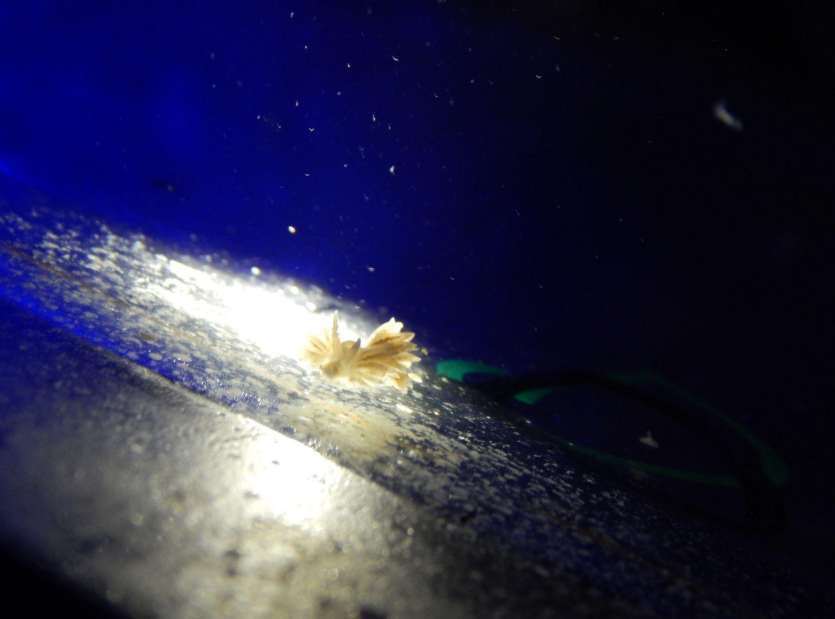
<p><span class="dropcap">N</span>udibranchs of the genus <i>Phestilla</i> are somewhat akin to the late American comedian Rodney Dangerfield - <i>They can't get no respect</i>. Nor should they get any if you enjoy keeping corals in captivity. While <i>Montipora</i>-eating nudibranchs are well-recognized, and <i>Acropora</i>-eating flatworms send waves of fear and loathing among dedicated SPS keepers, the coral-eating nudibranch genus <i>Phestilla</i> gets little attention, although its presence in a reef aquarium can prove detrimental or deadly to a number of coral species. They are voracious feeders and a single adult can strip away as much as 10 square inches (25 square centimeters) of coral tissue in one day. Even worse, they are generally nocturnal, spending their days hidden from view only to emerge at night to begin their destruction. Searching the aquarium at night with a flashlight can be a lesson in frustration since these nudibranchs are well-camouflaged and blend in well with the tissues of its prey (See Figure Two below for an excellent example). Scant evidence of their existence is apparent at first, with perhaps poor coral polyp expansion, slight discoloration, and a bare spot here and there being the initial clues. Unless immediate action is taken, the affected corals have only a few days at most to live.</p>
<div class="photo-wrapper"><a class="popup" href="inverts_album/image001.png" rel="gallery" title="Figure One. Innocuous in appearance, the parasitic nudibranch Phestilla is swift and certain death to some corals. Probably Phestilla sibogae or P. lugubris. Photo by the author."><img src="inverts_album/image001.png/image_full" alt="image001.png" class="image-inline" /></a>
<p class="caption">Figure One. Innocuous in appearance, the parasitic nudibranch <i>Phestilla</i> is swift and certain death to some corals. Probably <i>Phestilla sibogae</i> or <i>P. lugubris</i>. Photo by the author.</p>
</div>
<ul>
<li class="ListParagraph">Kingdom: Animalia</li>
<li class="ListParagraph">Phylum: Mollusca</li>
<li class="ListParagraph">Class: Gastropoda</li>
<li class="ListParagraph">Subclass: Opisthobranchia</li>
<li class="ListParagraph">Order: Nudibranchia</li>
<li class="ListParagraph">Suborder: Aeolidina</li>
<li class="ListParagraph">Family: Tergipedidae</li>
<li class="ListParagraph">Genus: Phestilla</li>
</ul>
<h2>Distribution</h2>
<p><i>Phestilla</i> nudibranchs have a wide geographical distribution, and have been reported from waters of Australia, Indonesia, Guam, Hawaii, the Philippines, Pacific Panama, Iran, Egypt, Thailand, Palau, Kenya, Tanzania, and India. Since one of <i>Phestilla</i>'s coral hosts ('Sun Corals' - <i>Tubastrea</i> spp.) are now considered an invasive species in the Atlantic, one has to wonder if <i>Phestilla</i> is there as well.</p>
<h2>Taxonomy and <i>Phestilla</i></h2>
<p>Those researchers - taxonomists - concerning themselves with the classification of living organisms hold one of the most secure jobs - they are constantly sorting and re-sorting, leaving their practice, where order is the goal, in a constant state of disarray. To make this point, the exact identification of at least some coral hosts' (especially finger and lobe stony corals -<i>Porites</i>) species status and their parasites (<i>Phestilla</i>) mentioned in this article are in debate among researchers.</p>
<p>Nudibranch taxonomy is not a research field heavily populated so descriptions of new species are sporadic, yet there is little doubt that many new species await discovery. These are some of the described species, or those with enough morphological differences to make researchers suspect they are species:</p>
<h3><i>Phestilla lugubris</i> (Also described a <i>P. sibogae</i>)</h3>
<ul>
<li>Adult size: 40mm (~1.5 inches)</li>
<li>Color: Assumes the color of its host hence coloration depends upon the host color and pigment content of zooxanthellae, but usually whitish, beige, dark brown, sometimes greenish.</li>
<li>Known Hosts: <i>Porites compressa</i>, <i>P. lutea</i> and/or <i>P. lobata</i> (the latter two are personal observations and no attempt was made to identify these corals to the species level)</li>
<li>Foods: <i>Porites</i> coral tissue, zooxanthellae (<i>Symbiodinium</i>)*</li>
<li>Notes: Faucci et al., 2007 believe <i>P. lugubris</i> and <i>P. sibogae</i> are different species based on observation of adult and egg mass sizes, and nudibranch morphology</li>
</ul>
<h3><i>Phestilla melanobranchia</i></h3>
<ul>
<li>Maximum Adult size: 40mm (~1.5 inches)</li>
<li>Color: Red, yellow, orange, dark brown or black</li>
<li>Known Hosts: 'Sun Corals' such as <i>Dendrophyllia elegans, Tubastrea aurea, Tubastraea coccinea</i>, <i>Tubastraea diaphana</i>*</li>
<li>Food: Adults eat <i>Dendrophyllia</i> tissues, veliger eat green and brown algae (<i>Duneliella</i> and/or <i>Phaeodactylum triconutum,</i> respectively)</li>
<li>Life Span: ~140-160 days</li>
<li>Notes: Males sexually mature at 10mm length, females at 20mm (at an age of ~60 days). See Figure Two for a photo of <i>P. melanobranchia</i>.</li>
</ul>
<div class="photo-wrapper"><a class="popup" href="inverts_album/image003.jpg" rel="gallery" title="Figure Two. Phestilla melanobranchia blends in almost perfectly with its host. It is at the 10 o'clock position. Photo courtesy Dr. Art Reed."><img src="inverts_album/image003.jpg/image_full" alt="image003.jpg" class="image-inline" /></a>
<p class="caption">Figure Two. <i>Phestilla melanobranchia</i> blends in almost perfectly with its host. It is at the 10 o'clock position. Photo courtesy Dr. Art Reed.</p>
</div>
<h3><i>Phestilla minor</i></h3>
<ul>
<li>Adult size: 7mm (~1/4 inch)</li>
<li>Color: Translucent white to cream</li>
<li>Known Hosts: Hawaiian Finger Coral (<i>Porites compressa</i>), Small Mound Coral (<i>Porites annae)</i>, and the Mound Coral (<i>Porites lutea)</i>*</li>
<li>Life Span: ~140 days</li>
<li>Notes: Sexually mature in about 38 days</li>
</ul>
<h3><i>Phestilla</i> minor #2</h3>
<ul>
<li>Host: Mound Coral (<i>Porites lutea)</i></li>
</ul>
<p><i>Phestilla panamica</i></p>
<ul>
<li>Maximum Adult size: 24mm (~1 inch)</li>
<li>Host: The Lobe Coral (<i>Porites lobata)</i></li>
<li>Coloration: Body is translucent orange with grey-brown cerata with yellow tips.</li>
<li>Location: Pacific coast of Panama</li>
<li>Note: Resembles <i>P. sibogae</i> in morphology (Faucci et al., 2007). <i>P. panamica</i> is the only known <i>Phestilla</i> species from the Americas.</li>
</ul>
<h3><i>Phestilla sibogae -</i> See <i>P. lugubris</i></h3>
<h3><i>Phestilla</i> species #1</h3>
<ul>
<li>Hosts: Plate Coral (<i>Porites rus),</i> Mound Coral <i>(Porites lutea)</i></li>
<li>Location: Palau</li>
</ul>
<p><i>Phestilla</i> species #2</p>
<ul>
<li>Hosts: Flower Pot Corals (<i>Goniopora</i> species).</li>
</ul>
<p>Some <i>Goniopora</i> species are difficult to keep in captivity. It has long been my view that inadequate feeding is the cause (I published this viewpoint in the mid-1990's in <i>Freshwater and Marine Aquarium</i> magazine). Now we know parasitic nudibranchs could be a cause of these corals' losses as well.</p>
<h2>*Host Fidelity</h2>
<p>Faucci et al. (2007) report a possible case of host-switching, where <i>Phestilla</i> species jumped from their primary food source (<i>Porites</i> corals) to other corals (<i>Goniopora</i> and <i>Tubastrea</i> spp.). If this is indeed the case, the implication is frightening, and conjures the possibility of <i>Phestilla</i> nudibranchs finding alternative food sources when normal hosts are not available.</p>
<p>Haramaty (1991) found at least some zooxanthellae ingested by <i>Phestilla sibogae</i> remained intact, were not digested (or at least not immediately), and were able to photosynthesize at relatively low light levels (45 µmol·m²·sec, or about 2,250 lux). This leads to the interesting possibility that this species benefits by gaining translocated nutrition from the zooxanthellae. Pacific <i>Porites</i> corals generally contain zooxanthellae (specifically zooxanthellae Clade C15) possessing the remarkable ability to survive in conditions of low light. Thus even cryptic nudibranchs could gain nutritionally even when hidden from strong light during the day.</p>
<h2>Reproduction</h2>
<p>Many <i>Phestilla</i> species are prolific spawners after becoming sexually mature in only a few weeks after hatching. These animals are gonochoric (separate sexes) and females can lay several thousands of eggs every day until they are near the end of their short lifespans. Hence we can calculate a single female may lay as many as 320,000 eggs in about 2 months. It is thought that heavy predation of these nudibranchs by certain fishes, crabs and mantis shrimp has resulted in the reproductive strategy of 'Reproduce quickly and abundantly - life is short!' See Figure Three.</p>
<div class="photo-wrapper"><a class="popup" href="inverts_album/image005.jpg" rel="gallery" title="Figure Three. A Phestilla nudibranch with multiple="><img src="inverts_album/image005.jpg/image_full" alt="image005.jpg" class="image-inline" /></a>
<p class="caption">Figure Three. A <i>Phestilla</i> nudibranch with multiple spiral egg masses found of the underside of a <i>Porites</i> coral in Hawaii. Note the egg mass on the far left - most of the eggs within it have already hatched, leaving only a transparent ribbon. Photo by the author.</p>
</div>
<h2>Quarantine and Chemical Control</h2>
<p>When I attended the 2011 MACNA conference in Des Moines, I was given a small sample of a product called 'CoralRx One Shot'. The small tube held ~6 milliliters of a product said to act a 'coral dip', where the coral is placed for a few minutes in a container containing a mixture of aquarium water and CoralRx. This product reportedly kills parasites outright, or causes them to abandon their host. It is said to work on parasitic copepods and nudibranchs. Would it work on <i>Phestilla</i> nudibranchs?</p>
<p>My observations are not meant to be an in-depth analysis; however, I did wonder what effects this treatment would have on water quality. My first test broke a cardinal rule learned during HazMat First Responder training - I opened the container and smelled the contents. My best guess is that CoralRx is a natural terpene as it had a smell similar to pine oil, not unlike other coral dips on the market.</p>
<p>A quick visit to the company website (www.coralrx.com) provided mixing directions, as well as a link to a Product Review published in Advanced Aquarist: <a href="../../2009/4/aafeature2">http://www.advancedaquarist.com/2009/4/aafeature2</a></p>
<p>This review recommends a dosage of 8 milliliters per gallon. I mixed 6 milliliters with one gallon of aquarium water. I checked the mixture's pH with a calibrated meter, and found it did not differ from that of the aquarium's water.</p>
<p>I had previously collected a <i>Phestilla</i> specimen (as luck would have it I could find only one) and placed it in a clean glass fingerbowl containing about 200 milliliters of water. During the night, the nudibranch laid two egg masses on the glass. This indicated two things - it was obviously a female and she was not near the end of its expected lifespan (<i>Phestilla</i> nudis are known to live for a few weeks after they stop laying eggs).</p>
<p>The fingerbowl was placed in the contents of the bucket holding the CoralRx solution and a little gentle mixing replaced the aquarium water with the coral dip mixture (I did not want to allow the nudibranch to be exposed to the air or be crushed by its own weight while out of water).</p>
<p><i></i>The<i>Phestilla</i> showed rapid movement and squirming (subjectively interpreted as 'displeasure') after only a few seconds of exposure to CoralRx. After about 15 minutes, the CoralRx solution was again carefully replaced, this time with fresh aquarium water. The next morning the <i>Phestilla</i> was dead, and had disintegrated with only its cerata covering the bottom of the bowl. The egg masses appeared unharmed and remained intact until the contents were discarded 5 days later (no attempt was made to hatch the eggs). I made an assumption that the egg masses would have rapidly deteriorated (as the adult had) if they were killed by the treatment.</p>
<p>I also placed a small piece of live rock in the solution. The next morning, I removed a dead crab, but a small sea urchin did not seem to the affected. There was some unidentifiable debris (remains of sponges?) covering the bucket's bottom.</p>
<p>This very limited observation suggests CoralRx may be effective against <i>Phestilla</i> nudibranchs, although the eggs are apparently not harmed. CoralRx seems to have effects on select invertebrates or life stages. Further experimentation is needed to confirm these results.</p>
<p>As a footnote, the manufacturer recommends CoralRx as a precautionary dip, and does not recommend it for whole tank treatment.</p>
<h2>Natural Controls: Predators of Predators and Water Motion</h2>
<p>If quarantine and prophylactic measures fail and the evil genie is out of the bottle, natural methods to control <i>Phestilla</i> populations are possible.</p>
<p>These include the Hawaiian 'Old Lady' Wrasse called Hinalea Luahine (<i>Thalassoma ballieui</i>), Saddle Wrasse (<i>Thalassoma duperrey)</i>, Threadfin Butterflyfish (<i>Chaetodon auriga),</i> Aerolated Xanthid Crab <i>(Pilodius aerolatus)</i>, Xanthid crab (<i>Phymodius monticulosus)</i>, Swimming Crabs (<i>Thalamita</i> spp.), and the nasty little Mantis Shrimp (<i>Gonodactylus falcatus)</i> as predators of this species.</p>
<p>Some may be surprised when seeing <i>Chaetodon auriga</i> included as it known to be a 'coral-picker.' The rationale for including it is as follows. First, corals targeted by <i>Phestilla</i> are doomed without predatory pressures to keep the nudibranch population under control (or better, eliminated). Second, some studies show at least some <i>Chaetodon auriga</i> specimens obtain only a small fraction of their nutritional needs from corals, in fact, they are one of the easier butterflyfishes to maintain in captivity and can be trained to eat a variety of prepared and frozen foods. If the fish proves troublesome, its removal is probably easier than removing the corals or tearing the tank down.</p>
<p>Predators of <i>Phestilla</i> show food size preferences. <i>Thalassoma duperrey</i> prefers larger nudibranchs, as does the crab <i>Phymodius monticulosus</i>. The Threadfin Butterflyfish eats large and small nudibranchs. There is little danger of fishes being harmed by <i>Phestilla</i> since these mollusks cannot concentrate nematocysts gathered from their coral hosts into their cerata, thus the nudibranchs do not sting.</p>
<p>One point should be clear: Predators of <i>Phestilla</i> nudibranchs cannot eat them if they are not within reach. A recurring tidbit of advice seems common within internet threads addressing issues with nudibranchs: 'Blow' the nudibranchs off corals by any means necessary including fanning them with your hand or using a baster. What does this tell us? An outbreak of predatory nudibranchs could be prevented or controlled by vigorous water motion. Water motion is always poor in aquaria when compared to that seen on real reefs.</p>
<p>This concludes our quick look at <i>Phestilla</i> nudibranchs. A listing of resources for those wishing to learn more is presented at the close of this article.</p>
<h2><i>Embletonia</i>: 'Montipora-eating Nudibranchs'</h2>
<div class="photo-wrapper"><a class="popup" href="inverts_album/image007.jpg" rel="gallery" title="Figure Four. Embletonia, a threat to Montipora corals. Photo by the author."><img src="inverts_album/image007.jpg/image_full" alt="image007.jpg" class="image-inline" /></a>
<p class="caption">Figure Four. <i>Embletonia</i>, a threat to <i>Montipora</i> corals. Photo by the author.</p>
</div>
<ul>
<li class="ListParagraph">Kingdom: Animalia</li>
<li class="ListParagraph">Phylum: Mollusca</li>
<li class="ListParagraph">Class: Gastropoda</li>
<li class="ListParagraph">Subclass: Opisthobranchia</li>
<li class="ListParagraph">Order: Nudibranchia</li>
<li class="ListParagraph">Suborder: Aeolidina</li>
<li class="ListParagraph">Family: Embletoniidae</li>
<li class="ListParagraph">Genus: Embletonia</li>
</ul>
<p>If you do not know the names of things, the knowledge of them is lost too. <br /> -- Carl Linnaeus, 1751</p>
<p>At last we have the real name for these nudibranchs which is fortunate - It gives me an excuse to refrain from calling them some of the rather nasty names I've heard them called. Perhaps we should give them a break as they are only doing what they do, fulfilling their role in the natural scheme of things. They are a 'problem, because we have created an artificial environment where <i>Embletonia</i> can exist and thrive. The same points for control of <i>Phestilla</i> nudibranchs made above can apply to <i>Embletonia</i>: First and foremost, quarantine all new additions to an aquarium. If this proves unsuccessful, research and define natural predators and increase water motion.</p>
<p>Although discovery of the scientific name for <i>Montipora</i>-eating nudibranchs may seem trivial, it is not as it allows access to information found in peer-reviewed journals on the internet.</p>
<p>A quick internet search found this information. There are only two described <i>Embletonia</i> species:</p>
<ul>
<li class="ListParagraph"><i>E. gracilis</i>: Found off the southwestern side of Africa (just barely into the Atlantic) and across the Pacific in waters off Mexico, the Indo-Pacific (including Australia, New Zealand, Indonesia, Philippines) and Japan. Said to eat hydroids.</li>
<li class="ListParagraph"><i>E. pulchra.</i> A cold-water species of the North Atlantic.</li>
<li class="ListParagraph"><i>Undescribed species.</i> At present, the 'Montipora-eating nudibranch' falls into this category.</li>
</ul>
<p>If there is a bright side in finding <i>Embletonia</i>, it would be furthering our understanding of their life and reproductive cycles and describing their predators.</p>
<p>Questions? Comments? Leave a message below in the Comment section. For a quicker reply, contact me at <a href="mailto:RiddleLabs@aol.com">RiddleLabs@aol.com</a>.</p>
<h2>References and Suggested Reading</h2>
<ol>
<li>Faucci, A., R. Toonen, and M. Hadfield, 2007. Host shift and speciation in a coral-feeding nudibranch. Proc. R. Soc. B, 274, 1606:111-119.</li>
<li>Gochfeld, D. and G. Aeby, 1997. Control of populations of the coral-feeding nudibranch,</li>
<li><i>Phestilla sibogae</i>, by coral reef fishes and crustaceans. Mar. Biol., 130:63-70.</li>
<li>Haramaty, L., 1991. Reproduction effort in the nudibranch <i>Phestilla sibogae</i>: Calorimetric analysis of food and eggs. Pac. Sci., 45, 3: 257-262.</li>
<li>Harris, L., 1975. Studies on the life history of two coral-eating nudibranchs of the genus <i>Phestilla</i>. Biol. Bull., 149: 539-550.</li>
<li>Control of populations of the coral-feeding nudibranch <i>Phestilla sibogae</i> by fish and crustacean predators. Mar. Biol., 130, 1: 63-69.</li>
<li>Rudman, W., 1982. A new species of <i>Phestilla</i>; the first record of a corallivorous aeolid nudibranch from tropical America. <i>Journal of Zoology, London</i> 198: 465-471</li>
<li>Rudman W., 1981. Further studies on the anatomy and ecology of opisthobranch molluscs feeding on the scleractinian coral <i>Porites</i>. <i>Zoological Journal of the Linnean Society</i> 71: 373-412.</li>
</ol>
<h2>Related Websites</h2>
<ul>
<li><a href="http://www.seaslugforum.net">www.seaslugforum.net</a></li>
<li><a href="http://www.nudipixel.net/">www.nudipixel.net</a></li>
<li><a href="http://www.seaslugsofhawaii.com">www.seaslugsofhawaii.com</a></li>
</ul>
</div> <br /><br /> <script type="text/javascript"><!-- google_ad_client = "ca-pub-5170032844807535"; /* Square250x250 */ google_ad_slot = "6862474606"; google_ad_width = 250; google_ad_height = 250; //--></script><script type="text/javascript" src="http://pagead2.googlesyndication.com/pagead/show_ads.js"></script>]]></content:encoded>
    <dc:publisher>No publisher</dc:publisher>
    
    <dc:creator>Dana Riddle</dc:creator>
    <dc:rights>Pomacanthus Publications, Inc.</dc:rights>
    
      <dc:subject>Tubastrea</dc:subject>
    
    
      <dc:subject>Coral</dc:subject>
    
    
      <dc:subject>Aquarium Invertebrates</dc:subject>
    
    
      <dc:subject>Goniopora</dc:subject>
    
    
      <dc:subject>Porites</dc:subject>
    
    
      <dc:subject>Dana Riddle</dc:subject>
    
    
      <dc:subject>Nudibranch</dc:subject>
    
    
      <dc:subject>Dendrophyllia</dc:subject>
    
    <dc:date>2012-06-13T15:00:00Z</dc:date>
    <dc:type>Page</dc:type>
  </item>


  <item rdf:about="http://www.advancedaquarist.com/2012/4/inverts">
    <title>Aquarium Invertebrates: Aiptasia, dinoflagellate algae and cyanobacteria - a three-way symbiosis?</title>
    <link>http://www.advancedaquarist.com/2012/4/inverts</link>
    <description>Aiptasia are tropical sea anemones which are commonly found in marine aquaria. Usually introduced as hitchhikers on live rock, they rapidly colonize the aquarium due to their prolific growth. Although Aiptasia may settle on any available substrate, chemical signals may attract them to specific microhabitats. In this article I report on the settlement preference of Aiptasia for cyanobacterial mats, a finding which suggests a three-way symbiosis between sea anemones, dinoflagellate algae and bacteria.</description>
    <content:encoded xmlns:content="http://purl.org/rss/1.0/modules/content/"><![CDATA[<p><em><strong>Click through to see the images.</strong></em></p> <br /><div id="body">
<p><img src="inverts_album/aip2.jpg" alt="aip2.jpg" class="image-inline" /></p>
<p><span class="dropcap">T</span>he genus <i>Aiptasia</i> contains several species of tropical anemones, which are found throughout the world. These anemones, similar to many other cnidarians such as reef-building corals, have formed a mutualistic symbiosis with dinoflagellate algae known as zooxanthellae (Venn et al. 2008), which translocate photoautotrophically produced organic compounds to their host. Next to making use of light, <i>Aiptasia</i> feed on a wide range of particulate organic matter, ranging from copepods and <i>Artemia</i> nauplii to dried fish feed.</p>
<div class="photo-wrapper"><a class="popup" href="inverts_album/image001.jpg" rel="gallery" title="Aiptasia, armed with powerful nematocytes, are the Nemesis of many aquarists."><img src="inverts_album/image001.jpg/image_full" alt="image001.jpg" class="image-inline" /></a>
<p class="caption"><i>Aiptasia</i>, armed with powerful nematocytes, are the Nemesis of many aquarists.</p>
</div>
<p>As <i>Aiptasia</i> have both autotrophic and heterotrophic feeding modes, these coelenterates thrive in well- and poorly-lit habitats as well as under complete darkness, provided that sufficient food particles are available. For example, completely bleached anemones have been reported growing in PVC pipes, solely relying on heterotrophy. Moreover, <i>Aiptasia</i> can tolerate large swings in temperature, pH and salinity, and survive in live rock exposed to air for some time.</p>
<div>
<p><iframe frameborder="0" height="381" src="http://www.youtube.com/embed/jkCTZPMUhe4" width="690"></iframe></p>
<p class="caption">Based on their diet, <i>Aiptasia</i> are true generalists. Here, a specimen is feeding on commercial fish feed.</p>
</div>
<p>In addition to their resilient nature, <i>Aiptasia</i> can reproduce very effectively in aquaria.<i>Aiptasia</i> spp. mainly reproduce asexually through a process called pedal laceration (Hunter 1984), during which parts of the pedal or basal disc break off which subsequently regenerate into new, smaller anemones. These new clones increase in size until they are perfect copies of their parent anemone. Their sexual reproduction entails the release of gametes (ova and sperm), after which fertilized ova develop externally into planula larvae (Chen 2008). These planula or propagules may settle on any substrate. Growth of <i>Aiptasia</i> usually is prolific, and they may outcompete other invertebrates if their populations are not controlled. Their potent nematocytes often damage and kill neighboring invertebrates, including corals, in a quest for space. These abilities make <i>Aiptasia</i> the Nemesis of many aquarists, which is why both chemical and biological methods are used to eliminate them.</p>
<div class="photo-wrapper"><a class="popup" href="inverts_album/image003.jpg" rel="gallery" title="Aiptasia quickly reproduce asexually in aquaria, by means of pedal laceration."><img src="inverts_album/image003.jpg/image_full" alt="image003.jpg" class="image-inline" /></a>
<p class="caption"><i>Aiptasia</i> quickly reproduce asexually in aquaria, by means of pedal laceration.</p>
</div>
<h2><b>A three-way symbiosis?</b></h2>
<p>Recently, I observed the settlement behavior of an <i>Aiptasia</i> sp. (possibly Indo-Pacific <i>A. pulchella</i>) in the laboratory, where this species grows in oligotrophic coral aquaculture systems. Individuals settled on cyanobacterial mats, which in turn grew on the aquarium glass, PVC, pumps, corals and gastropod shells. With two exceptions, no <i>Aiptasia</i> settlement was observed on surfaces without cyanobacteria. This preferential settlement of an <i>Aiptasia</i> sp. on cyanobacterial mats suggests a symbiotic relationship between the anemone and bacteria. This symbiosis may be based on translocation of nitrogen, in the form of ammonia or ammonium, from cyanobacteria to <i>Aiptasia</i>. To further clarify this, I will briefly address the symbiosis between different types of cells found in cyanobacterial mats, also called a bacterial consortium.</p>
<div class="photo-wrapper"><a class="popup" href="inverts_album/image005.jpg" rel="gallery"><img src="inverts_album/image005.jpg/image_full" alt="image005.jpg" class="image-inline" /></a></div>
<div class="photo-wrapper"><a class="popup" href="inverts_album/image007.jpg" rel="gallery"><img src="inverts_album/image007.jpg/image_full" alt="image007.jpg" class="image-inline" /></a></div>
<div class="photo-wrapper"><a class="popup" href="inverts_album/image009.jpg" rel="gallery" title="Aiptasia sp. settled on cyanobacterial mats, which in turn grew on PVC plates, the coral Seriatopora hystrix and the gastropod Astraea sp. Scale bars: 10 mm."><img src="inverts_album/image009.jpg/image_full" alt="image009.jpg" class="image-inline" /></a>
<p class="caption"><i>Aiptasia</i> sp. settled on cyanobacterial mats, which in turn grew on PVC plates, the coral Seriatopora hystrix and the gastropod <i>Astraea</i> sp. Scale bars: 10 mm.</p>
</div>
<p>Cyanobacteria are capable of diazotrophic growth, which means they are able to convert or fix dinitrogen gas (N<sub>2</sub>) into ammonia (NH<sub>3</sub>) using the enzyme nitrogenase (Postgate 1998). Ammonia, in turn, is further assimilated as the amino acid glutamate (glutamic acid), an example of biosynthesis. Glutamate can be converted to other amino acids and proteins, a so-called metabolic pathway which is important for organismal growth. Nitrogen fixation is hampered, however, by the presence of oxygen. Cyanobacteria have solved this problem by making use of heterocysts, specialized bacterial cells that are protected from the photosynthetic oxygen produced by the bulk of the cyanobacteria in the mat by multiple cell walls (Fay 1992). Heterocysts fix and translocate nitrogen as ammonia to the photosynthesizing cells of the mat, whereas these latter cells provide the heterocysts with organic carbon. In this way, the consortium of cyanobacterial cells is able to convert carbon dioxide (CO<sub>2</sub>) and dinitrogen gas (N<sub>2</sub>) into organic compounds for growth. This strategy allows cyanobacteria to overcome nitrogen-limitation, enabling them to grow in an oligotrophic environment with low levels of nitrogen. Examples are <i>Anabaena sphaerica</i> and <i>Nostoc punctiforme</i>.</p>
<p>In a very similar way, <i>Aiptasia</i> may also become nitrogen-limited. These anemones have overcome carbon limitation by forming a mutualistic symbiosis with dinoflagellate algae, which supply them with organic compounds (or photosynthates) such as glycerol produced from photosynthesis. These photosynthates may, however, be deficient in nitrogen, requiring supplementary nutrient uptake for growth (Houlbrèque and Ferrier-Pagès 2009). Corals have gone a step further by associating with cyanobacteria, in this context referred to as zoocyanellae, next to zooxanthellae. Intracellular nitrogen-fixing cyanobacteria provide scleractinian corals with significant amounts of nitrogen (Lesser et al. 2004), from which the zooxanthellae directly benefit. The same strategy, the formation of a three-way symbiosis between an animal, dinoflagellate algae and bacteria, may have been adopted by anemones from the genus <i>Aiptasia</i>. Instead of, or next to harboring intracellular zoocyanellae, <i>Aiptasia</i> spp. may use free-living cyanobacteria as symbionts. More specifically, the ectoderm (or skin) of the anemones may physically interact with heterocysts living in cyanobacterial mats. The ammonia (NH<sub>3</sub>) produced by heterocysts may be absorbed through the ectoderm of the animal. It is known that <i>Aiptasia</i> take up ammonia from the external environment, after which it is assimilated into glutamate by the anemone's cells and its symbiotic zooxanthellae (Stambler 2011 and references therein), in the same way as in cyanobacteria. Although glutamate can be converted to proteins for growth, the anemones require ammonia as a precursor, which is usually present in low concentrations only. In this perspective, settling on cyanobacterial mats may be beneficial to <i>Aiptasia</i>: ammonia produced by cyanobacteria may be taken up by the anemone through the aboral ectoderm of the basal disc or column. This would provide these anemones and their symbiotic zooxanthellae access to both autotrophically fixed carbon and nitrogen, allowing <i>Aiptasia</i> spp. to grow rapidly in a nitrogen-limited environment, just like their symbiotic cyanobacteria. The hypothesized model below provides an overview of this symbiosis:</p>
<div class="photo-wrapper"><a class="popup" href="inverts_album/image011.jpg" rel="gallery" title="Hypothesized model of the symbiosis between cyanobacteria and Aiptasia spp. Heterocysts in cyanobacterial mats take up dissolved dinitrogen gas (N2) from seawater, and convert it to ammonia (NH3) with the enzyme nitrogenase (NG). Ammonia is subsequently taken up by the aboral ectoderm and gastroderm of Aiptasia, and its symbiotic zooxanthellae (depicted here as a brown sphere). Finally, ammonia is assimilated into the amino acid glutamate (GA) by the enzyme glutamate dehydrogenase (GLDH) and used for growth of the anemone and its symbiotic algae. Model based on Stambler (2011) and references therein. "><img src="inverts_album/image011.jpg/image_full" alt="image011.jpg" class="image-inline" /></a>
<p class="caption">Hypothesized model of the symbiosis between cyanobacteria and <i>Aiptasia</i> spp. Heterocysts in cyanobacterial mats take up dissolved dinitrogen gas (N<sub>2</sub>) from seawater, and convert it to ammonia (NH<sub>3</sub>) with the enzyme nitrogenase (NG). Ammonia is subsequently taken up by the aboral ectoderm and gastroderm of <i>Aiptasia</i>, and its symbiotic zooxanthellae (depicted here as a brown sphere). Finally, ammonia is assimilated into the amino acid glutamate (GA) by the enzyme glutamate dehydrogenase (GLDH) and used for growth of the anemone and its symbiotic algae. Model based on Stambler (2011) and references therein.</p>
</div>
<p>This possible symbiosis between <i>Aiptasia</i>, zooxanthellae and cyanobacteria may explain the abundance of these anemones in oligotrophic environments, including heavily skimmed aquaria, and their preference for cyanobacterial mats as a settlement substrate. The discovery of potential symbiotic bacteria in the ectoderm of <i>Aiptasia pallida</i> (McKinstry et al. 1989, Palincsar et al. 1989) lends credence to the hypothesized model above, which encompasses an intimate link between heterocystic cyanobacteria and the aboral ectoderm of <i>Aiptasia</i>. More research will be required to confirm whether translocation of ammonia from heterocysts to <i>Aiptasia</i> occurs, for example by using isotope-labeled ammonia. In addition, it would be interesting to determine at what ammonia concentration this settlement behavior no longer occurs, and whether feeding (nitrogen-rich) zooplankton influences settlement choices of offspring.</p>
<p>If <i>Aiptasia</i> can benefit from the nitrogenous secretion of heterocystic cyanobacteria, the anemones will have to locate them. <i>Aiptasia</i> may be drawn towards cyanobacterial mats by chemotaxis, i.e. chemicals released by the bacteria, including ammonia, may attract the anemones. For example, when fragments of the pedal disc released by a parent anemone encounter a cyanobacterial mat, high local ammonia levels may trigger a settlement response. Subsequently, the fragment regenerates after which it may benefit from excreted ammonia by heterocysts. Whether the cyanobacteria also benefit (mutualism) or even suffer (parasitism) from this symbiosis remains to be determined. This symbiosis may be an example of commensalism, where the <i>Aiptasia</i> benefit whilst having a neutral effect on the bacteria.</p>
<div class="photo-wrapper"><a class="popup" href="inverts_album/image013.jpg" rel="gallery" title="When cyanobacteria are available, and ammonia concentrations are low, Aiptasia seem to have a strong preference for settling on cyanobacterial mats. "><img src="inverts_album/image013.jpg/image_full" alt="image013.jpg" class="image-inline" /></a>
<p class="caption">When cyanobacteria are available, and ammonia concentrations are low, <i>Aiptasia</i> seem to have a strong preference for settling on cyanobacterial mats.</p>
</div>
<h2><b>In the home aquarium</b></h2>
<p>Even though <i>Aiptasia</i> will settle on substrates without cyanobacterial cover, it may be helpful to minimize the growth of cyanobacteria in the aquarium, as this may promote settlement and thus survival of <i>Aiptasia</i> propagules. This may be especially true when ammonia, and possibly nitrate concentrations in the aquarium are low, i.e. nitrogen-limiting to <i>Aiptasia</i> growth. It is not yet clear at what ammonia concentration the uptake of this nutrient is no longer limiting the anemones in their growth, however this is likely to lie above average ammonia concentrations of marine aquaria. Using GFO to maintain a low phosphate concentration of the aquarium water may aid in the prevention of cyanobacterial mats, and in turn, may somewhat retard asexual reproduction of <i>Aiptasia</i>.</p>
<p>Either way, <i>Aiptasia</i> will probably always be considered an aquarium pest. In my opinion, these creatures are fascinating, having formed an intricate relationship with dinoflagellate algae, and possibly cyanobacteria, allowing them to make use of the sun's energy and dissolved nitrogen gas next to plankton. When predators such as certain Butterflyfishes (<i>Chelmon rostratus</i>) or Peppermint shrimp (<i>Lysmata wurdemanni</i>) are introduced in the aquarium, <i>Aiptasia</i> populations may be kept under control. In such cases, these anemones can be an interesting addition to the aquarium rather than a nuisance.</p>
<h2><b>References</b></h2>
<ol>
<li>Chen C, Soong K, Chen CA (2008) The smallest oocytes among broadcast-spawning actiniarians and a unique lunar reproductive cycle in a unisexual population of the sea anemone, <i>Aiptasia pulchella</i> (Anthozoa: Actinaria). Zool Stud 47:37-45</li>
<li>Fay P (1992) Oxygen relations of nitrogen fixation in cyanobacteria. Microbiol Mol Biol Rev 56:340-373</li>
<li>Houlbrèque F, Ferrier-Pagès C (2009) Heterotrophy in tropical scleractinian corals. Biol Rev Camb Philos 84:1-17</li>
<li>Hunter T (1984) The energetics of asexual reproduction: Pedal laceration in the symbiotic sea anemone <i>Aiptasia pulchella</i> (Carlgren, 1943). J Exp Mar Biol Ecol 83:127-147</li>
<li>Lesser MP, Mazel CH, Gorbunov MY, Falkowski PG (2004) Discovery of symbiotic nitrogen-fixing cyanobacteria in corals. Science 305:997-1000</li>
<li>McKinstry MJ, Chapman GB, Spoon DM, Peters EC (1989) The occurrence of bacterial colonies in the epidermis of the tentacles of the sea anemone <i>Aiptasia pallida</i> (Anthozoa: Actinaria). Trans Am Micr Soc 108:239-244</li>
<li>Palincsar EE, Jones WR, Palincsar JS, Glogowski MA, Mastro JL (1989) Bacterial aggregates within the epidermis of the sea anemone <i>Aiptasia pallida</i>. Biol Bull 177:130-140</li>
<li>Postgate J (1998) Nitrogen Fixation, 3rd Edition. Cambridge University Press, Cambridge, UK</li>
<li>Stambler N (2011) Marine microalgae/cyanobacteria-invertebrate symbiosis: Trading energy for strategic material. 385-414. In: Seckbach J, Dubinsky Z (Eds.) All flesh is grass - Plant-animal interrelationships, Springer, Dordrecht, 531 p</li>
<li>Venn AA, Loram JE, Douglas AE (2008) Photosynthetic symbioses in animals. J Exp Bot 59:1069-1080</li>
</ol></div> <br /><br /> <script type="text/javascript"><!-- google_ad_client = "ca-pub-5170032844807535"; /* Square250x250 */ google_ad_slot = "6862474606"; google_ad_width = 250; google_ad_height = 250; //--></script><script type="text/javascript" src="http://pagead2.googlesyndication.com/pagead/show_ads.js"></script>]]></content:encoded>
    <dc:publisher>No publisher</dc:publisher>
    
    <dc:creator>Tim Wijgerde, M.Sc.</dc:creator>
    <dc:rights>Pomacanthus Publications, Inc.</dc:rights>
    
      <dc:subject>Cyanobacteria</dc:subject>
    
    
      <dc:subject>Aiptasia</dc:subject>
    
    
      <dc:subject>Aquarium Invertebrates</dc:subject>
    
    
      <dc:subject>Tim Wijgerde</dc:subject>
    
    <dc:date>2012-04-11T14:30:00Z</dc:date>
    <dc:type>Page</dc:type>
  </item>


  <item rdf:about="http://www.advancedaquarist.com/2012/2/inverts">
    <title>Aquarium Invertebrates: A Look at the Giant Clam Tridacna maxima</title>
    <link>http://www.advancedaquarist.com/2012/2/inverts</link>
    <description>With their desirability in mind, if you can find a good specimen these clams can be relatively easy to care for in a well-run reef aquarium. However, they do have particular lighting requirements, and are by no means bulletproof when it comes to keeping them long-term. So, this article will cover their basic biology, how to identify them, and how to best care for them in aquaria.</description>
    <content:encoded xmlns:content="http://purl.org/rss/1.0/modules/content/"><![CDATA[<p><em><strong>Click through to see the images.</strong></em></p> <br /><div id="body">
<p><img src="inverts_album/Tmax2.jpg" alt="Tmax2.jpg" class="image-inline" /></p>
<p><span class="dropcap">T</span>here are several species of clam belonging to the family Tridacnidae, which are best known as the tridacnids or giant clams. Of these, one of the most attractive species is <i>Tridacna maxima</i>, which is also one of the most commonly offered species available to hobbyists. I say most attractive because they can come in a wide range of colors, which can be arranged in a variety of unusual patterns, with many specimens being striped, sprinkled, spotted, blotched, marbled, etc. The colors themselves also range from black and white, with essentially everything else in between being seen on some specimen or another. In fact, I'd say it's harder to find a maxima that's unattractive than to find one that is.</p>
<h2>Basic Information</h2>
<p>To get started, maxima is the most widely distributed species of the tridacnids. They're found in the Red Sea and from East Africa all the way across the Indo-Pacific to Polynesia. They also live as far north as southern Japan, and as far south as the Great Barrier Reef (Rosewater 1965). Maximas can be found in high numbers around many reef areas where waters are relatively shallow and clear, with the majority living at depths less than about 25 feet. Some can be found living as deep as about 50 feet, but their abundance drops off dramatically below about 25 feet, with these deeper-living clams occurring mostly as solitary individuals (Jaubert 1977).</p>
<h2>Maxima range</h2>
<p>Regardless of their depth of occurrence, essentially all of them are found living on limestone substrates, on top of living corals, or on coral rubble. Supposedly they're occasionally found on sandy bottoms (Pasaribu 1988), but after doing a lot of diving around Japan and Indonesia I have yet to see this. Regardless, on hard bottoms maximas can chemically bore a shallow indentation into the substrate that the bottom of their shells fits into, and they strongly affix themselves in place using a tough structure called a byssus. So, they typically stay in one spot for life, with the bottom third or half of the shell kept out of sight in their burrow. Conversely, on coral rubble bottoms they simply bury themselves amongst the coral chunks and attach to something solid with their byssus if they can. Again, usually only part of the shell rises above the substrate. The odd thing is that they won't do this in aquariums, though. It seems that if they don't start making a burrow while they're relatively tiny, they won't do it at all. So, don't expect a specimen to dig into your live rock. Regardless, they almost always attach to the substrate using their byssus anyway.</p>
<p>Aside from that, the most notable thing to point out here is that, like all the other members of the family, maximas harbor large populations of zooxanthellae. These single-celled photosynthetic algae live in the tissues of a host clam primarily within a specialized system of tubes that permeate the fleshy, colorful, mantle tissue that extends from the top of the shell, and when given enough light, they can make far more food than they need for themselves. The extra food (in the form of carbon and energy-packed glucose) is then given to the clam host, which is the same thing that occurs within most reef-dwelling corals.</p>
<p>Under optimal conditions, these zooxanthellae are constantly multiplying within a tridacnid, and some of these live algal cells can be digested by specialized amoeboid cells within the host, too. So, a host clam can rely on its zooxanthellae for more than just sugar, and is considered to be a "farmer" to some degree since it can consume these surplus zooxanthellae grown inside its body.</p>
<p>In addition, all tridacnids can also absorb a variety of nutrients directly from seawater. Their fleshy mantle is covered by a specialized tissue that can very effectively take in dissolved nutrients like ammonia, nitrate, and phosphates. So, here they have a third means of nutrient acquisition, with one more to go.</p>
<p>The last way they cover their nutritional needs is through filter-feeding. All tridacnids can eat fine particulate matter strained from surrounding waters by their specialized gills, which not only work to exchange carbon dioxide and oxygen, but can also act as sieves that can collect such particles. A tridacnid, like most other clams, pumps water into its body chamber, where it flows over the finely-branched gills and then flows out the other end of the body chamber, minus some particulates. These collected bits are can include phytoplankton, zooplankton, and detritus, meaning they can make use of a broad range of things.</p>
<h2>Identification</h2>
<p>When it comes to identification, once you know what to look for maxima is usually pretty easy to distinguish from all other tridacnids with the exception of <i>T. crocea</i>. So, I'll go over the basic features used to ID them, and then give you some tips on how to differentiate them from croceas, too.</p>
<p>When it comes to shells, they're almost always grayish-white when clean. However, one of the interesting things about the shells of this species is that sometimes they may be tinted with light yellow or pinkish-orange. Rarely, the shell may also be completely yellow. It's almost always strongly elongated in form, being much longer than it is tall, and some maximas are very thin from side to side while others are quite fat. Deformed shells are not particularly uncommon either, as maximas sometimes live in very crowded groups and/or partially burrowed into coral rock preventing them from producing a normally-shaped shell. Regardless, at its top each half of the shell typically has four or five smoothly-curved and inter-digitating projections that are symmetrical to those on the other, allowing the them to close together tightly. However, there are occasional individuals that have more elongated and even pointed tooth-like projections that don't inter-digitate as smoothly with those on the opposite side.</p>
<div class="photo-wrapper"><a class="popup" href="inverts_album/max_shells1.jpg" rel="gallery"><img src="inverts_album/max_shells1.jpg/image_full" alt="max_shells1.jpg" class="image-inline" /></a></div>
<p>Some species of tridacnids have petal or shelf-like structures on their shells, which are called scutes, and maxima is one of them. In fact, their shells are typically covered by numerous tightly-spaced but thin scutes, which run in rows from the bottom to the top of the shell. However, when maximas partially burrow into the substrate, many of these scutes are either not formed in the first place, or are broken/eroded away in the process. So, maxima shells oftentimes have no scutes on the bottom portion, while numerous scutes are still present on the rest. Still, there are occasional individuals that have none at all for some reason, while aquacultured specimens that are not permitted to burrow typically retain most or all of their scutes.</p>
<div class="photo-wrapper"><a class="popup" href="inverts_album/max_shells2.jpg" rel="gallery"><img src="inverts_album/max_shells2.jpg/image_full" alt="max_shells2.jpg" class="image-inline" /></a></div>
<p>Also note that it's possible for a maxima's shell to reach almost 16 inches in length, but that's the largest ever reported (Kinch 2002). Thus, you shouldn't expect any given specimen you purchase to get so big. In fact, McMichael (1974) did a survey of several hundred maximas in the wild and reported that only 3% were larger than 9 inches and the largest specimen found in the whole survey was only 9.8 inches. So, that record holding 16-inch specimen was quite an anomaly.</p>
<p>When it comes to the soft parts, maximas typically extend their zooxanthellae-packed mantle tissue well beyond the upper edges of the shell. In fact, it's typically extended to the point that it completely obscures the shell from view when looking down on one. The mantle can also come in such a wide range of colors and patterns that there really is no standard color, although blue is the most common. As noted, the patterns covering it may also be striped, sprinkled, spotted, blotched, marbled, etc. and quite fancy, which is why various specimens are often called things like teardrop maximas, striped maximas, super maximas, or even ultra maximas, etc.</p>
<p>Still, the only patterns that are relatively consistent in how they look are that of the teardrop and striped varieties. Teardrop maximas may vary significantly in color, but they tend to have the same sort of pattern covering their mantle, being covered in teardrop-shaped splotches, while striped maximas tend to have a dark, solid background color with thin radiating stripes of blue, yellow, or white. Other than that, the mantle has rows of simple, closely-spaced, dark eyes near the outer edge and sometimes has numerous eye-tipped tubercles/protrusions on its upper surface, too. The large mouth-like opening in it (called the inhalent siphon) is also ringed with numerous simple, small tentacles that usually lack anything more than very fine branches.</p>
<div class="photo-wrapper"><a class="popup" href="inverts_album/img_4140.jpg" rel="gallery"><img src="inverts_album/img_4140.jpg/image_full" alt="img_4140.jpg" class="image-inline" /></a></div>
<div class="photo-wrapper"><a class="popup" href="inverts_album/img_8194.jpg" rel="gallery"><img src="inverts_album/img_8194.jpg/image_full" alt="img_8194.jpg" class="image-inline" /></a></div>
<div class="photo-wrapper"><a class="popup" href="inverts_album/img_0539.jpg" rel="gallery"><img src="inverts_album/img_0539.jpg/image_full" alt="img_0539.jpg" class="image-inline" /></a></div>
<div class="photo-wrapper"><a class="popup" href="inverts_album/img_2912.jpg" rel="gallery"><img src="inverts_album/img_2912.jpg/image_full" alt="img_2912.jpg" class="image-inline" /></a></div>
<div class="photo-wrapper"><a class="popup" href="inverts_album/img_2740.jpg" rel="gallery"><img src="inverts_album/img_2740.jpg/image_full" alt="img_2740.jpg" class="image-inline" /></a></div>
<div class="photo-wrapper"><a class="popup" href="inverts_album/img_2402.jpg" rel="gallery" title="The dark spots on these maxima's mantles are simple eyes."><img src="inverts_album/img_2402.jpg/image_full" alt="img_2402.jpg" class="image-inline" /></a>
<p class="caption">The dark spots on these maxima's mantles are simple eyes.</p>
</div>
<div class="photo-wrapper"><a class="popup" href="inverts_album/img_9364_2.jpg" rel="gallery" title="A typical teardrop maxima."><img src="inverts_album/img_9364_2.jpg/image_full" alt="img_9364_2.jpg" class="image-inline" /></a>
<p class="caption">A typical teardrop maxima.</p>
</div>
<div class="photo-wrapper"><a class="popup" href="inverts_album/dsc08975.jpg" rel="gallery" title="A typical striped maxima."><img src="inverts_album/dsc08975.jpg/image_full" alt="dsc08975.jpg" class="image-inline" /></a>
<p class="caption">A typical striped maxima.</p>
</div>
<p>Now, as I said above, maximas are indeed easily confused with croceas because both species have relatively large and often brightly-colored mantles with small tentacles around their inhalent siphons. The vast majority of maximas has elongated shells with lots of scutes, while almost all croceas have shorter, taller shells that lack scutes or only have a few small ones. But, there are exceptions, which lead to this confusion. A typical crocea's shell lacks scutes and is far less elongated than the shell of a typical maxima, but there are individuals of each species that are in between. Croceas can be rather elongated at times, and may actually have a lot of scutes, while some maximas may have rather short shells and lack scutes. So, I'll give you some additional pointers for trying to figure out which is which in case it isn't clear who is who.</p>
<div class="photo-wrapper"><a class="popup" href="inverts_album/img_8898_6778.jpg" rel="gallery" title="Some maximas are not elongated (L), while some croceas are (R). This crocea even has a few rudimentary scutes, which are often larger and more numerous on aquacultured specimens."><img src="inverts_album/img_8898_6778.jpg/image_full" alt="img_8898_6778.jpg" class="image-inline" /></a>
<p class="caption">Some maximas are not elongated (L), while some croceas are (R). This crocea even has a few rudimentary scutes, which are often larger and more numerous on aquacultured specimens.</p>
</div>
<p>First, a maxima's shell usually has larger, much more pronounced waves or folds than that of a crocea, as crocea's shells are typically relatively smooth. A maxima's shell sometimes has very sharply-pointed, almost triangular projections at the shell's upper edge, but crocea's are always more rounded and never sharp. Maximas can reach significantly larger sizes than croceas, as the record-holding crocea was only 6 inches long. So, anything larger than about 5 inches in length is almost certainly a maxima. There is no such thing as a teardrop crocea or a striped crocea. Croceas may have some stripes on them at times, but I've never seen one that had a solid background color with thin radiating stripes on top, or the characteristic droplets of a teardrop. And lastly, the tentacles around the inhalent siphon of a maxima are typically simple and un-branched, while those of a crocea are usually finely branched at their tips.</p>
<div class="photo-wrapper"><a class="popup" href="inverts_album/max_cro.jpg" rel="gallery" title="The tentacles surrounding maxima's inhalent siphon are typically simpler than those of crocea."><img src="inverts_album/max_cro.jpg/image_full" alt="max_cro.jpg" class="image-inline" /></a>
<p class="caption">The tentacles surrounding maxima's inhalent siphon are typically simpler than those of crocea.</p>
</div>
<p>So, there is no straightforward single way to always ID both species correctly, but by looking at a combination of these features you can usually figure out just about any of them. I will admit though, over the years I've come across a handful of specimens that have been quite difficult to differentiate. At such times most folks just throw up their hands and declare that a hard-to-ID specimen in a hybrid between the two species, but after doing a lot of searching, reading, and asking clam farmers questions I'm still far from convinced that these two species can/do hybridize. That's a topic for another day, though.</p>
<h2>Aquarium Care</h2>
<p>When it comes to caring for maximas, water quality requirements are typical for reef aquariums in general. Basically, if you're successfully keeping corals alive and well, then your water quality is good enough for a maxima. On the other hand, if you're having problems maintaining excellent water quality - don't fool with any species of tridacnid.</p>
<p>When it comes to water motion, tridacnids live in reef and near-reef environments, and are regularly exposed to strong currents and wave activity. This is especially so for maximas, which often live right at the crest of a reef where waves break hardest. Thus, they are no strangers to strong, surging and turbulent water motion. However, in aquariums the flow tends to be quite linear and constant, as a pump outlet might blast water in one particular spot day and night at about the same volume per minute, and rarely creates any real surge or turbulence. So, you need to think about this when it comes to the placement of a maxima (or any other tridacnid) in an aquarium.</p>
<p>It's okay to expose maximas to a low velocity surge, or to turbulent flow, but putting them in a position where a pump constantly hits them with a strong, non-stop linear current is not recommended. Basically, any sort of current that causes the mantle to fold upwards too much, or over onto itself all the time is bad, as is any current that makes a specimen chronically retract its mantle. Thus, you can put one anywhere you like with respect to current, as long as it doesn't bring on either of these reactions. I'll also add that while they're almost always found on hard substrates and rubble in the wild, placing them on such is highly recommended, but is not required. Placing a specimen on sand/gravel won't kill them, but they often move around a lot, trying to find something to attach their byssus to. Next is lighting, which not surprisingly is of critical importance.</p>
<p>Maximas live at relatively shallow depths where they receive relatively intense light, so fluorescent lighting will only suffice in shallow tanks, or if a specimen is placed on the rockwork near the water's surface in a deeper tank. I would try fitting as many bulbs into the canopy/fixture as possible at that, and mount the bulbs close to the water, and then place any specimens within a foot of the surface, preferably less. Some specimens may be able to get by at times with less light, or further down in deeper tanks, but I implore you to not take chances. Metal halide or comparable L.E.D. lighting is your best option.</p>
<p>I know that some people have gotten by with less, but when it comes down to it insufficient lighting is certainly one of the most common causes of losses. The problem is that corals are very simple organisms that have no real "guts" to speak of, while tridacnids have all the organs you'd expect to find in a higher animal. They've got stomachs, kidneys, gonads, gills, and even a heart. Thus, they are far more complex than you might think, and they use a lot of calories to keep everything running. So, it's a mistake to think that just because your lighting is bright enough to keep corals healthy and growing that they're necessarily bright enough to keep a maxima alive long-term.</p>
<p>To make matters worse, it can take a tridacnid months to slowly starve to the point of no return. So, everything can look fine for weeks on end, then a specimen may seem to just up and die for no apparent reason when it was really starving the whole time. Every maxima is genetically different at that, and long-term experience has proven that some individuals can get by with less while others need much more, even though they may be the same species and even the same size and color. To add, you cannot give a tridacnid too much light as long as a specimen is given time to adapt to intense lighting, so it's better to err on the bright side than the dim side. For more on this, refer to my article <i>On Lighting for Tridacnid Clams</i> in the March 2011 issue, and for even more than that see my book <i>Giant Clams in the Sea and the Aquarium</i>.</p>
<div class="photo-wrapper"><a class="popup" href="inverts_album/dsc02382.jpg" rel="gallery" title="You can't overdo it when it comes to lighting, as many maximas are found in the intertidal zone where they're exposed to tropical sunlight that's as bright as it gets."><img src="inverts_album/dsc02382.jpg/image_full" alt="dsc02382.jpg" class="image-inline" /></a>
<p class="caption">You can't overdo it when it comes to lighting, as many maximas are found in the intertidal zone where they're exposed to tropical sunlight that's as bright as it gets.</p>
</div>
<p>Lastly, there's the question of whether or not you need to feed a maxima in an aquarium. As covered, all tridacnids are filter-feeders, yet their zooxanthellae can cover a great deal of their nutritional needs, and they're able to absorb pretty much everything else they need directly from seawater. In fact, if provided with enough light, maximas of any size have no need to filter feed and can thrive in particulate-free water as long as there are enough dissolved nutrients present. Controlled experiments by Fitt &amp; Trench (1981) proved that tridacnids can do without, and I kept them for years before anyone was talking about adding phytoplankton to aquaria, much less sold any in a bottle. You can get all the details in my article <i>Tridacnid Clams (Usually) Don't Need to Be Fed in Aquaria</i> in the July 2010 issue, but I'll give you some basic info on the subject anyway.</p>
<p>When you feed your fishes some amount of the food won't get eaten and becomes detrital particles, which maximas can filter out. Any uneaten food also releases nutrients into the water as it decomposes. Likewise, the food that is eaten by the fishes ends up becoming solid wastes that can also become detritus. However, even more importantly, fishes excrete dissolved substances that can be absorbed by a clam, too. For example, fishes give off dissolved ammonia as a waste product, but tridacnids can absorb it and use it as a source of nitrogen. Thus, when you feed your fishes, you're feeding your tridacnid(s), too.</p>
<p>So, the real question is whether or not there are enough fishes in your aquarium to support one or more tridacnids. While it's unlikely to happen, I suppose it is possible to have too low a fish load (or too high a tridacnid load depending on how you look at it) in an aquarium, which would mean that the amount of fish waste being produced would not be enough to support the needs of the clam(s). So, my advice is to refrain from taking any chances and use a quality phytoplankton product if you have any doubts. I have to say though, I imagine that very, very few hobbyists have problems due to nutrient levels that are too low since for most of us the fight is to prevent them from getting to high.</p>
<p>Anyway, I need to wrap things up, and unfortunately I'll going to end on a bad note. As gorgeous as they may be, most all experienced aquarists agree that maxima is the least hardy of the tridacnids. I've seen and heard of more losses of this single species than all the rest by far, and I think it's usually due to insufficient lighting. They are especially dependent on excellent water quality and intense lighting. So, if you don't have both, don't buy one of these.</p>
<p>I'll also add that despite their attractiveness, availability, and relatively low price, really small specimens are even more likely to pass away. In fact, I experienced so many losses of small maximas back in my selling days that I outright refused to order/sell them after a while, and I've heard the same from many other vendors, too. They didn't tolerate shipping and acclimation to aquarium life very well at all, and it was common for more to die in the first couple of weeks than to live. Stick with larger specimens, as in at least few inches long, and you'll have much better odds of success.</p>
<h2>References</h2>
<ol>
<li>Fitt, W.K. and R.K. Trench. 1981. Spawning, development, and acquisition of zooxanthellae by <i>Tridacna squamosa</i> (Mollusca, Bivalvia). <i>Biological Bulletin</i> 161:213-235.</li>
<li>Jaubert, J. 1977. Light, metabolism, and the distribution of Tridacna maxima in a South Pacific atoll: Takapoto (French Polynesia). <i>Proceedings of the 3rd International Coral Reef Symposium</i> 1:489-494.</li>
<li>Kinch, J. 2002. Giant clams: their status and trade in Milne Bay Province, Papau New Guinea. <i>TRAFFIC Bulletin</i> 19(2):1-9.</li>
<li>McMichael, D.F. 1974. Growth rate, population size and mantle coloration of the small giant clam <i>Tridacna maxima</i> (Roding), at One Tree Island, Capricorn Group, Queensland. <i>Proceedings of the Second International Coral Reef Symposium</i> 1:241-254.</li>
<li>Pasaribu, B.P. 1988. Status of giant clams in Indonesia. In: Copeland, J.W. and J.S. Lucas (eds.) <i>Giant Clams in Asia and the Pacific</i>. ACIAR Monograph Number 9, Canberra. 274pp.</li>
<li>Rosewater, J. 1965. The family Tridacnidae in the Indo-Pacific. <i>Indo-Pacific Mollusca</i> 1:347-396.</li>
</ol></div> <br /><br /> <script type="text/javascript"><!-- google_ad_client = "ca-pub-5170032844807535"; /* Square250x250 */ google_ad_slot = "6862474606"; google_ad_width = 250; google_ad_height = 250; //--></script><script type="text/javascript" src="http://pagead2.googlesyndication.com/pagead/show_ads.js"></script>]]></content:encoded>
    <dc:publisher>No publisher</dc:publisher>
    
    <dc:creator>James W. Fatherree, M.Sc.</dc:creator>
    <dc:rights>Pomacanthus Publications, Inc.</dc:rights>
    
      <dc:subject>M.Sc.</dc:subject>
    
    
      <dc:subject>Clams</dc:subject>
    
    
      <dc:subject>Aquarium Invertebrates</dc:subject>
    
    
      <dc:subject>James W. Fatherree</dc:subject>
    
    <dc:date>2012-02-22T16:00:00Z</dc:date>
    <dc:type>Page</dc:type>
  </item>


  <item rdf:about="http://www.advancedaquarist.com/2011/9/inverts">
    <title>Aquarium Invertebrates: A Trip to an Indonesian Coral and Clam Farm</title>
    <link>http://www.advancedaquarist.com/2011/9/inverts</link>
    <description>A few years ago when I was working on my book about giant clams, I was lucky enough to get a tour of the CV Dinar coral and giant clam aquaculture facility in Indonesia. I'm sure a lot of hobbyists have heard of the "farms" in the Pacific, but I figured I'd give you something of a virtual tour of the place and show you a bit about how things are done there. It was quite interesting to say the least.</description>
    <content:encoded xmlns:content="http://purl.org/rss/1.0/modules/content/"><![CDATA[<p><em><strong>Click through to see the images.</strong></em></p> <br /><div id="body">
<p><img src="inverts_album/clams2.jpg" alt="clams2.jpg" class="image-inline" /></p>
<p><span class="dropcap">T</span>he CV Dinar aquaculture facility, which is more easily called a farm, is located on the northeast coast of Bali, not too far east of Tulamben. It's also around 6 degrees south of the equator meaning the water's warm and there's plenty of sun year round, which gives rise to wonderful coral reefs. And, needless to say, the diving in spots around the island are absolutely incredible.</p>
<div class="photo-wrapper"><a class="popup" href="inverts_album/IMG_3004.jpg" rel="gallery" title="The main area of the CV Dinar facility."><img src="inverts_album/IMG_3004.jpg/image_full" alt="IMG_3004.jpg" class="image-inline" /></a>
<p class="caption">The main area of the CV Dinar facility.</p>
</div>
<div class="photo-wrapper"><a class="popup" href="inverts_album/DSC03378.jpg" rel="gallery" title="Some of the gorgeous Tridacna croceca clams they've grown at the farm."><img src="inverts_album/DSC03378.jpg/image_full" alt="DSC03378.jpg" class="image-inline" /></a>
<p class="caption">Some of the gorgeous Tridacna croceca clams they've grown at the farm.</p>
</div>
<p>Diving in many areas can be deceptive though, because you typically get to see the best, healthiest areas, while other locations may be in bad shape. Most everyone has heard of the spectre of coral bleaching that has affected so many reefs around the world, and then there are the added insults of pollution, over-collecting, dynamite fishing, shipwrecks, etc. that have all taken their toll on both corals and giant clams, as well. These are some of the reasons that many businesses are aquaculturing a variety of organisms for the aquarium hobby now, and why other organizations are doing the same for the purpose of restocking natural areas. Farming clams has also helped to satisfy the demand for giant clams as food in Asian countries, too.</p>
<p>Anyway, after contacting the farm, I was picked up by Aspari Rachman, the facility manager, and taken for a full tour of the whole place. It isn't particularly big, but they certainly squeeze a lot of livestock into what they have. There are about 30 large concrete grow-out and holding tanks, and quite a few other concrete and acrylic tanks used for various other purposes, too. They have an on on-site lab, and various other buildings, one of which is used to raise their own phytoplankton used to feed infant clams, and zooxanthellae for them, too.</p>
<div class="photo-wrapper"><a class="popup" href="inverts_album/IMG_2987.jpg" rel="gallery" title="Here you can see some of the pre-shipping holding tanks."><img src="inverts_album/IMG_2987.jpg/image_full" alt="IMG_2987.jpg" class="image-inline" /></a>
<p class="caption">Here you can see some of the pre-shipping holding tanks.</p>
</div>
<div class="photo-wrapper"><a class="popup" href="inverts_album/IMG_2949.jpg" rel="gallery" title="Many of the concrete growing and holding tanks for the clams."><img src="inverts_album/IMG_2949.jpg/image_full" alt="IMG_2949.jpg" class="image-inline" /></a>
<p class="caption">Many of the concrete growing and holding tanks for the clams.</p>
</div>
<div class="photo-wrapper"><a class="popup" href="inverts_album/IMG_3007.jpg" rel="gallery" title="Here is the room where phytoplankton is produced."><img src="inverts_album/IMG_3007.jpg/image_full" alt="IMG_3007.jpg" class="image-inline" /></a>
<p class="caption">Here is the room where phytoplankton is produced.</p>
</div>
<p>They have a huge water intake system at the shore, which allows them to pump water directly from the sea, after which it's run through a series of baffles that contain progressively smaller gravels and sands that act as filters. This water is then pumped through the tanks, making it easy to maintain high water quality. And, in the case of infant clams, the water is also run through micron filters to remove any sorts of parasites, too. Thus, there is a constant turnover of fresh, clean seawater in the systems, with no other sorts of filtration. There's also no need for additional lighting either, as there's plenty of sunlight for free. In fact, the sun does such a good job that they have shade cloth over all the tanks to cut down the amount of light the inhabitants get, and to help keep leaves and such out of the tanks, too.</p>
<h2><b>The Corals</b></h2>
<p>They were growing several types of stony coral at the farm, primarily being <i>Acropora</i> and <i>Seriatopora</i>, and also had plenty of the soft/leather corals <i>Sarcophyton</i> and <i>Sinularia</i>, as well as a few others. All of these were attached to small pieces of rock (which I'll talk about below), and had started out as frags/cuttings from other larger specimens. All of these corals can easily be cut or broken into pieces, and the pieces will live and grow into new specimens. So, they do the same thing that's regularly done by hobbyists and businesses here, but on a much larger scale, and with one big difference. Once the frags/cuttings are made and are attached to a base, they're put in the sea instead of being kept in a tank for weeks or months.</p>
<p>The farm has numerous metal cages on hand, and the corals are placed in these where they can be kept together and get some protection from wave activity and predators, too. The cages are carried maybe 100 yards out off the beach and placed on the bottom in about 20 feet of water. Then they sit for quite a while, sometimes several months. Of course, when you're not paying for salt, additives, and lighting the amount of time they sit is determined by how fast they grow to the size the farm likes rather than moving them to market as soon as they get big enough for someone to want to buy them - and the farm likes them pretty big.</p>
<p>Once the corals have grown large enough to satisfy the farmers, the cages are pulled and the specimens are placed in holding tanks on land. Then they're bagged up and shipped out.</p>
<div class="photo-wrapper"><a class="popup" href="inverts_album/DSC03571.jpg" rel="gallery" title="The cages are placed just offshore in about 20 feet of water. Hundreds of them are right under me in this shot, but I didn't get any photos because the water had been clouded up by a storm that passed through a couple of days earlier."><img src="inverts_album/DSC03571.jpg/image_full" alt="DSC03571.jpg" class="image-inline" /></a>
<p class="caption">The cages are placed just offshore in about 20 feet of water. Hundreds of them are right under me in this shot, but I didn't get any photos because the water had been clouded up by a storm that passed through a couple of days earlier.</p>
</div>
<div class="photo-wrapper"><a class="popup" href="inverts_album/DSC03576.jpg" rel="gallery"><img src="inverts_album/DSC03576.jpg/image_full" alt="DSC03576.jpg" class="image-inline" /></a></div>
<div class="photo-wrapper"><a class="popup" href="inverts_album/IMG_2978.jpg" rel="gallery" title="They like to grow the corals to a good size before bringing them in from the cages for export."><img src="inverts_album/IMG_2978.jpg/image_full" alt="IMG_2978.jpg" class="image-inline" /></a>
<p class="caption">They like to grow the corals to a good size before bringing them in from the cages for export.</p>
</div>
<h2><b>The Clams</b></h2>
<p>The farm also raises all six species of giant clam commonly seen for sale over here, being <i>Tridacna crocea</i>, <i>T. maxima</i>, <i>T. derasa</i>, <i>T. squamosa</i>, <i>T. gigas</i>, and <i>Hippopus hippopus</i>. And, they raise <i>H.</i> <i>porcellanus</i> too, which I was looking forward to finally seeing. These are <i>very</i> difficult to find for sale, and haven't been seen in the U.S. market for many years as best as I know. I bought one about four years ago, and the supplier said it was the first they'd ever seen after being in the clam-selling business for over seven years. Despite having at least a couple hundred mature specimens on hand, they told me that none were sent to the U.S. Anyway, while the corals are relatively easy to deal with, the clams take a lot more work, as they obviously can't be cut up to make more.</p>
<div class="photo-wrapper"><a class="popup" href="inverts_album/DSC03529.jpg" rel="gallery" title="They also had lots of blue Tridacna squamosa clams on hand, something not seen very often in the U.S. I was quite surprised when they told me that about 10% of the squammies they raise are blue, meaning they aren't rare at all - just rare in the U.S. market."><img src="inverts_album/DSC03529.jpg/image_full" alt="DSC03529.jpg" class="image-inline" /></a>
<p class="caption">They also had lots of blue <i>Tridacna squamosa</i> clams on hand, something not seen very often in the U.S. I was quite surprised when they told me that about 10% of the squammies they raise are blue, meaning they aren't rare at all - just rare in the U.S. market.</p>
</div>
<div class="photo-wrapper"><a class="popup" href="inverts_album/DSC03512.jpg" rel="gallery" title="They also had dozens of full-size Hippopus porcelanus, which are practically impossible to find by in the U.S. "><img src="inverts_album/DSC03512.jpg/image_full" alt="DSC03512.jpg" class="image-inline" /></a>
<p class="caption">They also had dozens of full-size <i>Hippopus porcelanus</i>, which are practically impossible to find by in the U.S.</p>
</div>
<p>Giant clams are spawners, meaning when the time comes, individuals can spew out huge numbers of sperm and eggs into the water where some will meet the sperm and eggs of other clams. All of them are hermaphrodites when they are mature, so each can produce both sperm and eggs, too.</p>
<p>Well, on the farm they can be artificially enticed into spawning by injecting them with a small dose of the hormone serotonin. Once the hormone is injected into a clam's gonads, it will begin to spew clouds of sperm at first and then the eggs come after the sperm is depleted. So, in order to keep the clams from self-fertilizing (which makes for bad genetics), a clam is allowed to pump out the sperm and is then moved to another tank where the eggs can be released. Then the sperm can be collected from the water and intentionally mixed with the eggs from another clam. This sort of thing can be done with multiple clams, assuring that they have a good mixing of genetic material, which produces healthier clams.</p>
<div class="photo-wrapper"><a class="popup" href="inverts_album/IMG_2963.jpg" rel="gallery" title="These are the adult broodstock clams used as the source of sperm and eggs."><img src="inverts_album/IMG_2963.jpg/image_full" alt="IMG_2963.jpg" class="image-inline" /></a>
<p class="caption">These are the adult broodstock clams used as the source of sperm and eggs.</p>
</div>
<p>After all of this, the eggs start to divide and grow, and soon become swimming larvae. At this stage they still do not have any symbiotic zooxanthellae though, as it's not passed from the parents to the offspring. Coral fragments already contain some, of course, but the clam larvae have to get their own complement of the algae by filtering some from the water.</p>
<p>So, the farmers grow zooxanthellae on site using a method they developed themselves, and add a little to the tanks that the larvae are in. The larvae then eat and hold onto it and allow it to reproduce inside their tissues. Other types of phytoplankton are also added, which the infant clams can also eat and used for food. Oddly enough, no one has figured out how it works, but the clams are able to keep the zooxanthellae alive for themselves, while simultaneously digesting other sorts of algae.</p>
<p>Anyway, the swimming larvae drop to the bottom after a short period of time and begin to undergo a metamorphosis, losing the ability to swim and taking on a new life upon the bottom. The farmers continue to add phytoplankton for two months, and they also begin adding nitrogen-based chemicals, too. Giant clams need a source of nitrogen and can extract it directly from seawater in the form of ammonia and nitrate, but giving them extra amounts can increase their growth rates significantly. So, things like ammonium nitrate (fertilizer) or sodium nitrate can be added to help speed things up.</p>
<p>Then, after sitting and growing in a holding tank, typically for more than a year, the clams are big enough to be placed in cages and put out to sea with the corals. At this time they still may be only an inch or two in length depending on the species, so many have a lot of growing to do before they can be sold as good-sized specimens. Some farms do sell clams while still at such a small size, but CV Dinar doesn't. I didn't ask why, but from what I understand, the small clams suffer significantly higher mortality rates, while bigger clams can handle shipping stresses much better.</p>
<p>Once in the cages, the clams are left in place for as long as three more years. So, you can see that this can be a slow process that takes a lot of patience. The timing of collection is primarily due to the species, I should also add, as some clams like <i>T. gigas</i> and <i>T. derasa</i> can potentially grow many times faster than other clams, like <i>T. crocea</i>.</p>
<div class="photo-wrapper"><a class="popup" href="inverts_album/DSC03502.jpg" rel="gallery" title="These Hippopus hippopus clams have spent a long time in the cages, and are now ready for export."><img src="inverts_album/DSC03502.jpg/image_full" alt="DSC03502.jpg" class="image-inline" /></a>
<p class="caption">These <i>Hippopus hippopus</i> clams have spent a long time in the cages, and are now ready for export.</p>
</div>
<p>Regardless, the farmers are constantly putting out hundreds of clams at a time, and everything ends up running like a conveyor belt. Small ones go in and big ones come out. The seafloor has plenty of space for cages too, so using them and keeping them in the sea means that there can be thousands of clams out at a time while the facility only needs enough room to hold the juvenile clams and those that are ready for export. Everything in between takes up no space in the tanks.</p>
<h2><b>And Live Rock Too</b></h2>
<p>By the way, the rock they need for the bases is made by hand on site by using local stone and cement, and they make lots of artificial live rock ranging from fist-size up to large mounds a couple of feet tall, too. Basically they just lay out some palm leaves on the ground and pile up the concrete-like mix to the desired size. The cement is allowed time to harden, and then the pieces are put in piles in the sea for several months. So, it becomes fully cured there, and also gets some stuff growing on it. In the end, much of it looks as good as much of the live rock coming from the Pacific and is sold as aquacultured live rock. But, they also hold onto some of it to use in re-stocking efforts.</p>
<div class="photo-wrapper"><a class="popup" href="inverts_album/IMG_2910.jpg" rel="gallery" title="All of the bases and rock they need is made on site."><img src="inverts_album/IMG_2910.jpg/image_full" alt="IMG_2910.jpg" class="image-inline" /></a>
<p class="caption">All of the bases and rock they need is made on site.</p>
</div>
<div class="photo-wrapper"><a class="popup" href="inverts_album/IMG_2903.jpg" rel="gallery"><img src="inverts_album/IMG_2903.jpg/image_full" alt="IMG_2903.jpg" class="image-inline" /></a></div>
<div class="photo-wrapper"><a class="popup" href="inverts_album/IMG_2907.jpg" rel="gallery"><img src="inverts_album/IMG_2907.jpg/image_full" alt="IMG_2907.jpg" class="image-inline" /></a></div>
<h2><b>Restocking Reefs</b></h2>
<p>Again, many reefs are having problems, and the farm has been directed to help out by the Indonesian government. According to Aspari, they are allowed to operate the farm and export livestock as long as 10% of everything they grow is used to help the local reefs. So, they take some of the larger pieces of rock they produce and mount various corals and clams to them, then place them in areas that have been damaged in various ways. They were also trying to start new reefs in some spots, too. All in all, they're doing a great job and helping the hobby and the reefs.</p>
<p><i>The staff at the CV Dinar facility was exceptionally nice and very knowledgeable, but I have no experience with them on the exporting and business end. This article is by no means an advertisement for them, and is strictly for education.</i></p>
<p>Sources for more information on clam farming, which can be found online:</p>
<ol>
<li>Ellis, S. 2000. <i>Nursery and Growout Techniques for Giant Clams (Bivalvia: Tridacnidae).</i> Center for Tropical and Subtropical Aquaculture Publication 143.</li>
<li>Ellis, S. 1998. <i>Spawning and Early Larval Rearing of Giant Clams</i>. Center for Tropical and Subtropical Aquaculture Publication 130.</li>
</ol></div> <br /><br /> <script type="text/javascript"><!-- google_ad_client = "ca-pub-5170032844807535"; /* Square250x250 */ google_ad_slot = "6862474606"; google_ad_width = 250; google_ad_height = 250; //--></script><script type="text/javascript" src="http://pagead2.googlesyndication.com/pagead/show_ads.js"></script>]]></content:encoded>
    <dc:publisher>No publisher</dc:publisher>
    
    <dc:creator>James W. Fatherree, M.Sc.</dc:creator>
    <dc:rights>Pomacanthus Publications, Inc.</dc:rights>
    
      <dc:subject>Clams</dc:subject>
    
    
      <dc:subject>Coral</dc:subject>
    
    
      <dc:subject>Aquarium Invertebrates</dc:subject>
    
    
      <dc:subject>James W. Fatherree</dc:subject>
    
    
      <dc:subject>aquaculture</dc:subject>
    
    
      <dc:subject>M.Sc.</dc:subject>
    
    <dc:date>2011-09-07T12:00:00Z</dc:date>
    <dc:type>Page</dc:type>
  </item>


  <item rdf:about="http://www.advancedaquarist.com/2011/6/inverts2">
    <title>Aquarium Invertebrates: A Look at the Sponges</title>
    <link>http://www.advancedaquarist.com/2011/6/inverts2</link>
    <description>Start small. If you have a certain sponge in mind, if at all possible try to find out as much as you can about that particular type. What environment it comes from, whether it is symbiotic or not, if it is highly toxic (some are), how big it gets, etc. The more you know in the beginning, the greater your chances for success.</description>
    <content:encoded xmlns:content="http://purl.org/rss/1.0/modules/content/"><![CDATA[<p><em><strong>Click through to see the images.</strong></em></p> <br /><div id="body">
<div class="remove"><img src="inverts2_album/sponges2.jpg" /></div>
<p><span class="dropcap">T</span>here are approximately 8,000 species of sponges, and they can be found living in many different marine environments from shallow water reefs down to the depths of the abyssal plains and trenches. They can range from a full size of less than one centimeter up to well over one meter, and they come in many beautiful colors, too. They also come in many shapes, having thin or thick branched forms, short and fat to tall and thin vase-shaped forms, round to fan-shaped clumps, or growing as encrustations over various surfaces.</p>
<p>Unfortunately, as widespread, diverse, and attractive as they may be, their survival rate in aquariums in generally poor, though. Yes, there are some successes, but many sponges do not survive long-term in captive systems. There are obvious reasons for this at times, and not so obvious reasons at other times, so I'll give you some information about sponge biology, why they often die, and what you can do to increase your chances of success.</p>
<h2>Sponge Biology</h2>
<p>Sponges are the simplest of the multi-cellular animals, lacking any sorts of tissues or organs, etc. Instead, they are collections of a few types of cells living together in an organized mass. They stay attached to the bottom for their adult life, and with the exception of a few that can slowly move by re-arranging the placement of some cells, they stay in one place.</p>
<p>They're also filter feeders that strain tiny food particles from the water, using specialized types of cells called choanocytes or collar cells, which line their interior surfaces. These cells have a mesh-like collar at one end that encircles a tiny whip-like structure called a flagellum, and when thousands of them simultaneously wiggle these whips it creates a current of water. This current moves water (and food particles carried in it) from the outside into the sponge's body through numerous tiny openings, called ostia, then through lots of very tiny canals in the body, and then into a larger internal chamber called an atrium. From there it passes out of a relatively large opening, called an osculum, back to the environment.</p>
<div class="photo-wrapper"><a class="popup" href="inverts2_album/IMG_0607.jpg" rel="gallery" title="Here you can see down into the osculum of a large sponge."><img src="inverts2_album/IMG_0607.jpg/image_preview" alt="IMG_0607.jpg" class="image-inline" /></a>
<p class="caption">Here you can see down into the osculum of a large sponge.</p>
</div>
<div class="photo-wrapper"><a class="popup" href="inverts2_album/IMG_7048.jpg" rel="gallery" title="Many sponges, like this Haliclona specimen, have more than one osculum, which can be easily seen."><img src="inverts2_album/IMG_7048.jpg/image_preview" alt="IMG_7048.jpg" class="image-inline" /></a>
<p class="caption">Many sponges, like this <i>Haliclona</i> specimen, have more than one osculum, which can be easily seen.</p>
</div>
<p>What you should understand from this is that through the activity of numerous cells, water moves into, through, and out of a sponge via many canals, and that some of the canals are very small. When you look at a sponge, the big oscula where the water exits are typically obvious, and in looking a little closer you can sometimes pick out the numerous, but much smaller, ostia where water goes in, too. However, it's the much, much smaller system of collar cell-lined canals that run between the two that are most important right now. Important because during the passage of water through the sponge, those same collar cells that created currents also capture food particles with their collars. And, because all of the food particles a sponge eats are captured by these single cells, the particles obviously have to be extremely small in size. Bacteria and other microplankton are the largest things a typical sponge can eat in quantity, with a large portion of their diets often being much smaller carbon-rich bits of dead plankton and other specks of organic material. Typically this stuff is smaller than 0.5 micrometers in size, and may make up 80% of a sponge's diet.</p>
<p>There are also some other sponge cells, called archeocytes or amoebocytes, that can grab particles that are bigger. But, while these food bits are larger than what the collar cells eat, they are still quite small, typically being only a few micrometers in size.</p>
<p>Here's a great video on water flow and feeding in the phylum Porifera (sponges):</p>
<p><a href="http://www.biology.ualberta.ca/courses.hp/zool250/animations/Porifera.swf">http://www.biology.ualberta.ca/courses.hp/zool250/animations/Porifera.swf</a></p>
<p>On top of all this cellular-level feeding, many sponges also acquire nutrients from internal populations of symbiotic microorganisms. Photosynthetic algae similar to that found in reef corals are present in some, while others contain large quantities bacteria and/or cyanobacteria, which can make more food than they need for themselves when conditions are optimal. So, they give off their surpluses and the host sponge takes them. Sponges can generally absorb some nutrients directly from seawater, as well.</p>
<div class="photo-wrapper"><a class="popup" href="inverts2_album/DSCN1472.jpg" rel="gallery" title="Some varieties, like the chicken liver sponge (Chondrilla), contain photosynthetic symbionts and acquire some of their nutrition from them."><img src="inverts2_album/DSCN1472.jpg/image_preview" alt="DSCN1472.jpg" class="image-inline" /></a>
<p class="caption">Some varieties, like the chicken liver sponge (<i>Chondrilla</i>), contain photosynthetic symbionts and acquire some of their nutrition from them.</p>
</div>
<p>A few sponges can eat larger foods, and some can live entirely off the excesses produced by their symbionts and/or what they can take directly from seawater, but these sorts of sponges are not the typical sorts you'll find at a store. Instead, you're usually going to find those that must eat tiny food particles and can't live off the generosity of their symbionts, or by simply sitting in nutrient-rich waters.</p>
<h2>Why Sponges Die</h2>
<p>Now that you have a little understanding of how a sponge works, we'll look at some of the causes of death, which should make sense. These are not in any particular order or ranking, and they aren't the only things that can lead to the death of a sponge, but they are the most common.</p>
<h3>Exposure to air</h3>
<p>Sponges are full of tiny canals, so if you remove a sponge from water it will drain out to some degree and parts of it will be filled with air. There are a few sorts of intertidal sponges that have adapted to being temporarily exposed to air during low tides, but most sponges do not tolerate an exposure to air very well at all. The problem is that the water runs out, air goes into the canals, and then when the sponge is re-submerged, some of the air gets trapped inside the tiny canals and other areas. It gets trapped as little bubbles, and the bubbles won't come out.</p>
<p>Cells surrounding the bubbles may then die, and their deaths can lead to the deaths of their neighbors, and so on, and so on. It typically doesn't take much for an entire sponge to die, and how long it was out of water often has little to do with it. If it comes out of the water for even one second, the end result will often be the same - death.</p>
<div class="photo-wrapper"><a class="popup" href="inverts2_album/IMG_0127.jpg" rel="gallery" title="Most sponges do not tolerate being exposed to air very well. But, there are some species, like this one I found on an Indonesian reef at low tide, which are apparently not affected."><img src="inverts2_album/IMG_0127.jpg/image_preview" alt="IMG_0127.jpg" class="image-inline" /></a>
<p class="caption">Most sponges do not tolerate being exposed to air very well. But, there are some species, like this one I found on an Indonesian reef at low tide, which are apparently not affected.</p>
</div>
<h3>Starvation</h3>
<p>Most aquariums do not contain enough food particles of small enough size to keep a sponge alive. So, they starve to death. Even top-quality plankton-in-a-bottle products that you may add yourself may not help much (or any) in most cases, as what most sponges need is too small.</p>
<p>Remember that collar cells feed on particles that are typically smaller than 0.5 micrometers? Well, the phytoplankton in one of the most popular brands of these products ranges from 2 to 12 micrometers. Thus, even the smallest of it is larger than the largest thing an average collar cell can eat. Other similar products may also be fine for many other organisms, but in general they have even larger particles and/or tend to form clumps, and may simply be unsuitable for trying to keep sponges alive. If you intend to try using any such things, it is very important to find out the size of the particles they contain.</p>
<div class="photo-wrapper"><a class="popup" href="inverts2_album/IMG_4165.jpg" rel="gallery" title="This is a typical ball sponge, probably Cynachyra alloclada. These are often fine at very small sizes, but larger ones tend to starve."><img src="inverts2_album/IMG_4165.jpg/image_preview" alt="IMG_4165.jpg" class="image-inline" /></a>
<p class="caption">This is a typical ball sponge, probably <i>Cynachyra alloclada</i>. These are often fine at very small sizes, but larger ones tend to starve.</p>
</div>
<h3>Improper placement</h3>
<p>Some sponges can thrive in areas of low current, such as under or behind rocks. But, for many, a stronger current is essential. Currents obviously bring food and oxygenated water to a sponge, and also remove wastes, but there's more to it than that.</p>
<p>As water flows over many sponges that are properly oriented, it typically creates a draft over a sponge's oscula (where water exits). This, in turn, pulls water through the rest of the sponge and helps the collar cells. They work hard, but i such cases the shape of the sponge's body, and the shape, size, and position of the oscula, and the nature of the surrounding currents also influence how much water can move through the canals. Thus, each type of sponge may be adapted to a certain type of current, and individuals typically grow in an orientation and form that makes best use of it.</p>
<p>So, if a sponge is randomly placed anywhere in an aquarium, it may not be positioned correctly to make use of the prevailing currents. This leaves the collar cells to do all the work, and that is often too much. This is especially so in aquariums where the food supply is very low already. As you might guess, placing a sponge in an area of strong current won't necessarily help if it is oriented incorrectly. In fact, you may end up forcing water the wrong way through a sponge, which would be very bad, too. Therefore, even if plenty of appropriately-sized food is provided, a sponge may still starve to death if it is positioned incorrectly.</p>
<h3>Overgrowth by algae</h3>
<p>Sponges that spend their lives in brightly-lit waters have developed chemical defenses to keep various sorts of algae from overgrowing and smothering them. However, many sponges come from dimmer waters where algae is less common or even absent, and have not developed any such defense. They don't have to.</p>
<p>So, when these defenseless sponges are placed in a brightly-lit reef aquarium, trouble can come quickly. It is not uncommon for them to be overgrown by algae, which can block the ostia, and cut the flow of water into the sponge. Thus, being overgrown can obviously lead to the death of the sponge.</p>
<h3>Being eaten</h3>
<p>Yes, there are lots of fishes and other animals that will feed on sponges. Most hobbyists will only purchase a sponge for a reef aquarium stocked with reef-safe fishes and such, but there are those that mistakenly try sponges in non-reef aquariums due to their bright colors. Regardless of the circumstances, it is imperative that you check the diet of what you have before you add a sponge. A variety of angelfishes, triggerfishes, and filefishes with eat them, as will numerous sorts of nudibranchs, cowries, sea stars, and other invertebrates.</p>
<h2>Shopping and Aquarium Care</h2>
<p>In general, only aquariums that are set up with a deep sand bed full of life and/or a refugium, etc. can consistently keep many sponges alive. These methods of reef-keeping produce a constant supply of natural foods of varying size, some of which are small enough for sponges. Thus, it seems that at least for now, finding a way to let your own aquarium make natural food for sponges is the best way to go. Really, it's the only way to go unless you just like taking chances, with low odds for success. Non-reef aquarium owners and bare-bottom reefers beware.</p>
<div class="photo-wrapper"><a class="popup" href="inverts2_album/IMG_0497.jpg" rel="gallery" title="Specimens of the finger sponge, Axinella, are common at stores. Unlike most other relatively large sponges, I've actually seen a few of these live for years."><img src="inverts2_album/IMG_0497.jpg/image_preview" alt="IMG_0497.jpg" class="image-inline" /></a>
<p class="caption">Specimens of the finger sponge, <i>Axinella</i>, are common at stores. Unlike most other relatively large sponges, I've actually seen a few of these live for years.</p>
</div>
<p>Of course, there are exceptions, and it is not uncommon for a few small sponges to occasionally arise from nowhere on the live rock in mature systems that lack deep sand beds/refugia. However, these are typically small specimens of a few specialized species. I've even seen a few large sponges do fine in bare-bottom tanks, too. This is likely because the specimens happen to have a large population of algal/bacterial symbionts, and/or for whatever reason the system they were in carried a lot of bacteria and/or organic matter, etc. Once again though, these are exceptions to the general rule and you should not assume that you will have the same luck.</p>
<div class="photo-wrapper"><a class="popup" href="inverts2_album/DSCN0682.jpg" rel="gallery" title="Sycon"><img src="inverts2_album/DSCN0682.jpg/image_preview" alt="DSCN0682.jpg" class="image-inline" /></a>
<p class="caption"><i>Sycon</i></p>
</div>
<div class="photo-wrapper"><a class="popup" href="inverts2_album/IMG_0909.jpg" rel="gallery" title="Tethya"><img src="inverts2_album/IMG_0909.jpg/image_preview" alt="IMG_0909.jpg" class="image-inline" /></a>
<p class="caption"><i>Tethya</i></p>
</div>
<div class="photo-wrapper"><a class="popup" href="inverts2_album/IMG_1427.jpg" rel="gallery" title="Clathrina"><img src="inverts2_album/IMG_1427.jpg/image_preview" alt="IMG_1427.jpg" class="image-inline" /></a>
<p class="caption"><i>Clathrina</i></p>
</div>
<div class="photo-wrapper"><a class="popup" href="inverts2_album/IMG_2736.jpg" rel="gallery" title="Clathrina. Even though most sponges can't get enough food in aquariums, sometimes small specimens like these arise from live rock and survive."><img src="inverts2_album/IMG_2736.jpg/image_preview" alt="IMG_2736.jpg" class="image-inline" /></a>
<p class="caption"><i>Clathrina</i>. Even though most sponges can't get enough food in aquariums, sometimes small specimens like these arise from live rock and survive.</p>
</div>
<p>All of this being considered, if you still want one, it is imperative that you buy the healthiest specimen that you can get. A thorough inspection is important, as any potential purchase should be looked at closely. Look for any discolored areas, and especially any areas that appear milky, like they are filled with gray or whitish mucous. This is a common sign of decay. Likewise, if you can find an air bubble of any size anywhere on or within a sponge, it is likely a sign that the specimen has been exposed to air at some point between collection and being put up for sale, or it is a gas by-product of decay. It will also pay to ask if a sponge has been kept submerged, even if it looks great, as it may have been exposed shortly before your visit and the signs haven't showed up yet. Likewise, you can also ask about how it was shipped. You're paying for it - so ask questions. Any specimens with signs of physical damage should be avoided, too.</p>
<p>If you can find a suitable specimen, you'll obviously want to make sure that it stays submerged all the way to its new home. Make sure the store employee submerges the bag, then fills it with water and lets all the air out, then adds the specimen, and then closes it up while the whole thing is still submerged. I don't even want a little air trapped in the top of the bag - water and sponge only. It's true that corals can be exposed to air with no problems, but sponges are not corals!</p>
<div class="photo-wrapper image-right"><a class="popup" href="inverts2_album/IMG_2067.jpg" rel="gallery"><img src="inverts2_album/IMG_2067.jpg/image_half" alt="IMG_2067.jpg" class="image-inline right-align" /></a></div>
<div class="photo-wrapper image-right"><a class="popup" href="inverts2_album/IMG_1628.jpg" rel="gallery"><img src="inverts2_album/IMG_1628.jpg/image_half" alt="IMG_1628.jpg" class="image-inline right-align" /></a></div>
<div class="photo-wrapper image-right"><a class="popup" href="inverts2_album/IMG_2148.jpg" rel="gallery"><img src="inverts2_album/IMG_2148.jpg/image_half" alt="IMG_2148.jpg" class="image-inline right-align" /></a></div>
<p>Any new sponge must be slowly acclimated to your aquarium (or preferably a quarantine tank). You can very carefully put it in a container with the water it came in and then drip water from the tank into the container, or you can put the whole bag in the tank, open it up and then scoop some tank water into it every few minutes. If you use a drip, you'll need to put the whole container in the tank when you are done to transfer it without exposing it, or conversely, you can dunk the whole bag when you are done if you don't use a drip. Dripping is slower and better, but it gives you more chances to expose the sponge, too.</p>
<p>If you can find out what sort of environment the specimen came from, try to put it in the same sort of conditions in your aquarium. Of course, assuming that its specific origin will be unknown, I suggest that you place the specimen in an area with moderate intensity lighting (not directly under bright lights), and in such a position that it is bathed by a moderate to strong and turbulent current. You should try to position it so that water flows around the body and over the oscula, if you can see them.</p>
<p>Some specimens may have a round or oddly-shaped body with numerous oscula all over, or may even have none that you can see, but these may be signs that the sponge is adapted to currents that come from different directions. This is why a current that is turbulent in nature and not always straight from one direction may be much better for many sponges. You'll have to take a look at what you get and try to figure out what is best, given this information. Conversely, if it has only one (or a few) large osculum you MUST NOT position the specimen so that currents blast directly into it. This would likely push water the wrong way through the sponge's body, as mentioned earlier.</p>
<p>In addition, avoid placing the specimen in direct contact with, or even very close to other specimens, regardless of what they are. Many corals can produce defensive and/or offensive chemicals, and sponges can, too. They can make and exude various sorts of compounds, and some of them may have the potential to injure other specimens. Correct placement may not be easy to figure out, but do your best.</p>
<p>Once you have it in place, keep a close watch on it. If the current is altogether unacceptable, many sorts of sponges will typically close down, as the body will contract and the oscula will close. If this happens and the specimen stays this way for a few days, you should go ahead and try another position with different conditions. Conversely, if the placement/current is great the specimen will likely expand and the oscula will open wide.</p>
<p>For situations in between, you'll need to be patient. Many sponges can and will change their shape to some degree, and can also change the size and orientation of their oscula at times. So, if currents aren't just right, but aren't too bad, a specimen may slowly change itself and adapt to the new environment. As I mentioned earlier, some may even crawl a bit and attempt to relocate themselves to a better position without your help.</p>
<p>Once a specimen is situated, you need to continue to watch it for a while. Over the next several days it is particularly important to look for decay and/or bubbles that may result from an unknown exposure to air. If you see something, but it is only a localized problem, get a razor blade and carefully cut it out. The rest may survive if all other conditions are optimal.</p>
<p>You'll also need to watch for algal growth for a couple of weeks, at the least. If the sponge can't defend itself against algal overgrowth, you'll need to relocate it again, but in an area with lower illumination. If it can't keep the algae away, then it was likely living in relatively dimly-lit waters in the first place. Thus, relocating it to a darker area of your aquarium should not be a problem.</p>
<p>Now, with all that covered, I'll give you just a bit more advice. First, you should start small. When starvation is such an issue, you'll be much better off to start with a very small specimen and see if it grows. If there is sufficient food, a small specimen will get bigger, whereas a large specimen will die if there isn't enough. There's absolutely no good reason to buy a big, beautiful sponge if you aren't sure that your system can provide enough food to keep a much smaller specimen alive and well.</p>
<p>Secondly, do more homework. If you have a certain sponge in mind, if at all possible try to find out as much as you can about that particular type. What environment it comes from, whether it is symbiotic or not, if it is highly toxic (some are), how big it gets, etc. The more you know in the beginning, the greater your chances for success.</p>
<h2>References</h2>
<ol>
<li>Rupert, E. E., R. S. Fox, and R. D. Barnes. 2004. <i>Invertebrate Zoology: A Functional Evolutionary Approach</i>: 7<sup>th</sup> ed. Brooks, Cole, Thomson, Belmont CA. 963pp.</li>
<li>Bergquist, P.R. 2001. Porifera. Encyclopedia of Life Sciences. John Wiley &amp; Sons, Ltd. URL: <a href="http://www.els.net/WileyCDA/ElsArticle/refId-a0001582.html">http://www.els.net/WileyCDA/ElsArticle/refId-a0001582.html</a></li>
</ol></div> <br /><br /> <script type="text/javascript"><!-- google_ad_client = "ca-pub-5170032844807535"; /* Square250x250 */ google_ad_slot = "6862474606"; google_ad_width = 250; google_ad_height = 250; //--></script><script type="text/javascript" src="http://pagead2.googlesyndication.com/pagead/show_ads.js"></script>]]></content:encoded>
    <dc:publisher>No publisher</dc:publisher>
    
    <dc:creator>James W. Fatherree</dc:creator>
    <dc:rights>Pomacanthus Publications, Inc.</dc:rights>
    
      <dc:subject>Sponges</dc:subject>
    
    
      <dc:subject>Aquarium Invertebrates</dc:subject>
    
    
      <dc:subject>James W. Fatherree M.Sc.</dc:subject>
    
    <dc:date>2011-06-08T12:00:00Z</dc:date>
    <dc:type>Page</dc:type>
  </item>


  <item rdf:about="http://www.advancedaquarist.com/2011/6/media">
    <title>Book Review: Breeding Berghia Nudibranches - The Best Kept Secret by Dene Banger</title>
    <link>http://www.advancedaquarist.com/2011/6/media</link>
    <description>'Breeding Berghia Nudibranches' is a new book by Dene Banger that explains how to set up and maintain a system for breeding Aiptasia devouring Berghia nudibranchs, sell them for fun and profit, and scale the system based on demand.</description>
    <content:encoded xmlns:content="http://purl.org/rss/1.0/modules/content/"><![CDATA[<p><em><strong>Click through to see the images.</strong></em></p> <br /><div id="body">
<p><span class="dropcap">O</span>n May 19, <a href="http://www.advancedaquarist.com/blog/breeding-berghia-nudibranches-the-best-kept-secret-book-available">Advanced Aquarist reported that Banger's Berghia nudibranch breeding book is available from Premium Aquatics</a> and that those interested in learning how to breed them may benefit from the information published within its pages. After posting about the new book, I ordered a copy, as I was curious about his breeding setup and techniques.</p>
<div class="photo-wrapper"><a class="popup" href="media_album/image.jpg" rel="gallery" title="'Breeding Berghia Nudibranches' is a 140 page black and white book documenting how to rear Berghia nudibranchs from egg strand to adult."><img src="media_album/image.jpg/image_preview" alt="image.jpg" class="image-inline" /></a>
<p class="caption">'Breeding Berghia Nudibranches' is a 140 page black and white book documenting how to rear Berghia nudibranchs from egg strand to adult.</p>
</div>
<p>Title: Breeding Berghia Nudibranches - The Best Kept Secret <br /> Author: Dene Banger <br /> Book: 6" x 9", color cover, black and white interior, 140 pages <br /> Publisher: Self-published, CreateSpace, April 4, 2011 <br /> Language: English <br /> ISBN-10: 1461065674 <br /> ISBN-13: 978-1461065678</p>
<p>Dene Banger was the owner of <a href="http://web.archive.org/web/20081003214143/http://www.coralscaping.com/">Sea Life Aquaculture Inc.</a> based out of Kitchener, Ontario, Canada, where in addition to breeding seahorses and Banggai cardinalfish, they bred Berghia nudibranchs by the thousands. The book did not contain an author biography, so here is what <a href="http://www.amazon.com/Breeding-Berghia-Nudibranches-best-secret/dp/1461065674/ref=sr_1_1?s=books&ie=UTF8&qid=1306725810&sr=1-1">Amazon</a> has to say about the author: "<em>Dene Banger is an experienced saltwater hobbyist that turned a passion into a small aquaculture business. Applying his experience from years of automotive engineering with his passion for breeding marine organisms he designed and built his own systems and has successfully bred several species of seahorses, the Banggai Cardinalfish and the Berghia nudibranch</em>." Banger was also active on the <a href="http://www.seaslugforum.net/search/?searchstring=dene+banger">Sea Slug Forum</a> for a couple of years and had many discussions about the Berghia nudibranch with other professionals on the listserv.</p>
<p>As mentioned in the book, the Berghia nudibranch was <a href="http://www.seaslugforum.net/factsheet.cfm?base=aeolstep">reclassified</a> in 2005 from <em>Berghia verrucicornis</em> to <i><a class="external-link" href="http://en.wikipedia.org/wiki/Aeolidiella_stephanieae">Aeolidiella stephanieae</a></i>. The author, however, continues using the old genus classification throughout the book since this is how most reef hobbyists know them. I will too for consistency's sake.</p>
<div class="photo-wrapper"><a class="popup" href="media_album/stephanie.jpg" rel="gallery" title=" The " berghia="Berghia"><img src="media_album/stephanie.jpg/image_preview" alt="stephanie.jpg" class="image-inline" /></a>
<p class="caption">The "Berghia" nudibranch: <em>Aeolidiella stephanieae</em> formerly known as <em>Berghia verrucicornis</em>.</p>
</div>
<p>For those new to the subject, the <em>Aeolidiella stephanieae</em> nudibranch (colloquially referred to as the Berghia nudibranch in the hobby) is used to deal with <em>Aiptasia spp.</em> anemone infestations. Their sole food source is the Aiptasia anemone, and they eat them with gusto. They are hermaphroditic (each specimen has both male and female genitalia) and readily breed in captivity so long as there are at least two adults. It is a challenge to grow them to saleable lengths of ½ to ¾ of an inch (12 to 19 mm) in a significant quantity because it takes 4-6 weeks from hatching to reach this size. A breeder needs to have a breeding and grow-out system conducive to retaining large numbers of the tiny Berghia larvae without them accidentally being sucked into the filtration system. Another requirement is to have a large population of Aiptasia anemones to feed their voracious appetites. Herein lays the challenge.</p>
<p>As the title suggests, "Breeding Berghia Nudibranches" documents the system design and maintenance for breeding Berghia nudibranchs for fun and profit. The first 30 or so pages deal with basic Berghia anatomy and physiology, husbandry, marketing, and shipping. The remaining ~100 pages deal with system design and maintenance for Berghia and its Aiptasia food source. Three systems are presented: a hobbyist system, an intermediate system, and a semi-commercial system. Additionally, a system is described for growing <em>Aiptasia spp.</em> anemones as the Berghia's sole food source.</p>
<p>The book delivers on what the author states: it shows how to setup a simple, modular, hobbyist system for breeding a few hundred Berghia. It also demonstrates how to increase the Berghia output by increasing the number of breeding modules that plug into the existing breeding setup. Each breeding module connects to a central sump that provides filtration (skimmer, heater, etc). Ten modules plug into one common sump, and each module can produce 100-400 saleable Berghia every 4-6 weeks. By adding more modules and sumps (when needed), the hobbyist can scale their system(s) to meet demand. The overall design is straight forward, and planning went into making it simple, pluggable, and mobile. If there is a problem with a module, it is easy to remove it from the system and perform maintenance on it without affecting other breeding tanks. Parts for the system can be purchased from a local fish store, online, and from a local hardware store like Home Depot or Lowes. The construction is written in detail; Anyone handy with power tools can put a system together in a weekend, assuming he or she has all the required parts at their disposal. After setup, it is a waiting game until the farmed Aiptasia population increases to a point where it can sustain a breeding population of Berghia nudibranchs.</p>
<p>According to the book, the real trick behind the entire system is scaling the Aiptasia anemone farm in order to feed the growing Berghia population. If Aiptasia output cannot keep pace with Berghia demand, one will have either to severely cull the existing Berghia population or liquidate the excess Berghia at below market prices in order to downsize to a manageable level. It is not as if a breeder can go to the local fish store and buy a couple hundred Aiptasia anemones for their Berghia to eat as a hobbyist can with goldfish for an Oscar. The breeder has to stay ahead of the game at all times. Banger explains how to induce the existing Aiptasia population to reproduce at a faster than normal rate in order to scale-up its output. It is a bit odd wanting Aiptasia to spread and grow faster (?!), but since they are the sole food source for Berghia, this is a high priority. What is interesting to me is how large the Aiptasia farm needs to be in relation to the number of Berghia breeding modules in a breeder's system. As an example, the author provides a floor plan for a semi-commercial setup with ten Berghia breeding modules producing a combined total of 1000 - 4000 saleable Berghia monthly. One-eighth of the floor plan is the Berghia breeding and grow-out system. Another eighth is worktables, storage, and a brine shrimp hatchery for feeding the Aiptasia. One fourth is for boxing and shipping. The other <strong>half</strong> of the floor plan is the Aiptasia farm. Berghia eat a lot of Aiptasia!</p>
<div class="photo-wrapper"><a class="popup" href="media_album/aiptasia.jpg" rel="gallery" title="Aiptasia sp. anemone. Photo by Dana Riddle."><img src="media_album/aiptasia.jpg/image_preview" alt="aiptasia.jpg" class="image-inline" /></a>
<p class="caption"><em>Aiptasia sp.</em> anemone. Photo by Dana Riddle.</p>
</div>
<p>Since Banger states that his design is new and unique compared to how others are breeding Berghia, I decided to check the <a href="http://www.mbisite.org/">Marine Breeding Initiative</a> (MBI) website to see if there are hobbyists using similar methods for breeding Berghia or other organisms like shrimp. In all cases I found hobbyists using bare-bottom tanks or tanks with simple sponge filters with a bit of crushed coral substrate. Banger's system, while basic, is more involved than I have seen others using at the MBI. A very basic view of his setup would be akin to an undergravel filter system with crushed coral substrate with a way to pull water out from the <a href="http://en.wikipedia.org/wiki/Interstitial">interstitial space</a> under the filter plate. This water then flows to a central sump containing filtration equipment and then back to the larval tank. While I cannot comment on whether this system works as advertised, it is certainly more "advanced" than what hobbyists are using. Banger states this is how he ran his Berghia breeding business for years in Canada, producing a couple thousand Berghia monthly.</p>
<p>Now for the things I did not like about the book. These are all editorial in nature. I mention these problems since I want to present both the good and the bad so that the reader can make an informed decision about spending $20 for this book. Here were some of the issues I found:</p>
<ol type="1">
<li>Punctuation mistakes, run-on sentences, and misspellings were evident in the text. One notable misspelling is the plural of nudibranch (it's 'nudibranch<strong>s</strong>' not 'nudibranch<strong>es</strong>'). The title of the book even suffers from this misspelling.</li>
<li>The author repeats himself at times - sometimes mere paragraphs apart. I found myself saying, "I just read that on the previous page!" on more than one occasion.</li>
<li>There are a couple of chapters that span only a page to a page and a half that could be consolidated. This was especially prevalent in the beginning of the book but less so once the author began describing the design of his systems.</li>
<li>Many of the photos placed within the text were not resized proportionally, which made them look stretched. A number of the Berghia photos were skewed in this fashion including the one on the cover.</li>
<li>The interior photos were all black and white.</li>
</ol>
<p>It is because the author chose to self-publish instead of using a publishing house that these issues exist. Had the book been published through a traditional publishing house, the aforementioned problems should have been resolved. <a href="https://www.createspace.com/">CreateSpace</a> (an Amazon.com subsidiary), which Banger chose to publish his book, gives an individual the tools to self-publish their works, get placement on Amazon.com, and become listed in additional book distribution channels. Anyone can publish their own book using CreateSpace. The downside is that the author is completely responsible for everything that a traditional publishing house would normally take care of: proof reading, cover art and design, marketing, sales, distribution, etc.</p>
<p>I do not want the reader to walk away from this review believing that self-published works are unacceptable. Quite the opposite, I wish more hobbyists would choose this route! Self-publication is a viable way for individuals to distribute information in a consolidated format on specific topics. April Kirkendoll, Martin Moe, Jr. and Advanced Aquarist's editor Terry Siegel chose the self-published route years ago when information was not easily available in the marine aquarium hobby. Self-published works may not be the most polished product, but they are accessible all-in-one volumes. The alternative is for individuals to piece together information from numerous forum posts, personal emails, conversations, articles, etc. into a method for doing something specific like breeding Berghia, building equipment, or caring for azooxanthellate corals - all of which is time intensive, confusing, and error prone.</p>
<p>The criticism about the black and white photos is a bit nit-picky, as I have grown accustomed to aquarium publications having full color interiors. This can be forgiven, however, as I am certain Banger is trying to hit a certain price point with his book. Publishing the interior photos with 100% color would have added significantly to the cost, especially since the book is self-published.</p>
<p>Even with these caveats, I believe that this book is still beneficial to the hobby, and persons interested in breeding Berghia would find this book useful if nothing more than using it as a springboard to learn a new technique. At this point, it looks as though Mr. Banger is no longer in the aquaculture business, so maybe this is why he has chosen to publish his "best kept secret" for the general public.</p>
<p>Incidentally, the book is <a href="http://www.amazon.com/Breeding-Berghia-Nudibranches-best-secret/dp/1461065674">also available from Amazon.com</a> (aff) for the same price that <a href="http://premiumaquatics.com/aquatic-supplies/BK-BB.html">Premium Aquatics is selling it for on their website</a> (an Advanced Aquarist <a href="http://www.advancedaquarist.com/advertise">sponsor</a>). We highly recommend that if you do purchase the book, you purchase it from our sponsors as they keep this website free for everyone to read.</p>
</div> <br /><br /> <script type="text/javascript"><!-- google_ad_client = "ca-pub-5170032844807535"; /* Square250x250 */ google_ad_slot = "6862474606"; google_ad_width = 250; google_ad_height = 250; //--></script><script type="text/javascript" src="http://pagead2.googlesyndication.com/pagead/show_ads.js"></script>]]></content:encoded>
    <dc:publisher>No publisher</dc:publisher>
    
    <dc:creator>Shane Graber</dc:creator>
    <dc:rights>Pomacanthus Publications, Inc.</dc:rights>
    
      <dc:subject>Nudibranch</dc:subject>
    
    
      <dc:subject>Media Review</dc:subject>
    
    
      <dc:subject>Shane Graber</dc:subject>
    
    
      <dc:subject>Aiptasia</dc:subject>
    
    <dc:date>2011-06-01T14:00:00Z</dc:date>
    <dc:type>Page</dc:type>
  </item>


  <item rdf:about="http://www.advancedaquarist.com/2011/6/inverts">
    <title>Aquarium Invertebrates: Hermit Crabs</title>
    <link>http://www.advancedaquarist.com/2011/6/inverts</link>
    <description>Reef keeping is replete with these simple pleasures and hermits provide so many; they are cheap, durable, often long-lived and useful. Seeing a well known hermit sporting a new shell one morning is always a pleasant sight and is a sign that things are going as they ought.</description>
    <content:encoded xmlns:content="http://purl.org/rss/1.0/modules/content/"><![CDATA[<p><em><strong>Click through to see the images.</strong></em></p> <br /><div id="body">
<p class="remove"><img src="inverts_album/Fhermit2.jpg" alt="hermits" class="image-inline" /></p>
<p><span class="dropcap">H</span>ermit crabs are found in just about all reef tanks, key members of the 'clean up crew' and often introduced after a comment on a web forum about how you should 'chuck in a handful of hermits' to any new tank with an algae problem. Hermits are often the most hardworking, undervalued and unloved residents of our tanks. In this article I hope to share with you my love of these amiable, remarkably well designed and often brilliantly coloured characters.</p>
<div class="photo-wrapper"><a class="popup" href="inverts_album/1-tricolor.jpg" rel="gallery" title="Blue Legged Hermit Crab Clibanarius tricolor. A main-stay in the aquarium trade, also known as the Dwarf Blue Legged Hermit Crab, C. tricolor is considered an essential aquarium resident by many, though several authors warn against creating too much competition between specimens for limited food resources and available shells by keeping stocking densities low - 1 or fewer per 10 gallons for example (Shimek, R., 2009). "><img src="inverts_album/1-tricolor.jpg/image_preview" alt="1-tricolor.jpg" class="image-inline" /></a>
<p class="caption">Blue Legged Hermit Crab <i>Clibanarius tricolor</i>. A main-stay in the aquarium trade, also known as the Dwarf Blue Legged Hermit Crab, <i>C. tricolor</i> is considered an essential aquarium resident by many, though several authors warn against creating too much competition between specimens for limited food resources and available shells by keeping stocking densities low - 1 or fewer per 10 gallons for example (Shimek, R., 2009).</p>
</div>
<h2></h2>
<h2>Taxonomy</h2>
<p>More closely related to Squat Lobsters and Porcelain Crabs than they are to the true crabs (brachyurids), six families of hermit crabs are recognised in the superfamily Paguroidea, making over 1100 recorded species:</p>
<ul>
<li>Coenobitidae - 2 genera of terrestrial hermit crabs including the largest land living arthropod the Coconut Crab (<i>Birgus latro</i>).</li>
<li>Diogenidae - 20 genera of 'left handed hermits'; includes well known aquarium species such as the Blue Legged Hermit (<i>Clibanarius tricolor</i>).</li>
<li>Paguridae - 76 genera including the Red Legged hermit Crabs, <i>Paguristes cadenati</i> and <i>P. Digueti</i>.</li>
<li>Parapaguridae -10 genera of deep water hermits, some associated with deep water hydrothermal vents.</li>
<li>Pylochelidae - 10 genera of hermits that show little interest in shells, but often choose wood, live sponges or bamboo.</li>
<li>Pylojacquesidae - 2 genera with one species each.</li>
</ul>
<p> </p>
<h2>Biology</h2>
<p>Hermits are found throughout the seas and oceans of the world apart from the Arctic and Antarctic regions. Many terrestrial genera have fascinating lives and are important in the pet trade in their own right. This article will focus on marine dwelling hermit crabs.</p>
<p>The fundamental and most obvious feature of hermit crabs is their dependency upon a rigid structure for shelter and protection from predation. In most cases this is a shell from a gastropod such as a Whelk, Triton or Cerith for example, though not exclusively so. Hermits from the order Pylochelidae have been recorded as using Tusk Shells, lengths of bamboo or even living sponges. Species such as <i>Discorsopagurus schmitti</i> from the Pagurids inhabit the tubes of tubeworms such as Sabellids and occasionally enter tanks as hitchhikers on live rock.</p>
<div class="photo-wrapper"><a class="popup" href="inverts_album/2-elegans.jpg" rel="gallery" title="Blue Knuckle Hermit Crab - Calcinus elegans. This highly attractive species should come with a health warning - it often targets useful species of snails. In this example, this specimen killed a Mexican Turbo prior to taking its shell. C. elegans is often bought by novices as a small specimen and is regularly 'sumped' as time passes. "><img src="inverts_album/2-elegans.jpg/image_preview" alt="2-elegans.jpg" class="image-inline" /></a>
<p class="caption">Blue Knuckle Hermit Crab - <i>Calcinus elegans</i>. This highly attractive species should come with a health warning - it often targets useful species of snails. In this example, this specimen killed a Mexican Turbo prior to taking its shell. <i>C. elegans</i> is often bought by novices as a small specimen and is regularly 'sumped' as time passes.</p>
</div>
<p>Some species have specific shell requirements such as <i>Ciliopagurus strigatus</i>, the Cone Shell Hermit Crab. This dandy of the group, with its yellow and red 'stocking' striped legs is often seen in the trade and sometimes sold as the Hawiain Hermit.</p>
<p>Needless to say, hermits rarely wait for their future 'homes' to become free through natural causes - original inhabitants are commonly picked out and eaten prior to the hermit moving in. Occasionally, examples of 'vacancy chains' are noted, often in terrestrial species, where the largest specimen moves into a larger shell, thus freeing up its vacated shell, the next largest moves in and so on and all specimens benefit. This is sometimes seen in aquaria, when overnight all an aquarists hermits have 'upgraded'.</p>
<p>Living in a borrowed shell offers a significant benefits - hermits are freed from the biological 'effort' of growing and maintaining their own hard carapace as other arthropods are required to do, though this does limit hermits to habitats where 'homes' are available. Hermits will fight and remove smaller specimens from shells where 'upgrades' are scarce and a hermit without a shell is easily picked off by predators. Moving to a larger shell is required when the hermit moults its rigid exoskeleton; often this is the first time aquarists become aware of the hidden morphology of hermits as the ghostly remains are found. The inability to move into a larger shell will slow growth as well as increase competition.</p>
<div class="photo-wrapper"><a class="popup" href="inverts_album/3-tinctor.jpg" rel="gallery" title="Red Sea Anemone Hermit Crab - D.tinctor. Sporting five Calliactid anemones this crab from the Red Sea may be unwieldy but is certainly well protected. "><img src="inverts_album/3-tinctor.jpg/image_preview" alt="3-tinctor.jpg" class="image-inline" /></a>
<p class="caption">Red Sea Anemone Hermit Crab - <i>D.tinctor</i>. Sporting five Calliactid anemones this crab from the Red Sea may be unwieldy but is certainly well protected.</p>
</div>
<p>Some hermits such as the Anemone Hermit Crabs (<i>Dardanus pedunculatus</i> for example) take protection to the next level and recruit anemones (<i>Calliactis sp.</i>) to provide protection from predators. The anemones benefit by snaring particles of the crab's food. A crab will keep its anemones with it as it changes shells and will collect others when the opportunity is presented.</p>
<p>Hermits use two sets of legs for walking; the others are for moving their bodies in their shells and gripping the shell interior. The pincers (chelipeds) can be used as a 'door' or operculum to block entry to the shell when the hermit has retreated.</p>
<p>Reproduction is by dispersal of free swimming larvae from eggs carried by the female. Reports of spawning in home aquariums are not uncommon. The 'shrimp like' free swimming juveniles will go through several moults before settling and looking for their first shell.</p>
<p>Hermits are omnivorous, enjoying many algae species, uneaten fish food and dead animals. Many aquarists will provide the occasional treat for their hermits, such as a piece of mussel or cockle, though many rely on the hermit's ability to scavenge food. Hermits are often sold for their algae eating ability, but beware - many species of algae seem to be ignored by hermits; Briopsis, Asparagopsis and Valonia all seem to be passed over. It would be better to treat the cause of the algae rather than throwing hermits at the problem.</p>
<h2>Conservation in the Wild</h2>
<p>In general, marine hermits are not considered as threatened, though imports for the aquarium trade are significant. Collection of the Blue Legged Hermit Crab from waters off Florida has caused concerns for some authors. The removal of over nine million individuals in 2009 has led some to suspect that important algae control on the reefs will not occur - though this has yet to be proven.</p>
<div class="photo-wrapper"><a class="popup" href="inverts_album/4-tibicen.jpg" rel="gallery" title="Calcinus tibicen. Maybe reef safe, but certainly not 'snail safe'. Note the left 'pincer' eclipsing the right - the key morphological feature of this order. "><img src="inverts_album/4-tibicen.jpg/image_preview" alt="4-tibicen.jpg" class="image-inline" /></a>
<p class="caption"><i>Calcinus tibicen.</i> Maybe reef safe, but certainly not 'snail safe'. Note the left 'pincer' eclipsing the right - the key morphological feature of this order.</p>
</div>
<h2>Reef Compatibility</h2>
<p>Smaller hermits such as <i>C. tricolor</i> and the Red- Legged hermits (<i>P. Cadenati</i>, <i>P. digueti</i>) seem to be a main-stay of the trade and rightly so - dealing industriously with uneaten food and dead creatures. In large tanks removal of dead fish may be impossible - hermits along with other 'clean up crew' will perform this duty. In sensible numbers these hermits will cause a reef keeper no significant problems, apart from the occasional over exuberant removal of captured food from a sand dwelling coral such as <i>Catalaphylla</i>. At this point though, I should remind readers that in my experience ALL hermits may kill other shell dwelling creatures, Ceriths are particular favoured by <i>C. tricolor</i>, so reef safe doesn't mean snail safe.</p>
<p>Larger species such as <i>C. elegans</i> are reputedly reef safe, though seeing one destroying a fragile hard coral as it drags a large shell across the reefscape can raise the blood pressure somewhat, leading to the hermit being relegated to the sump. Significantly larger species such as the Giant Hermit Crab (<i>Petrochirus diogenes</i>) and the Halloween hermit crab (<i>Ciliopagurus strigatus</i>) are going to be a real threat due to their outright size and ability to damage corals and even knock over unsecured live rock.</p>
<p>In most cases though the old adage seems true - some reefers have no problems, whilst others do, and key to keeping your hermits happy and your reef safe, is supplying empty shells in a range of sizes, ready for growing hermits to move into. Hermits will use a wide variety of shells, but in my experience a trip to the seaside to collect Common Periwinkles (<i>Littorina littorea</i>) and whelks such as the Dog Whelk (<i>Nucella lapillus</i>) is well worth it. Murex, Ceriths and Top Shells also make good homes.</p>
<p>As noted earlier, without sufficient empty shells and food, hermits will not prosper and for this reason aquarists should be encouraged to avoid the 'throw a load in' approach and only add a few hermits at a time. I suspect many hermits starve in today's low nutrient tanks and the addition of hermits is carried out as a 'just in case' strategy, i.e. if there's too much waste the hermits will live and deal with it, if there's not enough food then the aquarist is succeeding in keeping a low nutrient system and the hermits perish. The outlook for many 'janitors' is equally grim, millions of snails commonly sold as 'Turbos' will encounter a similar fate - assuming the hermits don't eat them first of course!</p>
<div class="photo-wrapper"><a class="popup" href="inverts_album/5-lagopodes.jpg" rel="gallery" title="Dardanus lagopodes. A species not commonly seen in the aquarium trade."><img src="inverts_album/5-lagopodes.jpg/image_preview" alt="5-lagopodes.jpg" class="image-inline" /></a>
<p class="caption"><i>Dardanus lagopodes</i>. A species not commonly seen in the aquarium trade.</p>
</div>
<p>Hermits are very sensitive to copper based medications, but are generally considered tolerant of less than perfect water conditions, being often found in tidal in shore habitats in the wild rather than in more pristine reef conditions.</p>
<h2>The Joy of Hermits</h2>
<p>Hermits offer no end of amusement and their antics can provide much entertainment. I feed my hermits with the occasional tablet of Spirulina algae; the merest whiff of these treats in the water will cause hermits to hurl themselves from the decor and race across the substrate. A lucky hermit will then grab the tablet and not let go despite the attentions of a Tang or two that no doubt are grateful someone is holding the algae steady in the current.</p>
<p>Reef keeping is replete with these simple pleasures and hermits provide so many; they are cheap, durable, often long-lived and useful. Seeing a well known hermit sporting a new shell one morning is always a pleasant sight and is a sign that things are going as they ought.</p>
<p>Hermit proofing a tank need not be difficult, if you accept their nature and their clumsy ways by securing rockwork and accepting potential damage to fragile corals then a hermit tank can be rewarding and the larger species can be kept with ease in a suitably sized tank.</p>
<p>So celebrate your hermit crabs, enjoy them for the marvellous creatures they are; look after them and their needs and they will keep doing what they do for many years to come.</p>
<p> </p>
<p> </p>
<hr />
<p> </p>
<h2>References</h2>
<ol>
<li>"<a href="http://en.wikipedia.org/wiki/Hermit_crab">Hermit Crab</a>." <i>Wikipedia, The Free Encyclopedia</i>. Wikimedia Foundation, Inc. 29 May 2011.</li>
<li>Marine Invertebrates, R. Shimek, TFH, 2004.</li>
<li>Coral Reef Guide - Red Sea, E. Lieske &amp; R. Myers, Collins, 2004.</li>
</ol></div> <br /><br /> <script type="text/javascript"><!-- google_ad_client = "ca-pub-5170032844807535"; /* Square250x250 */ google_ad_slot = "6862474606"; google_ad_width = 250; google_ad_height = 250; //--></script><script type="text/javascript" src="http://pagead2.googlesyndication.com/pagead/show_ads.js"></script>]]></content:encoded>
    <dc:publisher>No publisher</dc:publisher>
    
    <dc:creator>Richard Aspinall</dc:creator>
    <dc:rights>Pomacanthus Publications, Inc.</dc:rights>
    
      <dc:subject>Richard Aspinall</dc:subject>
    
    
      <dc:subject>Aquarium Invertebrates</dc:subject>
    
    
      <dc:subject>Crab</dc:subject>
    
    <dc:date>2011-06-01T07:00:00Z</dc:date>
    <dc:type>Page</dc:type>
  </item>


  <item rdf:about="http://www.advancedaquarist.com/2011/3/inverts">
    <title>Aquarium Invertebrates: On Lighting for Tridacnid Clams</title>
    <link>http://www.advancedaquarist.com/2011/3/inverts</link>
    <description>To summarize, it is impossible to give a single number recommendation when it comes to tridacnids' lighting requirements, even for a particular species. Each clam is genetically different, and some members of a given species will need more light than others.</description>
    <content:encoded xmlns:content="http://purl.org/rss/1.0/modules/content/"><![CDATA[<p><em><strong>Click through to see the images.</strong></em></p> <br /><div id="body">
<p><span class="dropcap">A</span>s best as I can tell, for as long as tridacnids have been put in aquariums there has been much debate about how much light is needed to keep them healthy. I've heard all sorts of ideas here and there, and have even seen specific PAR values recommended for each species. However, most of what I've heard is bad advice, which is a result of the general lack of understanding of tridacnid biology. So, I'll try to straighten things out this month, and save the lives of some clams.</p>
<div class="photo-wrapper"><a class="popup" href="inverts_album/IMG_3688.jpg" rel="gallery" title="A beautiful batch of T. derasa, the least demanding of the tridacnid clams available to hobbyists."><img src="inverts_album/IMG_3688.jpg/image_preview" alt="IMG_3688.jpg" class="image-inline" /></a>
<p class="caption">A beautiful batch of T. derasa, the least demanding of the tridacnid clams available to hobbyists.</p>
</div>
<h2>Tridacnids are complicated</h2>
<p>To start, one of the biggest problems is the false notion that if various corals can be kept healthy under a given lighting system that tridacnids can be kept healthy under it, too. It's easy enough to see why many people would think this, but tridacnids are not corals.</p>
<p>Corals are very simple animals, and they don't really do too much when you think about it. They just sit there and soak up the sun, they don't move around, and they use very few calories from day to day to stay alive. Tridacnids, on the other hand, are actually very complicated animals with mouths, stomachs, intestines, kidneys, gonads, a beating heart, big gills, etc. They also use millions of tiny cilia to draw water into their bodies non-stop. Yes, they just sit around most of the time, but there's a heck of a lot more going on inside that shell than you might think. So, it takes a lot more calories to keep one alive.</p>
<p>Both can get some of their calories by eating plankton and such, but the vast majority of their needs are covered via the photosynthesis carried out by their complements of zooxanthellae. So, they both require light, and tridacnids generally need a lot more than corals. Therefore, you should never assume that good coral growth would equate to good clam growth under the same lighting. More on this in a minute, though.</p>
<h2>Tridacnid species aren't all the same</h2>
<p>Next, I'll point out that some tridacnid species can live at greater depths than others, and can survive with less light than others. <i>Tridacna crocea</i>, <i>Hippopus hippopus</i>, and <i>H. porcellanus</i> aren't found at depths greater than about 20 feet, and I don't think I've ever seen a single <i>T. crocea</i> living deeper than about ten. However, <i>T. maxima</i> and <i>T. squamosa</i> can be found at more than twice this depth, living down to around 50 feet, and <i>T. gigas</i> can be found even deeper, at around 65 feet. Then there's <i>T. derasa</i>, which can be found all the way down to around 80 feet, and the deepest-living species, <i>T. tevoroa</i>, which can be found down to a about 110 feet (but isn't offered in the hobby). This could be due to some structural differences between the various species, differences in their metabolism, or they may preferentially carry different strains of zooxanthellae, or all of the above, or something entirely different.</p>
<div class="photo-wrapper"><a class="popup" href="inverts_album/depths.jpg" rel="gallery" title=" Here's a graph showing each species' maximum reported depth of occurrence in meters."><img src="inverts_album/depths.jpg/image_preview" alt="depths.jpg" class="image-inline" /></a>
<p class="caption">Here's a graph showing each species' maximum reported depth of occurrence in meters.</p>
</div>
<p>Regardless, intensity at the surface on a bright day in the tropics is around 2,500 µE/m<sup>2</sup>/s, but at 3 feet below the surface, depending on water clarity, light intensity is already reduced by about 15%, and by 110 feet it has dropped by about 94%. This means intensity drops to about 2,125 at just 3 feet and all the way down to about 150 by 110 feet, and that's in clear oceanic waters on a clear day. So, the deepest living tridacnid has never been found where intensity is lower than about 150 µE/m<sup>2</sup>/s, and all the rest live in waters where the intensity is higher.</p>
<p>By comparison, I've taken light readings in a couple of relatively dim reef aquariums lit with fluorescent bulbs and found that there are many stony corals that can live <i>and grow</i> under less light than this. Some examples are (in µE/m<sup>2</sup>/s):</p>
<table class="listing nosort" id="table1">
<caption>Coral and Light Measurements</caption> <thead> 
<tr>
<th scope="col">Coral Species</th> <th scope="col">µE/m<sup>2</sup>/s</th>
</tr>
</thead> 
<tbody>
<tr>
<td><i>Pachyseris rugosa</i></td>
<td>110</td>
</tr>
<tr>
<td><i>Montipora capitata</i></td>
<td>110</td>
</tr>
<tr>
<td><i>Montipora spongodes</i></td>
<td>110</td>
</tr>
<tr>
<td><i>Pocillopora</i> sp.</td>
<td>107</td>
</tr>
<tr>
<td><i>Montipora</i> sp.</td>
<td>100</td>
</tr>
<tr>
<td><i>Monitpora digitata</i></td>
<td>95</td>
</tr>
<tr>
<td><i>Acropora cervicornis</i></td>
<td>80</td>
</tr>
<tr>
<td><i>Montastrea</i> sp.</td>
<td>80</td>
</tr>
<tr>
<td><i>Acropora millepora</i></td>
<td>79</td>
</tr>
<tr>
<td><i>Scolymia</i> sp.</td>
<td>70</td>
</tr>
<tr>
<td><i>Turbinaria peltata</i></td>
<td>64</td>
</tr>
<tr>
<td><i>Turbinaria reniformis</i></td>
<td>58</td>
</tr>
<tr>
<td><i>Fungia</i> sp.</td>
<td>54</td>
</tr>
<tr>
<td><i>Euphyllia cristata</i></td>
<td>52</td>
</tr>
<tr>
<td><i>Trachyphyllia geoffroyi</i></td>
<td>40</td>
</tr>
<tr>
<td><i>Caulastrea furcata</i></td>
<td>32</td>
</tr>
</tbody>
</table>
<p>Again, all of these were healthy and growing, so it should be clear that you could have a reef aquarium where the light intensity is less than 150 µE/m<sup>2</sup>/s and still have lots of growing corals, while not having enough light to keep any species of tridacnid healthy.</p>
<p>Anyway, I can tell you for sure that trying to get a <i>T. crocea</i> to live on the sparse light a <i>T. derasa</i> might receive at 80 feet just isn't going to work. Likewise, <i>T. derasa</i> can't live side by side with <i>T. tevoroa</i> at 110 feet. So, how much light is needed depends a lot on which species of tridacnid is being considered.</p>
<h2>Individual tridacnids of each species aren't all the same, either</h2>
<p>In addition to these species-level differences, there's also variability between individuals. There are countless subtle genetic differences that can make one clam more fit than another under the same conditions, even if they are the same species. Individuals may be carrying different strains of zooxanthellae, too. So, all of the members of a given species can't necessarily adapt to the same minimum light intensity, either. Sibling clams can grow at different rates and grow to different sizes, etc. under the same environmental conditions due to genetic differences, and I'm certain that some clams have varying abilities to deal with more or less light, too.</p>
<div class="photo-wrapper"><a class="popup" href="inverts_album/DSC03438.jpg" rel="gallery" title="Here's a good example of how genetically diverse clams of the same species can be. These three T. croceaclams came from the same parents at the same time and have lived right next to each other since being placed in this outdoor tank. Notice the big one is about twice the size of the small one."><img src="inverts_album/DSC03438.jpg/image_preview" alt="DSC03438.jpg" class="image-inline" /></a>
<p class="caption">Here's a good example of how genetically diverse clams of the same species can be. These three <i>T. crocea</i>clams came from the same parents at the same time and have lived right next to each other since being placed in this outdoor tank. Notice the big one is about twice the size of the small one.</p>
</div>
<p>For example, I've seen areas where there are hundreds of <i>T. maxima</i> within a few feet of the surface in an area of sloping reef, but their numbers dropped off drastically within the next 20 feet depth, and almost none were living within the last 20 feet of their maximum reported depth. Actually, I'm pretty sure I've never come across one any deeper than about 35 feet. The same pattern of distribution is generally seen with the other species, too. Many individuals in shallower, brighter waters, with abundance dropping steeply as the depth approaches their reported maximum depth of occurrence.</p>
<p>Still, the salinity and temperature are essentially the same across these depths, and larval clams are at the mercy of waves and currents for several days, which can scatter them all over the place. This means that while the larvae are spread across a reef and nearby waters, the ones that settle in shallow waters are apparently more likely to survive while those that settle into deeper waters are not. So, it would seem that some individuals, for some reason(s), are better able to tolerate lower illumination than others, and go on to survive where others can't. They're the tough ones.</p>
<h2>Further discussion and my recommendations</h2>
<p>With this in mind, you should be able to see that there's no way to come up with a single number that would be the exact minimum amount of light that a species of clam can live under, because one clam's need for light is not necessarily the same as another clam's, even if they're the same species. Basically, the idea of asking for a specific lighting number would be like asking how many calories a day a Cocker Spaniel needs to survive without knowing its age, size, metabolic rate, etc.</p>
<p>This is very important to remember, as you will always want to provide at least enough light to keep any clam of a given species alive, not the minimum that you think an individual of the species could possibly live under. Of course, there are literally hundreds of bulbs and possible combinations of bulbs that can be used over reef aquariums, and they can get dimmer with age, as well. So, I obviously won't be covering every possibility below, but will give some conservative recommendations based on personal experiences and the advice of numerous other experienced aquarists.</p>
<p>To start, I'll say that all available species of tridacnids can and have been successfully kept under fluorescent lighting systems using high-output bulbs with good reflectors and/or metal halide bulbs. So, it is certainly possible to provide what they need through the use of commonly-offered lighting systems.</p>
<div class="photo-wrapper"><a class="popup" href="inverts_album/DSC06923.jpg" rel="gallery" title="What about LEDs? Well, I've seen a lot of new LED fixtures over the last few years, and some of them are bright enough to put your eyes out, while many others aren't very bright at all. So, I can't say much about how well they may work with tridacnids. If you want to try, I suggest using an LED fixture with an intensity that's comparable to a metal halide fixture, and then look for shell growth."><img src="inverts_album/DSC06923.jpg/image_preview" alt="DSC06923.jpg" class="image-inline" /></a>
<p class="caption">What about LEDs? Well, I've seen a lot of new LED fixtures over the last few years, and some of them are bright enough to put your eyes out, while many others aren't very bright at all. So, I can't say much about how well they may work with tridacnids. If you want to try, I suggest using an LED fixture with an intensity that's comparable to a metal halide fixture, and then look for shell growth.</p>
</div>
<p>Still, in the case of <i>T. crocea</i>, which is apparently the most light-hungry species of the bunch, fluorescent lighting will only suffice in very shallow tanks, or if a specimen is placed very near the water's surface in a deeper tank. I would highly recommend squeezing as many bulbs into the canopy/fixture as possible at that, and then mount the bulbs so that they are as close to the water as possible, and then place the specimen within a foot of the surface, preferably less. Again, some individuals (the "tough" ones) may be able to get by at times with less light, or further down in deeper tanks, but I implore you to not take chances. So, I have to say that metal halide lighting is really the way to go for this species.</p>
<div class="photo-wrapper"><a class="popup" href="inverts_album/DSC03379.jpg" rel="gallery" title="By the way, you can't have too much light, as long as a specimen is given plenty of time to adapt to a possible increase over what it's used to. All species available can be found in very shallow waters around reefs and have been raised on farms in very shallow outdoor tanks (like these T. crocea) without being over-illuminated, and our lights don't come close to the brightness of the tropic sun in three feet of water."><img src="inverts_album/DSC03379.jpg/image_preview" alt="DSC03379.jpg" class="image-inline" /></a>
<p class="caption">By the way, you can't have too much light, as long as a specimen is given plenty of time to adapt to a possible increase over what it's used to. All species available can be found in very shallow waters around reefs and have been raised on farms in very shallow outdoor tanks (like these <i>T. crocea</i>) without being over-illuminated, and our lights don't come close to the brightness of the tropic sun in three feet of water.</p>
</div>
<p>Moving along, <i>H. hippopus</i> and <i>H. porcellanus</i> are the other shallowest-living species, and I say give them as much light as you would give a <i>T. crocea</i>. Again, several high-output fluorescents will probably suffice over small tanks, but metal halide lighting is still preferred, and is required for deeper tanks.</p>
<p><i>T. maxima</i> can live at over twice the depth that these other three can, and should be able to get by with much less light. So, many individuals can be kept under fluorescent systems, even if they're on the bottom of shallow to medium size tanks, as long as there are plenty of bulbs in use. But, they're far more abundant in shallow waters, and much less so at the deeper end of their range, so I still say you should play it safe and go with metal halides, or at least place specimens closer to the bulbs in medium to large size tanks.</p>
<p><i>T. squamosa</i> can live at about the same depth as <i>T. maxima</i>, but from what I've seen, they don't drop of in numbers with depth to the degree that the other species do. Thus, they seem to be generally better at living under reduced light than <i>T. maxima</i> is, despite the fact that both of these species have the same reported maximum depth of occurrence. This observation has been backed up by my experiences with them in aquariums too, as they've categorically been more tolerant of lower light/greater depth in tanks. Thus, I think it's safe to say that <i>T. squamosa</i> can typically be kept under fluorescent lighting at the bottom of both small and medium size tanks without worry (again, as long as there are several bulbs with reflectors). But, I still say get metal halides for deeper tanks.</p>
<p><i>T. gigas</i>, on the other hand, is very uncommon near its maximum reported depth, so I'd treat them the same as <i>T. squamosa</i>, even though they have been found many feet deeper. Fluorescents will do in small to medium size tanks, but metal halides should be used for deeper ones. Note that these are giants though, and it's probably best that you don't bother trying to keep a <i>T. gigas</i> in a relatively small tank anyway. So, I say keep a <i>T. gigas</i> in a big tank with metal halides, unless you're absolutely sure that you'll be getting a bigger tank in the (near) future, or can find your oversized clam a new home somewhere else.</p>
<p>Lastly, there's <i>T. derasa</i>, the deepest living species we can get. <i>T. derasa</i> tends to be especially hardy and while using several fluorescent bulbs and reflectors over small to medium tanks is all that is needed, this is the one species that I say can often be kept under fluorescent lights even if they are on the bottom of deeper aquariums. Not always though, as I had one in my 125 gallon tank for a few years that immediately stopped growing after I switched from three 175w metal halides and two 165 V.H.O. fluorescents to 14 three-foot T-5 bulbs with reflectors (seven bulbs over each half of the tank). Even after a few weeks it still didn't resume its growth, and I had to remove it. So, I still say use metal halides if at all possible, just to be sure.</p>
<div class="photo-wrapper"><a class="popup" href="inverts_album/IMG_5193.jpg" rel="gallery" title="Hard to believe that despite the continued coral growth, this 14-bulb T-5 fixture wasn't bright enough to keep my T. derasa healthy after it had been fine under metal halides for about three years."><img src="inverts_album/IMG_5193.jpg/image_preview" alt="IMG_5193.jpg" class="image-inline" /></a>
<p class="caption">Hard to believe that despite the continued coral growth, this 14-bulb T-5 fixture wasn't bright enough to keep my <i>T. derasa</i> healthy after it had been fine under metal halides for about three years.</p>
</div>
<p>Speaking of growth, watching for it is the key to figuring out if you really have enough lights. If your water quality is up to par, and a clam is free of disease, it should add on new shell material if it's getting enough light. So look for new, white material at the rim of the shell. If there's no growth, then the lights are probably too dim. This is important to remember because tridacnids can take months to slowly starve to death, and everything can look fine right up to that point. If they're slowly starving, they won't be doing any growing, though.</p>
<div class="photo-wrapper"><a class="popup" href="inverts_album/shell_growth.jpg" rel="gallery" title="Shell growth is a good indicator of health. If water quality and disease aren't issues, there should be some growth if the lights are bright enough. It's seen as the band, thick or thin, of light material at the shell's rim."><img src="inverts_album/shell_growth.jpg/image_preview" alt="shell_growth.jpg" class="image-inline" /></a>
<p class="caption">Shell growth is a good indicator of health. If water quality and disease aren't issues, there should be some growth if the lights are bright enough. It's seen as the band, thick or thin, of light material at the shell's rim.</p>
</div>
<p>To summarize, it is impossible to give a single number recommendation when it comes to tridacnids' lighting requirements, even for a particular species. Each clam is genetically different, and some members of a given species will need more light than others. There is no way to determine this by looking at them though, so to be safe you need to provide enough light to keep any member of the species alive, and the best way to do this is to use intense metal halide lighting, or a fluorescent lighting system that includes quality reflectors and as many bulbs as will fit over the tank. If you're not sure if your lights are bright enough, always look for shell growth, and take action if there isn't any.</p>
<p>And don't forget, this and many other subjects are covered in great detail in <i><a href="http://www.amazon.com/Giant-Clams-Aquarium-James-Fatherree/dp/0978619404">Giant Clams in the Sea and the Aquarium</a></i>, so grab a copy if you want to do some further reading on the topic.</p>
</div> <br /><br /> <script type="text/javascript"><!-- google_ad_client = "ca-pub-5170032844807535"; /* Square250x250 */ google_ad_slot = "6862474606"; google_ad_width = 250; google_ad_height = 250; //--></script><script type="text/javascript" src="http://pagead2.googlesyndication.com/pagead/show_ads.js"></script>]]></content:encoded>
    <dc:publisher>No publisher</dc:publisher>
    
    <dc:creator>James W. Fatherree</dc:creator>
    <dc:rights>Pomacanthus Publications, Inc.</dc:rights>
    
      <dc:subject>Clams</dc:subject>
    
    
      <dc:subject>Aquarium Invertebrates</dc:subject>
    
    
      <dc:subject>James W. Fatherree</dc:subject>
    
    
      <dc:subject>Intensity</dc:subject>
    
    
      <dc:subject>Lighting</dc:subject>
    
    <dc:date>2011-03-15T14:00:00Z</dc:date>
    <dc:type>Page</dc:type>
  </item>


  <item rdf:about="http://www.advancedaquarist.com/2010/12/inverts">
    <title>Aquarium Invertebrates: Crabs in the Marine Aquarium</title>
    <link>http://www.advancedaquarist.com/2010/12/inverts</link>
    <description>It's important to know what crabs are okay and which aren't. Unfortunately, while there are a few good ones, most of them are definitely off limits for reef aquarists, so I'll give you some basic information about crabs in general and cover the more common types you'll likely come across. Hopefully it will help you decide what to buy or not buy, or what to leave in or get out.</description>
    <content:encoded xmlns:content="http://purl.org/rss/1.0/modules/content/"><![CDATA[<p><em><strong>Click through to see the images.</strong></em></p> <br /><div id="body">

<p><span class="dropcap">T</span>here are quite a few types of crabs offered to hobbyists, and there are occasional hitchhiking crabs that make their way into our tanks without our approval, too. Some of these are suitable for reef aquariums and aren't likely to bother other tank inhabitants, but many of them are not, and some are rather iffy. So, it's important to know what crabs are okay and which aren't. Unfortunately, while there are a few good ones, most of them are definitely off limits for reef aquarists, so I'll give you some basic information about crabs in general and cover the more common types you'll likely come across. Hopefully it will help you decide what to buy or not buy, or what to leave in or get out.</p>
<p>Before getting into the particulars, I do need to point out that not all crabs are really crabs. The name is applied to a variety of arthropods that bear common features, but some of these are just cousins of the "true" crabs, such as horseshoe crabs, which are actually more closely related to spiders and scorpions. True crabs are crustaceans, but horseshoes are chelicerates. Really, this is a taxonomic detail that isn't very important when trying to determine which are good or bad though, as there are often greater differences between the overall characteristics of two true crabs than there is between some true crabs and their cousins. But, I figure I should point it out anyway.</p>
<p>Regardless, the next thing to note is that many crabs (true ones and the others) are omnivorous and will often eat just about anything. Some may eat a particular sort of preferred food as long as it is present, but even these can switch to something else in times of need. For example, a hypothetical crab that eats nuisance algae day in and day out may switch to eating your snails within minutes if it ever runs out of algae to eat. So, you'd have to make sure that it always had plenty of algae to eat if you planned on keeping your snails.</p>
<p>Likewise, as much as I hate to use words like "usually", "typically", "may", etc., the fact of the matter is that the behavior of various crabs can often vary greatly from individual to individual, as well. There are many crabs that are safe with various other invertebrates and okay to keep in reef aquariums that can turn into a problem, yet some of those that are considered to be off limits may never bother anything at all as long as they're provided with plenty of food. My point is, even if a crab is supposed to be reef-safe, you should still keep a watchful eye on it and see what it does for a while just to be sure.</p>
<p>Lastly, it's also important to keep in mind that even very small crabs may feed on very small animals that you want to keep alive in your aquarium. This is of special importance to hobbyists that have systems set up with quality live rock and/or deep sand beds full of tiny organisms like worms and such, which can become the staple of choice for a juvenile predatory crab. If you have such a system, don't make the mistake of thinking that a small uninvited crab is nothing to worry about due to its size. Over time the damage to the populations of other like-size things can be serious.</p>
<p>With that said, now I'll get to the specifics:</p>
<h2>Mithrax Crabs: <em>Mithrax</em> spp. and <em>Mithraculus</em> spp.</h2>
<p>Mithrax crabs are one of the most commonly available types of crab, which are quite popular due to their algae-eating habits, especially the green emerald crab <em>Mithraculus sculptus</em>. They can be quite helpful, as they'll rove around, out of sight for the most part, eating unwanted <em>Valonia and Ventricaria</em> (bubble algae). These crabs will also eat many other sorts of algae, but they're still omnivores nonetheless. So, make sure they get plenty of green food or they may decide to munch on something else. In addition, while most stay relatively small (those in the genus <em>Mithraculus</em>) there are some that will grow to much larger sizes (those in the genus <em>Mithrax</em>) and may need to be removed at some point, as they are more likely to pose a threat to other invertebrates and may even catch and eat small fishes.</p>
<div class="photo-wrapper"><a class="popup" rel="gallery" href="inverts_album/DSCN1974.jpg" title="Mithraculus forceps"><img src="inverts_album/DSCN1974.jpg/image_preview" alt="DSCN1974.jpg" class="image-inline" /></a>
<p class="caption"><em>Mithraculus</em> <em>forceps</em></p>
</div>
<div class="photo-wrapper"><a class="popup" rel="gallery" href="inverts_album/IMG_4259.jpg" title=" IMG4259 (Mithraculus sculptus)"><img src="inverts_album/IMG_4259.jpg/image_preview" alt="IMG_4259.jpg" class="image-inline" /></a>
<p class="caption">IMG4259 (<em>Mithraculus sculptus</em>)</p>
</div>
<h2>Sally Lightfoot Crabs: <em>Percnon gibbesi</em></h2>
<p>Sally Lightfoots, which are also called spray crabs, are also regularly available. They're also primarily algae eaters in aquariums, and have been used by hobbyists for years to help keep things cleaned up. But, again, they'll eat meat if the opportunity/need arises. They may go for other small invertebrates, and big ones may even try for small fishes, too. Years ago I heard of one that would perch on top of a tall rock and leap out at small fishes that swam close by! This is not a common behavior, though. Regardless, they'll be fine in fish-only aquariums if the fishes are big enough to take care of themselves, but you'd be taking a chance putting one in an aquarium with other small invertebrates.</p>
<div class="photo-wrapper"><a class="popup" rel="gallery" href="inverts_album/IMG_0494.jpg" title="IMG0494 (Percnon gibbesi) "><img src="inverts_album/IMG_0494.jpg/image_preview" alt="IMG_0494.jpg" class="image-inline" /></a>
<p class="caption">IMG0494 (<em>Percnon gibbesi</em>)</p>
</div>
<div class="photo-wrapper"><a class="popup" rel="gallery" href="inverts_album/IMG_3139.jpg" title="Percnon gibbesi"><img src="inverts_album/IMG_3139.jpg/image_preview" alt="IMG_3139.jpg" class="image-inline" /></a>
<p class="caption"><em>Percnon gibbesi</em></p>
</div>
<h2>Arrow Crabs: <em>Stenorhynchus</em> spp.</h2>
<p>Arrow crabs are also regularly seen for sale, most commonly <em>Stenorhynchus</em> <em>seticornis,</em> which is another of the most popular species around. At first glance they appear to be some sort of long-legged spider, but they have a distinctive snout, called a rostrum, that projects from the front of their shell. They're carnivores that will eat any sorts of meaty foods including other small invertebrates, especially bristle worms and feather duster worms, and they've been known to go after small sleeping fishes when given the chance, as well. So, they're fine in fish aquariums, if the fishes are big enough to take care of themselves, but again, I'd be wary of putting one in an aquarium with other small invertebrates.</p>
<div class="photo-wrapper"><a class="popup" rel="gallery" href="inverts_album/IMG_6762.jpg" title="Stenorhynchus setocornis"><img src="inverts_album/IMG_6762.jpg/image_preview" alt="IMG_6762.jpg" class="image-inline" /></a>
<p class="caption"><em>Stenorhynchus setocornis</em></p>
</div>
<div class="photo-wrapper"><a class="popup" rel="gallery" href="inverts_album/IMG_2777.jpg" title="Stenorhynchus setocornis"><img src="inverts_album/IMG_2777.jpg/image_preview" alt="IMG_2777.jpg" class="image-inline" /></a>
<p class="caption"><em>Stenorhynchus setocornis</em></p>
</div>
<h2>Decorator Crabs: <em>Stenocionops</em> spp., <em>Camposcia</em> spp. and others</h2>
<p>There are quite a few decorator crabs, all of which are recognized by their habits of taking small bits of algae, sponge, tunicates, and/or various soft coral polyps and sticking them to their own shells in order to make an effective coat of living camouflage. Some are omnivores, but the majority seems to be carnivores, so these aren't recommended in reef tanks, either. To stay decorated, they need a supply of things to decorate themselves with, but if you put them in a reef aquarium they may also cut up and even eat from the things they need, too. Some species also have very specific diets and will likely starve in captivity, so I do not recommend these for most folks.</p>
<div class="photo-wrapper"><a class="popup" rel="gallery" href="inverts_album/IMG_1387.jpg" title="Camposcia retusa"><img src="inverts_album/IMG_1387.jpg/image_preview" alt="IMG_1387.jpg" class="image-inline" /></a>
<p class="caption"><em>Camposcia retusa</em></p>
</div>
<div class="photo-wrapper"><a class="popup" rel="gallery" href="inverts_album/IMG_4124.jpg" title="Camposcia retusa"><img src="inverts_album/IMG_4124.jpg/image_preview" alt="IMG_4124.jpg" class="image-inline" /></a>
<p class="caption"><em>Camposcia retusa</em></p>
</div>
<h2>Porcelain Crabs: <em>Petrolisthes</em> spp.</h2>
<p>These are anomurans, rather than true crabs, and aren't seen for sale that often. However, they're found in live rock from time to time, especially in aquacultured Florida rock. These are quite unique, as they're filter feeders that use special appendages to capture plankton. They have what appear to be little fans that they sweep through the water over and over, and pass whatever they catch to their mouth. They do have relatively large, flattened claws for their small size too, but these are apparently just for show and aren't anything to be concerned with. They'll eat some fish foods if offered, but they won't bother anyone else. So, they're fine for any aquarium setting.</p>
<div class="photo-wrapper"><a class="popup" rel="gallery" href="inverts_album/DSCN1504.jpg" title="Petrolisthes galthinus"><img src="inverts_album/DSCN1504.jpg/image_preview" alt="DSCN1504.jpg" class="image-inline" /></a>
<p class="caption"><em>Petrolisthes galthinus</em></p>
</div>
<div class="photo-wrapper"><a class="popup" rel="gallery" href="inverts_album/DSCN2453.jpg" title="Petrolisthes galthinus"><img src="inverts_album/DSCN2453.jpg/image_preview" alt="DSCN2453.jpg" class="image-inline" /></a>
<p class="caption"><em>Petrolisthes galthinus</em></p>
</div>
<h2>Anemone Crabs: <em>Neopetrolisthes maculata</em> and <em>ohshimai</em></h2>
<p>These two species are also anomurans, and are also filter feeders that look a lot like their porcelain crab cousins. But, these two species have distinctive colors, being white with reddish-brown to almost black spots and speckles. As the name implies, they also live in close association with anemones, as they don't get stung by them and may spend the better part of their life on one, crawling about the base and even through the tentacles. You may see one (or a mated pair) for sale with or without an anemone, but keep in mind that if they come with an anemone, the anemone will probably be much more difficult to keep alive than the crabs. If they don't come with an anemone, you'll need to provide one for them. Otherwise, you'll likely never see them.</p>
<p>They'll eat plankton if available, but they will also eat some fish foods if offered. They won't bother anyone else, though. So, they're fine for any aquarium setting as long as you can provide them with an appropriate host anemone. The carpet anemones (<em>Stichodactyla</em> spp.) work well, and are typically relatively hardy as far as anemones go.</p>
<div class="photo-wrapper"><a class="popup" rel="gallery" href="inverts_album/IMG_6111.jpg" title="Neopetrolisthes ohshimai"><img src="inverts_album/IMG_6111.jpg/image_preview" alt="IMG_6111.jpg" class="image-inline" /></a>
<p class="caption"><em>Neopetrolisthes ohshimai</em></p>
</div>
<div class="photo-wrapper"><a class="popup" rel="gallery" href="inverts_album/IMG_1644.jpg" title="Neopetrolisthes ohshimai"><img src="inverts_album/IMG_1644.jpg/image_preview" alt="IMG_1644.jpg" class="image-inline" /></a>
<p class="caption"><em>Neopetrolisthes ohshimai</em></p>
</div>
<h2>Fiddler Crabs: <em>Uca</em> spp.</h2>
<p>Every once in a while I come across some fiddler crabs for sale, but these are unsuitable for typical aquariums. The reason is that they normally live in the intertidal zone, where they dig burrows and spend much of their time out of water. The males have a greatly enlarged claw, which they use to attract mates and threaten potential male competitors, and all are omnivores that will eat meaty foods and algae. Because they spend much of their time out of water, these should only be kept in a specially designed aquarium that mimics the intertidal zone with a deep and soft substrate.</p>
<div class="photo-wrapper"><a class="popup" rel="gallery" href="inverts_album/IMG_1350.jpg" title="Uca sp."><img src="inverts_album/IMG_1350.jpg/image_preview" alt="IMG_1350.jpg" class="image-inline" /></a>
<p class="caption"><em>Uca</em> sp.</p>
</div>
<div class="photo-wrapper"><a class="popup" rel="gallery" href="inverts_album/DSCN3458.jpg" title="Uca sp."><img src="inverts_album/DSCN3458.jpg/image_preview" alt="DSCN3458.jpg" class="image-inline" /></a>
<p class="caption"><em>Uca</em> sp.</p>
</div>
<h2>Stone Crabs: many genera and species</h2>
<p>I doubt you'll see any of these for sale, but hitchhiking juveniles are found in live rock at times. These get big though, and can be outright destructive, eliminating all sorts of creatures in no time if given a chance. They're recognized by having exceptionally large, heavy claws that can easily crush the shells of clams and snails. And they do. They also have a bad habit of knocking over and intentionally rearranging rocks over and over, digging burrows all over the place, and being an all around real nuisance. None of them are suitable for reef aquariums.</p>
<div class="photo-wrapper"><a class="popup" rel="gallery" href="inverts_album/DSCN1178.jpg" title="Menippe mercenaria"><img src="inverts_album/DSCN1178.jpg/image_preview" alt="DSCN1178.jpg" class="image-inline" /></a>
<p class="caption"><em>Menippe mercenaria</em></p>
</div>
<div class="photo-wrapper"><a class="popup" rel="gallery" href="inverts_album/DSCN1304.jpg" title="Menippe mercenaria"><img src="inverts_album/DSCN1304.jpg/image_preview" alt="DSCN1304.jpg" class="image-inline" /></a>
<p class="caption"><em>Menippe mercenaria</em></p>
</div>
<h2>Shame face/Box Crabs: <em>Calappa</em> spp. and <em>Hepatus</em> spp.</h2>
<p>While I don't recall ever seeing a stone crab for sale, I have seen small shame face/box crabs at shops from time to time. However, like the stone crabs, these will also get big. They also have large claws purpose built for breaking open shells, and can break open large snail shells in something of a can opener fashion. They'll also bury themselves in sediments and stir everything up all the time, and are big enough to bowl over rocks and rearrange things, too. So, these aren't suitable for reef aquariums, either.</p>
<div class="photo-wrapper"><a class="popup" rel="gallery" href="inverts_album/IMG_4100.jpg" title="Calappa lophos"><img src="inverts_album/IMG_4100.jpg/image_preview" alt="IMG_4100.jpg" class="image-inline" /></a>
<p class="caption"><em>Calappa lophos</em></p>
</div>
<div class="photo-wrapper"><a class="popup" rel="gallery" href="inverts_album/DSC05742.jpg" title="Hepatus epheliticus molt"><img src="inverts_album/DSC05742.jpg/image_preview" alt="DSC05742.jpg" class="image-inline" /></a>
<p class="caption"><em>Hepatus epheliticus</em> molt</p>
</div>
<h2>Coral Crabs: <em>Tetralia</em> spp., <em>Trapezia</em> spp. and others</h2>
<p>There are a number of small crabs that spend their lives in pairs, nestled between the branches of stony corals. Those in the genus <em>Tetralia</em> are most often found in <em>Acropora</em> colonies, while those of the genus <em>Trapezia</em> are most often found in <em>Pocillopora</em> colonies, and both are sometimes imported with these corals. So, you may get one unintentionally when you buy one of these corals, but most are nothing to worry about and are interesting and often colorful, too. While they are carnivores that will eat small meaty bits, they're thought to dine on the mucus produced by the corals that they live in too, but are commensal creatures that don't do any actual harm to the corals.</p>
<p>Be aware that there are a few imposters that will feed on coral tissue, though. So, if you find a crab living in a coral and can't positively identify it, be sure to watch its activities. If it appears to be eating the coral's flesh, it should be removed immediately.</p>
<div class="photo-wrapper"><a class="popup" rel="gallery" href="inverts_album/IMG_1793.jpg" title="Tetralia nigrolineata"><img src="inverts_album/IMG_1793.jpg/image_preview" alt="IMG_1793.jpg" class="image-inline" /></a>
<p class="caption"><em>Tetralia nigrolineata</em></p>
</div>
<div class="photo-wrapper"><a class="popup" rel="gallery" href="inverts_album/IMG_2205.jpg" title="Trapezia sp."><img src="inverts_album/IMG_2205.jpg/image_preview" alt="IMG_2205.jpg" class="image-inline" /></a>
<p class="caption"><em>Trapezia</em> sp.</p>
</div>
<h2>Small hermit Crabs: Many genera and species</h2>
<p>Small-sized hermits, which are also anomurans, are regularly available at stores. The blue-legged hermit (<em>Clibanarius</em> <em>tricolor</em>) and the slightly larger scarlet hermit (<em>Paguristes</em> <em>cadenati</em>) being good examples. Many small hermits are very desirable, as they make great algae eaters that don't cause problems, and they're small enough that they don't knock things over or disturb much of anything when they crawl all over rocks and such. However, there are some small ones that may be carnivores, which can kill other small invertebrates. So, if you can't positively ID a small hermit and make sure it's okay, be sure to keep a close watch on them. Do note that all of these will scavenge on meat if the opportunity arises though, so don't be surprised if you ever find them dining on a deceased fish, snail, etc.</p>
<div class="photo-wrapper"><a class="popup" rel="gallery" href="inverts_album/IMG_0509.jpg" title="Clibanarius tricolor"><img src="inverts_album/IMG_0509.jpg/image_preview" alt="IMG_0509.jpg" class="image-inline" /></a>
<p class="caption"><em>Clibanarius</em> <em>tricolor</em></p>
</div>
<div class="photo-wrapper"><a class="popup" rel="gallery" href="inverts_album/IMG_1581.jpg" title="Calcinus laevimanus"><img src="inverts_album/IMG_1581.jpg/image_preview" alt="IMG_1581.jpg" class="image-inline" /></a>
<p class="caption"><em>Calcinus laevimanus</em></p>
</div>
<h2>Big hermit Crabs: Many genera and species</h2>
<p>Many hermits that are commonly seen for sale at stores can get much larger and much fancier in appearance, some being very beautiful animals. But don't let their good looks fool you. They're essentially all omnivores that can be a threat to many other invertebrates and small fishes, and are rarely suitable for reef aquarium life. Even those that are more mild-mannered may get large enough to knock things over/down with their shells when they crawl around, as well, as they tend to be a bit clumsy.</p>
<p>However, for fish-aquarium owners I highly recommend them and have kept hermits in just about every fish-aquarium I've ever set up. If there's nothing for them to do damage to, they make great pets and kids are especially fond of them. While the vast majority of crabs tend to keep a low profile, staying out of sight much of the time, hermits are much more likely to crawl about in the open and give you something to watch. They're good at cleaning up fish food leftovers, too.</p>
<div class="photo-wrapper"><a class="popup" rel="gallery" href="inverts_album/IMG_4126.jpg" title="Petrochirus sp."><img src="inverts_album/IMG_4126.jpg/image_preview" alt="IMG_4126.jpg" class="image-inline" /></a>
<p class="caption"><em>Petrochirus</em> sp.</p>
</div>
<div class="photo-wrapper"><a class="popup" rel="gallery" href="inverts_album/IMG_1333.jpg" title="Trizopagurus strigatus"><img src="inverts_album/IMG_1333.jpg/image_preview" alt="IMG_1333.jpg" class="image-inline" /></a>
<p class="caption"><em>Trizopagurus strigatus</em></p>
</div>
<h2>Horseshoe Crabs: <em>Limulus polyphemus</em></h2>
<p>These aren't true crabs either, being merostomates, and while you might see small ones for sale from time to time, they probably shouldn't be. These can easily grow to well over a foot in length, and spend most all of their time buried in sediments. They're omnivorous, but eat primarily clams and worms which they find while digging around in the substrate, so in an aquarium they would require a lot of space, a very deep sand bed, and plenty of meaty food. Even juveniles can be harmful in reef aquariums with a deep sand bed, as they'll eventually clear it of any beneficial worms and such. The bottom line is that these really aren't suitable for reef aquariums, or typical non-reef aquariums, either.</p>
<div class="photo-wrapper"><a class="popup" rel="gallery" href="inverts_album/IMG_2157.jpg" title="Mating Limulus polyphemus"><img src="inverts_album/IMG_2157.jpg/image_preview" alt="IMG_2157.jpg" class="image-inline" /></a>
<p class="caption">Mating <em>Limulus polyphemus</em></p>
</div>
<div class="photo-wrapper"><a class="popup" rel="gallery" href="inverts_album/Image_35.jpg" title="Limulus polyphemus molt"><img src="inverts_album/Image_35.jpg/image_preview" alt="Image_35.jpg" class="image-inline" /></a>
<p class="caption"><em>Limulus polyphemus</em> molt</p>
</div>
<h2>Other Crabs</h2>
<p>Well, there are plenty of others that show up here and there. Sometimes for sale, and sometimes not. In most cases, if you should happen to find one that you can't identify, the best thing to do is figure out how to get it out. I'd think it is better to not take chances when in doubt. Of course, if you have a fish-aquarium full of fishes that are big enough to take care of themselves, there shouldn't be any problem, but everyone else should take action to protect their other critters.</p>
<h2>References</h2>
<ol>
<li>Calfo, A. and R. Fenner. 2003. <em>The Natural Marine Aquarium Series: Reef Invertebrates, An Essential Guide to Selection, Care, and Compatibility</em>. Reading Trees, Monroeville, PA. 398pp.</li>
<li>Fossa, S. and A. Nilsen. 2000. <em>The Modern Coral Reef Aquarium, Volume 3</em>. Birgit Schmettkamp Velag, Bornheim, Germany. 448pp.</li>
<li>Rupert, E. E. and R. D. Barnes. 1994. <em>Invertebrate Zoology,</em> 6th ed. Saunders College Publishing, Fort Worth, TX. 1140pp.</li>
</ol>

</div>

 <br /><br /> <script type="text/javascript"><!-- google_ad_client = "ca-pub-5170032844807535"; /* Square250x250 */ google_ad_slot = "6862474606"; google_ad_width = 250; google_ad_height = 250; //--></script><script type="text/javascript" src="http://pagead2.googlesyndication.com/pagead/show_ads.js"></script>]]></content:encoded>
    <dc:publisher>No publisher</dc:publisher>
    
    <dc:creator>James W. Fatherree, M.Sc.</dc:creator>
    <dc:rights>Pomacanthus Publications, Inc.</dc:rights>
    
      <dc:subject>Aquarium Invertebrates</dc:subject>
    
    
      <dc:subject>James W. Fatherree</dc:subject>
    
    
      <dc:subject>M.Sc.</dc:subject>
    
    <dc:date>2010-12-15T00:00:00Z</dc:date>
    <dc:type>Page</dc:type>
  </item>


  <item rdf:about="http://www.advancedaquarist.com/2010/11/inverts">
    <title>Aquarium Invertebrates: A Look at the Giant Clam Tridacna gigas</title>
    <link>http://www.advancedaquarist.com/2010/11/inverts</link>
    <description>Keep in mind that if you plan on having a gigas long term, it will need to be kept in a tank that is at least 18 inches wide, and will more than likely eventually need something even bigger than this. These clam are not suited for life in 55 gallon tanks, etc.</description>
    <content:encoded xmlns:content="http://purl.org/rss/1.0/modules/content/"><![CDATA[<p><em><strong>Click through to see the images.</strong></em></p> <br /><div id="body">

<p><span class="dropcap">A</span>ll of the species of clams in the family Tridacnidae are commonly called giant clams, but they actually vary a great deal when it comes to how large they can grow. For example, a large specimen of <em>Tridacna crocea</em> may be only four inches in length when measuring the shell from end to end, while its close cousin, <em>T. maxima</em>, often reaches eight inches in length. <em>Tridacna gigas</em>, on the other hand, is the real giant of the bunch, which commonly reaches lengths greater than two feet. In fact, the record holder was four and a half feet from end to end!</p>
<div class="photo-wrapper"><a class="popup" href="inverts_album/DSC03451.jpg" rel="gallery"><img src="inverts_album/DSC03451.jpg/image_preview" alt="DSC03451.jpg" class="image-inline" /></a></div>
<p>With this in mind, it should be obvious that <em>T. gigas</em> is not a clam for many reef hobbyists to consider keeping, despite their hardiness and good looks. But, for those with large tanks (and very bright lights), such clams can certainly be breathtaking additions. So, I'll fill you in on this species, and will cover its basic biology, how to identify it, and its aquarium needs.</p>
<div class="photo-wrapper"><a title="Bob Fenner helps provide some scale to show how big Tridacna gigas can get." class="popup" href="inverts_album/IMG_3633.jpg" rel="gallery"><img src="inverts_album/IMG_3633.jpg/image_preview" alt="IMG_3633.jpg" class="image-inline" /></a>
<p class="caption">This photo provides some scale to show how big <em>Tridacna gigas</em> can get.</p>
</div>
<h2>Basic Information</h2>
<p><em>Tridacna gigas</em> (which I'm going to just call gigas from here on out) is found in the eastern Indian Ocean and west Pacific Ocean, ranging from Thailand and western Australia eastward all the way over to Micronesia. The species' range also extends northward to the southern islands of Japan and south to the Great Barrier Reef and New Caledonia. However, all giant clams, and particularly big gigas specimens, are eaten by many people in Asia and the Pacific Islands and have been over-fished in many parts of their natural ranges. So, there are spots here and there where gigas has been completely wiped out, with Okinawa being one example. After all, they're essentially big pieces of meat that live in shallow water, are easy to find, and can't swim away.</p>
<div class="photo-wrapper"><a title="T. gigas range." class="popup" href="inverts_album/gigas_range.jpg" rel="gallery"><img src="inverts_album/gigas_range.jpg/image_preview" alt="gigas_range.jpg" class="image-inline" /></a>
<p class="caption"><em>T. gigas</em> range.</p>
</div>
<h2>Gigas Range</h2>
<p>Regardless, within its range, gigas is commonly found on reef flats and in shallow lagoons, with many of them living in intertidal areas where they may be completely exposed to air at low tide. That might sound odd, but all species of giant clam have the ability to live out of water for at least a few hours. So, being left high-and-dry for a while during low tide is not an issue for them.</p>
<p>Still, gigas isn't always found in such shallow waters, as I've found them living at various depths all the way down to about 50 feet, and some individuals can apparently live even deeper than that, as Knop (1996) reported that they can live down to about 65 feet. Regardless of the exact depth, they're usually found on sandy bottoms or on coral rubble, but may be found amongst live corals and on limestone hard bottoms at times, as well. So, they don't seem to be too picky about what they live upon.</p>
<p>Again, when it comes to maximum size, the largest specimen reported in the scientific literature was an unbelievable 4.5 feet long from one end of its shell to the other (Rosewater 1965), certainly making it the largest species of clam in the seas. This specimen isn't the record holder for weight though, as a somewhat shorter (but apparently fatter) gigas weighed in at 734 pounds (Knop 1996). Thus, gigas is the heaviest clam, too.</p>
<div class="photo-wrapper"><a title="This shell at the American Museum of Natural History in New York isn't the record holder, but it's still impressive at 579 pounds!" class="popup" href="inverts_album/DSCN6562.jpg" rel="gallery"><img src="inverts_album/DSCN6562.jpg/image_preview" alt="DSCN6562.jpg" class="image-inline" /></a>
<p class="caption">This shell at the American Museum of Natural History in New York isn't the record holder, but it's still impressive at 579 pounds!</p>
</div>
<p>In addition to its staggering potential size, gigas is also an odd clam because, like all the members of the family, it harbors large populations of zooxanthellae. These single-celled photosynthetic algae live in the tissues of a host clam within a specialized system of tubes, and when given enough light, they can make far more food than they need for themselves. The extra food (in the form of carbon and energy-packed glucose) is then given to the clam host, which is the same thing that occurs within most reef-dwelling corals.</p>
<div class="photo-wrapper"><a class="popup" href="inverts_album/Image_101.jpg" rel="gallery"><img src="inverts_album/Image_101.jpg/image_preview" alt="Image_101.jpg" class="image-inline" /></a></div>
<p>Under optimal conditions, these zooxanthellae are constantly multiplying within a tridacnid, and some of these live algal cells can be digested by specialized amoeboid cells within the host, too. So, a host clam can rely on its zooxanthellae for more than just sugars, and is considered to be a "farmer" to some degree, as it can consume these surplus zooxanthellae grown inside its body.</p>
<p>Like all other giant clams, gigas can also absorb nutrients directly from seawater. Their mantle is covered by a specialized tissue that is very effective at taking in dissolved nutrients like ammonia, nitrate, phosphates, and many other nutrients found in seawater. So, here they have a third means of nutrient acquisition, with one more to go.</p>
<p>Lastly, all giant clams can filter-feed, as they can eat fine particulate matter strained from surrounding waters. They all have very specialized gills, which not only work to exchange carbon dioxide and oxygen, but can also act as sieves that can collect such particles from the water. A clam basically pumps water into its body chamber, then it flows over the sieve-like gills and out the other side of the body chamber, minus some particles. These collected bits are primarily phytoplankton (single-cell or tiny multi-celled algae), zooplankton (single-cell or tiny multi-celled animals), and detritus (particles that are mostly fish wastes with bacterial coatings).</p>
<div class="photo-wrapper"><a title="Here you can see the incurrent siphon wide open, with the white gills in plain view." class="popup" href="inverts_album/DSC03527.jpg" rel="gallery"><img src="inverts_album/DSC03527.jpg/image_preview" alt="DSC03527.jpg" class="image-inline" /></a>
<p class="caption">Here you can see the incurrent siphon wide open, with the white gills in plain view.</p>
</div>
<h2>Identification</h2>
<p>When it comes to identification, gigas is actually pretty easy to distinguish from its cousins once you've seen a few. However, just to make sure that you don't mistakenly buy a clam that can grow to a few feet across instead of a few inches across, here's some key information.</p>
<p>Gigas' mantle tissue is most commonly yellowish to green to brown, and is dotted by eyes that are usually bordered by a blue, blue-green, or green ring. These eyes are sometimes erroneously called iridophores, but iridophores are actually light-reflecting bundles of cells, not big dark spots. It's the blue-green rings themselves that contain large numbers of iridophores, with the dark spots being simple eyes.</p>
<div class="photo-wrapper"><a title="Here you can see the simple eyes, which are surrounded by rings of glittering iridophores." class="popup" href="inverts_album/IMG_2701.jpg" rel="gallery"><img src="inverts_album/IMG_2701.jpg/image_preview" alt="IMG_2701.jpg" class="image-inline" /></a>
<p class="caption">Here you can see the simple eyes, which are surrounded by rings of glittering iridophores.</p>
</div>
<p>However, on occasion you may find a gigas that is dark purple, orange, or another color, and it's also important to note that gigas typically has significant areas of its mantle that are rather translucent and lighter-colored, or even colorless. These unpigmented, zooxanthellae-free parts of the mantle are typically seen as meandering stripes and patches, or numerous small blotches, which are prominent in the flat area of the mantle between the valves.</p>
<p>The inhalent siphon, where water enters the body chamber, is typically large and is often held wide-open, enough so that the gills can be plainly seen. The inhalent siphon also lacks tentacles, being smooth around its margin. The exhalent siphon, where water leaves after passing through the body chamber, is usually hose-like and is often pointed away from the inhalent siphon, as well.</p>
<p>Mantle extension is variable for gigas, as some individuals have very large mantles, which reach out relatively far, while others extend their mantle tissue only to the shell margin, or just a little over its edge. The texture of the mantle is variable, as well. Smaller clams and those with well-extended mantles tend to have smooth mantle surfaces that sometimes have crenulated or rough margins. But, many specimens have very lumpy mantles that look much thicker and, for lack of a better term, "meatier".</p>
<div class="photo-wrapper"><a title="The mantle can often look rather lumpy, much more so than any of the other common species." class="popup" href="inverts_album/DSC03545.jpg" rel="gallery"><img src="inverts_album/DSC03545.jpg/image_preview" alt="DSC03545.jpg" class="image-inline" /></a>
<p class="caption">The mantle can often look rather lumpy, much more so than any of the other common species.</p>
</div>
<p>The shell is always grayish-white, and juveniles usually have a hinge that is about 1/2 the length of the whole shell, which is fan-shaped in outline. Larger individuals tend to get somewhat elongated though, and the hinge may increase to as much as 2/3 the length of the shell, which allows gigas to gape open exceptionally wide. The shell is also moderately inflated when small, but typically becomes more and more inflated as a clam grows, making gigas look rather fat for a clam.</p>
<p>The shell typically has four to six folds/ribs on each half too, four or five of which become very prominent. While they're much lower-profile when the clams are young, as a gigas grows, the folds become more and more convex and broad. Regardless of size, there are no scale-like scutes on the shell of a gigas though, which are often seen on the shells other species. However, when they're young they may have small semi-tubular structures near the base of shell, which are lost as they grow.</p>
<p>When small, each half of the shell (the valves) may be perfectly symmetrical to each other, having smooth curves that allow the shell to close very tightly. However, they lose this ability altogether as they grow larger. Over time, each valve develops three or four exceptionally large, pointed, finger-like projections, but these do not fit together with the projections on the opposite valve. Instead, they sit in a much larger and very open curve on the opposite valve when the shell is closed. Oddly enough, this means the shell can never close tightly and can't hide the retracted mantle very well at all, as there's always a sizeable gap left between the valves.</p>
<p>And lastly, gigas is a species of giant clam that typically lives attached to the substrate when very small, using a number of tough strands that protrude from an opening in the bottom of the shell. As they get larger and heavier they release this attachment though, as their own weight is typically enough to keep them in place. Accordingly, the byssal opening (where the threads emerge) is variable in size, but is generally relatively small in juveniles, becoming closed completely as an individual matures.</p>
<p>With all that said, about the only clam that can easily be confused with gigas by the unexperienced is <em>T. derasa</em>. When they're young, both of these have shells that can look a lot alike, but gigas eventually develops those big finger-like projections on the valves and derasa won't. Derasa's shell can also close tightly at any size, but a moderate to large gigas shell won't. Regardless, an easy and reliable way to figure out which is which at any size is to look for those little blue-green rings of iridophores around the randomly scattered eyes of a gigas, which no other species has. Additionally, you can look for the presence of tentacles around the inhalent siphon. Derasa's siphon, with very few exceptions, is ringed with tentacles, some of which are branched and/or paddle-shaped. Conversely, gigas' has no tentacles at all.</p>
<div class="photo-wrapper"><a title="When they're still small, the shells of gigas and derasa do look a lot alike. But, the soft parts are rather easy to differentiate." class="popup" href="inverts_album/IMG_2807.jpg" rel="gallery"><img src="inverts_album/IMG_2807.jpg/image_preview" alt="IMG_2807.jpg" class="image-inline" /></a>
<p class="caption">When they're still small, the shells of gigas and derasa do look a lot alike. But, the soft parts are rather easy to differentiate.</p>
</div>
<h2>Aquarium Care</h2>
<p>As far as water quality goes, gigas will need the same type of environmental conditions that corals and other reef (aquarium) inhabitants require. Water quality should be the same as that needed to keep corals alive and well, and the only parameters requiring some particular attention are calcium and alkalinity.</p>
<p>Like stony corals, giant clams make their hard parts out of calcium carbonate, and need plenty of calcium to keep growing. A small gigas may not use that much, but as they get bigger and bigger, they can really start to suck the calcium up and rapidly deplete alkalinity, too. As they grow, new shell material isn't added to just the edge of the shell, but is added to the inside, as well. So, the shell gets thicker and thicker, not just bigger and bigger, and it's a big shell. Clam shell is also much denser than most any coral skeleton, so it takes a proportionally greater amount of calcium to produce it. What this means is that calcium and alkalinity need to be kept high, and should be monitored regularly, especially if you have a large specimen.</p>
<p>When it comes to current, it's okay to expose a gigas to a low velocity surge, or to turbulent flow, but putting them in a position where a pump bathes them in a strong, non-stop linear current is not recommended. Basically, any sort of current that causes their extended soft tissue to fold upwards too much, or over onto itself all the time is bad, as is any current that makes one keep its mantle pulled into the shell. Thus, you can put a gigas anywhere you like in an aquarium with respect to current, as long as it doesn't bring on either of these reactions. Yes, a gigas can take an occasional blasting that folds it up or makes it retract, but if it happens all the time, the clam can suffer from stress, or may even begin to starve from lack of light due to the lack of mantle extension.</p>
<p>As far as specific placement goes, all of the giant clams can be found living on hard substrates at times, like corals, the skeletons of dead corals, limestone, or other kinds of rock, and all but one (<em>T. crocea</em>) can also be found on coral rubble, and on sandy bottoms, too. This means that a gigas can be placed on either hard or soft substrates. Still, when they're small in size they tend to attach themselves to hard bottoms, so it may be better to put them on a piece of rock, shell, etc. when they are small and let them do the same thing in your tank. Then, after they get big enough to stay in place due to their own weight, rather than their attachment, they will release their attachment. At that point, you can put them anywhere you like (as long as the current is okay, of course). I'm not suggesting you absolutely must to do this by any means, but I do recommend it since this is what they do in their natural habitat.</p>
<p>Gigas obviously needs bright lights in order for the zooxanthellae to do their job too, so proper lighting is critical. Very few hobbyists have successfully kept gigas specimens under high-output fluorescent lights in shallow tanks, so I strongly recommend that you use metal halide lighting. For one, you should never try to keep a gigas in a small/shallow tank in the first place, as it'll certainly outgrow one, and it's always better to have more light than is absolutely required, rather than not enough. Tridacnids that are under-illuminated will slowly starve to death over a period of months, without exception, thus you might think your lights are good enough only to find that they aren't at a much later time. So, don't take any chances. I'll go ahead and throw it in here that you should not make the mistake of thinking that a gigas can make up for a lack of light by simply eating more particulate matter and absorbing more stuff from the water, either. It won't work.</p>
<p>So, we get to feeding. There has been a long-running debate about whether the tridacnids can be self-sufficient and get by without the use of particulate/planktonic foods in aquariums, but I can assure you that they can - under the right conditions. In well-stocked aquariums, there is usually no shortage of dissolved nutrients, which a gigas can absorb. In fact, having more nutrients than are wanted is typically the rule in tanks, rather than not having enough, as long as there are plenty of fishes that are being fed. Any uneaten food will break down are release nutrients, and fishes give off both ammonia and phosphorus as waste products, too. There's also some particulate matter drifting about in aquariums, some of which can be collected by tridacnids, as well. Thus, as long as you have sufficient lighting, and a good number of fishes, there shouldn't be any need to add extra foods, like phytoplankton.</p>
<p>That's not to say that a tridacnid can't benefit from some extra particulate foods, or that they'll just stop feeding altogether if given enough light to allow the zooxanthellae to really crank out a lot of food and such. But, the lighting and the presence of dissolved nutrients are, without a doubt, the keys to getting what they need to stay alive. Of course, I just covered this in much greater detail in the July issue (Fatherree 2010), so take a look at that article for more on feeding (or not feeding) giant clams if you need to.</p>
<p>With all that covered, the last thing to bring up is that they can grow fast, and obviously get big. Under optimal conditions, gigas is certainly the fastest growing of the giant clams, which can be great if you have a huge tank, or terrible if you have a relatively small one. Keep in mind that if you plan on having a gigas long term, it will need to be kept in a tank that is at least 18 inches wide, and will more than likely eventually need something even bigger than this. These clam are not suited for life in 55 gallon tanks, etc.</p>
<p>And that's all I've got for now. If you want even more information about gigas and all of the rest of the tridacnids, pick up a copy of my book on the topic, <em><a href="http://www.amazon.com/Giant-Clams-Aquarium-James-Fatherree/dp/0978619404">Giant Clams in the Sea and the Aquarium</a></em>. It includes lots of specific information about their biology, and all aspects of their aquarium care are covered, as well.</p>
<h2>References</h2>
<ol>
<li>Fatherree, J.W. 2010. Aquarium Invertebrates: Tridacnid Clams (Usually) Don't Need to Be Fed in Aquaria<em>. Advanced Aquarist's Online Magazine</em>, 9(7).</li>
<li>Fatherree, J.W. 2006. <em>Giant Clams in the Sea and the Aquarium</em>. Liquid Medium, Tampa. 227pp.</li>
<li>Knop, D. 1996<em>. Giant Clams: A Comprehensive Guide to the Identification and Care of Tridacnid Clams</em>. Dahne Verlag, Ettlingen, Germany. 255pp.</li>
<li>Rosewater, J. 1965. The family Tridacnidae in the Indo-Pacific. <em>Indo-Pacific Mollusca</em> 1:347-396.</li>
</ol>

</div>

 <br /><br /> <script type="text/javascript"><!-- google_ad_client = "ca-pub-5170032844807535"; /* Square250x250 */ google_ad_slot = "6862474606"; google_ad_width = 250; google_ad_height = 250; //--></script><script type="text/javascript" src="http://pagead2.googlesyndication.com/pagead/show_ads.js"></script>]]></content:encoded>
    <dc:publisher>No publisher</dc:publisher>
    
    <dc:creator>James W. Fatherree, M.Sc.</dc:creator>
    <dc:rights>Pomacanthus Publications, Inc.</dc:rights>
    
      <dc:subject>Aquarium Invertebrates</dc:subject>
    
    
      <dc:subject>James W. Fatherree</dc:subject>
    
    
      <dc:subject>M.Sc.</dc:subject>
    
    <dc:date>2010-11-15T00:00:00Z</dc:date>
    <dc:type>Page</dc:type>
  </item>


  <item rdf:about="http://www.advancedaquarist.com/2010/10/inverts">
    <title>Aquarium Invertebrates: Metasepia pfefferi – the aptly named Flamboyant Cuttlefish</title>
    <link>http://www.advancedaquarist.com/2010/10/inverts</link>
    <description>The Flamboyant cuttle is one of the most amazing animals I have encountered in the wild or in captivity. They are beautiful, masterful predators that live fast and die young. It is my hope that one day they will be bred in captivity and readily available for all cephalopod enthusiasts.</description>
    <content:encoded xmlns:content="http://purl.org/rss/1.0/modules/content/"><![CDATA[<p><em><strong>Click through to see the images.</strong></em></p> <br /><div id="body">
<p><span class="dropcap">C</span>uttlefish are the artists of the sea. They float through the water like oceanic ballet dancers. Their feeding tentacles shoot forward with a speed, accuracy and control that would make a martial artist weep.  One minute they have the color and texture of a smooth rock; the next they flash complex three dimensional patterns and suddenly resemble a monster out of Greek myth. While all cuttlefish share these abilities, there is one species that takes these arts to an apex, making the rest look like dull amateurs – the aptly named Flamboyant Cuttlefish.</p>
<div class="photo-wrapper"><a class="popup" href="inverts_album/image004.jpg" rel="gallery" title="Hatchling Metasepia with a mysid shrimp in the background for scale. The ‘rocks’ are grains of sand. "><img src="inverts_album/image004.jpg/image_preview" alt="image004.jpg" class="image-inline" /></a>
<p class="caption">Hatchling Metasepia with a mysid shrimp in the background for scale. The ‘rocks’ are grains of sand.</p>
</div>
<p>The Flamboyant cuttlefish, <i>Metasepia pfefferi</i>, is an astonishing little animal found primarily in muck habitats. These vast, rolling underwater plains of settled silt and mud appear desolate at first glance, but are in fact populated by an unexpectedly large number of strange animals including frogfish, ghost pipefish and a stunning array of nudibranchs. Fitting right in with these odd neighbors, the Flamboyant is normally a master of camouflage blending in completely with the grey substrate. When startled, however, those previously subdued colors change to bright purples, reds, yellows and whites. The colors shine out in coruscating patterns along the animal’s body.</p>
<p>Flamboyants are incredibly bold, even when startled, and will hold their ground while putting on their color show for an amazingly long time. These fantastic displays have helped make ‘muck’ diving popular, have put Flamboyant cuttlefish on the top of underwater photographer/videographers “must shoot list” and have made them a pined-for-but-rarely-obtained aquarium specimen.</p>
<div class="photo-wrapper"><a class="popup" href="inverts_album/image006.jpg" rel="gallery" title="Hatchling Metasepia on sand, with all the coloration that adults have. "><img src="inverts_album/image006.jpg/image_preview" alt="image006.jpg" class="image-inline" /></a>
<p class="caption">Hatchling Metasepia on sand, with all the coloration that adults have.</p>
</div>
<h2>What’s in a name?</h2>
<p>The ‘Flamboyant’ part of the common name is easy to understand, but the ‘cuttle’ or the ‘fish’ part might be a little less straightforward.</p>
<p>The origins of the word 'cuttlefish' or ‘cuttle’ have not been been nailed down. According  to cephalopod researcher John W Forsythe, "The name Cuttlefish originally came about as the best guess of how to spell or pronounce the Dutch or perhaps Norwegian name for these beasts. It is derived from something like 'codele-fische' or 'kodle-fische'. In German today, cuttlefish and squids are called tintenfische, meaning 'ink-fish'. I've been told that the term fische actually refers to any creature that lives in the sea or are caught in nets when fishing, not just fishes. Anyway, that's what I understand the derivation of name to be."</p>
<div class="photo-wrapper"><a class="popup" href="inverts_album/image008.jpg" rel="gallery" title="Adult Metasepia. "><img src="inverts_album/image008.jpg/image_preview" alt="image008.jpg" class="image-inline" /></a>
<p class="caption">Adult Metasepia.</p>
</div>
<p>Recently there has been a movement, at least in public aquariums, to make the names of certain animals more ‘correct’ to avoid confusion. For instance, neither Jellyfish nor Starfish are fish, thus they are now referred to as Jellies and Sea Stars respectively. Perhaps it is time to refer to cuttlefish as cuttles, because they aren’t fish at all. Cephalopod researcher Dr. James Wood sums it up clearly; "Octopuses, squids, cuttlefish and the chambered nautilus belong to class Cephalopoda, which means 'head foot'. Cephalopods are a class in the phylum Mollusca which also contains bivalves (scallops, oysters, clams), gastropods (snails, slugs, nudibranchs), scaphopods (tusk shells) and polyplacophorans (chitons)", however unlike their relatives, cephalopods move much faster, actively hunt their food, and seem to be quite intelligent.”</p>
<h2>Nuts and bolts</h2>
<p>There are actually two species in the <i>Metasepia</i> genus, <i>Metasepia pfefferi</i>, the Flamboyant cuttlefish, sometimes referred to as Pfeffer's Flamboyant cuttlefish, found from the Indonesia to northern Australia to Papua New Guinea, <i>and Metasepia tullbergi</i>, the Paint pot cuttlefish, found from Hong Kong to southern Japan. Both species are small, having a mantle length of 6-8 centimeters, with the females’ being larger than males. Distinguishing the species visually is difficult, and telling them apart relies on subtle differences in the animals’ cuttlebones.</p>
<p><i>Metasepia</i>, like all cephalopods, have three hearts (two branchial or gill hearts, and systemic heart that pumps blood through the rest of the body), a ring shaped brain, and blue, copper based blood. They have 8 arms, with two rows of suckers along each arm, and two feeding tentacles tipped with a tentecular club. The shafts of the feeding tentacles are smooth, while the grasping face of the club is covered with suckers, some of which are proportionally huge. The tentacles and tentecular club shoot forward to snare prey and pull it back to the arms. Once gripped by the arms, the preyis manipulated to a beak-like mouth and a wire brush like tongue called a radula, both of which help reduce the prey to appropriate size to be eaten.  Reducing the food size is critical because the esophagus actually runs through the middle of the cuttle’sring shaped brain; swallowing something too big might damage the brain.</p>
<p>The Flamboyant’s striking color changes are accomplished by organs in the skin called chromatophores The chromatophores are neurally controlled and allow for instant color changes over the entire skin of the cuttlefish by triggering muscles to change the amount of pigment that is displayed. The skin patterns aren't necessarily static either, they can move, like animation on a TV screen, and are thought to aid in communication, hunting and camouflage. This is evidenced on the dorsal surface of the mantle where violet stripes can often be seen pulsing across the white areas <i>Metasepia</i>.</p>
<div class="photo-wrapper"><a class="popup" href="inverts_album/image010.jpg" rel="gallery"><img src="inverts_album/image010.jpg/image_preview" alt="image010.jpg" class="image-inline" /></a></div>
<div class="photo-wrapper"><a class="popup" href="inverts_album/image012.jpg" rel="gallery"><img src="inverts_album/image012.jpg/image_preview" alt="image012.jpg" class="image-inline" /></a></div>
<p>In addition, to evade predators or hide from prey, Flamboyants can also change the shape of their skin by manipulating papillae across their bodies to break up their body outline. The larger papillae on the top side of the Flamboyant cuttlefish’s mantle don’t change at all.</p>
<p>Flamboyants use a three-tiered approach for movement. They have a fin that girds their mantle that allows for fine movement, and they can use jet propulsion via water pumped over the gills and through their funnel, which allows for surprisingly fast movement. Most amusingly, Flamboyant cuttles often amble or walk across the substrate using their outside pair of arms and two lobes on the underside of their mantle as ‘legs’. In my experience, <i>Metasepia</i> prefer this walking to swimming and only leave the substrate when extremely threatened or are overly harassed by groups of divers overzealously trying to get the perfect photo.</p>
<p>One of the most well known features of cuttles is the cuttle bone, which is often used by pet owners to provide calcium for caged birds. Cuttlefish use this multi chambered internal calcified ‘shell’ to change buoyancy by quickly filling or emptying the chambers with gas. Interestingly, while the cuttle bone of most cuttles is as long as the animal’s mantle, the diamond shaped cuttlebone of the Flamboyant is disproportionately small, thin, and only 2/3 to ¾ of the mantle length. The small size of the cuttlebone may make swimming difficult and may accounts for the Flamboyants preference to ‘walk’ along the bottom.</p>
<div class="photo-wrapper"><a class="popup" href="inverts_album/image014.jpg" rel="gallery"><img src="inverts_album/image014.jpg/image_preview" alt="image014.jpg" class="image-inline" /></a></div>
<div class="photo-wrapper"><a class="popup" href="inverts_album/image018.jpg" rel="gallery"><img src="inverts_album/image018.jpg/image_preview" alt="image018.jpg" class="image-inline" /></a></div>
<p>Like other cephalopods, Flamboyant cuttles can also produce copious amounts of ink if startled. It is thought that the ink acts as a smokescreen to allow the cuttlefish to escape predation, but most of the <i>Metasepia</i> inking events I have seen have been more along the lines of 'pseudomorphs', or blobs of ink that are thought to further aid in escape from predation by presenting the predator with multiple targets.</p>
<h2>Toxicity</h2>
<p>Recent research by cephalopod researcher Mark Norman, as reported in the episode of the television series NOVA – Kings of Camouflage, takes a step at explaining the weird colors, the fearlessness, and walking behaviors of the of the flamboyant cuttlefish.</p>
<p>According to Norman “Well, it turns out the flamboyant cuttlefish is toxic. It's as toxic as blue-ringed octopuses. And blue-ringed octopuses have killed humans from their bites, so we've got the first deadly cuttlefish in the world. And it's amazing on a couple of levels. First of all, it's actually poisonous flesh, the muscles themselves are poisonous. So this is the first time that flesh that is deadly has been reported in any of these groups of animals. And secondly, the toxin itself is not known. It's some completely different class of toxins. And toxins like those could be the key to whole new discoveries for lots of human medical conditions… This is a fantastic result, because it makes sense of what we're seeing in the wild. And this toxicity, this poisonousness is probably what's underpinning the whole weird behavior of the animal. And the fact that a group of animals that normally swim around or spend a lot of time trying to be camouflaged, have become so obvious, have given up swimming, are walking everywhere, it's like a major step towards a whole new line in the evolution of these animals.”</p>
<p>It is also possible the bite and ink of the Flamboyant contains toxins, so any handling of these animals should be taken with a good deal of caution and forethought.</p>
<h2>Lifecycle</h2>
<p><i>Metasepia</i> begin life as tiny eggs laid in crevices or under overhangs or sometimes hidden inside a sunken coconut husk. The eggs are laid individually, and are approximately 8 mm in diameter. Unlike some cuttlefish species, the female does not incorporate ink into the egg mass, so the egg appears to be white or translucent.  This makes it easy to see the developing cuttle inside., Hatchlings are roughly 6mm in length at hatching and are miniature versions of adults. These are instant predators ready to get out into the world and start changing colors and eating a diet of mostly small crustaceans, stomatopods and sometimes fish.</p>
<div class="photo-wrapper"><a class="popup" href="inverts_album/image002.jpg" rel="gallery" title="A 2 day old hatchling Metasepia. Note the coin is under the container holding the animal."><img src="inverts_album/image002.jpg/image_preview" alt="image002.jpg" class="image-inline" /></a>
<p class="caption">A 2 day old hatchling Metasepia. Note the coin is under the container holding the animal.</p>
</div>
<p>Like all cephalopods, <i>Metasepia</i> grow very quickly and can reach adult size somewhere between 4 and 6 months after hatching.Adult female <i>Metasepia</i> are larger than males, reaching 8 centimeters in mantle length while males top off at less than 4-6 centimeters in mantle length; this may account for the size discrepancy in descriptions of these animals. Like most cuttles, <i>Metasepia</i> mate by coupling head to head. The male deposits a packet of sperm called a spermatophore, via a groved arm called a hectocotylus into a pouch in the female's mantle.  The mating is very fast, the male darting in, making his deposit, and darting away, perhaps due to the threatening size difference of the mates.</p>
<p>Metasepia have a lifespan of about a year, and the end can be ugly as the animal enters into what is known as senescence. Motor control begins to fail, lesions can appear on the skin, and the cephalopod seems not to care about anything, including food or having arm tips eaten by bristleworms or hermit crabs.</p>
<h2>Keeping Metasepia: Ethical considerations</h2>
<p>The idea of keeping the more exotic cephs – <i>Wunderpus photogenicus, Thaumoctopus mimicus</i>, and both <i>Metasepia</i> <i>spp</i> – has generated much discussion in cephalopod circles, mostly because the size and health of their wild populations is unknown. Even the sharing of information, photos or video of these animals in captivity can be controversial. Some fear that detailed information and attractive photos may encourage inexperienced saltwater aquarists to obtain specimens and encourage over-collection, perhaps impacting the ability of wild populations to recover.</p>
<p>Personally, believe that the admiration of a species can be of benefit to its preservation in the wild rather than its detriment. Experienced cephalopod keepers can and have made positive additions to the overall knowledge about these animals. My hope is that the open sharing of information empowers aquarists to make sound, rational decisions regarding the advisability of keeping these animals.</p>
<p>Keeping <i>Metasepia</i> is not something that should be entered into on a whim and even experienced cephalopod keepers with mature tanks should think long and hard before obtaining this species. Their needs are resource intensive, specific, and not yet fully understood, so if you do decide to take give it a go, take your time and please document your efforts so others can learn from your successes and mistakes.</p>
<h2>Getting an animal</h2>
<p>The biggest drawback to keeping any cephalopod in aquaria is getting one. Cephalopods are notoriously terrible shippers, often arriving at their destination dead in a bag of ink-filled water. This may have to do with an inherent inability of the animal to deal with the stress of shipping, or it may be because the time and effort needed to ship these animals successfully is not well understood. Either way, currently importers are wary of ordering these animals because of their poor survival rate through the chain of custody.</p>
<p>The aquarium trade does not distinguish between the <i>Metasepia</i> species, and if you are lucky enough to find one, and willing to pay between 300 and 800 dollars US per animal, you really can’t be sure which species you have. I do think that most of the animals that make it into the trade are actually <i>Metasepia tullbergi</i> from Japan where they have been tank raised. <i>Metasepia pfefferi</i>, to be best of my knowledge, have not tank been tank raised anywhere.</p>
<p>What’s even worse about trying to obtain one of these animals for your aquarium is the idea that most of the animals imported are single adult males, which means they may only live for weeks or months and there is no possibility of eggs or breeding. Over the past 7 years I have been able to obtain 3 live <i>Metasepia</i> specimens, once driving from San Francisco to Los Angles and back in the same day to give the animal every chance to survive. All were adult males and lived between 2 and 4 months.</p>
<h2>Husbandry</h2>
<p>A mature aquarium with stable reef like water quality is necessary for housing <i>Metasepia</i>. Water temperature should be approx 78f (25.5c), salinity 33.5-34.5 ppt, pH 8.1-8.4, with ammonia, nitrite and nitrate as close to 0 as possible.  Ammonia seems to be particularly problematic for cephalopods so regular testing and an ‘ammonia alert’ card are useful to determine the frequency of needed water changes.</p>
<div class="photo-wrapper"><a class="popup" href="inverts_album/image016.jpg" rel="gallery" title="Richard Ross; Metasepia and the authors wife in Lembah, Suliwesi."><img src="inverts_album/image016.jpg/image_preview" alt="image016.jpg" class="image-inline" /></a>
<p class="caption">Richard Ross; Metasepia and the authors wife in Lembah, Suliwesi.</p>
</div>
<p>A good skimmer is necessary to provide oxygen and nutrient export as well as to provide “insurance” for any inking events. Carbon, along with mixed and heated saltwater for water changes is good to have on hand as well for any inking. A good amount of live rock and/or macro algae is a good “bonus” for filtration and shelter.</p>
<p>A substrate area of at least 36x12 inches (standard 30 gallon breeder aquarium) is recommended to provide enough ‘walking’ room for a single animal. I prefer to use a muck substrate substitute like Carib-Sea mineral mud, in combination with 4x6 inch sections of any of the ‘mud’ products available, but since <i>Metasepia</i> don’t dig, a fine sand bottom will also work adequately.</p>
<p>Simple fluorescent lighting is enough for the <i>Metasepia</i>, though something more powerful may be necessary if keeping macro algae or simple non-stinging (<i>Discosoma</i>, <i>Nepthea</i>, <i>Xenia</i> etc) corals along with the cephalopod. High intensity lighting should be fine as these animals are diurnal.</p>
<p>When possible, I like to keep my cephalopod tanks plumbed into a larger reef system. This allows for a larger overall water volume, more stable water conditions and alleviates the need for extra equipment. Since <i>Metasepia</i> don’t escape from aquariums like their octopus cousins, a tight fitting lid isn’t needed and plumbing into an existing system is easy. Best of all, a tank plumbed into a larger system can be taken off line and put on line very quickly given the availability of <i>Metasepia</i>.</p>
<p>I prefer to not keep any other fish or ceph with the <i>Metasepia</i>. Either the <i>Metasepia</i> will eat the fish or the fish will harass the <i>Metasepia</i>. In reality, these animals are so rare in the trade that I am an advocate of anything that gives them a better chance at survival… which means avoiding annoying tank mates. Clean up crew animals such as snails, hermit crabs in moderation, and bristle worms won’t be eaten by the <i>Metasepia</i>, and will help clean up any uneaten food.</p>
<p>If the Flamboyant arrives in good condition, it may start eating right away – the three I have been able to obtain over the years have eaten within minutes of being released into the aquarium. <i>Metasepia</i> seem to need to eat more than other cuttles, and I suggest feeding them at least 3 times a day. If the animal doesn’t get enough food, it may begin to float at the surface and not be able to fully submerge; it seems lack of food may be related to poor buoyancy control. I have heard accounts of the backs of under-fed <i>Metasepia</i> actually drying out from the animal not being able to get away from the water’s surface.</p>
<p>Almost any live shrimp will be eaten with gusto. I have used live and frozen saltwater ghost shrimp <i>(Palaemontes Vulgaris)</i> and local San Francisco bay bait shrimp (<i>Cragnon spp</i>) with great success. Start with live and then experiment with thawed frozen because one of the most important things you want from a newly imported <i>Metesepia</i> is to get the cuttle eating. Live crabs seem less interesting to <i>Metasepia</i> than to other cephalopods, and thawed frozen krill has been flatly ignored.</p>
<h2>Late Breaking News</h2>
<p>After 8 years of fruitless effort, I was able to obtain a group of Metasepia for captive breeding at the Steinhart Aquarium in the California Academy of Sciences. While the group suffered 80% loss in the first week, 90% in the first month,  we were able to mate one male with several females which then laid eggs. Some of the eggs have developed, and at the time of writing, we have two hatchling <i>Metasepia</i> and several more eggs developing. This is a good, but baby step on the road to being able to keep and breed these animals in captivity. I am working hard to keep the hatchlings alive.</p>
<p>What this experience tells me is that even with all the resources of a Public Aquarium, wild caught, adult Metasepia are difficult to keep alive for any length of time. However, the small success means there is hope on the horizon for studying, appreciating, and breeding this amazing cephalopod in captivity.</p>
<h2>Conclusion</h2>
<p>The Flamboyant cuttle is one of the most amazing animals I have encountered in the wild or in captivity. They are beautiful, masterful predators that live fast and die young. It is my hope that one day they will be bred in captivity and readily available for all cephalopod enthusiasts.</p>
<p>If you are interested in keeping cephalopods, there are several species that are easily available, better understood and make better starter cephs than <i>Metasepia</i>. Please do some reading on <a href="http://www.tonmo.com/">www.TONMO.com</a> before purchasing any cephalopod.</p>
<h2>References and other sources of Information</h2>
<h3>Hard Copy:</h3>
<ol>
<li>Dunlop, C and King, N. 2008. Cephalopods: Octopuses and Cuttlefish for the Home Aquarium. TFH Publications. 269 pages</li>
<li>Hanlon, RT and Messenger. 1996. Cephalopod Behaviour. Cambridge University Press. 232 pages</li>
<li>Jereb, P. and Roper, C.F.E. (editors). 2005. Cephalopods of the world. Issue 4, Volume 1, FAO. PP 60-62</li>
<li>Norman, Mark. 2000. 'Cephalopods a world guide'. ConchBooks : pp.86-89</li>
<li>Nesis, KN. 1987. Cephalopods of the World. TFH publications. 351 pages</li>
</ol>
<h3>Web:</h3>
<ol>
<li>Nova, Kings of Camouflage; <a href="http://www.pbs.org/wgbh/nova/transcripts/3404_camo.html" title="Linkification: http://www.pbs.org/wgbh/nova/transcripts/3404_camo.html">http://www.pbs.org/wgbh/nova/transcripts/3404_camo.html</a></li>
<li>Wood, J and Jackson, K, How Cephalopods Change Color; <a href="http://www.thecephalopodpage.org/cephschool/HowCephalopodsChangeColor.pdf">http://www.thecephalopodpage.org/cephschool/HowCephalopodsChangeColor.pdf</a></li>
<li>CephBase; <a href="http://www.cephbase.utmb.edu/TCP/faq/TCPfaq2b.cfm?ID=4">http://www.cephbase.utmb.edu/TCP/faq/TCPfaq2b.cfm?ID=4</a></li>
<li><a href="http://www.TONMO.com" title="Linkification: http://www.TONMO.com">www.TONMO.com</a></li>
<li><a href="http://www.DaisyHillCephFarm.org" title="Linkification: http://www.DaisyHillCephFarm.org">www.DaisyHillCephFarm.org</a></li>
<li><a href="http://www.TheCephalopodPage.org" title="Linkification: http://www.TheCephalopodPage.org">www.TheCephalopodPage.org</a></li>
</ol></div> <br /><br /> <script type="text/javascript"><!-- google_ad_client = "ca-pub-5170032844807535"; /* Square250x250 */ google_ad_slot = "6862474606"; google_ad_width = 250; google_ad_height = 250; //--></script><script type="text/javascript" src="http://pagead2.googlesyndication.com/pagead/show_ads.js"></script>]]></content:encoded>
    <dc:publisher>No publisher</dc:publisher>
    
    <dc:creator>Richard Ross</dc:creator>
    <dc:rights>Pomacanthus Publications, Inc.</dc:rights>
    
      <dc:subject>Richard Ross</dc:subject>
    
    
      <dc:subject>Aquarium Invertebrates</dc:subject>
    
    <dc:date>2010-10-15T00:00:00Z</dc:date>
    <dc:type>Page</dc:type>
  </item>


  <item rdf:about="http://www.advancedaquarist.com/2010/9/inverts">
    <title>Aquarium Invertebrates: Octopus chierchiae – The Lesser Pacific Striped Octopus</title>
    <link>http://www.advancedaquarist.com/2010/9/inverts</link>
    <description>(With special thanks to Dr. Roy Caldwell) Octopus chierchiae is an amazing little animal and  is clearly worth further study.</description>
    <content:encoded xmlns:content="http://purl.org/rss/1.0/modules/content/"><![CDATA[<p><em><strong>Click through to see the images.</strong></em></p> <br /><div id="body">

<p><span class="dropcap">W</span>ithout a doubt, octopuses are intriguing animals. Eight sucker covered arms, three hearts, copper based blood, defensive ink, a bird like beak, phenomenal carnivorous prey-stalking abilities, color-changing skin, eyes with an intelligent gleam and the apparent intelligence to escape the aquarium to explore all make keeping octopus a thrilling and fascinating endeavor.</p>
<p>In recent years there has been much public interest in the so-called ‘zebra’ octopuses - <em>Wunderpus photogenicus</em> and <em>Thaumoctopus mimicus</em>. And with good reason, as these animals can be stunning in coloration, patterning and displays. As their common moniker implies, these octopus can display distinctive black and white stripes over their mantle and arms. But there is another ‘zebra’ octopus that is rarely seen which may turn out to be even more fascinating than its better known cousins – the pygmy octopus <em>Octopus chierchiae</em>.</p>
<div class="photo-wrapper"><a class="popup" rel="gallery" href="inverts_album/image002.jpg" title=" Richard Ross: The first Octopus chierchiae  during acclimation."><img src="inverts_album/image002.jpg/image_preview" alt="image002.jpg" class="image-inline" /></a>
<p class="caption">Richard Ross: The first <em>Octopus chierchiae</em> &#160;during acclimation.</p>
</div>
<h2>Nuts and bolts</h2>
<p><em>Octopus chierchiae</em> is a striking, small octopus. The skin of the adult is usually a creamy color with dark bands bordered by white all over the body and arms. At times, the same individual bands can fade so the whole animal appears creamy with creamy stripes. At other times, that same specimen may become translucent, revealing the branchial, or gill, hearts beating in the animal’s pointed mantle. Finally, that same specimen might a uniform, dark brown. The skin itself alternates between a smooth and a bumpy texture, and there are star shaped papillae around each eye as well as prominent papillae towards the tip of the mantle.</p>
<p><em>Octopus chierchiae</em> occurs along the pacific coast of Panama and Nicaragua, living in the low inter-tidal zone where they may be periodically exposed to air and may survive in water that collects in rock cavities between tides. Being from this zone, it may be that this species is tolerant of a wide range of temperatures and salinities. Although they have been described in one of the few scientific papers about them as ‘common’, they may not be, or they may simply only be common at certain times of year. We simply don’t know because the science hasn’t been done. One expedition to collect these animals for research was unable to obtain a single specimen. If these octopuses are indeed not common, negative impact on wild populations due to collection is a very real possibility, as these animals are recognizable, andeasy to collect due to the environment they live in.</p>
<p>The lifespan of <em>Octopus chierchiae</em> is currently unknown, but thought to be roughly a year. The longest lived wild caught animal was kept alive for approximately 8 months.</p>
<p>One of the most astonishing features of this species is the female’s ability to lay multiple clutches of eggs over its lifetime. The reproductive strategy for most octopuses is semelparous, laying many small eggs at once and then dying. The small eggs almost always hatch as planktonic paralarvae and are essentially impossible to raise in captivity (although there has recently been some small success in that area). <em>Octopus chierchiae</em> however, is iteroparous, and it lays several, smaller clutches of eggs before dying. What makes <em>Octopus chierchiae</em> even more attractive from a breeding standpoint is that the eggs are large, and the hatchlings emerge essentially as miniature adults which makes raising the hatchlings possible in captive environments.</p>
<p>Females are larger than males, reaching a dorsal mantle length of 25mm and 18 mm respectively. The males have a hectocotylus, or grove, on the third right hand arm when the animal is viewed from above that is used to pass sperm packets to the female. It also appears that the males have ‘fringing’ along the tips of the arms that is absent in females.</p>
<p>It is also possible these animals are toxic in some way – their striking coloring and patterning seems very much like warning to would be predators. However, whether the bite is toxic or the flesh is toxic is a question that will have to wait for further research.</p>
<h2>History</h2>
<p><em>Octopus chierchiae</em> was first briefly described by G Jatta in 1889. Most of what we know about their lifecycle and behavior comes from a paper written in 1984 by Arcadio F. Rodaniche, along with some first hand observations by cephalopod researcher Dr Roy Caldwell. In the early 1970’s Dr. Caldwell collected several <em>Octopuschierchiae</em> while doing stomatopod research in Panama, and treated them as a curiosity. This experience was partly responsible for Dr. Caldwell becoming interested in studying pygmy octopuses. It was he who later returned to Panama to collect <em>Octopus chierchiae</em> and was unable to find a single specimen.</p>
<p>Since then, Dr Caldwell has obtained specimens of <em>Octopus chierchiae</em> sporadically, and they have leaked into the pet trade from time to time. The issue with getting them is there are few marine ornamental collectors in that part of South America, and they don’t collect and ship in a consistent manner for any animals, never mind a ‘specialty’ animal like a cephalopod. Dr. Caldwell wrote about them once on <a href="http://www.TONMO.com">www.TONMO.com</a> (the online source for all things ceph related), but since they were so rare in the trade and in research, I never imagined I would be able to work with them.</p>
<h2>As luck would have it…</h2>
<p>In early April 2008, I received an email from a supplier asking if I was interested in some zebra octopus they had received from Indonesia. One was a Wunderpus, but the other was clearly something different. It looked like <em>Octopus chierchiae</em>. Later discussion revealed that the specimen did not come from Indonesia, but rather arrived as a stow away in a gastropod shell in a shipment from Nicaragua. I asked for the animal to be shipped to me and went about modifying part of my cuttle system into an octopus system in anticipation of its arrival.</p>
<div class="photo-wrapper"><a class="popup" rel="gallery" href="inverts_album/image003.jpg" title="Richard Ross: A male swimming in the water column. Note the ‘fringing’ on the arm tips and the hectocotlys is visable on the arm under the mantle."><img src="inverts_album/image003.jpg/image_preview" alt="image003.jpg" class="image-inline" /></a>
<p class="caption">Richard Ross: A male swimming in the water column. Note the ‘fringing’ on the arm tips and the hectocotlys is visable on the arm under the mantle.</p>
</div>
<div class="photo-wrapper"><a class="popup" rel="gallery" href="inverts_album/image004.jpg" title=" Roy Caldwell; Octopus chierchiae  mating, male on top."><img src="inverts_album/image004.jpg/image_preview" alt="image004.jpg" class="image-inline" /></a>
<p class="caption">Roy Caldwell; <em>Octopus chierchiae</em> &#160;mating, male on top.</p>
</div>
<div class="photo-wrapper"><a class="popup" rel="gallery" href="inverts_album/image005.jpg" title=" Richard Ross; Female in her barnacle den with eggs getting ready to hatch."><img src="inverts_album/image005.jpg/image_preview" alt="image005.jpg" class="image-inline" /></a>
<p class="caption">Richard Ross; Female in her barnacle den with eggs getting ready to hatch.</p>
</div>
<p>Octopus are escape artists, inter-tidal octopus like <em>Octopus chierchiae</em> even more so because they are used to crawling around in areas without much water. They can also be cannibalistic, so keeping them separate is imperative. Luckily, the modifications were fast and straightforward because the system was mature, with Carib-Sea ‘mineral mud’ substrate. All that was needed was some ‘octo proofing’ of part of my cuttle breeding system. The cuttle system was a cube system with the cubes divided by slotted acrylic that an octopus could easily fit though, so I bought some small pored commercially-available aquarium divider material, cut it to size and super glued it in place over the slots while the tank was still full of water. Even though I didn’t think it would be possible for the octopus to escape through the return plumbed into each cube, I also covered the return… the chance simply wasn’t worth taking. I also purchased some large glass tiles to place over each cube and
the system was ready to go.</p>
<p>The octopus arrived, was acclimated and introduced into its new home. Its mantle was about 15 mm across, and all of its arms were intact and looked healthy.</p>
<p>I wanted some kind of den or hiding place for the octopus, but wanted to be able to easily check on the animal’s health – and to be sure it hadn’t escaped or died. Some dwarf octopus live in gastropod shells, but such dens would have made it difficult to keep track of the animals because they could easily disappear deep down into the spiral of the shell.. My initial offering, a piece of large vinyl tubing, was ignored, so I replaced it with large individual barnacle shells and the <em>Octopus chierchiae</em> quickly took up residence.</p>
<p>I offered live shore shrimp (Palaemontes v ulgaris) but they were ignored for the first few days, as were local San Francisco bay bait shrimp (Cragnon spp). I collected some local shore crabs (hemigrapsis spp), which were taken with gusto, although that might have been because the octopus were hungry rather than due to a preference for crabs. The crabs stopped struggling within seconds of being bitten which may point to possible toxicity of <em>Octopus chierchiae</em>.</p>
<p>Cephalopood researcher Dr Christine Huffard came byto take a look at the animal and confirm the identification. She alsodetermined that the animal was female. I immediately followed up with the initial supplier, as well as others, asking if they could get more specimens.. If we could get more, not only would we could learn more about them, but we could perhaps establish a breeding population which could benefit both research and hobbyists.</p>
<p>An online retailer had one <em>Octopus chierchiae</em> listed, which I quickly bought. He also told me that they had seen 4 more individuals at their supplier. I immediately sent them more money, but in a heartbreaking turn of events, it turned out that they had escaped into the wholesalers live rock holding tanks… never to be seen again. Fortuitously, when the second <em>Octopus chierchiae</em> arrived it turned out to be a male andDr Caldwell, Dr Huffard and I set up a date the next week to attempt to mate them</p>
<p>I’ll never forget that night, the three of us crowed around a 3 gallon tank, in the dark, with multiple still and video cameras ready to document the cephalopod pornography. When we put the male and female together, they copulated within minutes. The smaller male sized up the female and then quickly jumped on her, inserting his hectocotylized arm into her mantle. The mating lasted several minutes and the animals were then returned to their individual homes. It was like cephalopod Christmas morning.</p>
<h2>Here be hatchlings</h2>
<p>Two weeks later, a second male arrived, thanks to a donation by a generous and selfless hobbyist. Dr. Caldwell came over to mate the second male to the female. When I went to move the female to the photography tank I discovered a clutch of eggs in her barnacle den.</p>
<div class="photo-wrapper"><a class="popup" rel="gallery" href="inverts_album/image006.jpg" title="Richard Ross; 2 day old Octopus chierchiae  hatchling over US dime (approx 18mm) for size reference. Coins can contain metals that are deadly to cephalopods, so the coin was actually under the container that contained the octopus. "><img src="inverts_album/image006.jpg/image_preview" alt="image006.jpg" class="image-inline" /></a>
<p class="caption">Richard Ross; 2 day old <em>Octopus chierchiae</em> &#160;hatchling over US dime (approx 18mm) for size reference. Coins can contain metals that are deadly to cephalopods, so the coin was actually under the container that contained the octopus.</p>
</div>
<div class="photo-wrapper"><a class="popup" rel="gallery" href="inverts_album/image007.jpg" title=" Richard Ross; Octopus chierchiae at day 85."><img src="inverts_album/image007.jpg/image_preview" alt="image007.jpg" class="image-inline" /></a>
<p class="caption">Richard Ross; <em>Octopus chierchiae</em> at day 85.</p>
</div>
<div class="photo-wrapper"><a class="popup" rel="gallery" href="inverts_album/image008.jpg" title=" Roy Caldwell: 4 day old Octopus chierchiae  hatchling with chromatophore developing."><img src="inverts_album/image008.jpg/image_preview" alt="image008.jpg" class="image-inline" /></a>
<p class="caption">Roy Caldwell: 4 day old <em>Octopus chierchiae</em> &#160;hatchling with chromatophore developing.</p>
</div>
<div class="photo-wrapper"><a class="popup" rel="gallery" href="inverts_album/image009.jpg" title=" Roy Caldwell; 30 day old Octopus chierchiae  hatchling on calcarious worm tube used as dens."><img src="inverts_album/image009.jpg/image_preview" alt="image009.jpg" class="image-inline" /></a>
<p class="caption">Roy Caldwell; 30 day old <em>Octopus chierchiae</em> &#160;hatchling on calcarious worm tube used as dens.</p>
</div>
<p>Over the next few days, she tipped her den opening down and would walk around her tank as if she were trying to de-evolve back into a snail. If disturbed, she would use her arms inside the barnacle and against the bottom of the tank to ‘suck’ the barnacle to the bottom of the tank. I gently tried to pull up the den to see what was going on inside, but stopped because it was going to take a great deal of effort to separate it from the tank and I didn’t want to risk damaging her or the eggs.</p>
<p>Over the next several weeks I eagerly awaited hatchlings. I was pleasantly surprised to discover that the female would sneak an arm out from under the barnacle to take freshly killed shrimp; according to Rodaniche the females don’t eat during brooding. While waiting for the eggs to hatch, I prepared for hatchlings.</p>
<p>I built a water table to house individual octopus hatchling containers. I took small, clear plastic containers, cut a slot in their sides and glued netting from a commercially available net breeder over the slots. I drilled a hole in each lid and glued a piece of rigid tubing into the hole. I then attached airline tubing to a valved manifold fed by a small power head. I drilled a second hole in the top of each container for feeding. This set up was inexpensive, allowed me to add containers as necessary, allowed me to control the amount of water in each container, and gave me easy access and easy viewing to each container with minimal stress to the hatchling during feeding.</p>
<p>Finally the first hatchlings arrived. I discovered in them one morning, and found them to be an amazing orange color, very different from the adult coloration. They swam in the water column bouncing up and down like fishing bobbers. Over the next 20 days I discovered hatchlings in 1s and 2s, for a total of 23 hatchlings from the first clutch. I fed them small amphipods collected from the aquarium glass elsewhere in the system, and gave them black airline tubing to use as dens – which they ignored. About half of the hatchlings went to Dr. Caldwell’s lab, where they were kept in glass jars with netting over the mouth to prevent escape in a larger aquarium, and were given calcareous tube worm tubes as dens – which they immediately took to.</p>
<div class="photo-wrapper"><a class="popup" rel="gallery" href="inverts_album/image010.png" title=""><img src="inverts_album/image010.png/image_preview" alt="image010.png" class="image-inline" /></a></div>
<div class="photo-wrapper"><a class="popup" rel="gallery" href="inverts_album/image011.jpg" title=" Roy Caldwell; 40 day old Octopus chierchiae  hatchling on calcarious worm tube used as dens."><img src="inverts_album/image011.jpg/image_preview" alt="image011.jpg" class="image-inline" /></a>
<p class="caption">Roy Caldwell; 40 day old <em>Octopus chierchiae</em> &#160;hatchling on calcarious worm tube used as dens.</p>
</div>
<p>As the hatchlings grew they were given larger amphipods both cultured and collected from around the San Francisco Bay. As mentioned earlier, everyone knows that octopuses are amazing predators, but there is something phenomenal about watching a 5 mm long animal hunt, capture and eat a 7 mm long amphipod.</p>
<h2>The extended Cephalopod community</h2>
<p>For several years now, <em>Octopus chierchiae</em> have been <a href="http://www.TONMO.com">www.TONMO.com’s</a> most wanted octopus, so the obtaining of specimens and the successful breeding of these animals made for excitement among cephalopod enthusiasts. As it happened, a few more <em>Octopus chierchiae</em> had turned up across the country. Since broodstock is a traditional stumbling block to getting captive cephalopod breeding populations established, I asked all three of the people who had an <em>Octopus chierchiae</em>, to send them to me, letting them know that Dr. Caldwell and I would gladly pay for them. If our breeding project was successful, we would send them hatchlings as replacements. We were able to get two more males from generous hobbyists. There was one hobbyist that had a female and ended up with hatchlings, but wasn’t able to get them into the effort. This was unfortunate because we needed the genetic diversity. The hunt for more animals went on for months, but
none were to be found and the South American supplier had ceased shipping.</p>
<h2>Some Final Details</h2>
<ul>
<li>Two of the hatchlings climbed up the side of their containers, and met a grisly, dried out death. Several more of the hatchlings were lost due to an unfortunate ammonia spike, while others were lost to unfortunate salinity drops. Others were lost for unknown reasons.</li>
<li>The hatchling wet weight at 3 days was 22.3 mg, while at day 123, the wet weight was 330 mg.</li>
<li>The female was mated to 3 males, resulting in 3 clutches laid and 46 discovered hatchlings (some may have undetected on hatching and escaped into the larger system).</li>
<li>There were more male hatchlings than females. The longest lived male survived for 340 days, while the longest-lived female lasted 326 days. Both of these far exceed the lifespan of any wild-caught specimen on record.</li>
<li>Any attempted sibling or oedipal matings resulted in no eggs being laid.</li>
<li>We were not able to obtain any more specimens, so the effort ended after all the animals died.</li>
</ul>
<h2>In conclusion</h2>
<p><em>Octopus chierchiae</em> is an amazing little animal and is clearly worth further study. Every time I speak to a supplier I ask about getting more from South America, but a year and a half has passed without further specimens. It is my hope that someday we’ll succeed in establishing a viable breeding program, and in the process learn more about this fascinating little ‘zebra’ octopus.</p>
<h2>References and Resources</h2>
<h3>Hard Copy</h3>
<ol>
<li>Boyle, PR and Rodhouse, P. 2005. Cephalopods: ecology and fisheries. Wiley-Blackwell, 452 pages</li>
<li>Dunlop, C and King, N. 2008. Cephalopods: Octopuses and Cuttlefish for the Home Aquarium. TFH Publications. 269 pages</li>
<li>Hanlon, RT and Messenger. 1996. Cephalopod Behaviour. Cambridge University Press. 232 pages</li>
<li>Rodaniche AF (1984) Iteroparity in the Lesser Pacific Striped Octopus, <em>Octopus chierchiae</em>. (Jatta, 1889). Bull Mar Sci 35:99–104</li>
<li>Caldwell, Roy. Private communication.</li>
</ol>
<h3>Web</h3>
<ol>
<li><em>Octopus chierchiae</em> mating video: <a href="http://www.stickycricket.com/aquarium/movies/oc_movie.html">http://www.stickycricket.com/aquarium/movies/oc_movie.html</a></li>
<li>www.TONMO.com</li>
<li>www.DaisyHillCephFarm.org</li>
<li><a href="http://www.TheCephalopodPage.org">www.TheCephalopodPage.org</a></li>
</ol>

</div>

 <br /><br /> <script type="text/javascript"><!-- google_ad_client = "ca-pub-5170032844807535"; /* Square250x250 */ google_ad_slot = "6862474606"; google_ad_width = 250; google_ad_height = 250; //--></script><script type="text/javascript" src="http://pagead2.googlesyndication.com/pagead/show_ads.js"></script>]]></content:encoded>
    <dc:publisher>No publisher</dc:publisher>
    
    <dc:creator>Richard Ross</dc:creator>
    <dc:rights>Pomacanthus Publications, Inc.</dc:rights>
    
      <dc:subject>Aquarium Invertebrates</dc:subject>
    
    
      <dc:subject>Richard Ross</dc:subject>
    
    <dc:date>2010-09-15T00:00:00Z</dc:date>
    <dc:type>Page</dc:type>
  </item>


</rdf:RDF>